28 Days on a Cruise Ship with No Guest Laundry

Westerdam in Japan

Westerdam in Beppu, Japan

All the major cruise ships have a variety of cabin selections and plenty of food. Beyond that amenities vary greatly from one line to another, and even among ships of the same cruise line. Some lines provide self-serve passenger laundries on all their ships, some don’t have them on any. Holland America has them on some ships (like the Veendam), but not others (like the Westerdam). The best ship we’ve ever sailed on as far as guest laundries go was P&O Arcadia, where they were not only available, but free to use. All the other ships we’ve been on that had guest laundries charged something each for the washer and dryer, though the cost varied. Originally they were all coin-operated, but as time goes on newer ships or those who replace the equipment change it to paying with the same ship card people use to open their cabin door or make purchases in the shops, bars, or anywhere else on board. We took a 28-day cruise on the Westerdam from Vancouver to Shanghai, and would definitely have appreciated a guest laundry on that cruise if the ship had one. Unfortunately it didn’t.

cruise ship duck dinner

cruise ship dinner – it’s all good unless you spill it on your clothes

It’s easy to pack enough clothes to sail for a week without washing any clothes, but what do people do on longer cruises? If the ship has guest laundries of course that’s easy – they wash them. If not, there are other options. People high enough in the loyalty program often get free laundry service, but on some lines that requires a lot of past cruises. On Holland America for instance you have to get to 4 stars, which takes 200 cruise day credits before your benefits include laundry service. Free laundry service often comes as a perk for those who book suites, but not everyone can afford those. There’s always the option to use the bag provided in the cabin to send your things out to the crew for laundry service, but the price is usually steep, sometimes so much so that you could just about buy new clothes for what it costs to have the crew wash them for you. Although even at that paying for laundry service is still far cheaper than the price difference between a stateroom and a suite.

doing laundry on a cruise ship

sink full of laundry on the Westerdam

That pretty much leaves hand washing in the cabin for anyone on a budget. One advantage on the Westerdam was that anything above an inside cabin comes with a tub rather than a shower. This is useful for hand washing clothes because a tub gives a lot more hanging space than a shower. You could even use it to wash the clothes in if you wanted, though I do the handwashing in the sink. It doesn’t hold as many, but then the amount you can wash at one time is limited to the amount of space you have to hang them to dry anyway.

doing laundry on a cruise

laundry hanging on lines tied to metal fixtures on the tub

Cruise ship showers or tubs come equipped with a clothes line you can pull across and hook to the other side, which is great for hanging wet swimming suits or just a few laundry items, but not sufficient for much else. Luckily there are always places to tie things to if you come prepared. I’ve used just a plain clothesline rope and clothes pins in the past. This cruise I had a travel line that had clips attached already, but I supplemented those with clothespins because it didn’t have enough clips, and I also used clothespins on the line the ship provides. Clothespins often come in handy when traveling even if all you need to hang is a wet swimsuit. The sort of travel line with suction cups would come in useful as you would not need to tie it to anything, though its hanging distance is limited by the length of the shower or tub where the sort you tie can wind around giving more hanging space. Having both would be ideal to maximize the amount of hanging space and use areas where there is nowhere to tie a line to, which would help keep the wet clothes more separated – and separation helps them dry faster.

drying laundry on a ship

adding more laundry on the cruise ship line

Cruise ship bathrooms don’t tend to have a lot of airflow, so the clothes dry a whole lot faster if you keep the bathroom door open. Some things will dry overnight and most will dry within a full 24 hour day so long as the door stays open. Stewards tend to shut it whenever they clean the room though, so you have to open it when you get back. Once things stop dripping they can move to hangers. Usually there’s a spare towel shelf with a bar under it they can hang from. Things like thick socks or heavy jeans may take an extra day so that’s a good place to put them to finish drying, or to hang swimsuits when you get back from the pool or hot tub if the line is full of laundry. Even if you aren’t washing clothes and the only thing you hang to dry is a swimming suit it will still dry better in a cruise ship bathroom if you leave the door open.

doing laundry on a cruise ship

view of laundry lines from above

I’ve found that I can actually pack less clothes for a long cruise with no launderettes when I’m planning to wash things by hand than what I need for a shorter one where I won’t do any laundry or a long one that has guest laundries where I won’t need to wash clothes as often. Since there isn’t that much space to hang things if you wash clothes every day or two you don’t need enough clothes to last a whole week like you would for a shorter cruise or a long cruise where you can wash and dry a whole load at a time. Which is useful if you want to pack light to save on airline luggage fees. It does limit your wardrobe options so you don’t have a whole lot to choose from in what to wear each day though.

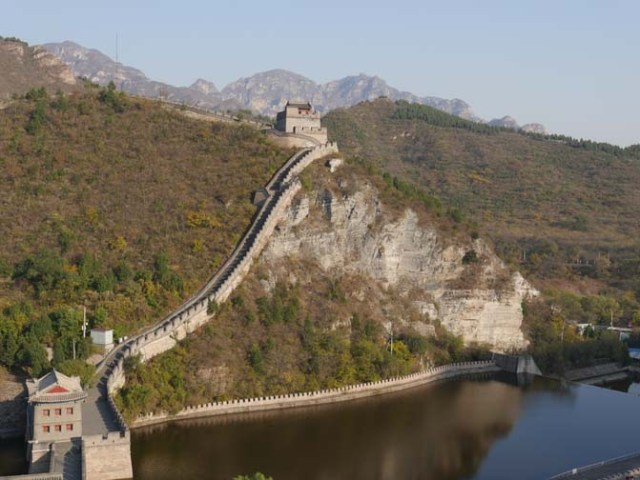
Great Wall of China

clothes worn on shore excursions might get sweaty – like when you walk on the Great Wall of China

My essentials for doing laundry in the cabin are a bottle of the sort of laundry soap intended for handwashing, clothes pins, and clothes line. Batch size of clothes that can be washed at once depends completely on hanging space, which varies from ship to ship depending on the size of the tub or shower as well as the amount of clothesline and clothespins you have available – and whether or not there is somewhere to hang the clothesline. It doesn’t help to bring a lot of line if you only have space to hang a little. Don’t count on using balcony space to hang clothesline as most ships don’t allow laundry hanging on balconies. It’s a safety thing. Ever since someone threw a cigarette butt off their cruise ship balcony and it landed in laundry hanging on the balcony below and started a fire most ships stopped allowing anyone to hang things on the balcony or to smoke there.

Great Wall of China

John’s clothes needed washing too after our visit to the Great Wall

Once your things are washed and hanging, wringing them out frequently will help them dry faster. Wring them out until they stop dripping. After awhile water works its way to the bottom of the garment and they start dripping again so they are ready for another wring. This is especially useful for things like socks that may otherwise take a long time to dry and don’t tend to wrinkle easily (and if they do it really doesn’t matter since putting them on would stretch the wrinkles out anyway.) Not so useful for clothing likely to wrinkle because the more you wring it the more wrinkles it will get and ships without guest laundries aren’t that likely to have irons available either. It does help some if you fluff the clothing up and smooth out all the wrinkles after you wring it out, and if you wring by rolling rather than squeezing the item.

doing laundry on a cruise

sometimes there is a lot of laundry crowding the line

If you’re ready to wash more things and some are still damp, but long done dripping they can move to hangers dangling from the towel rack or even into the closet if you have enough room there to hang things with some space between them and any other item so they get some airflow and to keep them from getting anything else damp. If you don’t mind clothes hanging in the middle of the room they’ll dry fastest hanging from the heater/air conditioner, which is usually a ceiling vent. Of course they would have to be well past the dripping stage and just finishing off a damp item for that because wet things dripping onto a carpeted floor is a very bad idea.

doing laundry on a cruise ship

when there’s less laundry you can spread it out so it dries faster

Handwashing in the cabin on a long cruise is something you have to keep up on throughout the cruise, but it does save a lot of money over sending clothes out for the crew to wash. You can cut down on the amount of laundry by wearing things more than once if they did not get dirty, sweaty, or spilled on. Often something just gets worn for a couple hours to dinner or some other onboard event so it doesn’t really need washing every time. Unlike gym clothes or something you sweated in all day on shore, which does need washing after each use.

Copyright My Cruise Stories 2020
Posted in Holland America, Shipboard Life, Westerdam | Tagged , , , , , , , | Leave a comment

Rhodes Castle and Walled City

View from the Knights Road with a bit of MSC Lirica in the background

Palace of the Grand Master of the Knights of Rhodes

Palace of the Grand Master of the Knights of Rhodes

Rhodes castle on the Avenue of the Knights is the dominant feature of the medieval walled city. This 14th century palace of the Grand Masters was occupied by the Knights of St. John, also known as the Knights of Rhodes from 1310 until 1523. Their presence influenced the character of the city with its walls, gates, churches, hospitals, and palaces.

one room in the Knights castle

The Gothic style medieval castle once functioned as the knight’s headquarters and a fortress as well as a palace. The castle was initially built during the 7th century as a Byzantine citadel and fortress on the foundations of an ancient temple of the Greek sun god Helios. After the Knights Hospitaller occupied Rhodes and other Greek Islands they were named the Knights of Rhodes. They turned the fortress into the palace of their grand master and administrative headquarters. They made numerous modifications and repairs early in the 14th century, but the castle was damaged in an earthquake in 1481 so they had to repair it again.
chapel in the knights castle

Knights Hospitaller were initially associated with a hospital and cared for sick and poor people. Over time they became more militant, participating in the crusades and defending the holy land as well as providing escort for pilgrimages to it. After their fortresses in the holy lands fell they found refuge in Cypress, but had no power there.  With the approval of the pope and the king of France they took Rhodes over from Greece after much fighting and many deaths on both sides as their presence had not been approved by the Greek emperor. Later they were called the Knights of Rhodes and defended against a succession of enemies including Barbary pirates, Egypt, and the Ottoman Empire. In 1522 the invasion fleet of Sultan Suleiman the Magnificent of the Ottoman Empire arrived. He sent 100,000 men against the island’s 7000 knights. It took the Turks 6 months to breech the ancient city’s walls and in 1523 the knights lost the siege and left Rhodes forever. The Ottoman Empire then used the castle as a command center and fortress.

display in the castle

An ammunitions explosion in 1856 damaged the lower level and destroyed many of the first floor rooms. It was restored between 1937-1940 when Rhodes was under Italian rule and the castle was used as a holiday residence first for the King of Italy and then for dictator Benito Mussolini, whose name is on a large plaque near the entrance.

You enter into this courtyard and find a lot of locked doors. There was only one open entrance to the inside of the castle when we were there.

In 1947 Greece obtained Rhodes and other islands in a peace treaty, and in 1948 the castle was turned into a museum. It cost us 4 euros to go inside. At first it seemed as if all there was to see was a giant courtyard, all doors off of it being locked other than one leading to a restroom, which was free to use since people have already paid to be in there. Just one stairway off in a corner next to where you pay to come in was open. That stairway led up to an assortment of rooms.

crowd in the castle

We hardly saw anyone out in the courtyard, or in most of the rooms as we went through them. We ran into a large tour group when we were nearly done looking around so at least for the most part we beat the crowd, which was likely a cruise ship excursion. They probably paid a lot more than 4 euros to see a castle within easy walking distance of the ship. If they stayed with their guide they might have found out what all the things with no explanatory signs are though.

one of many mosaics

Each room had different mosaics on the floor.

ornate furnishings

Some rooms had very fancy furnishings, others plainer furniture made of wood.

this light fixture definitely does not look original

Some light fixtures had a medieval look about them, but all held electric bulbs so whether they were original features adapted to electricity rather than candles, or more modern lights made to look old I can’t say. Some looked old and others did not.

a series of cables connected the columns to the walls

Some of the larger rooms had a series of columns in them, which were probably what once held the place up, but apparently are no longer up to the task as all of them had some bracing cables running from one to another, around each, and hooked into the walls.

these whatsits were around the walls of an entire room as well as in some hallways, but there was never any information about what they were used for

Each room had informational signs, but they were always about the pattern of the mosaic on that room’s floor and never about anything else in the room people might be curious about – like whether the rows of what appeared to be sort of bench type thrones were where knights sat, or was a structure to hold giant vases or to store their armor or something.

excavation exhibit

While the castle was well above ground and in good shape, one room was partly full of dirt with wheelbarrows and signs about excavating, with no explanation of why that would have been necessary. Possibly because some of the mosaics are not original to the castle, but were excavated on another island called Kos. Only 24 of the castle’s more than 150 rooms are open to the public.

fireplace in the castle

Some of the rooms and spaces in the castle are quite large, and it had some pretty massive fireplaces.

Knights Road leads to the castle

Rhodes Walled City

road between the castle and the moat

The walled city in old town Rhodes was designated a UNESCO World Heritage Site in 1988. The Knights quarter occupied about a third of the city, with the remainder where the common people lived. Apparently somebody was lacking in math skills when the Knight’s quarter takes up a third of the space. The walls stretch for 4 kilometers and have 11 gates.
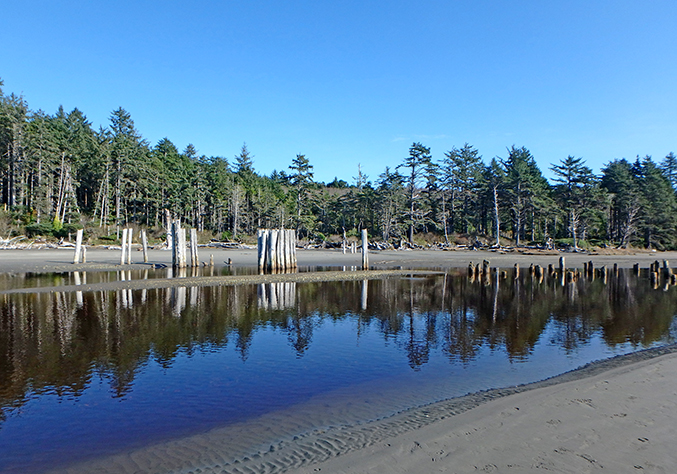
the former moat is now dry and turned into a park

Some of the streets snake through town under arches or over bridges that seem to be part of the castle, but aren’t, at least not currently. A long open parklike area under bridges sits in what was once a medieval moat, but now is dry land and greenery.

shops in the walled city

Architecture is predominantly Gothic, but also reflects the different time periods and occupations going back to the early Greeks and ruins of a temple of Aphrodite, as well as a Byzantine church and Ottoman Mosque among the cobblestone streets and stone buildings.

rock street corner with businesses on the wider road and residences on the narrow alley

Old town Rhodes is the oldest occupied medieval town in Europe. Current residents live in the same buildings where people lived in medieval times.  Quaint streets and alleys are interspersed with homes and businesses in these ancient buildings. Some of the smaller streets are made from small rocks rather than bricks or flat paving stones.

open square in the walled city

Open squares within the walled city are the result of World War II bombings.

cat on a plaque in front of the castle

Many cats live there too. Some are pets, but a lot of them are strays. The locals take care of them so even the strays have enough to eat. We saw one that was quite obese.

Copyright My Cruise Stories 2020
Posted in Europe, Lirica, MSC, Port Cities, Ports of Call | Tagged , , , , , , , | 4 Comments

San Juan Islands

map of the San Juan Islands

Washington state’s San Juan Islands consist of the peaks of an ancient mountain range on the Juan de Fuca tectonic plate. As this plate subducts under the North American Plate in the Cascadia Subduction Zone which runs from Vancouver Island in Canada to Northern California, it is one cause of earthquakes in the area. Subduction formed the volcanoes of the Cascade Mountains, part of the pacific ring of fire. This inland mountain range includes Mt. St. Helens, famous for its major eruption in 1980. The Olympic Mountains which are closer to the sea do not contain any volcanos. It is typical for ring of fire areas to have non-volcanic mountains closer to the sea with the volcanic range a bit farther inland. The San Juan Islands are not volcanic either.

Juan de Fuca plate

Than San Juan Islands are comprised of over 170 individual islands ranging in size from small rock piles to large forested islands. Early inhabitants of the San Juan’s were native Americans, mostly of the Lummi nation. Although early explorers noted the islands, European settlements didn’t infringe until the 1850’s. After 1846 the Oregon Treaty drew the boundary between the USA and Canada at the 49th parallel except for Vancouver Island which Canada claimed in its entirety. As this large island juts into what is otherwise the USA it caused some confusion as to where the boundary crossed by the neighboring San Juan Islands. Americans interpreted “middle of the channel” at the San Juan Islands as Haro Strait to the west of the islands as the border, being the deepest and widest channel. The English on the other hand claimed Rosario Strait to the east of the islands as the border, putting the islands in their territory.

American Camp and English Camp historical parks on San Juan Island

American Camp and English Camp on San Juan Island are both historical parks now. The two together make up San Juan Island National Historical Park. The confusion over ownership of the islands resulted in both English and Americans settling there and each country had an army camp on the island. Tensions escalated when an Englishman’s pig raided an American’s potato patch and the American farmer shot the pig for its nighttime marauding. When both farmers appealed to their nation’s military for settlement war nearly broke out. British warships and troops from both sides came to the islands in a major show of military force. These actions became known as the Pig War, with the only casualty being the pig. The boundary dispute was finally settled in 1872 when German arbitration ruled in favor of the USA.

beach detritus

Early settlers to the islands depended on farming, fishing, logging, trapping, and sheepherding. Tourism is a major part of the economy now. The ability to work from home on computers opened up the islands an attractive place to live for people who don’t have to commute to their jobs. They’ve joined the retirees, artists, and writers who have made up a portion of the population for years as people who don’t have to tie their job to where they live. The more populated islands also have some traditional jobs as they do have towns and small cities with stores and other places to work.

Piper on the beach

Average yearly rainfall in the islands is 29 inches, somewhat less than Seattle’s 37+. The pacific northwest is full of micro-climates with some coastal and mountain regions receiving more than 100 inches of rain annually (some significantly more) while rainshadow areas have less than 20. On the mostly drier east side of Washington State (east of the Cascade Mountains) there are places with less than 10 inches of annual rainfall. Islands in the San Juan’s tend to have their own tiny micro-climates with one side of the island generally wetter with a thick layer of underbrush in the forests and the other side drier with less vegetation between the trees.

orca and Washington State Ferry (internet photo)

Washington State Ferries provide service to the San Juan Islands from Anacortes. The wait there can be long so reservations are advised. Ferry service goes to San Juan Island and Orcas Island, the two main islands with tourist amenities, Lopez Island which has a village and some vacation rentals and campgrounds, and Shaw Island which has one small grocery store and a few primitive campsites at a county park. The ferry route sometimes extends to Canada on select sailings, at least it does when the border is open anyway. There are smaller inter-island ferries that just go between the islands and not to the mainland. Getting to the islands without ferry service can be done by small airplane, island charter services, or private boat depending on the island. Some small islands are accessible only by human powered craft. Many small islands are designated wilderness areas and/or part of the San Juan Islands National Wildlife Refuge and not accessible to people at all, though a few of those islands have small park areas where people can go.

map of Orcas Island

Orcas is the largest of the islands at 57 square miles. Much of the island is hilly and forested. Mount Constitution is the highest mountain in the islands. Its 2,398 foot peak is the highest point in all of the San Juan Islands. Parks on Orcas Island include the over 5000 acre Moran State Park, which is where Mt. Constitution is located. Places to stay include resorts, vacation rentals, and camping. The island has a towns, stores, and restaurants.

old car in Friday Harbor

San Juan Island is home to the town of Friday Harbor, which is the county seat for San Juan County. The shoreline along Friday Harbor sports huge homes with private docks. There’s a large marina next to the ferry dock and shops and restaurants in town. The island has lots of farmland as well as other parks in addition to American and English camps. There are lots of places to stay including the historic Hotel de Haro at Roche Harbor Resort. People sometimes spot whales from Lime Kiln State Park.

Obstruction Island (internet photo) – our beach was all rocks

As a kid I spent time every summer on Obstruction Island, a small private island between Orcas and Blakely where my parents used to have property. When we first went there the island had just one dock and no other amenities other than a dirt road circling the island so people could get from the dock to their lots. Later they added another dock closer to our property, though we just had a small boat and came in at high tide landing on our own bit of beach. At first we had to go to the marina at Blakely to get water if we ran out of what we brought, but at some point a community well was built that we could hike to and get water from an old fashioned hand pump. Eventually they added electricity and piped the water out to individual lots, after which some people built cabins, but we only ever camped. Now the island has a few permanent residents so it’s nothing like the island of my youth where we could go all over the island and never see any sign of other humans. My parents sold their property so we can’t go there anymore anyway.

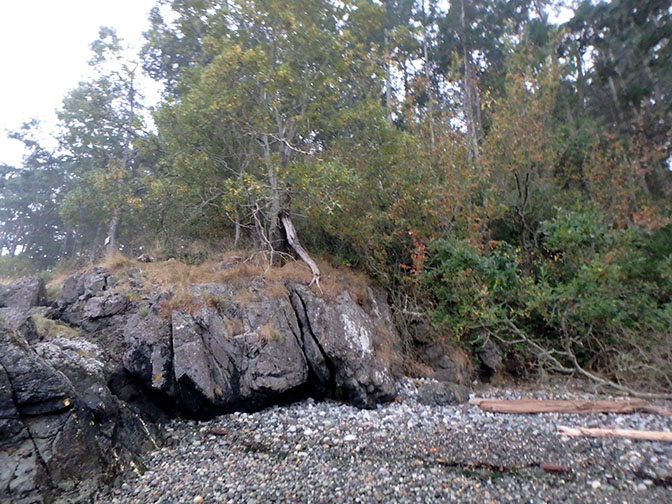
plants hanging onto the edge of an eroding cliff

The islands are a great place to get away and relax. There’s no big cities and even the bigger islands have plenty of places to get out into nature. It’s always a great place to visit, and in these times of social distancing and local vacations a great option for people living on the mainland. For those arriving by private boat there are many marine parks. Some entire small islands are state parks, like Sucia which we visited when we took a cruise with Uncruise Adventures, and James. Many of these parks have mooring buoys or docks.

map of the San Juan Islands

Copyright My Cruise Stories 2020

Posted in USA, Washington | Tagged , , , , | 2 Comments

Halloween on a Cruise Ship

witch on Carnival Vista

Sailing on a holiday often means activities specific to that day and food you won’t otherwise see on the menu. Major holidays also bring decorations around the ship.

blow-up dog on the Vista

For Halloween blow-up decorations are popular – after all ships have limited space to store things they aren’t using and these store flat, but then blow up into large objects. Most are stationary, but some have moving features.

pumpkin coach on the Explorer

We’ve spent Halloween on cruise ships a couple times, once on Carnival Vista and once on Royal Caribbean Explorer of the Seas.

pirates on the Vista

Vista had blow-up decorations all over the ship.

blow-up decorations by the ice rink on the Explorer

Explorer mainly had them around the ice skating arena.

Explorer photo desk

The photo desk on the Explorer of the Seas sat next to the doors to the ice arena and it too had some decorations.

Explorer’s haunted skating rink

Occupied!

A blow-up outhouse on the Explorer of the seas had some animation with a working door, which a blow-up pumpkin opened, snickering. The mummy inside was not so happy.

a ghost haunted the photo shop on the Vista

Not all the decorations were blown up. Like the photo shop on Explorer, Vista’s photo shop was also haunted by a hanging ghoul. Spider webs all over the displays added another element of creepiness.

decorated cabin doors on the Vista

Sometimes passengers get into the spirit of Halloween with their own door decorations.

pumpkin carving on the Vista

Halloween activities on a ship might include things like pumpkin carving, costume contests, a Halloween party, or games. The ship’s kid’s clubs arrange activities for the little ones like their own parties or trick-or-treating at the ship’s shops.

even the dog dressed up for Halloween

Some people like to dress up, like these people heading to dinner on the Vista.

ghostly goodies and chocolate death for Halloween dessert on Carnival Vista

Halloween menus are likely to contain things like pumpkin soup and special desserts.

blow up pumpkin on the Vista

Happy Halloween!

Copyright My Cruise Stories 2020
Posted in Carnival, Explorer of the Seas, Randoms, Royal Caribbean, Vista | Tagged , , , , , | 6 Comments

Things to do on the Royal Princess

life ring on the Royal Princess

On the Royal Princess, the ship itself has a variety of things to do without going to organized functions, but of course the daily newsletter called Princess Patter offers up plenty of those as well.

people dancing in the piazza

The daily schedule included things like games and dance classes, which we passed on. We did sometimes see other people in dance classes in the piazza, taught by our very enthusiastic cruise director who must have been in pretty good shape since he sometimes had several classes in a row.

relaxing in the enclave (spa thermal suite)

I tended to start my days at the gym, which luckily was open 24 hours, though I only knew that because one of the crew said the published open hours were just when it was staffed, but that the equipment was available anytime. I really didn’t need any staff there to run on a treadmill in the early morning so that information was greatly appreciated. I did wander about the ship in the very early morning one day because that’s a good time to get photos of places around the ship without anybody in them. Apparently my sisters and I did not spend enough time investigating what the ship had to offer in the evenings though because we totally missed the fountain show. We’d bought the spa thermal suite package and spent a lot of our free time onboard there and didn’t check out a lot of other options.

water fountain show video kiped from the internet

I did wander past the Princess Live show studio sometimes, but not usually when there was anything going on there and didn’t check out any of the shows. Apparently they film all sorts of different things like culinary shows, comedy, live concerts, and game shows to broadcast on the ship channel on the cabin TV’s. We didn’t spend much time in our room and I don’t recall actually ever turning on the TV other than to look for information so we did not catch any of their shows.

almost all the seats in the Royal Princess theater are good seats

I did go to a few of the organized events. We had invitations to the past guest gold and ruby level event. Attendance came with a show and free drink. The show was an actual singing and dancing performance in a shorter version of a nighttime production show. We had great seats and thought there wasn’t a bad one in the house, but when we went to an actual evening show we got there pretty late and nothing was left except for seats near the front off to one side by a speaker so we discovered that there are a few not so good seats in that theater. The free drink came in the form of a gift certificate to use later so it was the gift that keeps on giving since we got to enjoy their show at the event and then enjoy whatever drink we wanted later at a bar of our choice. We went to one on the edge of the piazza and had entertainment in the form of the dance class going on at the time while sipping on wine, daquiri, or piña colada depending on which sister was doing the sipping.

cooking demonstration in the theater that was part comedy show, part cooking

One day they had a cooking demo and galley tour that one of my sisters attended with me. Their cooking demo was more comedy routine than serious cooking, but they did show how to make a couple things. The chef also mentioned that he made 100 different kinds of potatoes and sure enough in the galley tour there were plates of all manner of potato dishes lined up along the edge of the counter the whole way, each with a little tag saying what it was. Not that I remember any of the names, but there was certainly a whole lot more than baked, mashed, and French fries.

galley tour with potatoes prepared 100 different ways

Like every attraction everywhere, the galley tour exited into a gift shop. Since the galley isn’t actually connected to any of the ship’s shops it was a makeshift gift shop in the dining room, but a gift shop just the same.

paper airplane contest with hoop, runway, and airplane marshall

Other events we attended included a paper airplane contest and a champagne fountain. The paper airplane contest was quite different from those I’ve done on other cruise ships where you just try to throw it farther than anyone else. Royal Princess actually had a little runway set up, with a crew member dressed as the aircraft marshaller who waves little lights around and directs the airplane where to go. There was also a hoop. The objective was to throw the airplane down from a balcony where it was intended to pass through the hoop and land on the runway. The hoop was pretty close to the balcony so the plane would have to drop down quite a lot and then go forward to get through. Only a couple people made it.

medal for a perfect landing

My plane sailed directly over the hoop and made a perfectly centered landing in the middle of the runway so they gave me a medal for a perfect landing even though I missed the hoop. Most people’s planes veered off to the side, completely missing the hoop and landing nowhere near the runway so very few people got medals. One person got one for going the farthest with a plane that sailed completely across the piazza and would have gone farther still had it not hit a wall.

champagne fountain

One evening there was a champagne fountain in the piazza, on a formal night when everybody was dressed up. People waited in line for a turn to pour champagne into a cup at the top of a pyramid of stacked champagne cups where it flows down the stack filling other cups along the way. Once everyone has a turn they pass out the cups to anyone who wants one, but we didn’t wait around for that. They had other special events in the piazza other nights. We saw all the balloons in a net one day ready for a balloon drop, but forgot about it by the time evening came around.

jogging track

The ship had a lot of other things to do, but we didn’t do any of them. We talked about going to afternoon tea, but never got around to actually doing it. We had early dinner and tea was served fairly late in the afternoon so it would have been a lot of food in a short amount of time. We also didn’t venture up to the sports deck, which has a jogging track, ping-pong table, game lounge, driving range, lasar shooting range, and basketball court. We did not go to the casino or any of the public freshwater pools or hot tubs. If we hadn’t bought the spa thermal suite package we may have gone to a hot tub, but since we did we used the spa pool instead. We never went to the nightclub either. We’re not really nightlife people. Relaxing in the enclave (spa thermal suite) in the evenings is more our style.

afternoon tea on Royal Princess (internet photo)

Music and dancing could be found around the ship, and of course it had quite a selection of bars too. Regardless of what people are into most can find something they like to do onboard. There’s also an art gallery and sometimes art auctions. The elevator bays all had video displays. These interacted with the medallions everyone had instead of a key card. They had additional functions besides room key card and onboard purchases. You could use the video displays for things like getting directions from where you were to where you wanted to go, finding out where your shipmates were, or playing video games.

Royal Princess ship model Christmas tree ornament

We did wander through the shops, where I got a Royal Princess ship Christmas tree ornament to add to my collection of other ship ornaments. We looked at the necklaces and bracelets they had to put the ship medallions in that were used on that ship instead of key cards, but they wanted too much money for them so we just stuck with the free lanyards for our medallions.

seawalk on the Royal Princess

The ship had a seawalk which curved out from the main deck and had a glass floor so you could see the sea beneath your feet and the side of the ship over the rail when walking there.

pro photo

When sailing with my husband we always avoid photos, but with my sisters we tend to seek them out in case we buy the photo package since it costs the same for everything whether there are a lot or a few. We visited the photo stations they had set up around the ship in the evenings several times to add a few more onto the stack. They merge some of the photos into fancier displays, but don’t usually use the ones we’d pick for that if we were given the option.

Lido deck movie screen

Besides the nightly theater shows, there were also movies out on the big screen on the Lido deck. If we’d gone to any of those we might have seen the water fountain show, though I don’t know that for sure.

surf & turf

Eating is of course something people do on cruises, and food is always plentiful. Between dining rooms, the buffet, the piazza café, and other little eateries as well as room service passengers aren’t likely to go hungry.

ship’s shops and casino

So basically the ship had a lot to do, but we did very little of it. We had lots of fun in our own way onboard and of course at the port stops too.

Copyright My Cruise Stories 2020
Posted in Princess, Royal Princess, Shipboard Life | Tagged , , , , , , , , | 4 Comments

Rhodes, Greece Cruise Port

MSC Lirica in Rhodes, Greece – there are some ruins and a seawalk right at the port

Rhodes was once home to one of the wonders of the ancient world – the colossus of Rhodes, a giant statue which stood at the harbor. This replica of the ancient Greek sun god Helios was built by Charles of Lindos to celebrate Rhodes’ victory over an unsuccessful siege by Cypress in 305 BC. Construction took 12 years, starting in 292 BC and completing in 280 BC. The statue was stood about as high as New York’s Statue of Liberty, the tallest statue of the era.

ruins of the 14th century Church of the Virgin of the Burgh inside the walled city

Some of the iron and bronze used in its construction came from weapons left behind by the army from Cypress. The statue only stood for 54 years before falling in an earthquake in 226 BC. The earthquake also did significant damage to the city and to buildings at the harbor. The colossus lay on the ground for over 800 years, and even broken was so impressive for its time that people still came from far away to see it. In 653 AD Rhodes was captured by Arabs who melted the fallen statue down and sold the metal.

Palace of the Knights of the Grand Masters

Rhodes lies just 12 miles off the coast of Turkey and is one of the Greek Isles. Rhodes is the name of the main town as well as of the island.

church in the walled city

The city has ancient, medieval, and modern sections with the walled old town its main attraction. It is Europe’s largest inhabited medieval city and contains the palace of the Grand Masters, built in the 14th century by the Knights of St John, also called the Knights Hospitaller. Knights Hospitaller were initially associated with a hospital and cared for sick and poor people. The castle is a tourist attraction now, with a small fee to go inside.

door in old town Rhodes

Over time they became more militant, participating in the crusades and defending the holy land as well as providing escort for pilgrimages to it. Later they were called the Knights of Rhodes and defended against a succession of enemies including Barbary pirates, Egypt, and the Ottoman Empire.

another fancy doorway in old town Rhodes

In 1522 they lost a 6-month siege to Sultan Suleiman the Magnificant of the Ottoman Empire who sent 100,000 men against the island’s 7000 knights.

cat and kittens

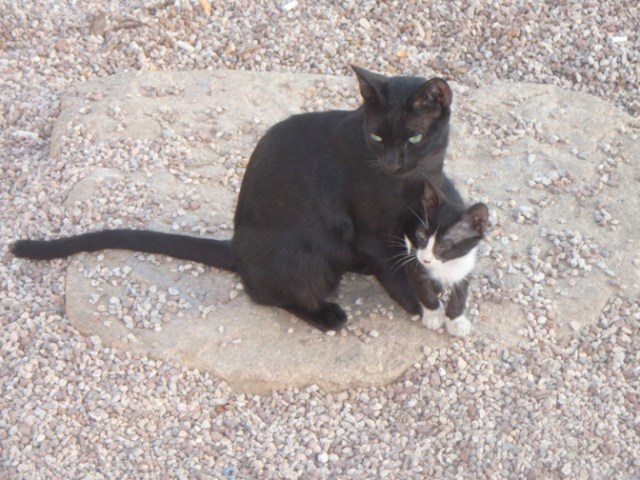
Old Town Rhodes could rival Old San Juan, Puerto Rico in the number of stray cats. There are cats everywhere. Locals feed them, and there is a spay/neuter program in place in an attempt to control the population, but we saw kittens in several places around town so they haven’t spayed them all.

there’s a few dogs in Rhodes

A few cats wear collars, those belonging to locals, but most are strays. The majority of them were in better condition than a scrawny dog that wandered by, and it had a collar on. We also saw some stray dogs, who generally looked better than the one with the collar. Way more cats than dogs though.

another one of the many cats we saw in Rhodes

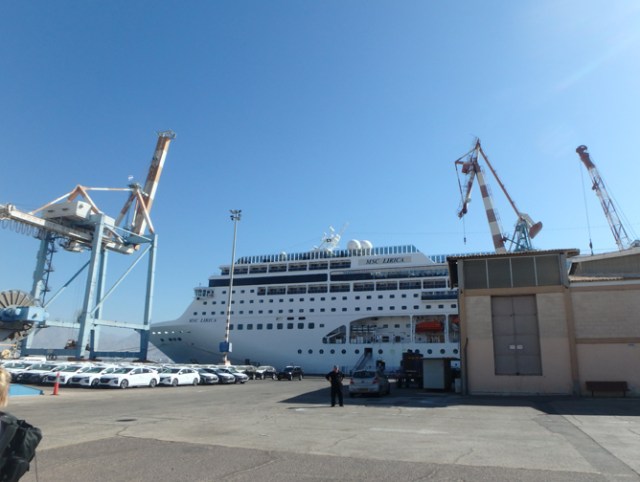
MSC Lirica docked on a pier with a view of ruins running down that pier right next to the ship. You don’t get far – as in just outside the port gates – before running into people offering taxi tours, though their prices were on the high side. Just a bit beyond the port behind the first small building there’s a stop for the hop on hop off bus, with tickets available there.

one of the gates into the walled city

Walk a very short distance beyond that and you come to the first gate into the walled city.

shops in the walled city

The walled city is full of little shops and restaurants, streets made of rocks or stone, people trying to entice you into their store or cafe, old buildings and of course the castle and lots of cats.

open square in old-town Rhodes

There are some open squares within the walled city, but they were not always there. The buildings that once stood in those places were demolished by bombs during World War II.

seawalk outside the old town city walls by the port in Rhodes

The walkway along the seawall runs alongside the city walls on the other side of the street and there are other entrances into the old city further down. The seawall is a nice walk and if you go far enough you come to a more modern town where there are things to do like semi-sub rides. This is a port where there are things to see right off the ship and you don’t have to spend a lot of money to find things to do.

ruins by the ship in Rhodes

Copyright My Cruise Stories 2020
Posted in Europe, Lirica, MSC, Ports of Call | Tagged , , , , , , , | 2 Comments

Innsbruck, Austria

colorful buildings

Innsbruck, Austria

Nestled into the Austrian Alps, Innsbruck is the capital of the western state of Tyrol. The name means bridge over the Inn.  It was once a major transportation link between north and south Europe being located along the easiest route over the Alps, with a bridge crossing the Inn River. Winter sports are a major attraction in this city which has both imperial and modern architecture. The Nordkette funicular brings people up a mountain to 2,256 meters above the city center for winter skiing or summer hiking and mountain climbing.

horse carriages may not be a modern mode of transportation, but you can still ride one in Innsbruck

The area has been settled since the stone age, and fallen under a variety of different rulers through the ages. It was taken over by the Nazis in WW2 and suffered heavy damage from allied bombings. Innsbruck hosted the winter Olympics in both 1964 and 1976. More recently it hosted the winter Paralympics in 1984 and 1988, and was the very first host of the youth winter Olympics in 2012.

the golden roof is more of an awning than a roof

Things to do in Innsbruck

Olympic Ski World is a main attraction for winter tourists. People go to the Bergisel Ski Jump for the views even when it’s not ski season. Other things to see or do include riding the funicular or cable cars, or a visit to the medieval old town area, Hofburg castle, the golden roof (which is an awning of gold plated copper, but also a major 5th century symbol of the city built by Maximilian I for his own personal viewing spot), Ambrass castle, and the Cathedral of St James –  a 17th century baroque style cathedral with interior pink marble columns, painted ceilings, and free admission.

old building in Innsbruck

Stradtturn town tower which once housed prisoners is another tourist destination. People can climb it for a fee. Hofkirke is a gothic style church built in 1553. It has bronze statues of Emperor Maximilian 1’s ancestors including King Arthur. The emperor’s grand black marble tomb sits empty as he was buried elsewhere.

view of Bergisel Ski Jump from the Alpenzoo

Innsbruck’s Alpenzoo is the highest altitude zoo in Europe. It has great views and animals native to the alps. Innsbruck also has a number of museums including Swarovski Crystal World, Tyrolean Folk Art Museum and Tirol Panorama. Hofgarten park has walking trails and a little river, formal gardens, a playground, and a beer garden.

Inn River in Innsbruck

Our train travels in Europe prior to boarding the MSC Lirica in Italy found us traveling from Buchs, Switzerland to Innsbruck, Austria. We got lucky on this leg of the journey having one train making the full distance with no need to transfer. This train was quite different from all the other trains we rode on this trip. It had separate little compartments with 6 seats each. We had reserved our seats in advance and had the ones by the window. This was also the only train on our journey that had a rack over the seats large enough for a full-sized suitcase. There was just one other person in the compartment when we got on, but we didn’t get far before the rest of the seats filled up. A reserved seat was definitely a good plan for this train. As it made more stops people got on, but rarely off and eventually there was someone without a seat who stood in the aisle outside of the compartments for several stops looking quite sad before someone finally got off the train. We were quite happy to have reserved our seats early enough to get the window seats because the scenery through the Alps is beautiful.

booth at one of Innsbruck’s Christmas markets

Innsbruck is a lovely town, surrounded in tall rugged mountains and full of interesting old buildings. We arrived shortly after noon so we had time to walk around and see things on our travel day. We went to the Golden Krone hotel where I had booked a room the previous summer through booking.com. The girl at the desk asked our name and looked at her list and couldn’t find it. I gave her the paperwork I printed out when I made the booking. She went and looked it up on her computer and then said it was cancelled because I didn’t update my credit card info and that Booking.com sent a message saying to do so.

Innsbruck arch next to the Hotel Golden Krone

My credit card info had not changed since I made the booking. Booking.com did send me a number of messages between when I booked 3 of our hotels for that trip through them and when we left for our trip, but none of those messages pertained to my credit card. The only ones regarding Innsbruck contained offerings of things to book to do while there. Later when I checked my email I found the hotel had sent a message just the day before our stay in Innsbruck saying they had cancelled the booking, but since we were traveling and I wasn’t checking it all that often I did not know about it at the time. All our hotels were booked on the same card and none of the others had any issues.

the stairway at Hotel Neue Post had stained glass windows

The hotel receptionist said the hotel was booked full and she couldn’t offer us another room. Just like that we were homeless in Austria with 2 days until our next train even though I had booked all our lodgings months in advance. All she could suggest was to try another hotel, but she wouldn’t even call any to see if they had room. Luckily around the corner and down the way there was a giant sign saying HOTEL in English so we actually knew what it said. We went there. It was called Hotel Neue Post. While more expensive than our original booking, at that point we were just happy to get a room. If the reception area was any reflection of the rooms, this was a much nicer hotel.

room in Hotel Neue Post

It was a nice room too, and this hotel had free breakfast. Like all the other hotels this trip they had the odd sleeping bag type sheet & quilt combo things. Typical of a European hotel there was no coffee pot, no washcloths, no USB ports, and like the last one in Liechtenstein, some sort of nasty soap/shampoo/body wash all-in-one stuff.

view from our hotel room

view from our hotel room looking the other direction

The view from our room was awesome with giant mountains and an old building with a tall spire or steeple in either direction. Giant mountains are the norm for views in Innsbruck as that is what you see anywhere where there is not a building blocking your view.

Christmas market

We took a walk around town and found some of Innsbruck’s famous sites like the golden roof, some old churches, and a row of colorful buildings along the Inn River that reminded me of Curacao. We wandered through a couple holiday markets and got a tasty spiraled potato on a stick at one of them. Passing by numerous restaurants we noticed that all of them had prices about half what they were in Switzerland. Although the language there is German, just about everyone speaks English as well so communication was not a problem.

government building

We didn’t see any of the red-spired churches in Innsbruck that we saw so many of in little mountain towns as the train passed by, but there was certainly no lack of churches. They just didn’t have red roofing. There were also lots of onion domes on buildings, something we rarely saw on the way over.

old town Innsbruck

Copyright My Cruise Stories 2020
Posted in Europe | Tagged , , , , , , | 1 Comment

The Micro Cruise

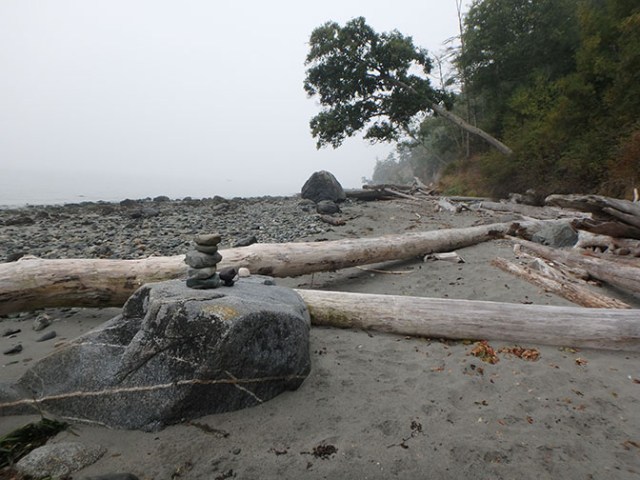
at the launch ramp dock in a marina getting ready to go to the San Juan’s

In these days of Covid 19, taking a cruise on a cruise ship is not an option for most people. Living in the USA where there was never any sort of national plan and covid-fighting was left piecemeal up to individual states we’ll probably be among the last countries where things return to any sense of normalcy. Meanwhile even in states that have tried to do something about it people do get tired of staying home all the time. Many look to local travel or some sort of social distance vacationing as a means of getting away.

outboard underway

While unable to book a long cruise to interesting destinations this year, we do have a small boat mainly used by my husband for going fishing. It’s no cruise ship, but it is a means of getting out on the water. We made plans to go out to Washington State’s San Juan Islands. Some of the larger islands have ferry service, but of course those islands have things you find on the mainland – like people. Many of the smaller islands are private. People live on some of the smaller islands, but in far fewer numbers. Vacation homes often outnumber permanent residences. Some small islands are uninhabited by anything but wildlife. Many are state parks, or have state or county parks on them, some of which are accessible only by boat.

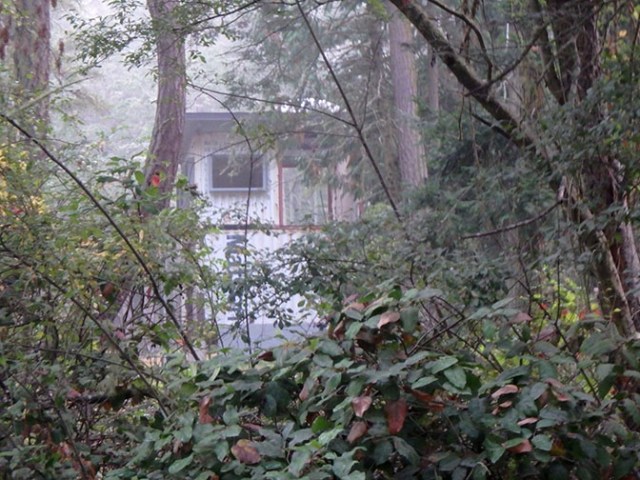
cabin on Decatur Island

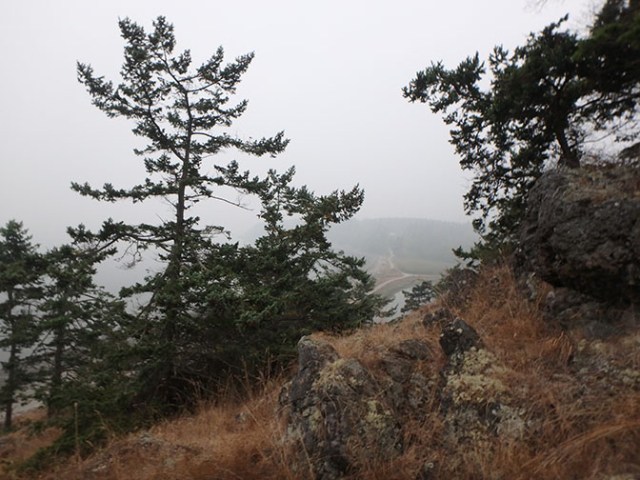
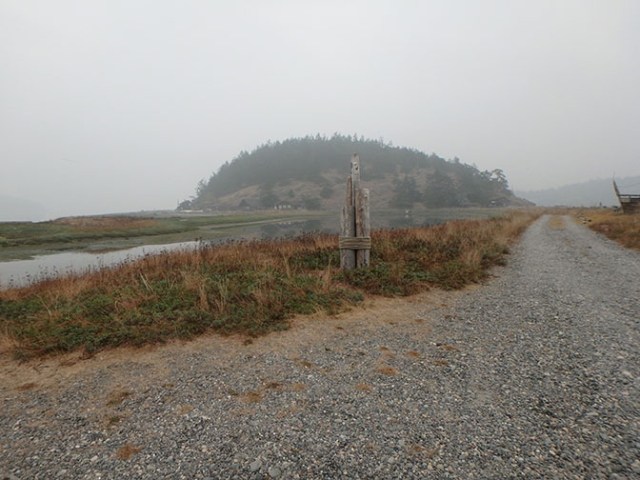
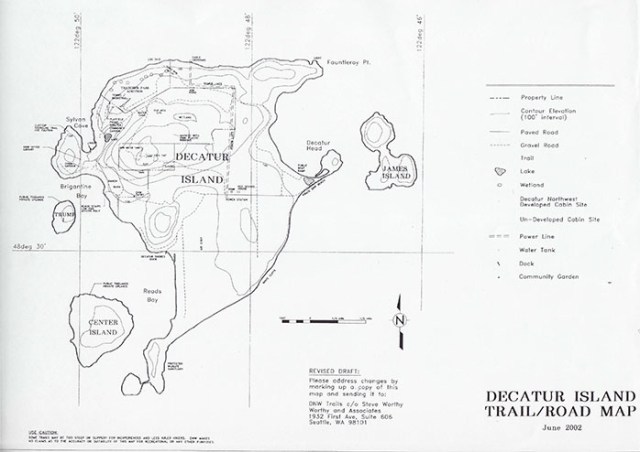
My husband’s sister has access to cabins on Decatur Island, so we made arrangements to stay there. Decatur has no ferry service, but people and supplies arrive by island transporter, private boats, or small airplanes. Unfortunately just before our time to go the whole west coast was either on fire or shrouded in smoke. With two businesses and a dog it’s not always easy for us to arrange time to get away and it has to be planned in advance so we went anyway. There were no fires near us, but smoke blanketed the area from fires in our state as well as Oregon, California, and British Columbia in Canada.

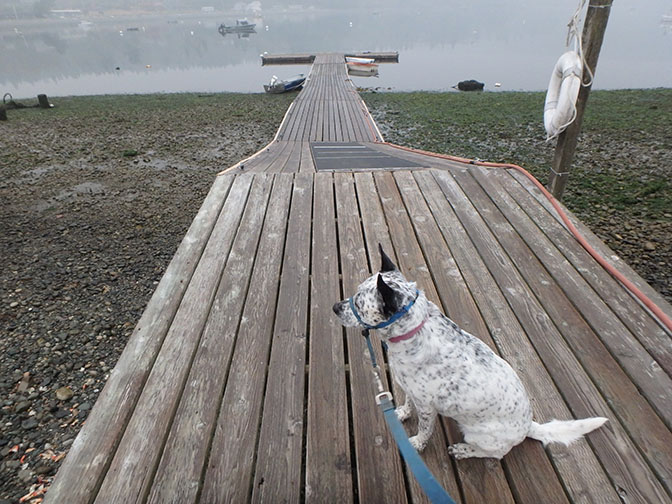
Piper on the boat

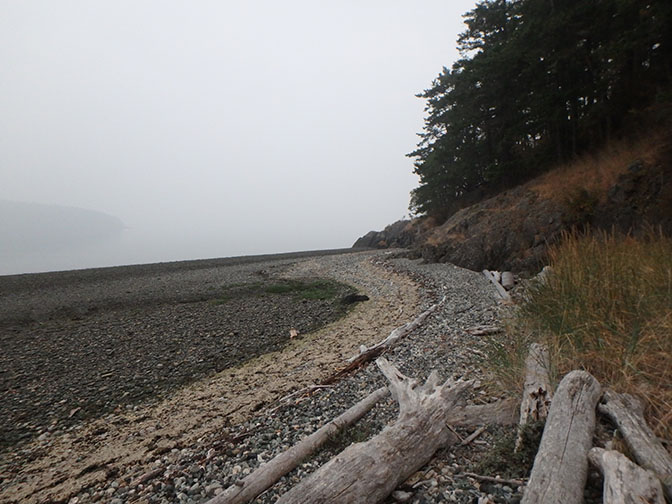
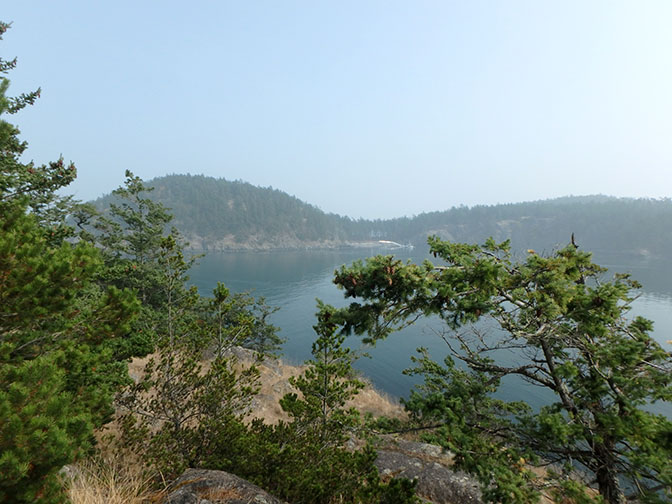
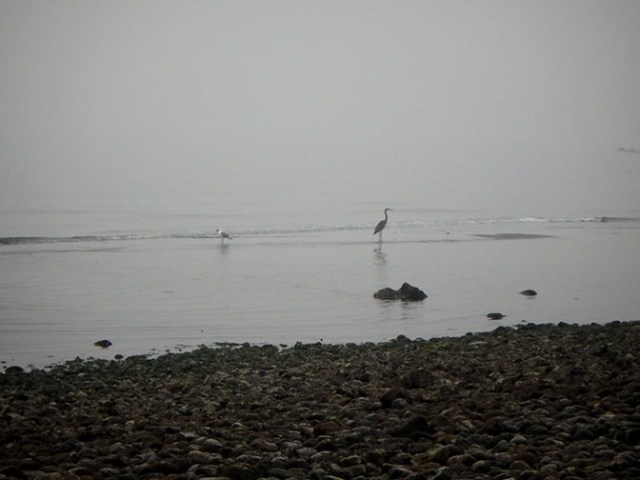
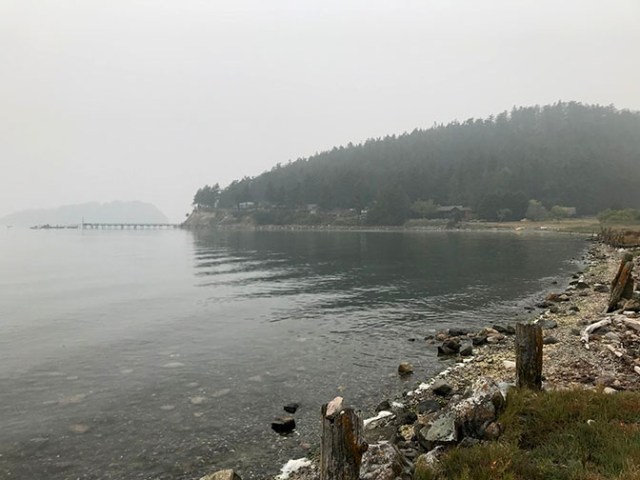
Traveling from the Strait of Juan de Fuca where we launched out to the San Juan Islands, you are never all that far from land. In normal times it’s a lovely view with water, islands, and mountains in the background. On this trip it was like we were in a little gray bubble. We could see the water immediately surrounding the boat and usually some sea birds, but other than the surrounding haze that was it unless there was an island very close. Traveling along in that lonely isolated bubble a couple old songs came to mind. Smoke on the Water and Your Eyes Have the Mist from the Smoke of a Distant Fire. Navigating by sight was impossible, but the boat is equipped with electronics. On the way home it was even worse with the bubble of sight pretty much limited to the boat itself and the occasional seabird scared up off the water for a good part of the way home even though it had been fairly clear with visibility across the bay near the cabin on the day we left. We had to keep a constant watch for other boats. We crossed several wakes without ever seeing the boat that left them and then came suddenly upon a boat sitting still pulling crab pots and had to make a quick turn to avoid hitting it.

the sun making a brief appearance through the smoke

Had the sky been clearer we may have done more island hopping, but between weather, sea, and smoke conditions we just went out to visit a couple other islands one day and stayed on Decatur the rest of the time other than a bit of crabbing or fishing by my husband, his sister, or our grandson.

Got crabs? After pulling a crab pot any that aren’t legal keepers go back into the water.

We had a cabin for just us and our dog. Our grandson and my husband’s sister stayed in a different cabin with her cats. There was one empty cabin between us and only a couple other occupied cabins, none of which were next to any other occupied cabins. Due to covid the cabins have a 2 day lag time between one occupant and the next so are often unoccupied. There’s 8 cabins total, 2 of which are set a bit apart from the rest, and one used by the caretaker. These are all private cabins, not available for public rentals.

the big island transport boat can drop cargo or vehicles on a boat launching ramp

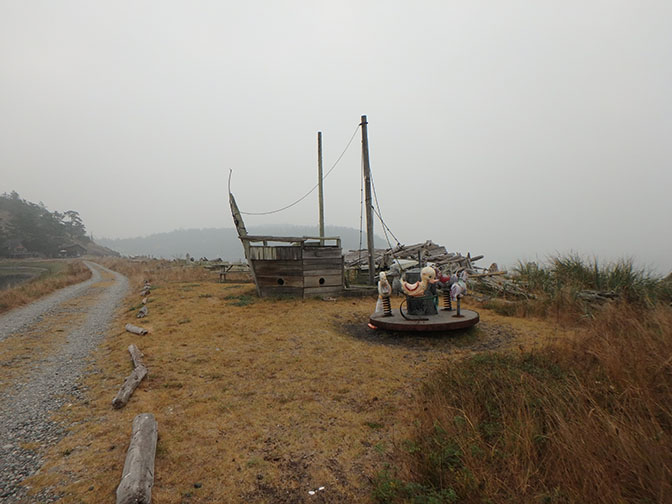
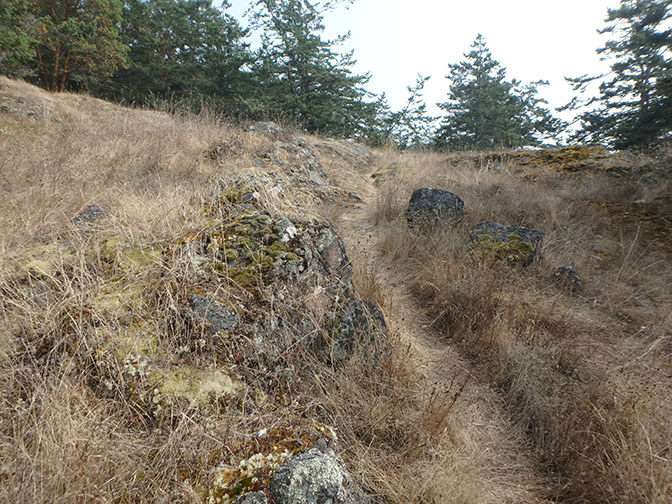
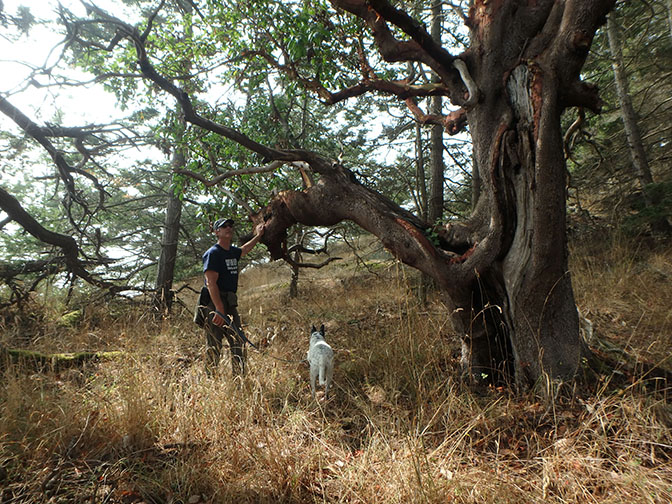
Though people do live on Decatur, it’s a decent sized island so there’s lots of room for them to spread out. There are no towns, cities, stores, or paved roads there and we hiked quite a lot around the island without coming into contact with anyone. There’s a one-room school, but I don’t know if it is open this year or if the few kids who go there are doing online school now. There was a small store and the building is still there, but it’s closed now.

the small island transport boat picks people and luggage up or drops them off at docks or boat ramps

We stayed nearly a week and had a great time relaxing away from our daily duties. The best thing about a do-it-yourself cruise is that the pets can come too.

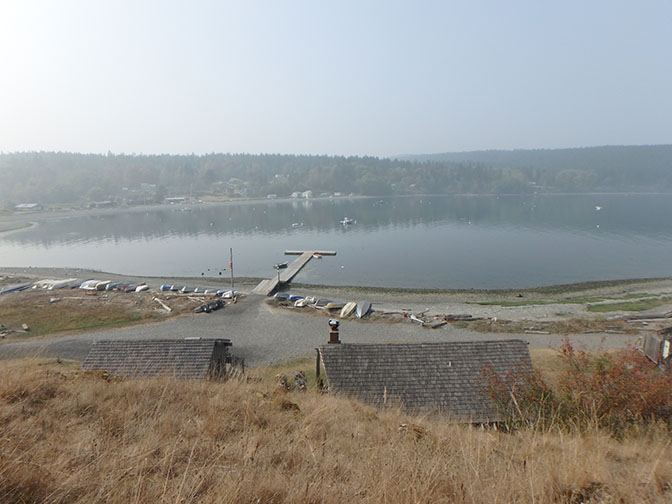
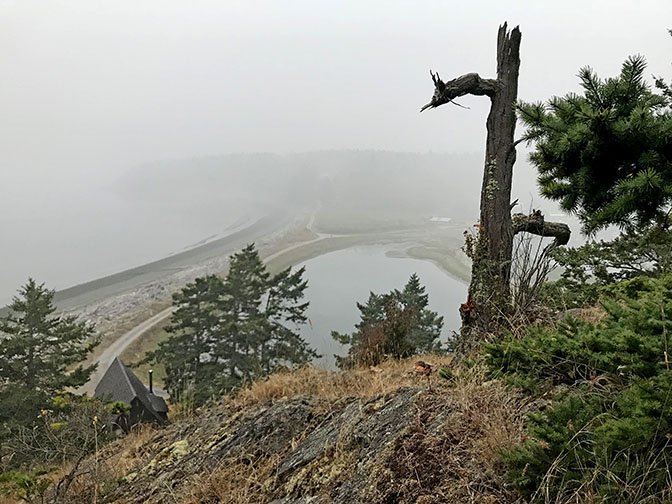
our boat on a mooring buoy by the Decatur Head dock when visibility was good through the smoke – sometimes you couldn’t even see the water from the shore and this photo was taken from up a hill

Copyright My Cruise Stories 2020
Posted in USA, Washington | Tagged , , , , | 5 Comments

Crete Venetian Fort and Sea Wall

Lirica through a mermaid sculpture on the seawall, and with the mermaid giving the ship a push

MSC Lirica docked in Heraklion on the island of Crete in Greece. Being a container port, passengers are not allowed to walk through the port area, but rather required to take a short bus ride to the cruise terminal. Following a painted yellow line on the sidewalk leads people past a marina to an old Venetian sea fort and seawall. From there it is not far to the downtown area where there are lots of shops and restaurants.

Koules Fortress

Koules Fortress

The fortress was built in the early 1500’s during the Venetian rule of Crete when the appearance of gunpowder in Europe made the previous tower guarding the harbor entrance obsolete. The original tower was demolished and boats full of rocks were sunk as landfill to form the platform on which the fort was built. Besides cannons, the 26-room fort had space for munitions storage, soldiers quarters, and accommodations for officers and the governor. It had its own mill and oven.

cannons and cannonballs

During the Turkish siege of the mid 1600’s the fort did not fare as well as the city walls. While the walls kept the Ottomans out for 20 years, the fort was neutralized early on giving the Turks control of the harbor. The Venetian Republic controlled Crete from 1205 after the dissolution of the Byzantine Empire until 1669 when the Ottoman Empire took control, finally victorious after their 20-year siege. Crete was called Candia during the period of Venetian rule.

viewport in the fort

It cost 2 euros to go inside this Venetion castle near the cruise port in Heraklion, usually called by its Turkish name of Koules Fortress, though during the Venetian period it was known as Castello a Mare or Rocca a Mare. For anyone without walking difficulties, it is within walking distance of the port. Just follow the well-marked yellow line along the pathway to the city center and you’ll be there. The distance from the cruise terminal to the fort is about a kilometer and a half.

artifacts in the fort

The castle (fort) dominates the view for the immediate area near the marina where it sits. Though not a large fort, the inside areas seem vast due to the very high ceilings. It is something of a museum with several rooms containing artifacts. One had a sign about a particular shipwreck near the end of the war just before the French ships left and Crete surrendered soon after.

decorated cannon

Different rooms in the fort have different things. Some have old cannons and cannonballs. Some of the old cannons are quite ornate and one near the shipwreck sign had 1666 clearly carved into it.

upper level of the fort

fort upper level

A stairway leads up to the roof of the fort, which has many raised glass squares that are all skylights letting in light to the chambers below.  There’s also something that looks like a door in the floor. It has knotched walls and some places where crumbling stairways are open allowing people to go higher.

some stairways are open to access the walkway at the top of the fort

upper level of the fort

Other stairways are closed to tourists. Windows to the sea would once have been used to aim weapons at approaching unfriendly ships.

castle and marina

Seawall

view of the seawall from the fort

Beyond the castle a seawall extends about a couple kilometers to a lighthouse. It’s a breakwater for the harbor, but also seemed to be a popular place for locals to jog or ride bikes. We even saw one guy fishing along the edge.

seawall

The inner side is open to the harbour, but the outer side has a wall much higher than the one with the main pathway, though there are a few stairways leading up to the top of the upper wall. There are also a couple small restrooms in the side of the wall along the pathway.

mural on the seawall

About halfway to the end there’s a row of artwork, some painted murals and some metal art sculptures. Most of the metal art is along the wall, but there’s a rusty mermaid out on a rounded-edged wide spot across from where our ship, the MSC Lirica docked. There’s a bench there where people can sit to rest or enjoy the view.

lighthouse out at the end of the seawall

Out at the end besides the lighthouse sitting at the center of another wide round area, there were some large metal pipes going up and down on the other side of the seawall.

wave generators

Climbing up to the top of the wall to look, they still just appear to be large metal pipes rising and falling with the waves – and a windmill, though when I was there the windmill was still.

one of the signs about the wave power project

Down on the main level, what looks like a dumpster on the end as you approach from the pathway has information on the longer front side explaining about the wave generation power project, which is what the moving metal pipes are so going to the end to see the lighthouse is rewarded by something else interesting and different. The power project is a prototype from a German company.

view from the top of the seawall

Copyright My Cruise Stories 2020
Posted in Europe, Lirica, MSC, Port Cities, Ports of Call | Tagged , , , , , , , , , | Leave a comment

Vaduz, Liechtenstein

Hotel Vaduzerhof in Vaduz, Liechtenstein

Liechtenstein

Liechtenstein is a German-speaking 25 km long principality of about 60 square miles between Austria and Switzerland. It’s known for its medieval castles, alpine landscapes, and villages linked by a network of trails. The capital, Vaduz, is a cultural and financial center. Liechtenstein is the 6th smallest country in the world, and one of the wealthiest. Bordering Switzerland and Austria, it is landlocked by landlocked countries, making it one of the only 2 double landlocked countries in the world (the other being Uzbekistan.)

government building

The area has been inhabited since the Neolithic age and was once part of the Roman Empire. Over the centuries it had a number of different rulers and and occupying nations. It became an Imperial Principality in 1719, and a sovereign state in 1806. Many people left due to poverty in the early 19th century, with economic conditions starting to improve in the mid 1800’s, and worsening after the first world war. The boom in the economy didn’t come until after the second world war when the country quickly became industrialized. It is currently one of the wealthiest countries per capita in the world with an average annual income over $700,000. Though the country is known for banking, manufacturing still plays an important role in the economy. Money in Liechtenstein is the Swiss franc, whose value is currently slightly higher than that of the US dollar.

Vaduz Castle

Liechtenstein’s capital city Vaduz sits on the Rhine River near the Swiss boarder and is home to Vaduz Castle, a royal family residence perched high on a hill overlooking the city and dating back to the 12th century. It has been the official residence of the Prince of Liechtenstein since 1939. The castle is the symbol of Liechtenstein. The town’s other most notable building is the Cathedral of Saint Florin built in 1873. There is no railway station in Vaduz, but a short bus ride from nearby Switzerland will get you there.

mountain view in Vaduz

Things to do in Vaduz

Start at the Liechtenstein Center tourist office where you can find out all sorts of information and things to do. See Vaduz castle, visit museums, see the giant postage stamps painted on the sidewalk, look for fine arts, see the cathedral, or try wine tasting at the Prince of Liechtenstein winery. Picturesque scenery is pretty much everywhere. Ride the city’s tourist road train for a narrated tour of some of the town’s main attractions. Visit the Mittledorf area or the red house for a look at traditional architecture, check out the chocolate shop in the town center. There’s also a main square and town hall. Outside of town there are hiking trails.

quirky seating outside a café in Vaduz included a gondola

All of that information came from online before our trip. When we actually got there we went to the tourist office and found out that some things are seasonal and were closed or not operating during our visit. You can’t go inside the castle, though you can go up the hill for a better view of it from outside.

Cathedral of St Florin

The Cathedral of St. Florin was built in 1874 on foundations from an earlier medieval site. It was originally a parish church, but given cathedral status in 1997. It is also referred to as the Vaduz Cathedral. Tourists are allowed inside when the church is not in use.

inside the cathedral

Our hotel, which was called Hotel Vaduzerhof, was at the edge of an area called
Städtle, which had all sorts things like shops, restaurants, and even museums surrounding a town square, and all connected by wide walking pathways and no roads. There are government buildings at the far end. Since the hotel was at the edge and on a corner it had roads on two sides. It was a nice hotel and the room was pretty spacious.

Städtle

Our hotel room had a balcony and a view overlooking the main square of Städtle. The square had an outdoor ice arena which had no activity going on other than what looked like people working on it when we first walked by so we thought they were just getting it set up. Later on people were skating there. After dark they added colored lights and music. We could also see a bit of Vaduz Castle, perched on the edge of a cliff high above.

view of the skating rink at night from our hotel balcony

The hotel was either fairly new or recently remodeled. The rooms were very clean with modern decor. It had more outlets than the older hotels we had been in so far, and better lighting, but still no USB ports. The room had a big very modern bathroom and beds with the same sort of individual sleeping bag style sheet/quilt combo the Swiss places had. There was a desk, closet, and luggage rack. There were a bath towel and hand towel for each person, but even this nicer hotel had no washcloths. I don’t know what Europeans have against washcloths. They are quite useful when you want to get clean after all. There was just some sort of all-in-one soap, shampoo, and bodywash combo in the shower so it was a good thing I had some individual toiletries of my own. My hair would have the feel and consistency of straw if I used that sort of combo product on it. The hotel had free wifi of a faster speed than some of the other places we stayed. Unlike most hotels in Europe, this one had free breakfast. While common in American hotels, this was the first time we found it anywhere we’ve been in Europe, though our next hotel in Innsbruck, Austria had a nice free breakfast buffet too. This was before Covid so they may not have it any more.

room in Hotel Vaduzerhof

Other things generally included in American lodgings, but missing nearly everywhere we stayed on this trip are a coffeemaker and a clock. Not that I drink coffee, but it is a means of heating water which is useful for making things like tea – or instant oatmeal in places that don’t serve breakfast.

residential street in Vaduz

Of all the places we went in Europe this trip Vaduz was the hardest to get to and had the least to do. Unless you want to go to Liechtenstein just for the sake of going to Liechtenstein (which is why we went there) it’s not really worth the hassle unless you have  time to explore beyond Vaduz. I would have enjoyed the trails if we’d had time to hike them and known where to find them and how to get there. Some tourist activities like the tram train that takes people to all the sights are just for summer. Some of the buildings look genuinely ancient, others look like they are more recently built, but in the older style as if they were made to look old. Some are entirely modern.

this crazy art museum was just up the hill from our hotel

We only stayed one night in Vaduz and arrived mid afternoon so we just walked around looking at stuff and had dinner at a Chinese place, which had quite good food. We found a Swiss chocolate shop with some different things than we had seen in Switzerland so we gave it a try and they were really quite tasty.

chocolate shop

When I looked up Liectenstein online before our trip, everything I found said that there was no train station in Liechtenstein, but it was a short bus ride there from the station at Buchs, Switzerland. We had to take an extra train to get to Buchs from Sargans, which was about a 9-minute ride. At Buchs we found no bus directly to Liechtenstein, but we could take one to Schaan and get to Vaduz on a different bus from there. As it turned out the bus from Schaan also went to Sargans so we could have skipped the extra train to Buchs and taken a bus directly to Liechtenstein from the train station in Sargans.

foot bridge

The other thing nobody mentioned when I was looking for information before the trip was that there is more than one bus stop in Vaduz. It stops about every couple blocks all the way through town. Only Vaduz Post actually said Vaduz on the scrolling readerboard on the bus that listed all the upcoming stops, but the driver started announcing Vaduz this and Vaduz that several stops prior. Vaduz Städtle was where we should have gotten off as that was right by our hotel, but we didn’t know that at the time and got off at Vaduz Post which seemed kind of central and like a main stop. Google maps then said we had to walk back a few blocks to get to the hotel. The weather was nice that day and it wasn’t too far so it wasn’t really a problem.

there are giant postage stamps painted on the sidewalk in Städtle

We had an early train the next morning and avoided the hassle of having to catch 2 different busses as well as not having to depend on them to get to the train on time by taking a taxi to the station since there were no Ubers in Liechtenstein. The hotel people arranged for the taxi in the evening so all we had to do the next morning was go outside and meet it.

Copyright My Cruise Stories 2020


Posted in Europe | Tagged , , , , , | Leave a comment