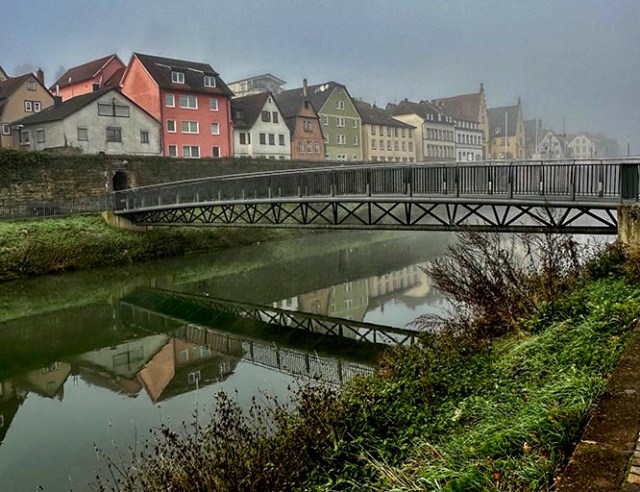
bridge over the Tauber River
Wertheim, Germany
Wertheim is a town in southwestern Germany located at the confluence of the Main and Tauber Rivers with a population of around 24,000 residents. A castle overlooks the town from a hill. The town has medieval historical buildings and is known for glass making and Franconian wine. Some of the town’s buildings have markers showing the extreme height of floodwaters from numerous previous floods. Small floods can be stopped by the town’s floodgates, but not the big ones. Raising the streets nearly 5 feet turned prior ground floors into basements, but still doesn’t keep the worst floods from inundating the town. Wertheim has a mild climate with average winter lows in the high 20’s F to average summer highs in the mid 70’s F, though it does get colder and hotter at times. The warm season runs from June to September, with the cold season from November to March. July is typically the hottest month and January the coldest. The driest part of the year is generally between January and May. Snow is most likely between December and February. Annual precipitation averages a bit over 20 inches each year. Things to do in Wertheim include exploring the old town area, visiting the glass museum or shopping in the town’s boutiques. Glassware and beaded jewelry has been made there since medieval times. Wertheim was known as a successful merchant’s town in the middle ages.
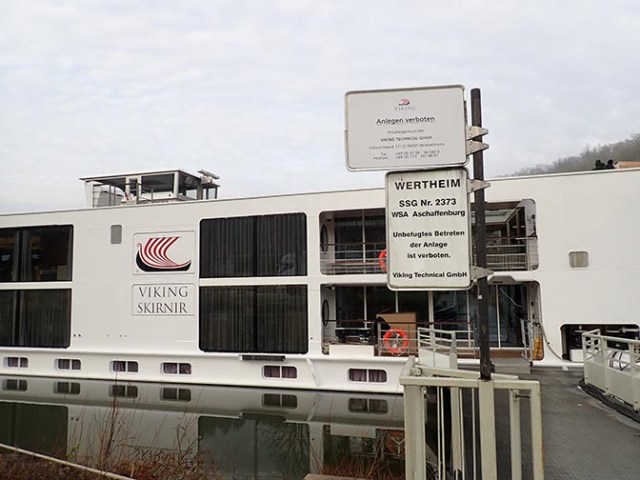
Viking Skirnir in Wertheim
Wertheim River Cruise Port
The port in Wertheim was within walking distance of the town, but a train tram was provided to take people for the scheduled tour. There were also several pick-up times running half an hour apart afterword so people could either go back shortly after the tour or spend a bit more time wandering around in the town and still get a ride back to the ship. Not much though since the ship did not stay there very long.
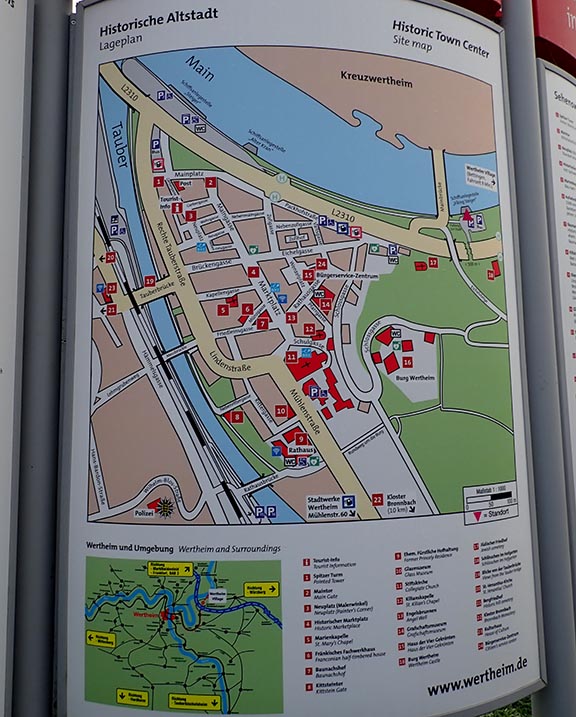
map at the dock in Wertheim
Wertheim Walking Tour
Viking Skirnir came to Wertheim for a brief port stop of about 4 hours on a cold foggy early December morning. The temperature started out below freezing, but warmed up to about mid 30’s F by noon. Which still feels mighty cold since it is not that far above freezing and the air is damp and chilly in the fog. It also gives the photos a misty distant look since they are taken through the fog. Especially the ones from the start of the tour. It did clear up a little before the end. After we got back to the ship the sun even made a brief appearance between bouts of fog.
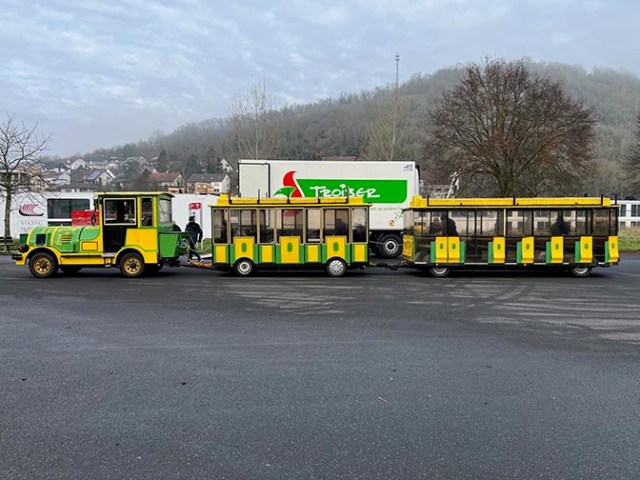
train tram
This tour had a unique start different from any of the other tours provided on this cruise. Taking the little train tram instead of walking straight off from the ship or taking a bus was unique to this port. Rather than starting everyone off at once groups were staggered a bit because there isn’t enough room on the train for everyone. We were assigned to the middle one of 3 groups. The stop where the train let us off was next to the Main River within walking distance of the ship. They said it would be about a 15-minute walk to get back, but we didn’t test that out since we got to the return stop when there was a train tram waiting there with seats available. Since the return trains ran half an hour apart if we had missed it we would have walked. There was a path alongside the river so just go until you get to the ship and it wouldn’t be hard to find from the tram stop – as long as you went in the right direction.
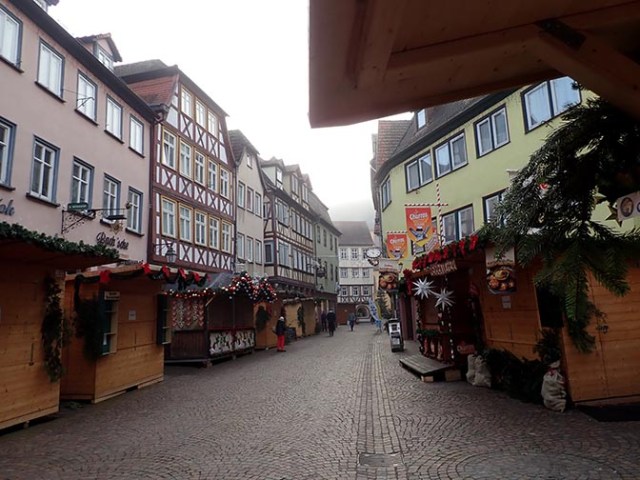
all of the Christmas market booths are closed
Wertheim is a pretty small town. The map that the ship provides showed a much smaller area for walking around in than any of the previous places we visited. It was apparently too small of a town to have enough business for the Christmas Market to stay open except on weekends so all of the little booths in the main market square were closed.
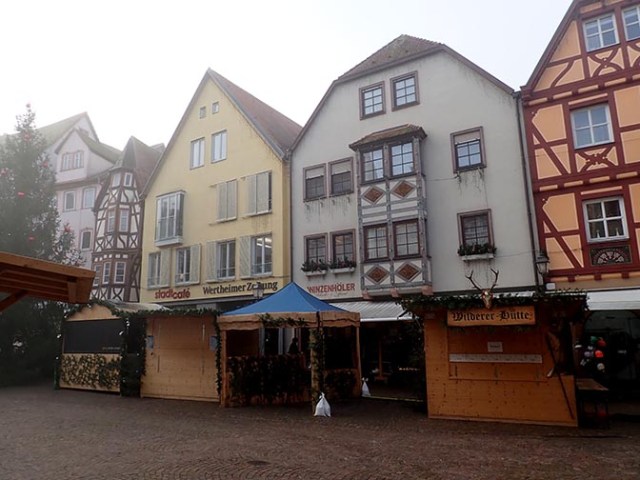
Everything was closed at the start of the tour. The yellow building is the bakery.
There was a bakery there that the guide said was the one place in town that provided free restrooms for the public without having to pay to use them or buy anything. I’m sure that free service gets them a lot of business from people coming in to use the bathroom. It was closed when we walked by it near the start of the tour, but open later after the tour was finished. Pretty much the whole town was closed when we first walked through it.
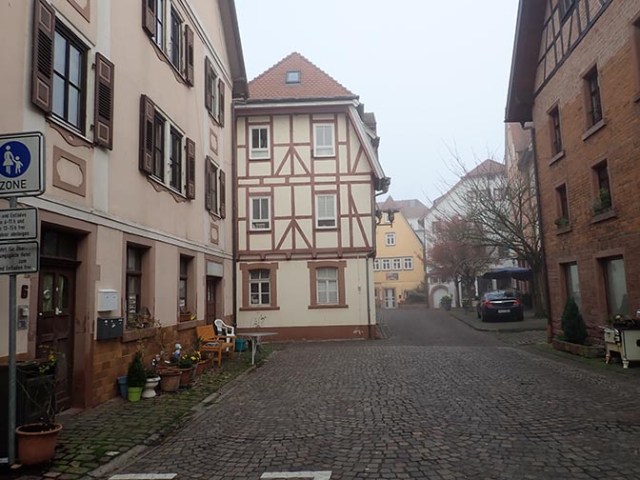
street in Wertheim
The tour guide was a retired Colonel from the German army. He was old, born shortly after the end of World War 2 in a small house in that very town.
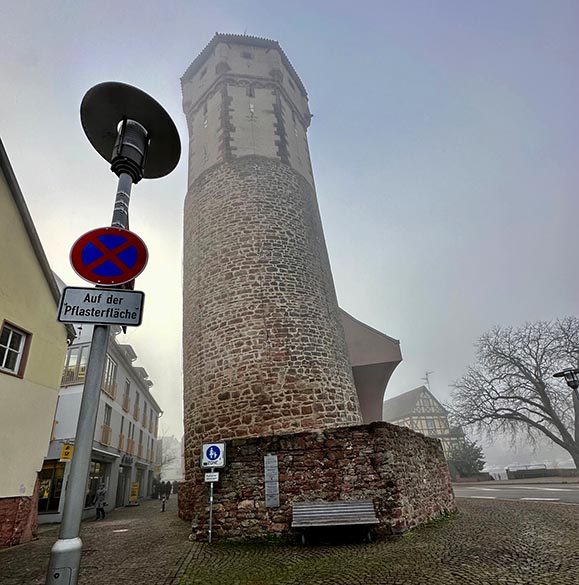
Spitzer Turm
Pisa is not the only place with a leaning tower, just the most famous one. We saw one previously on Burano Island in Venice, and Wertheim has one too. Not to mention just about all of the older buildings alongside the canals in Amsterdam are wonky. The leaning tower in Wertheim is a round tower that was once a prison with a door way up high where prisoners and guards climbed a ladder to get up, then prisoners were lowered by rope 30 feet down into the dark with all the other prisoners and no facilities. They stayed there in complete darkness for up to 6 weeks for the horrible crimes of public drunkenness, not paying bills, or being a nagging wife or quarreling women. Apparently it was fine for men to nag or argue as long as they weren’t drunk. The tower is called the Spitzer Turm, which means pointed tower. The lean is caused by 800 years of flooding.
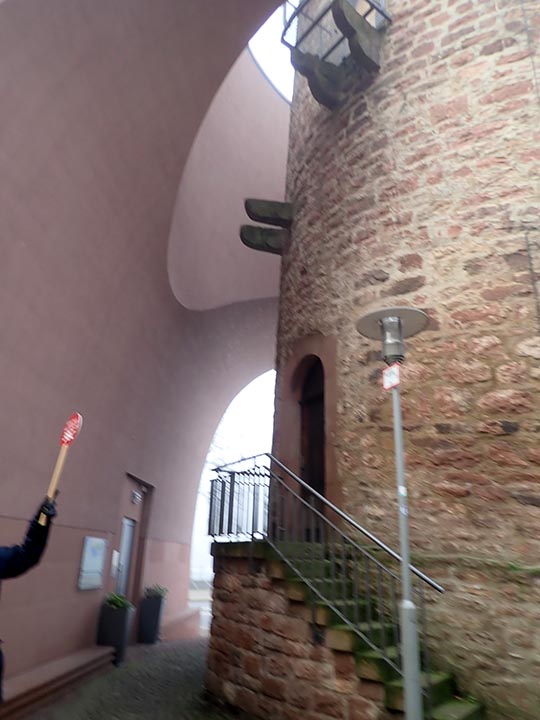
new stairway near the bottom of the tower
The bottom of the tower was the original part made of brick and the top was added later to turn it into a watchtower, with a door and stairway added on lower down than the original one for the prison. This tower is not as tall as the one in Pisa and the diameter is smaller as well.
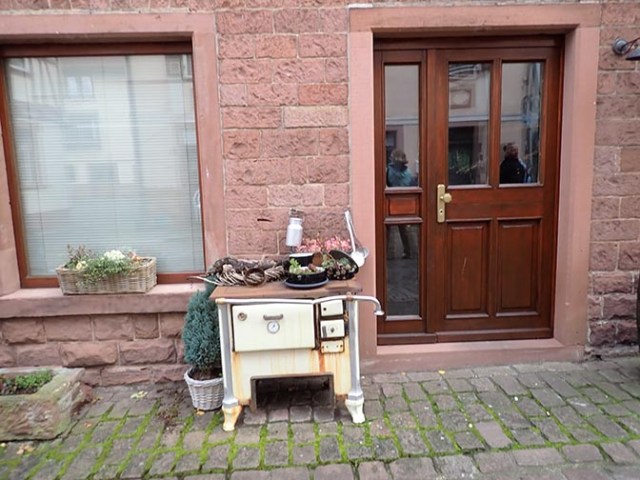
random doorway in Wertheim
Though there was a German military airport near the town during World War 2, Wertheim got spared from allied bombing, but not intentionally. Only because when the allies flew over to bomb it the day was extremely foggy. It had fog so thick they couldn’t see the ground. Since they couldn’t find the town they didn’t know where to drop the bombs so they left without bombing anything.
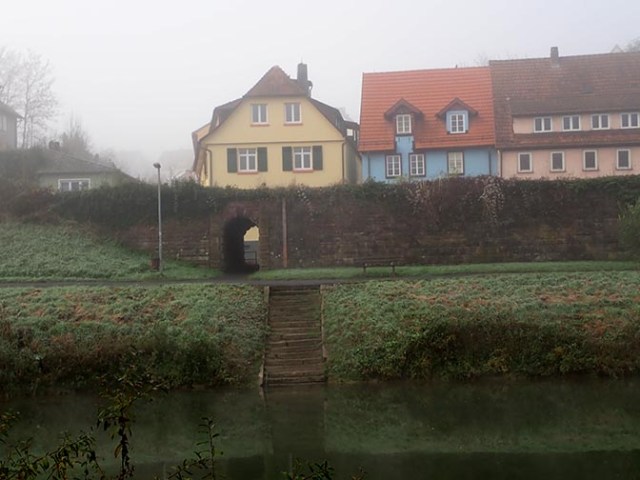
stairway to the river
The Tauber River which runs through town is a smaller river than the Main that we sailed in on. Homes line that river. Every so often there’s a seemingly random stairway going down the riverbank into the water. These are leftover from a time when the townspeople used them to get down to the river to wash their clothes.
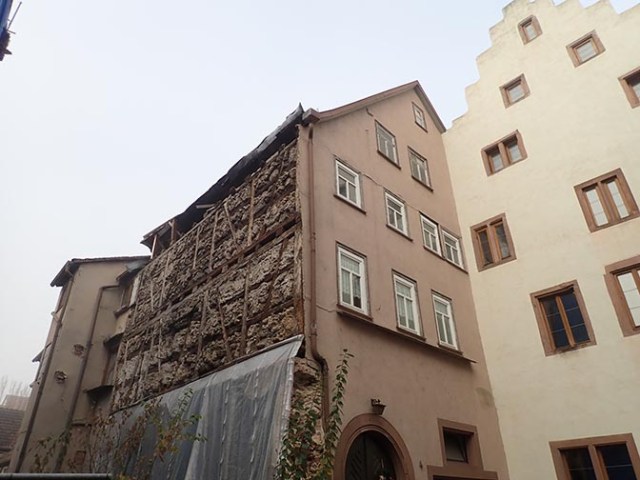
inside of a half-timbered wall
Much of the original construction of the town is in the medieval half-timbered style and many original buildings remain, with a few newer ones sprinkled in between. There was one house where the one next door had been torn down and nothing new built yet so you could see what it looked like inside the wall of a half-timbered house.
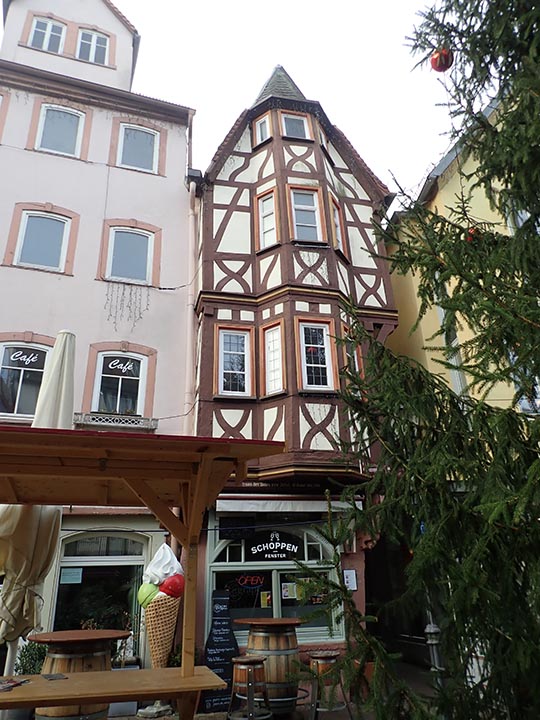
skinniest building in town
The narrowest building in town is very thin, sandwiched in between other buildings on the main market square. The bottom floor is very tiny. It gets a bit bigger as it goes up. The wider parts overhang a walkway that goes between it and the next building. The guide said the lowest story was originally made so small to avoid taxes because at the time it was built buildings were taxed only on the size of the space occupied at ground level regardless of how much space or how many stories they had above.
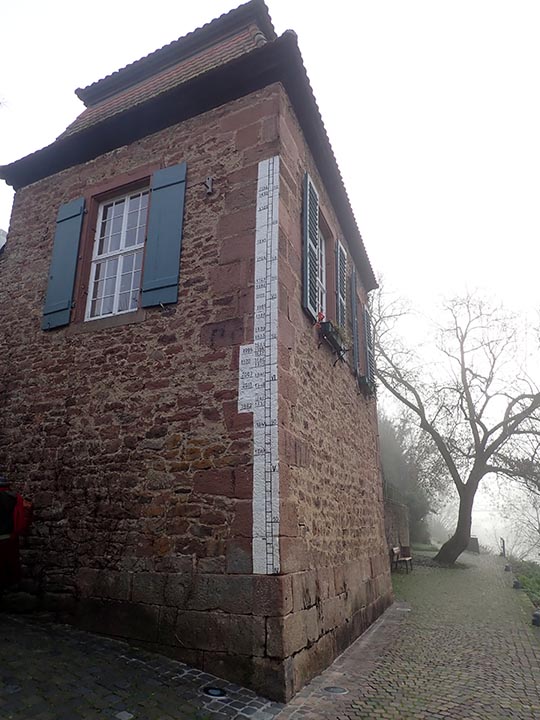
high water mark
Several of the buildings had high water indicators of previous floods. The river floods often enough that nobody lives on the bottom story in any of the buildings near the river. It’s the same in a lot of the riverside towns we visited. Seems like they would either build up on pilings above the high-water mark or build on high ground farther from the river, but apparently they all just take flooding in stride as part of normal life. There are often shops on the bottom floor so they would have to move all their merchandise whenever a flood is expected.
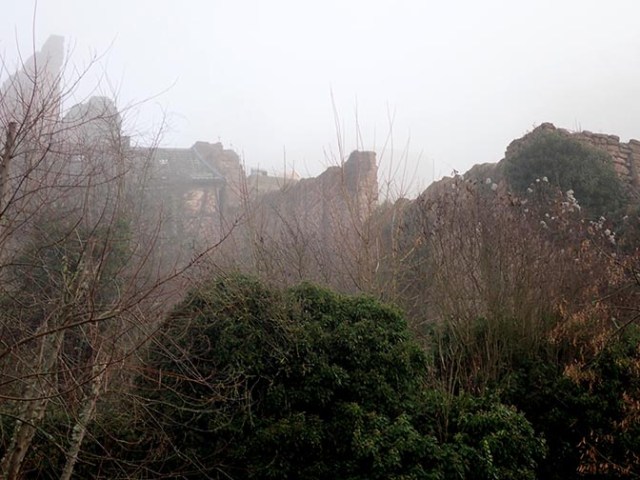
castle in the fog
Ruins of a castle perch high on a hill overlooking the town. It once belonged to the dukes (or counts) of Wertheim who built it in the 12th century. They aren’t recent ruins. That castle has been a ruin since the 30 years war of the 1600’s. The guide said he played in that castle as a child, though even back then it wasn’t allowed. He said since then some walls have fallen and the interior is not safe. Though the castle was not far away it was barely visible through the thick fog. Our local guide insisted that people are not allowed in the unsafe castle, but information online and from Viking said that partial restoration was done in the 1980’s and people are allowed to go there now. Even a sign at the dock listed castle tours.
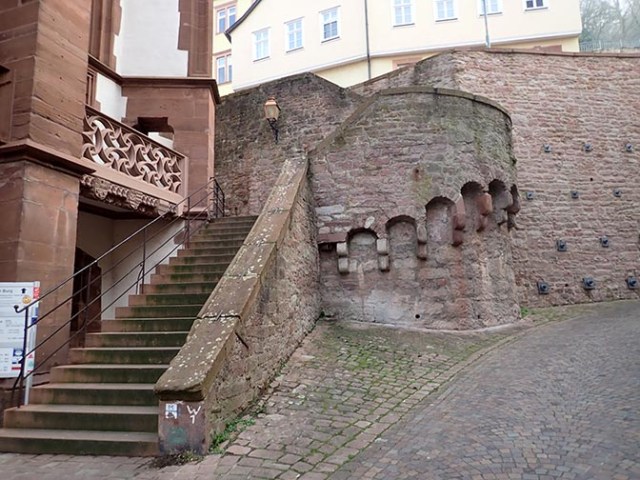
the tour ended by a synagogue on a hill
The tour wound through town in a somewhat mazelike fashion and ended not within sight of where it started. Though nothing is all that far there the guide’s directions on how to get back to the market square and train stop were not at all clear. Luckily a friend we were traveling with paid attention to where we started and how to get back there so we didn’t have to wander around aimlessly until we found it.


