Scrubba Washbag Review

scrubba wash bag

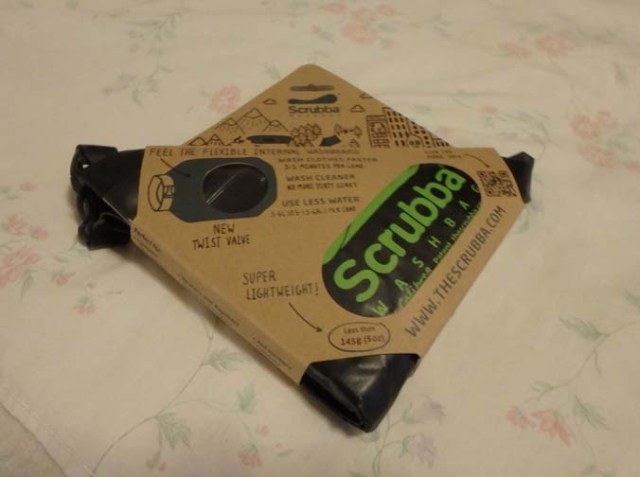
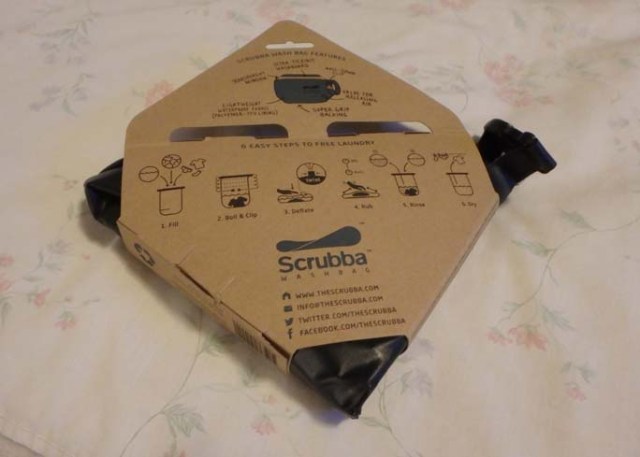
The Scrubba wash bag is an Australian invention – a portable washing machine for people on the go. It’s easy to use. Just put your dirty clothes into the bag along with water and soap intended for handwashing clothes. Then close off the end and squeeze the air out and rub your clothes on the built-in washboard. Empty out the wash water, put in rinse water and rinse them, then hang to dry.

directions are on the back of the package

This invention would be especially useful when camping where there is no access to a sink or anything to wash clothes in, so long as you had a hose or river or something to fill the bag with. A bonus when using it while camping outdoors is that any water leakage doesn’t really matter when you’re outside.

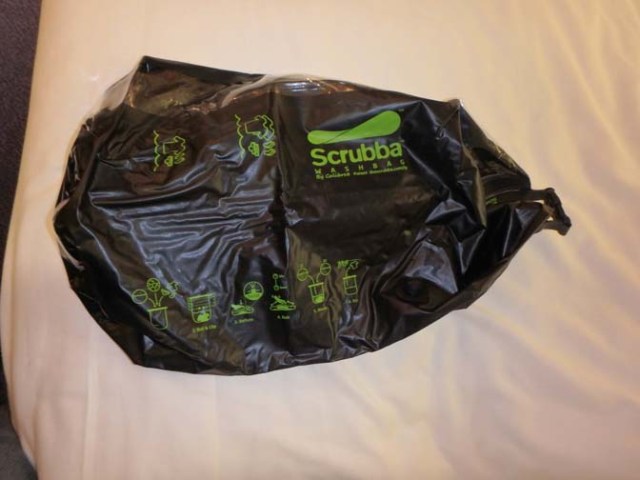
the directions are also on the bag

On a cruise ship of course there is a sink where clothes can be washed in the bathroom without the need to pack something extra like the scrubba bag. It does however hold more clothes than the sink does, assuming you have somewhere to hang them, which is always what limits the amount you can wash at one time on a ship since hanging space is limited by the size of the bathroom’s shower or tub.

one side of the bag works as a washboard

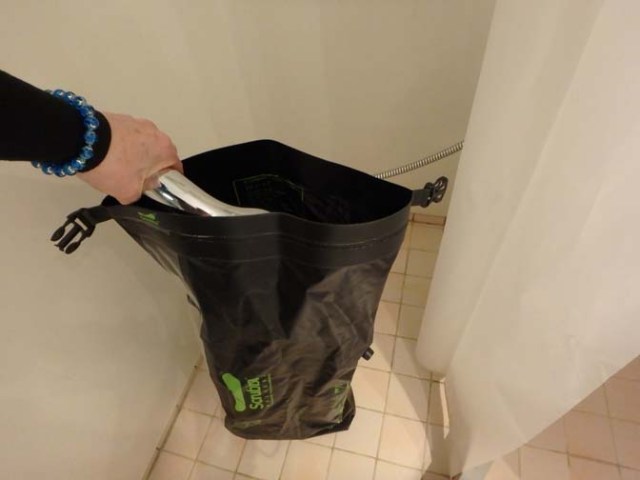
It’s hard to fill the bag in the cruise ship bathroom sink, but easy to fill it from the shower since the showerhead is always on a movable hose and you can just stick the showerhead into the bag and fill. It’s a good idea to do the washing part on the shower floor so any leakage just goes down the drain.

easy to fill with a hose, or a showerhead on a hose

The scrubba bag is easy to use and works well, but personally I find just washing in the sink easier. As well needing to pack something extra, there’s also the need to find space to dry the bag in addition to the clothes. I’ve met people who packed things like collapsible buckets and a plunger to make their own washer, so for them this would be far easier to use. It would take less space in the suitcase since a bucket and plunger would take up quite a lot of space while the scrubba washbag just takes about as much as an article of clothing.

Copyright My Cruise Stories 2020
Posted in Product Reviews | Tagged , , , | 4 Comments

Split, Croatia

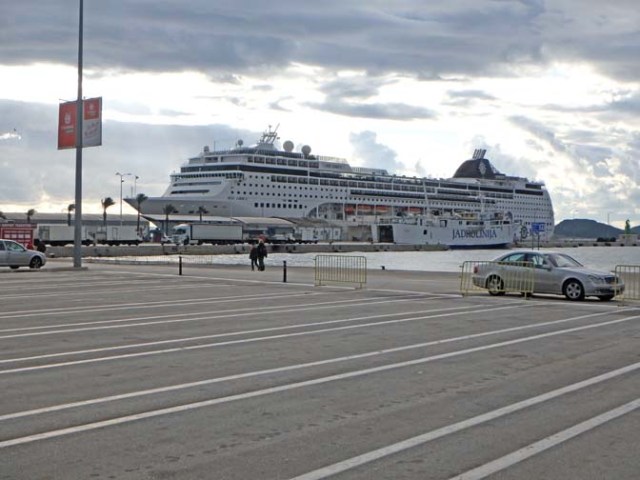
MSC Lirica in Split

SPLIT, CROATIA
Split is the second largest city in Croatia, with over 350,000 people living in its urban area. The city spreads over a peninsula and surrounding area on the eastern shore of the Adriatic Sea. It’s the largest city in the area called Dalmatia, where the famous spotted dogs originated. Development of the area first began as a Greek colony in the second or third century BC.
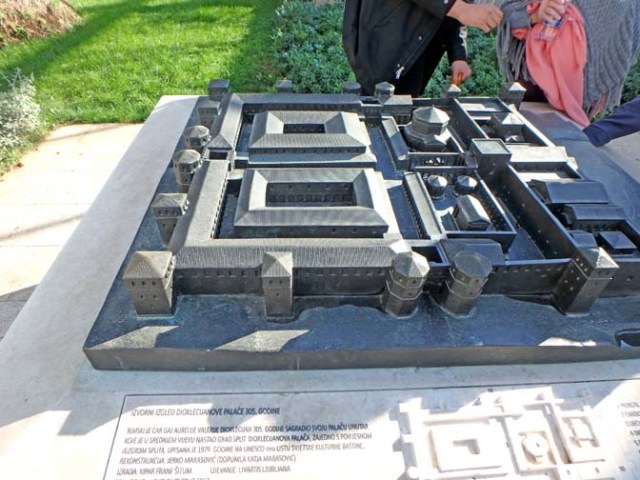
there’s a model of the original Diocletian Palace in the city

Founding of the city is associated with a palace built in 305 AD when a Roman named Diocletian wanted a retirement residence built there. The city developed within and around the walls of that early palace, which was subject to raids and sackings over the centuries.
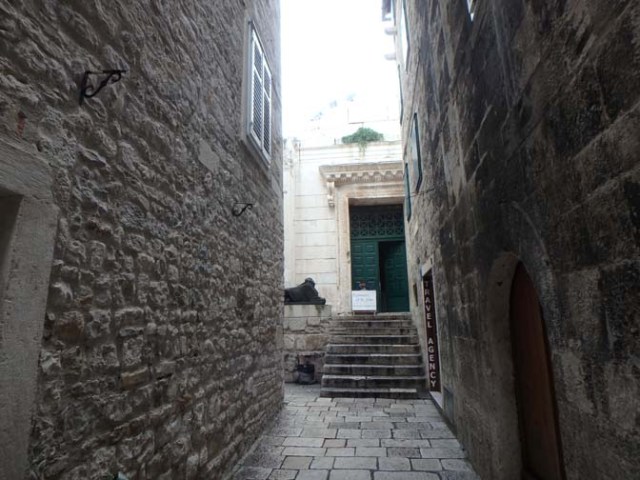
this narrow alley in Split is reminiscent of the alleys of Venice, except in Split they don’t lead to canals

Rule changed hands depending on the winners of various wars including 377 years under Venetian rule. Some of the streets through the old town area are narrow alleyways between tall buildings resembling the alleys winding through Venice. Croatia was part of Yugoslavia after WWII, gaining independence in 1991.
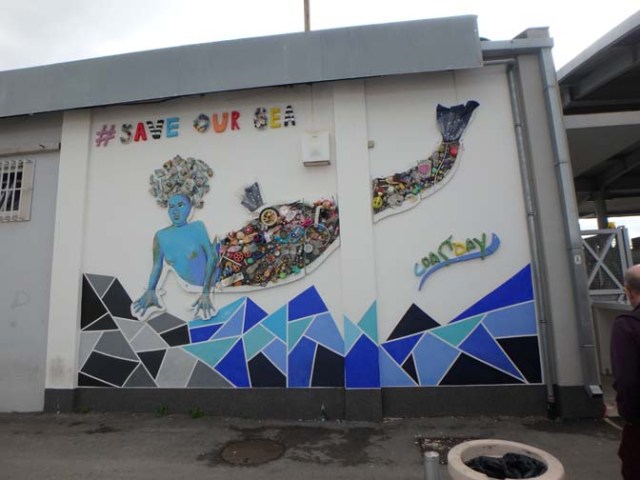
art made from garbage found in the sea on a wall at the port

SPLIT CRUISE PORT
Smaller cruise ships dock near the ferry terminal a short distance from town, larger ships anchor in the bay and tender to a dock even closer to the old town area. It’s less than a 15 minute walk from the cruise port to the old historic castle, which is pretty much unrecognizable as a castle since the town is built throughout the castle grounds and destruction and rebuilding occurred in ancient wars. There are some visible ruins and castle walls, and places where walls of the old castle are part of more recent buildings. An area of shops lies within an intact portion of the old castle.
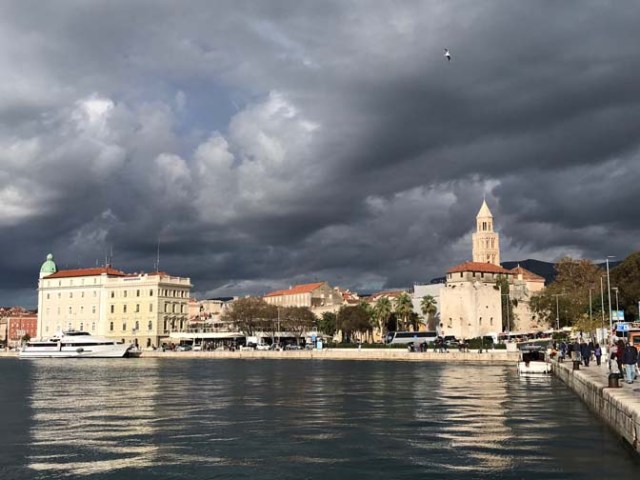
it’s a short walk to town along the waterfront

The language of the area is Croatian, but many of the people also speak English. Their currency is called Kuna. It takes over 6 kuna to equal one US dollar. Price tags make things look expensive since they are in kuna, but when translated into dollars the prices there were actually quite reasonable. Shops generally open at 8 on weekdays and 9 on Saturdays. Many are closed on Sunday. The old town area is easily reached by foot, being about 500 meters from the cruise dock.

seaside promenade outside the old walls

There’s a tourist office with free maps just outside the city walls near the historic center. It’s quite a unique place since the old town grew within the walls that once encircled Diocletian’s palace. Some of the original palace buildings that still exist have been converted to other uses while additional buildings and cobblestone streets built within the walls make it look more like a medieval city than a former palace. Outside the old castle walls the Riva Promenade is a nice place to walk with views of the port area.
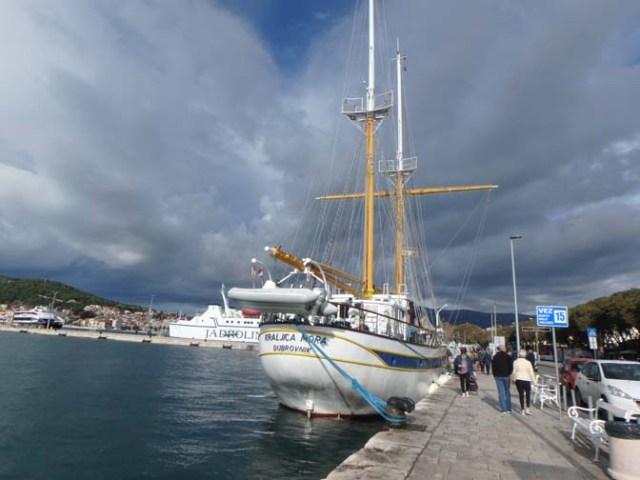
walking past a sailboat on the way into town from the port

The MSC Lirica docked in Split, Croatia late on a Friday morning. It was quite windy next to the ship, as is often the case. Large cruise ships seem to make their own wind tunnels, especially when docked near each other or at ports with large structures as this one had. You can see the town across the bay from the ship, and to get there you walk along the water past the ferry docks and then other ships docked along the seawall.
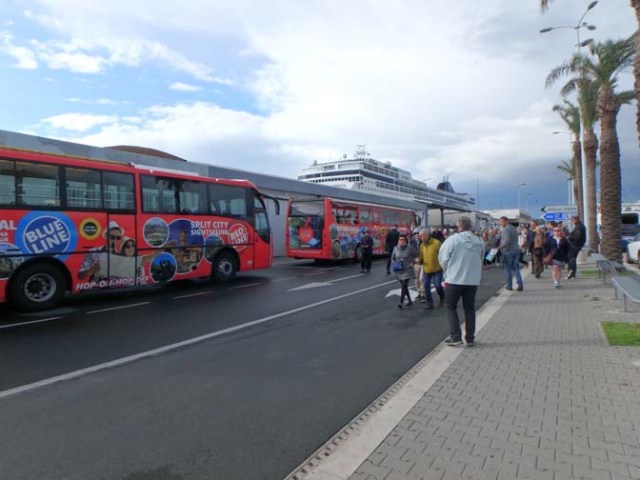
local tours at the port were expensive in Split

Once we walked beyond the ship the wind lessened dramatically. In town it was just a breeze. The ship offered a few tours for that port, cheap compared to usual cruise ship excursions. Once we cleared the port gate there were numerous locals offering taxi or van tours ranging from 1-4 hours. Had their prices been in the local kuna they wouldn’t have been bad, but since they were in euros they were actually higher than the cruise ship excursions, which is opposite what local tours at the port usually are.
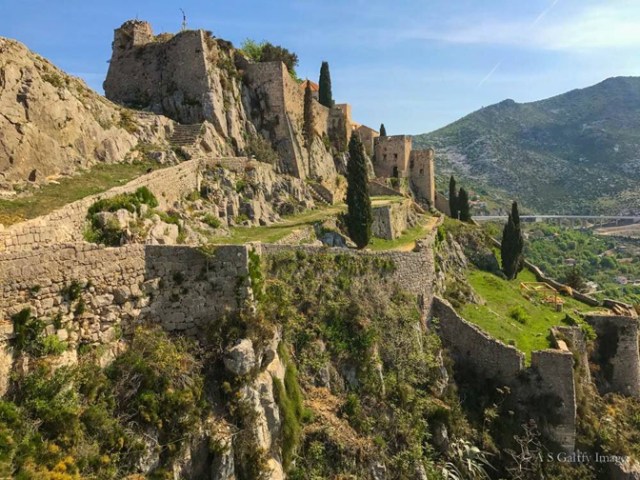
Fortress of Klis (internet photo)

One of the stop options on the taxi tours locals offered was the Fortress of Klis around 13 km away, which was used as the city of Meereen in the filming of Game of Thrones.
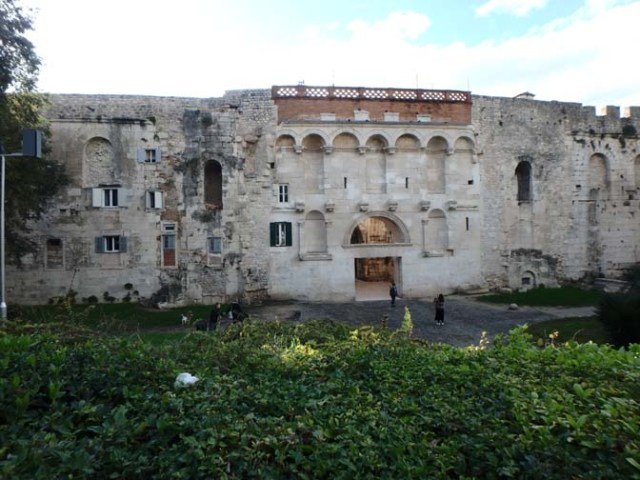
the old walls in Split range from ruins to intact or restored to parts of buildings

Some scenes in Game of Thrones were filmed right in old town Split in the basement area of the Dioecletian’s palace where it is still intact. This area was used for Daenerys’ throne room as well as where the dragons were kept. Another scene filmed in Split was at Papalićeva Street, which was one of the Streets from the slave rebellion scene. We found a shop where all the merchandise in the entire store was GoT oriented.
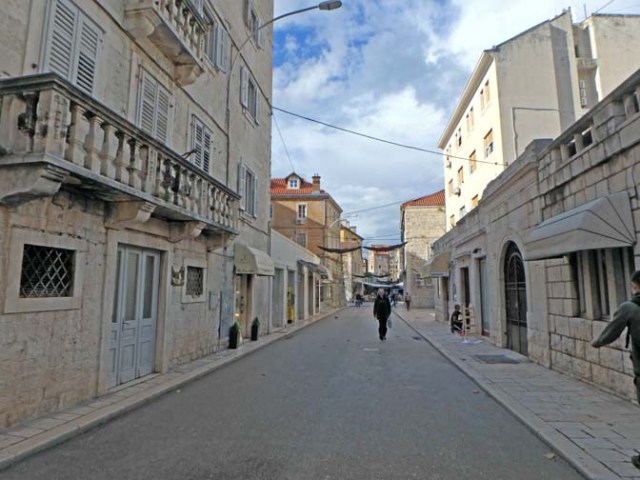
street in Split

We opted to just walk into town as the old town area is just past a bunch of ferries on the other side of the little bay area where the ship docked. For the most part it’s hard to tell there was once a palace there. Some of the streets are cobblestone and some of the sidewalks some sort of whiteish stone or brick. Some are quite narrow. Others are not quite that slim, yet narrow enough to give the feeling of walking through a medieval town or something out of Harry Potter as the lanes are surrounded in ancient buildings.
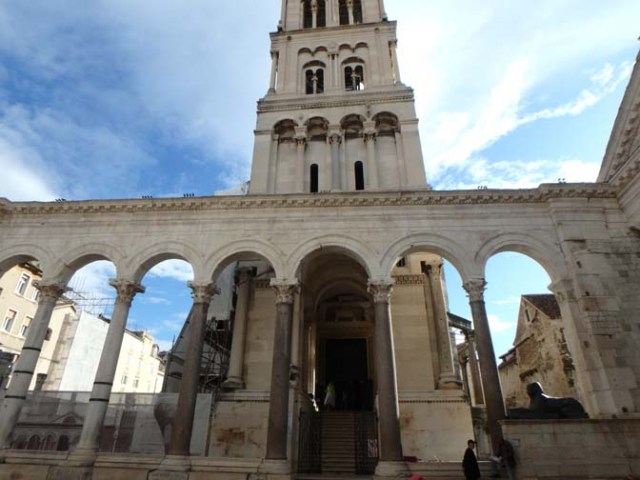
the tallest tower in old town Split

Split is a UNESCO world heritage site with 1700 years of history. As mentioned earlier, Split is Croatia’s second biggest city. Only Dubrovnik is larger. Split is located in the center of the country on the Adriatic coast. Its most famous monument is the 4th century Diocletian’s Palace, so basically the entire old town area.

ruins in Split

If you don’t have a specific agenda it really doesn’t matter where you go in the old town area because there are ancient structures everywhere. Some are in ruins, some current buildings use portions of the ruins as part of their walls, and some buildings are fully intact and though old, were not part of the original palace. A sort of tunnel filled with shops through an ancient and still intact basement of the palace leads from the seaside to a stairway up to an open area with an old church and some tall columns and other ruins, and is the basement mentioned earlier where the GoT scenes were filmed.

tower and statue of Bishop Gregory of Nin

Just outside the walls we came across other interesting things like a fountain, tower, and statue all in the same area near an entrance through the wall.
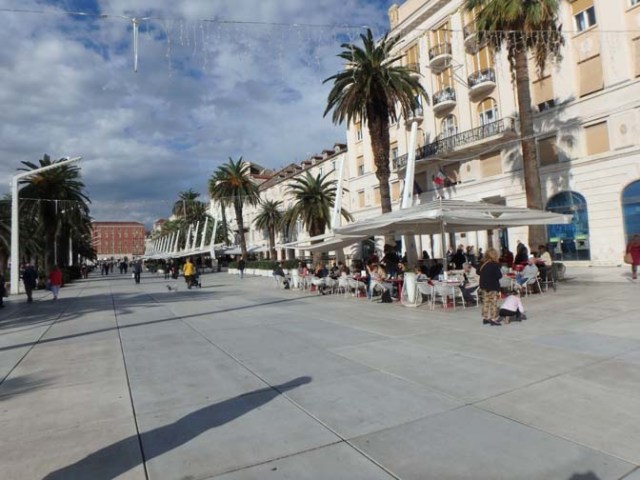
all the restaurants along the promenade have outdoor seating

The seaside walkway outside the old castle walls in the Riva Promenade area follows a wide open space next to the edge of town with palm trees and lots of little restaurants along a long row of outside tables. There’s a good view of the cruise ship from there.
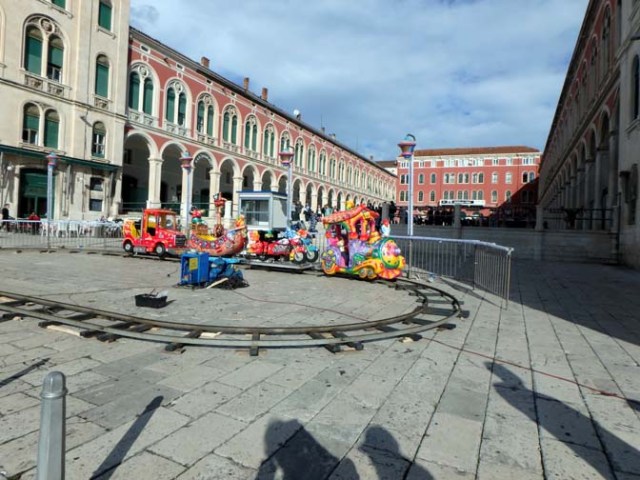
little train ride

We came upon a little train ride that seemed out of place among all the historic buildings.
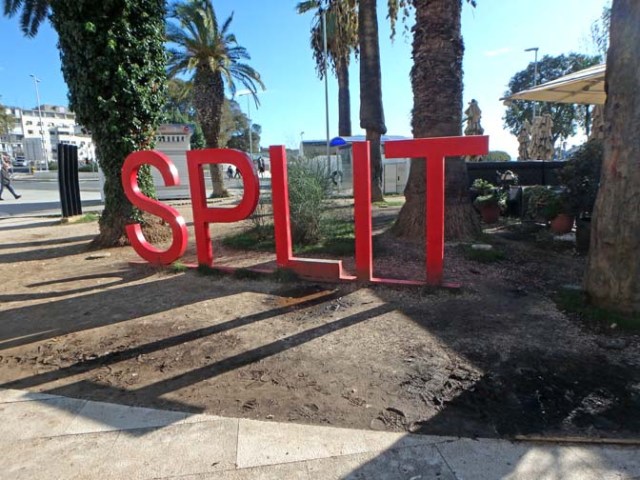
in case you are wondering where you are…

THINGS TO DO IN SPLIT
You can easily walk to all the main historical attractions in old town on your own, but if you want more information about the things you see there guided tours are available including a Game of Thrones walking tour. Segway tours are also an option. Split has lots of galleries and museums. Split also has lots of beaches. Bacvice is the most popular local beach, the only sandy beach around, and it’s the closest beach to the old town area. Expect crowds in warm weather. This beach also has water sports and stylish cafés. Snorkeling and diving are popular things to do in warm weather on islands near to Split. Excursions offered by MSC in Split included a city tour, walking tour through old town, bus tours to other historical cities, a walking tour through a national park that is a 1.5 hour bus ride away, and a mill tour.
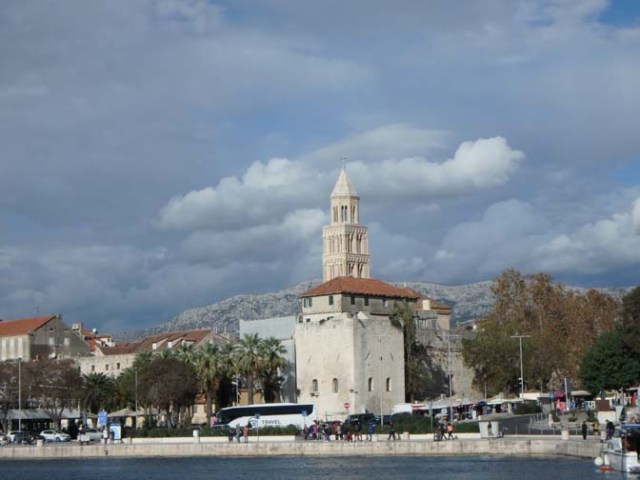
view of Split

The view from the ship is pretty awesome with all of the town in front of a range of tall, desolute and barren looking mountains. It’s an interesting place to visit.

Copyright My Cruise Stories 2020
Posted in Europe, Lirica, MSC, Port Cities, Ports of Call | Tagged , , , , , , , | 2 Comments

Busan, South Korea Cruise Port

Busan, South Korea

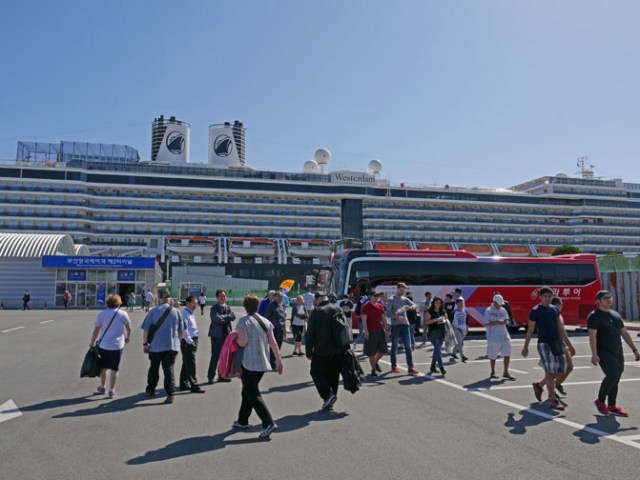
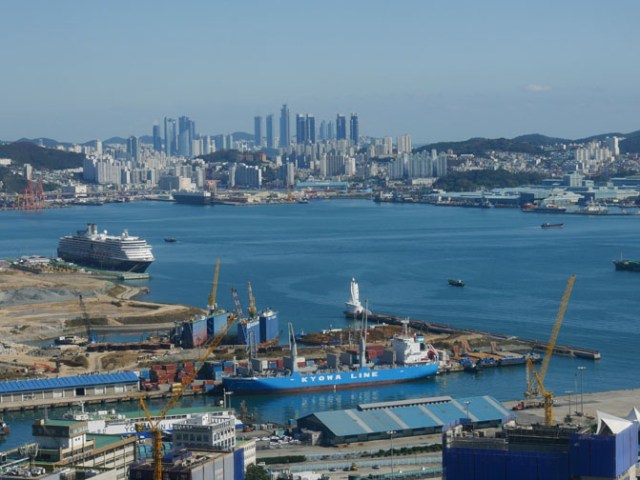
Westerdam in Busan, South Korea

Formerly spelled Pusan, but now changed to Busan although since apparently the Korean pronunciation actually is Pusan the spelling change really makes no sense, this city is South Korea’s second most populous city after Seoul. It is the 5th busiest seaport in the world and one of only 2 cities in South Korea not to be captured by North Korea during the Korean war. Being the closest Korean city to Japan, it has been a trade port for centuries. The climate is humid subtropical with average highs from the 40’s to 80’s °F and average lows from the 30’s to 70’s °F. August and September are generally rainy with a possibility of typhoons. October and November generally have nice weather. Busan has the least snow of anywhere in Korea falling only an average of 5 days per year.

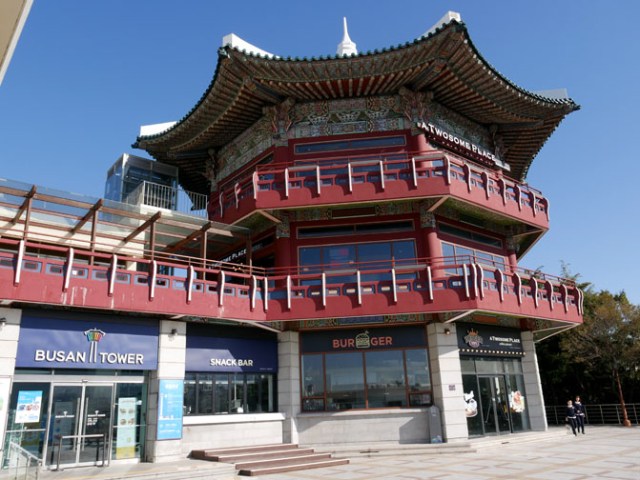
Busan Tower

entrance to Busan Tower

The port is mainly commercial, but provides free shuttles for cruise ship passengers into the city. When we came to Busan on the Holland America Westerdam, the port’s shuttle took us to Yongdusan Park, whose main attraction is Busan Tower. Free wifi is available at the port and in most coffee shops around town.

Busan, South Korea

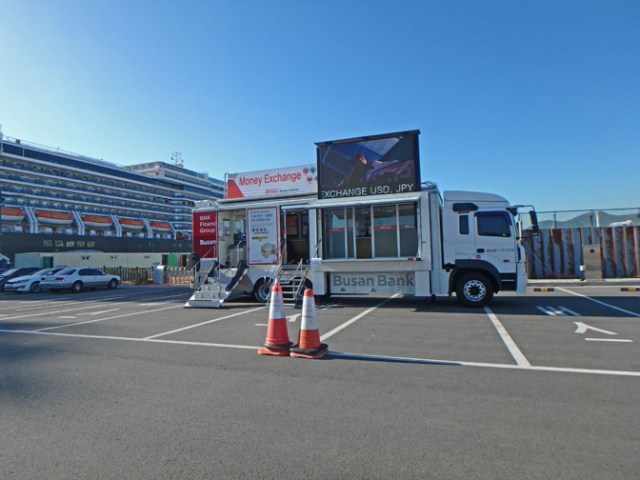
money exchange bus at the port in Busan

Currency is the South Korean won. There was a mobile bank booth right at the port that would exchange American money for Korean, and vice versa so passengers could change any leftover Korean money back to American before returning to the ship. We brought some Korean money from home, but didn’t use it all so we changed our leftover Korean money to American since we had no other ports in Korea. They gave the official exchange rate of the day and did not charge us a fee for their service.

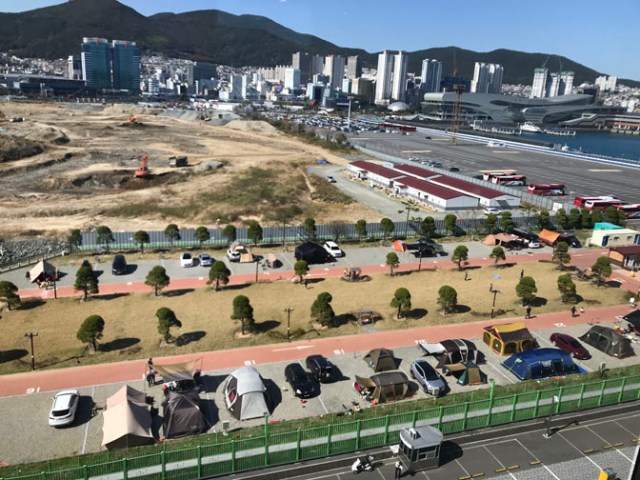
Busan South Korea campground

campground next to the cruise dock

From the ship we could see a little campground right next to the cruise terminal. Within a little fenced in area it had buildings that are probably restrooms, a loop road through the camping area, greenspace with a few swings in the center, and large square gravel campsites around the outer edge each marked with a number. Most of the people there had tents, but there was one with a trailer when we came. John saw another trailer pull in, but instead of maneuvering it around to park it while hitched up the guy had some sort of motorized jack. He unhitched the trailer and used a phone app to make the trailer park itself. John was pretty impressed by that and I was sorry I missed it because it would have been interesting to see and not something you see every day. We didn’t even know such a thing existed.

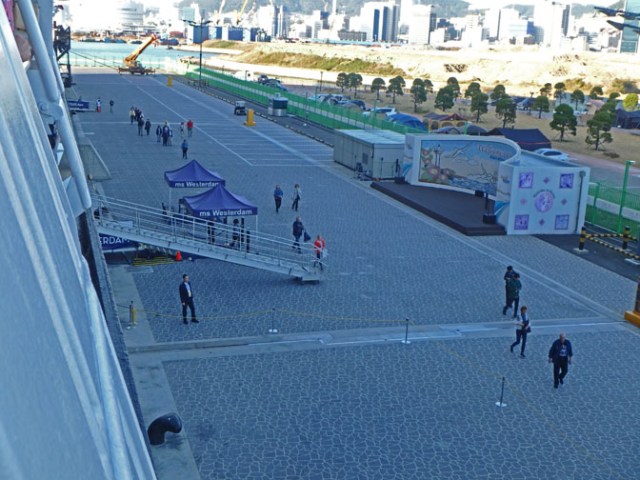
stage next to the cruise dock in Busan

Korean dancer

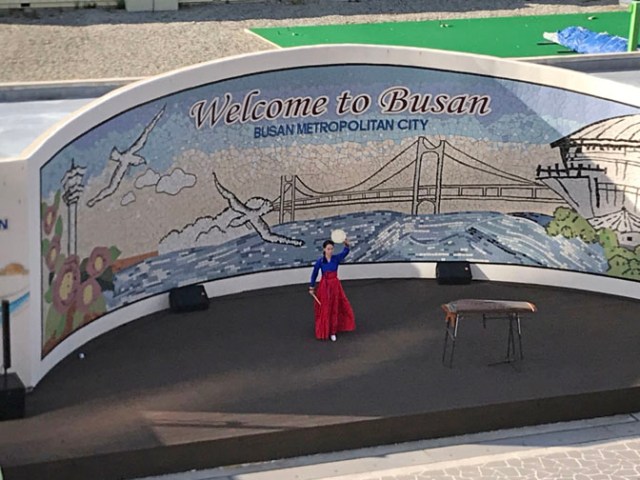
When it neared time for the ship to leave some Korean dancers gave a performance from the port on a little stage facing the ship.

cruise dock in Busan

Busan cruise ship dock

Tourist attractions in Busan include parks, museums, temples, a lighthouse, and lots of shopping including major brand stores, local markets, and the largest retail store in the world. Boat tours around nearby islands are popular with tourists. There is a maritime museum near the port with a hop on hop off bus stop nearby for one of the two available routes though some people said Busan’s Ho-Ho bus service is not always reliable. China town is also within walking distance of the ship. Busan does have a subway system for those who want to plan their own tours. For those who travel by taxi, tipping is not customary in Asia.

Korean war memorial in Busan, South Korea

Korean war memorial on a hill above Busan

There’s a war memorial up on a hill that you can see in the distance from the ship, or up close if you go there. The monument is located within the UN memorial cemetery, which is the only UN memorial cemetery in the world. It has the remains of people from 11 different countries who lost their lives in the Korean War.

Busan cruise port

cruise ship dock in Busan

Excursions offered from Holland America Westerdam mainly went to various temples. Some included things like a tea ceremony or beach stop. The highlights tour included a fish market, a skywalk trail over the ocean, an island visit, and a stop at Gujke Market.

Copyright My Cruise Stories 2020
Posted in Port Cities, Ports of Call, South Korea | Tagged , , , , , , | Leave a comment

Glow Worm Tunnel

glow worm tunnel

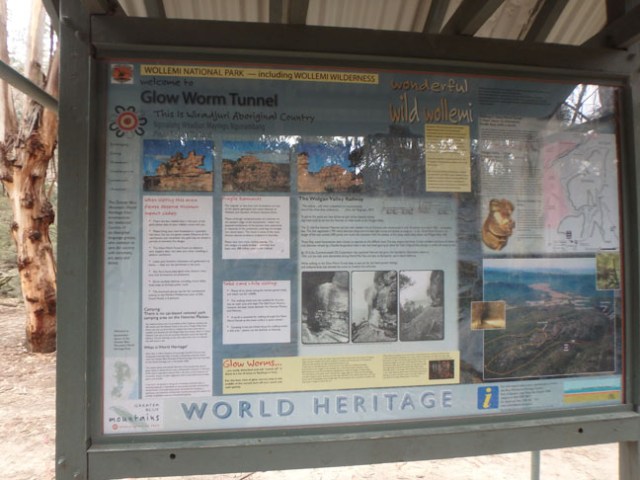
signs at the trailhead

Visiting Australia’s Glow Worm Tunnel in the Blue Mountains is a trip for the more adventurous sort of travelers. There’s no public transportation anywhere nearby so you need a car to get there. Preferably a 4×4 since whichever of the two approaches you choose involves a long trek down sometimes rough dirt roads.

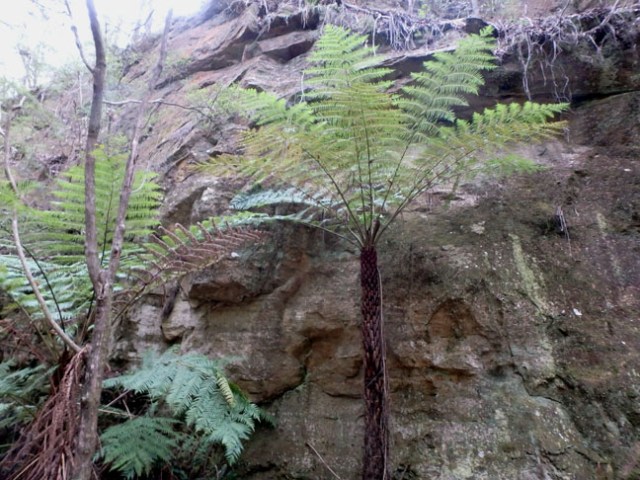
jurassic tree

prehistoric looking fern tree

The dirt road in from Lithgow is about 30K each way with parking available a couple kilometers or so from the tunnel. The Newnes approach requires a much longer hike, but the dirt road is considerably shorter. Annual Glow Worm Tunnel marathons start from the Newnes end and require all runners to wear a headlamp or carry a flashlight as well as walking rather than running through the tunnel.

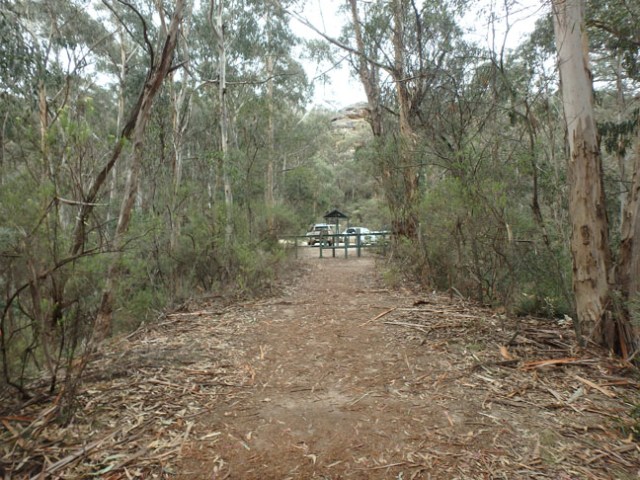
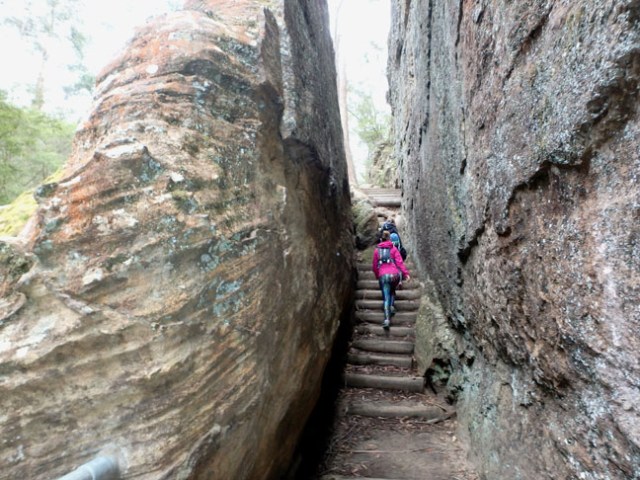
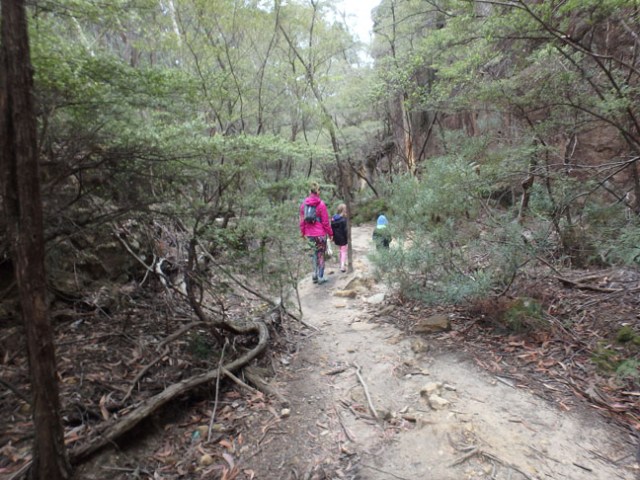
trail to Glow Worm Tunnel

looking back toward the parking lot at the start of the trail

We came down the long and often rutted road from Lithgow in my daughter’s van. There was one place fairly near the end of the road with a steep enough drop she actually stopped and got out to inspect the road questioning whether or not we’d be able to get back up if we went down it. We did. Not far after that we finally reached the parking lot. Ours was the only vehicle there that was not a 4×4. There is a rustic restroom with composting toilets by the parking lot.

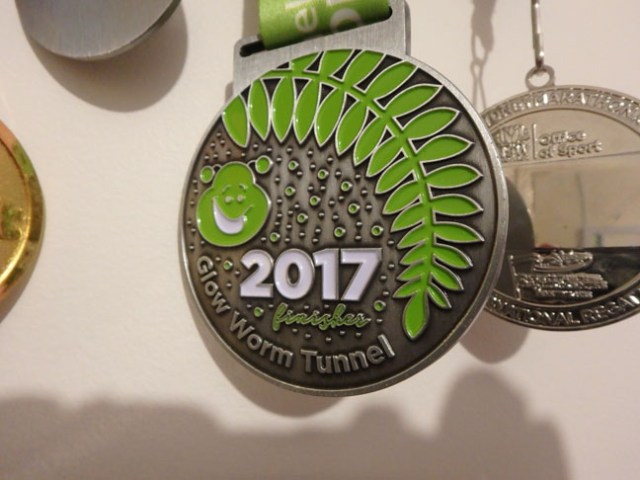
medal from glow worm tunnel marathon

runner numbers and medals from the glow worm marathon are covered in little green dots because that is what the glow worms actually look like

Glow Worm Tunnel is an old railroad tunnel used by a former shale oil mining operation which ran from around 1906 until the 1930’s and was dismantled in the 1940’s when they moved some of the equipment to another site. Tracks were removed both from the tunnel itself and from the trails in and out of it.

glow worm tunnel

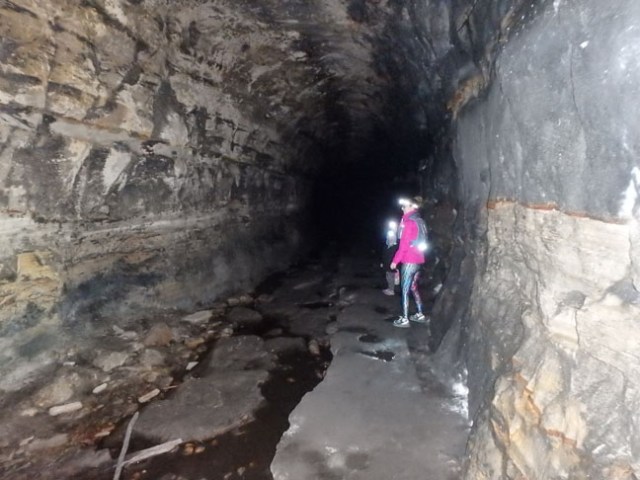
walking on the dry ledge through the glow worm tunnel

The 400-meter tunnel has a couple bends leaving the middle pitch black. A creek runs through most of the floor. Part of it has a ledge on one side to walk above the water level.

glow worms

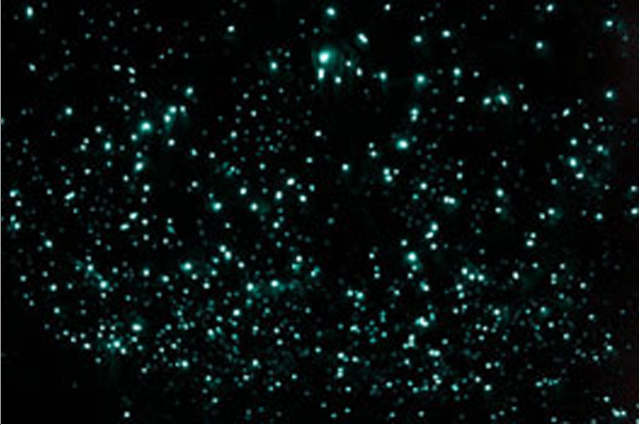
internet photo of glow worms

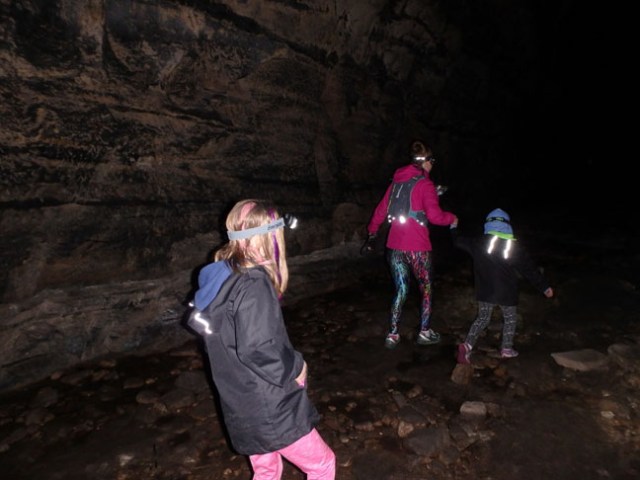
When far enough into the tunnel to be in full darkness stop and turn off all your lights to see the glow worms. They appear as pinpricks of green light along the wall or sometimes ceiling of the tunnel. If your light has a red setting you can see them with it turned to red, but they don’t show up in white light. There were no sections of the tunnel that had glow worms as plentiful as in the photo above and my attempts at getting photos resulted in nothing but blackness. The ones we saw looked green like the dots on the glow worm tunnel medal rather than blueish like the ones in the photo above.

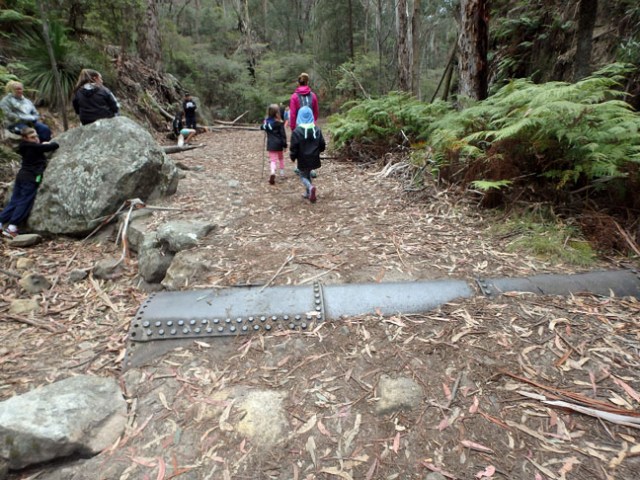
old railway pipe

parts of the trail still have remnants of the railway like this old pipe

The glow worms found in the tunnel are the larvae of the fungus gnat. Their glow comes from a chemical reaction within the body of the glow worm. They use the glow to lure in prey like mosquitos.

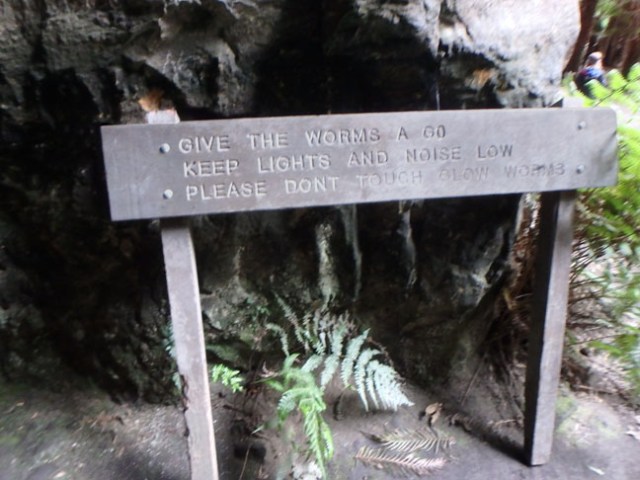
don't disturb the glow worms

sign near the opening into the tunnel

Signs warn visitors to pass through the tunnel without touching the walls or making too much noise so as not to disturb or destroy the glow worms. Bogan is an Australian term for lowlife people. Just within the time we were there we saw two different groups of people with no respect for nature who definitely fit that description as they apparently didn’t care to preserve the glow worms for anyone else to see. Both groups talked and shouted loudly enough to be heard for the entire length of the tunnel. One group clustered around glow worms on the wall, taking close-up phone pictures and getting their hands all over everything while loudly wondering if they would be able to hold a glow worm.

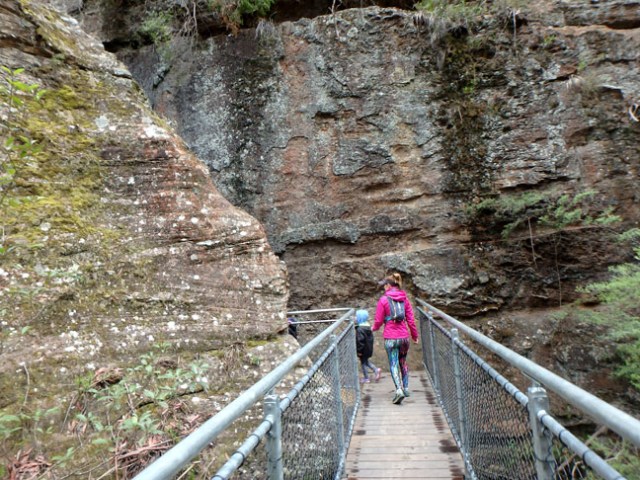
bridge on trail

bridge on the trail to the glow worm tunnel

The other group thought they could run through the tunnel without lights, perhaps thinking the worms were big and bright enough to light up the tunnel like neon lights. They’re not. You need a light to get far enough into the dark part of the tunnel, then darkness to actually see their glow. Just a small light to find your way, nothing too bright since the glow worms are sensitive to light. Not having lights that group didn’t get in far enough to see any glow worms before turning around and coming out loudly complaining that there weren’t any glow worms there, while smoking in the tunnel. Smoke is harmful to the glow worms, who are quite sensitive to environmental disturbances.

glow worm tunnel

looking for dry ground in the glow worm tunnel

All of the ground in the tunnel is damp and uneven whether in the wet part or not. At least it was during our visit. We were there after a recent rain, but not enough rain to have any water in the big dry wash below the trail near the parking lot.

trail stairs

stairway on the trail to the glow worm tunnel

If you like the wonders of nature, hiking on trails, and don’t mind rough roads this tunnel is pretty interesting to see, but if you are looking for spectacular sights, great photos, or easy tourist spots don’t bother because it takes a lot to get there and the glow worms are just little pinpricks of light that don’t show up at all in the average photo. Some areas of the tunnel had lots of them and other areas just a few or none. There would probably be more if visitors to the area had a bit more respect for the things they come to see as well as for others who might come to see them later on. Especially considering that all of the areas that had very many glow worms were up too high for anyone to reach.

trail to glow worm tunnel

hiking to glow worm tunnel

Sadly rocks near the tunnel entrance had graffiti on them and some areas of the trail as well as the road in had garbage strewn about. People seem to manage to carry things just fine when they are full and heavier, but when empty and lighter they want to get rid of them immediately whether it is appropriate or not, thus ruining otherwise pristine areas not just for other visitors, but also for the animals who live there. And often leaving plastic to work its way into the ocean where it wreaks all kinds of havoc.

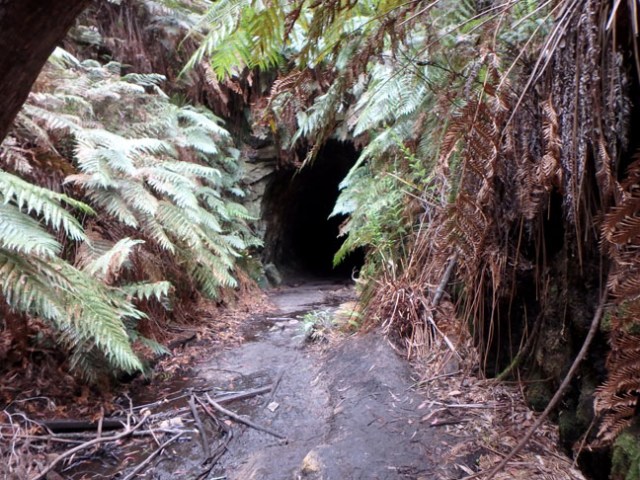
tunnel entrance

entrance to the glow worm tunnel

The Glow Worm Tunnel is located on the Newnes Plateau between Newnes and Lithgow. Lithgow is a town in Australia’s Blue Mountains while Newnes existed for the refinery. Not much is left of the town at Newnes. Many of the buildings were torn down and used elsewhere after World War II when building materials were in short supply. People can visit ruins of the refinery in Wollemi National Park.

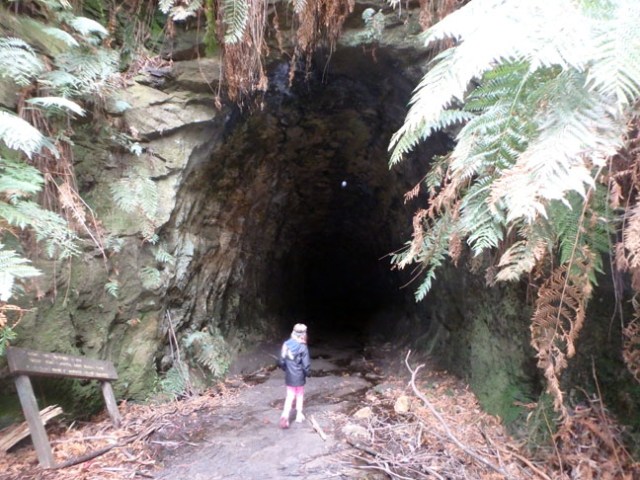
glow worm tunnel

Hannah at the tunnel entrance

Copyright My Cruise Stories 2020


Posted in Australia, Explorer of the Seas, Port City Side Trips, Royal Caribbean | Tagged , , , , , , , , , | Leave a comment

Royal Princess Balcony Cabin

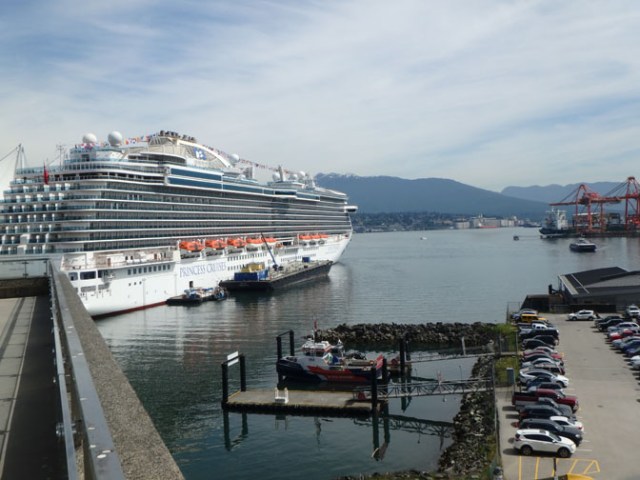
Royal Princess in Vancouver

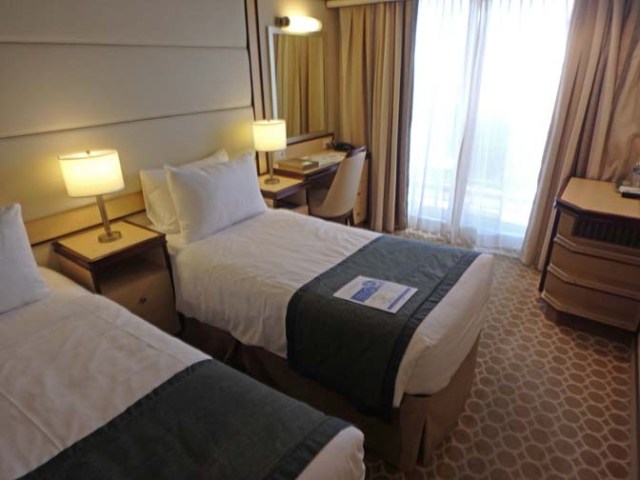
Royal Princess has a variety of cabins that have balconies, one of which is the standard balcony cabin. It also has deluxe balcony cabins and a several different types of suites with balconies. What the ship does not have is oceanview cabins. It’s missing that entire category. On the Royal Princess if you’re not in an interior cabin you have a balcony. Of course balcony cabins have an ocean view, but the oceanview category is for cabins with just a window, not a balcony.

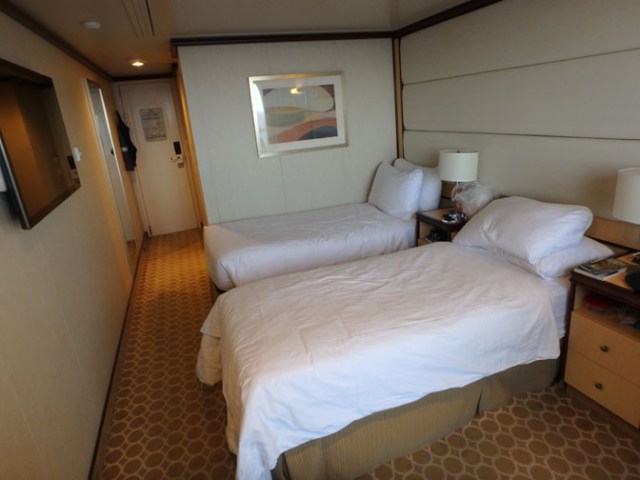
not the biggest cruise ship cabin, but it worked

While we likely would have booked oceanview to save money had it been available, since it wasn’t we went with the standard balcony cabin as that was the least expensive other than inside cabins. While higher priced than an oceanview cabin would have been if the ship had any, at least the standard balcony cabins on the Royal Princess were priced lower than balcony cabins on other Princess ships sailing a similar itinerary. Inside staterooms tend to be the smallest cabins, and with 3 in the room we wanted a bit more space. Which is exactly what we got. The standard balcony cabins have a desk and a chair, but to get larger room with a small sofa on this ship you have to book the deluxe balcony cabin so we didn’t have a whole lot more room than an inside cabin.

door entry on medallion class ships

Being a medallion class ship, entry into the cabins was done through the medallions that passengers had instead of key cards. The door was supposed to sense your medallion and unlock on approach, but we had to touch our medallions to the display by the doorway to get ours to unlock. Another passenger I talked to said his wife’s medallion would unlock their door from several feet away, but he had to touch his to the sensor like we did. So apparently some of them worked better than others in that respect.

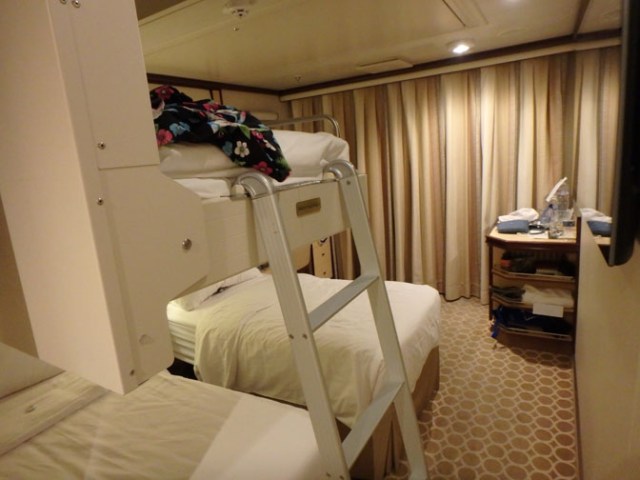
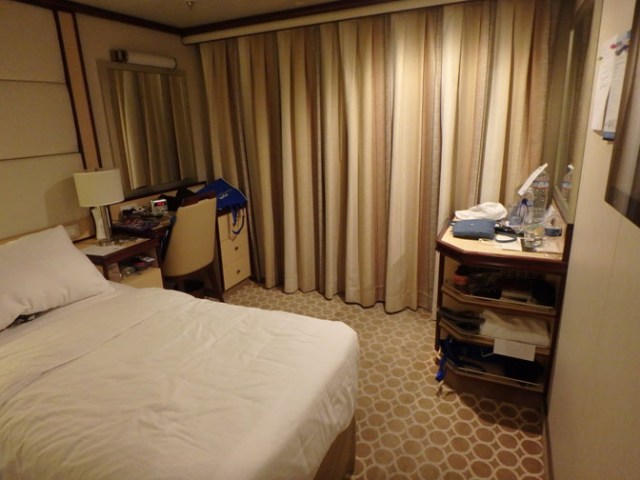
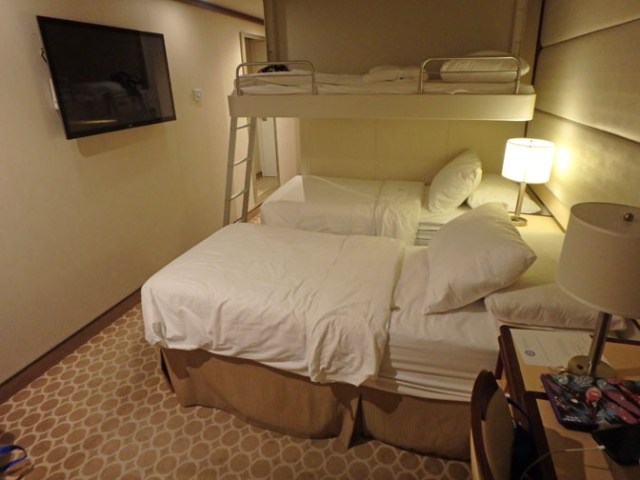
the bunk took up a good chunk of space when it was down

Our cabin had the standard two beds that can either be set apart as twins or together as a queen depending on who is in the room and what sort of bed configuration they want. We had 3 sisters in the room so in addition to the twin beds we also used one of the cabin’s drop-down bunks that fold up into the ceiling. Since the room wasn’t all that large and other than one chair we had nowhere to sit but the two lower beds we asked the steward to put the bunk up in the daytime and have it down just at night except on long port days when we’d be out all day. This made a bit more space in the room as it seems more open without the bed blocking so much of it, and left both lower beds open as a place to sit, which we rather needed since the room had just the one chair.

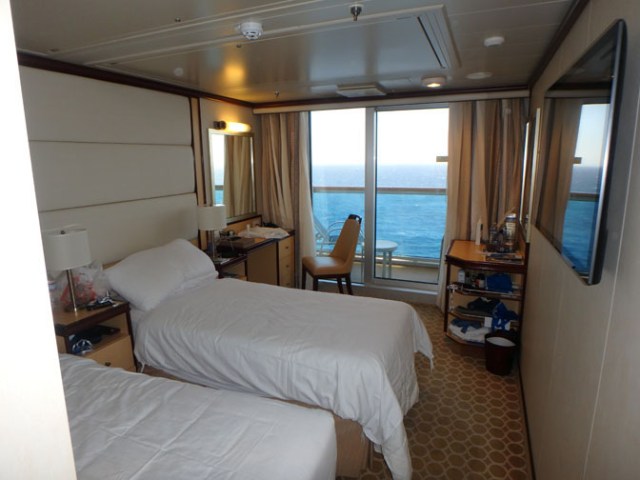
balcony view

The balcony had two chairs, but for the majority of the trip one actually would have been enough out there. There was one nice day when we all 3 sat out on the balcony awhile, for which we borrowed the one chair from the room.

boarding day before we cluttered up the cabin with all our stuff

In the mornings we each had our own routine of what we thought was important for our way to start the day. I tend to wake up earlier than my sisters, and on days where we did not have a port stop first thing in the morning I went to the gym for a run on the treadmill. My preference on ships is to run on the promenade deck, but Royal Princess doesn’t have much in the way of an outside promenade deck, and the few small sections it has don’t connect to one another. Luckily their gym was open 24 hours because I run earlier in the morning than most ships open their gyms. According to their published open hours in their daily newsletter it opened later, but one of the crew people told me that was just the staffed hours and the equipment was available for use anytime.

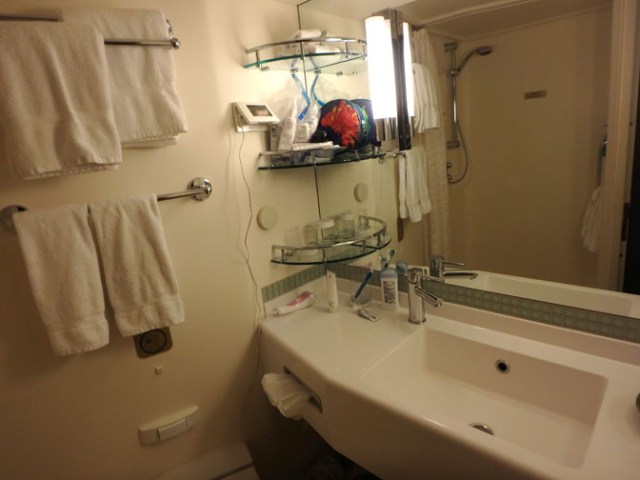
Royal Princess standard bathroom

The problem with running at that time of day was that I’d finish about the time my sisters got up and hogging the bathroom to take a shower right when they needed it wouldn’t be very nice. To solve that problem I showered in the locker room at the gym. The showers there looked nice with big square rainshower showerheads, but they did have a major problem. The source of hot water must have been quite distant from the gym because I was always nearly done with my shower before the water finally began to warm up so I spent a lot more time avoiding the chilly water than enjoying the fancy rainshower. Meanwhile our cabin shower (which I only used once the entire cruise) had nearly instant hot water.

the one bit of floorspace big enough for exercising

My sisters had their own morning routines with my younger sister ordering room service coffee that she would sit out on the balcony to drink no matter how cold the weather, even if she had to bundle up like an arctic explorer to sit out there. My older sister claimed the one area of the room with a bit of floorspace in front of the desk and between one bed and the sliding door to the balcony for her morning exercises and yoga. They both used the cabin bathroom for all their showers so they always had a nice hot shower. I thought about trying the one at the spa, but it was quite distant from the gym and the spa wasn’t open that time of morning. I didn’t particularly want to hike pretty much the entire ship between working out and showering so I never did check to see whether or not the locker room at the spa would be unlocked that early. On most ships the spa and gym are in the same area and share a locker room, but on Royal Princess they are on different decks and opposite ends of the ship so each has its own.

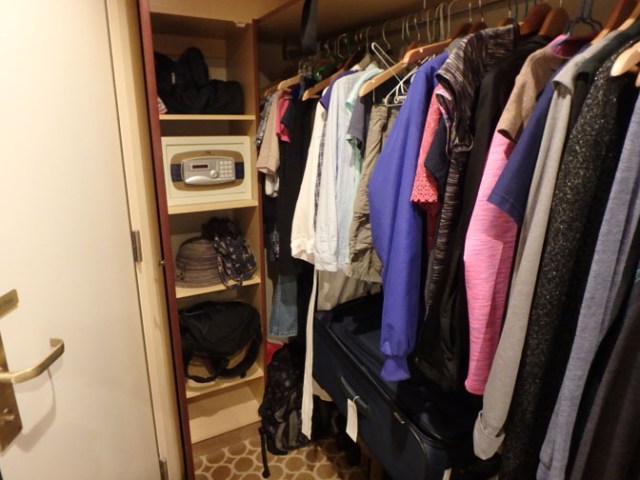
big open closet and small closet with shelves and a door

The cabin had a lot of storage space with a good sized open closet next to a small skinny closet with shelves and a door, 2 nightstands with drawers plus the same set of drawers in the desk, and shelves between the countertop and the floor on one end of the counter over the little refrigerator. They all divided well by 3. There were 3 shelves under the counter, 3 in the bathroom, and 3 that had about the same amount of room not taken up by a safe in the tall skinny closet (plus an extra one there). The two nightstands and desk made 3 sets of drawers. The one thing the room didn’t have was enough room under the beds for all 3 suitcases because most of the space there was taken up by bedding for the second bunk that we weren’t using. Two of them fit, but that left the third one taking up space in the closet. They were all about the same size so we couldn’t fit one into another.

cabin with the bunk down

While the cabin would have been a bit cramped if we actually lived there, it was just a one week cruise and we didn’t spend a lot of time in the cabin so it was fine.

Copyright My Cruise Stories 2020
Posted in Princess, Royal Princess, Shipboard Life | Tagged , , , , , , , | 2 Comments

Gondola Ride in Venice

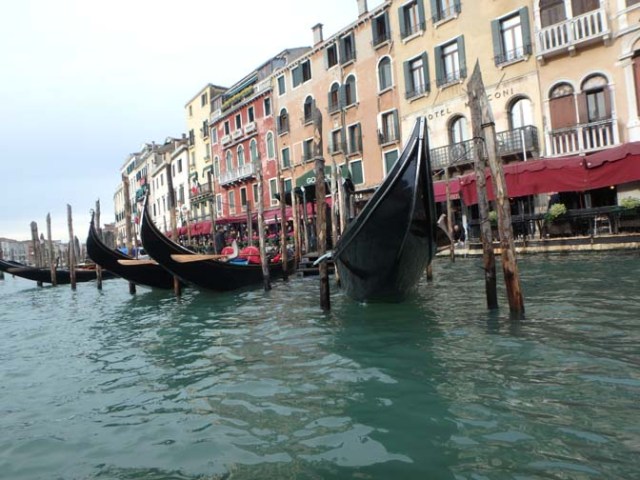
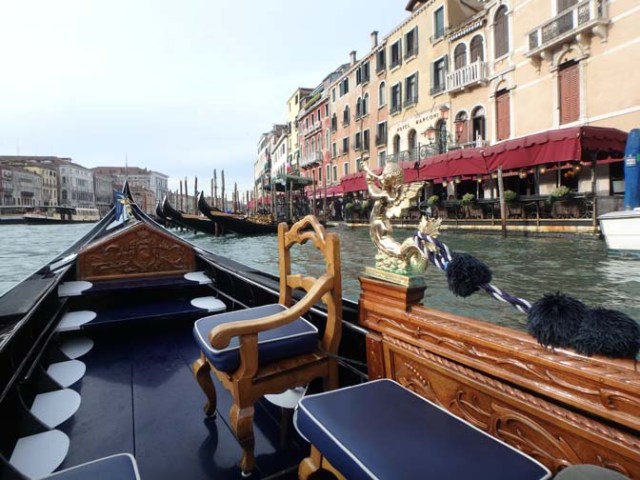
gondola in the Grand Canal

Our 20-day cruise on the MSC Lirica was scheduled from Venice to Dubai so we flew into Switzerland 10 days ahead and did some traveling around Europe by train, ending with 3 nights in Venice before boarding the ship. Although a last-minute change in the embarkation port ended up with passengers being bussed to Trieste 2 hours away, we still enjoyed having a bit of time to explore Venice before our cruise.

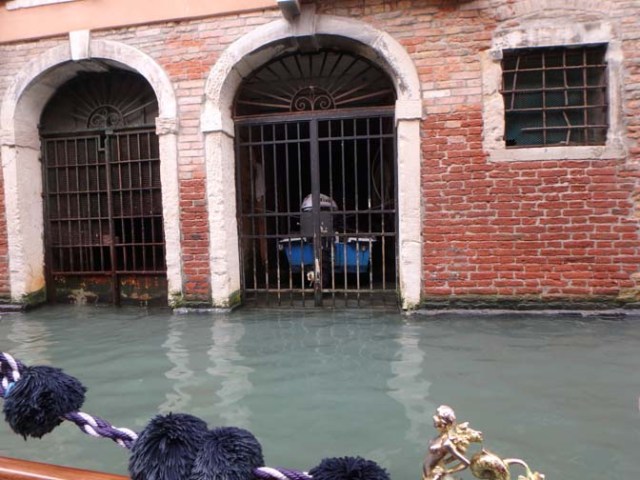
someone made use of this flooded building for boat storage

Venice is a city built on small marshy islands in a shallow lagoon. Construction of this unique city involved driving pilings into the ground and topping them with a stone foundation upon which to put the buildings. Between these pilings settling deeper into the ground over the centuries and sea level rising, Venice has been sinking ever since. In some places the lowest level of the buildings has been abandoned for constant flooding, but many are still in use and subject to periodic flooding with high tides and heavy rains.

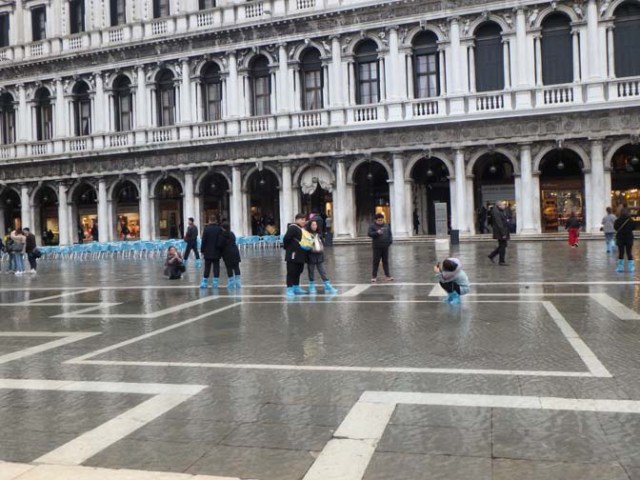
tourists with slip-over boots in a puddle at Piazza San Marcos (Saint Mark’s Square)

Flood barriers are a common sight across doorways, but when the waters rise higher than the barrier these places still flood. In areas like Piazza San Marcos (Saint Mark’s Square) flooding occurs frequently enough that they place portable raised walkways in high water areas. Enterprising local vendors also sell raincoat-like boots that tourists can wear over their shoes to keep dry when the water rises.

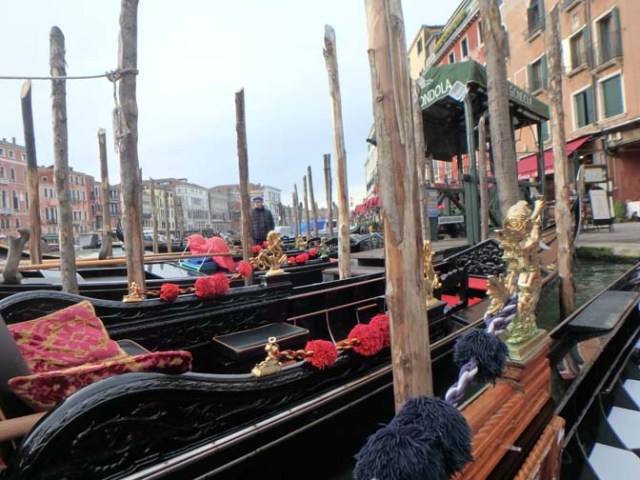
gondola stand

Gondolas are a major icon of Venice, and these long thin paddle powered boats are everywhere. You don’t go far without seeing gondolas tied up along the edges of the canals, or paddling by. The gondoliers don’t all sing though. Some places charge extra for a serenade, others don’t offer singing gondoliers. Once we happened to be on a small bridge when a gondola passed under with the gondolier singing away.

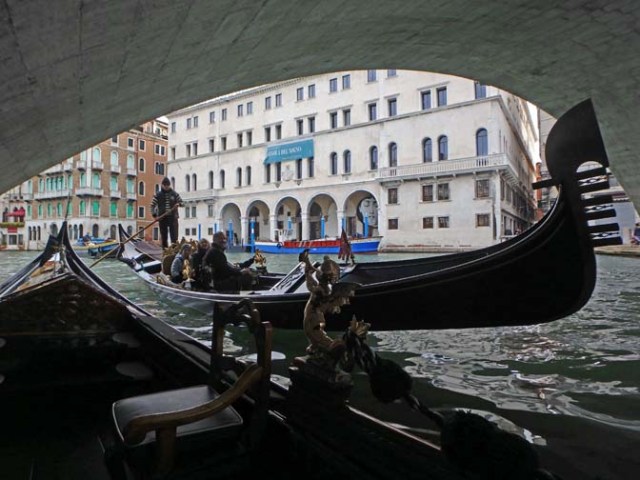
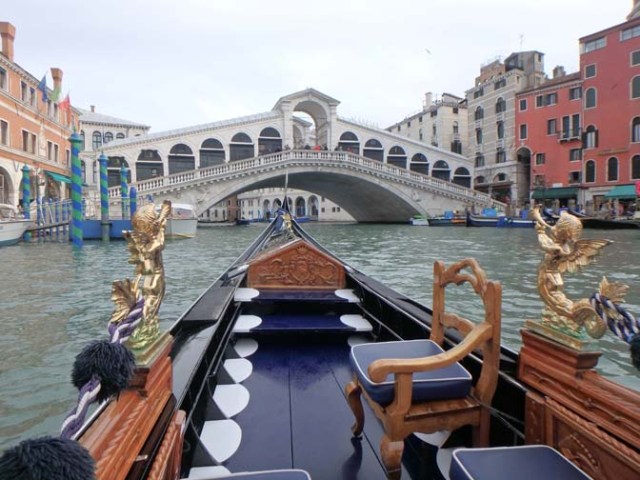
gondola about to go under the Rialto Bridge

We couldn’t go to Venice and not ride a gondola. Our first full day there was kind of rainy so we decided to wait until the next day when the weather forecast looked better. Walking around Venice we had seen quite a few places with gondola stands, though not all of them had anyone there. While crossing the Rialto Bridge we had seen a sizable one next to it, which had lots of boats and gondoliers. It wasn’t far from the bnb where we were staying so we went there.

passing another gondola under the Rialto Bridge

The ride was about half an hour long. We started by walking across one gondola to get into the next one where we sat down for our ride. First we went under the Rialto Bridge. Venice has many bridges, but the Rialto Bridge is big and famous. It also crosses the grand canal. Venice is criss-crossed by many canals of various sizes having been built on a series of swampy islands in a lagoon, but the S-shaped grand canal running through the main part of Venice is the widest and most traveled, being full of boats of all sorts.

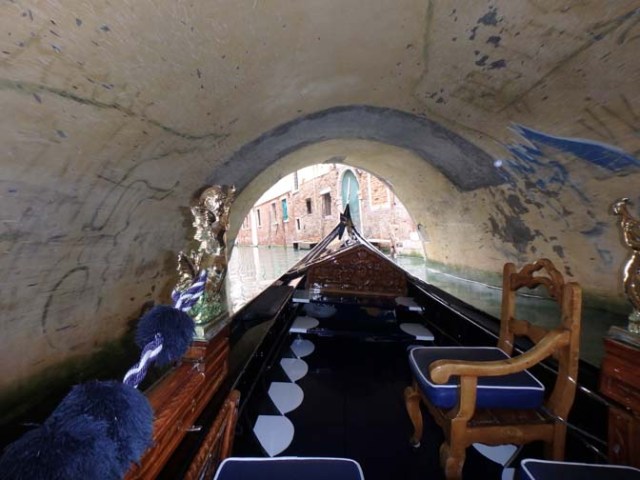
going under a small bridge

Whether powered by man or engine the canal boats all have one thing in common. They are long, low, and narrow. They have to be low to fit under the bridges, especially if they go into the smaller canals where the bridges are lower. They have to be narrow to fit into the small canals, and to get past one another even if they stay in the grand canal. Long is their only option for carrying much since they are low and narrow.

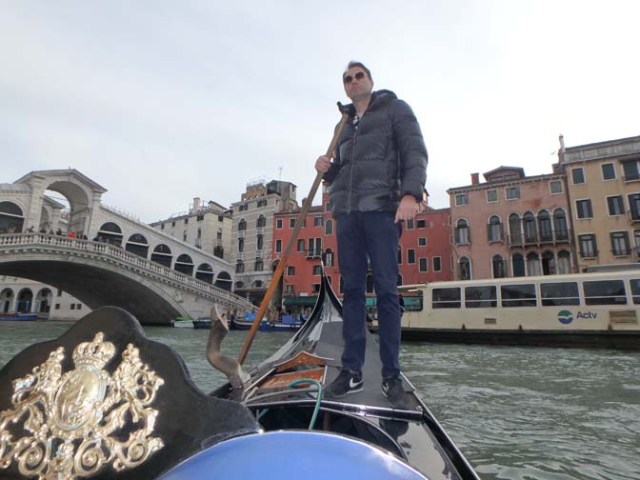
gondolier

The gondolier has to have some excellent boating skills to navigate the grand canal around and between bigger and speedier boats as well as to be able to cross it through a steady stream of other boats going by.

gondola in a small canal

He also needs mad skills to get around some of the tight corners without scraping building walls in the smaller canals, to pass other boats in a narrow canal where there’s barely room to squeak by, and to slide under bridges so low he has to duck and tilt the boat so the taller bits fit. Our gondolier didn’t scrape a thing, but we did see some scrape marks on the underside of a particularly low bridge where others had hit it.

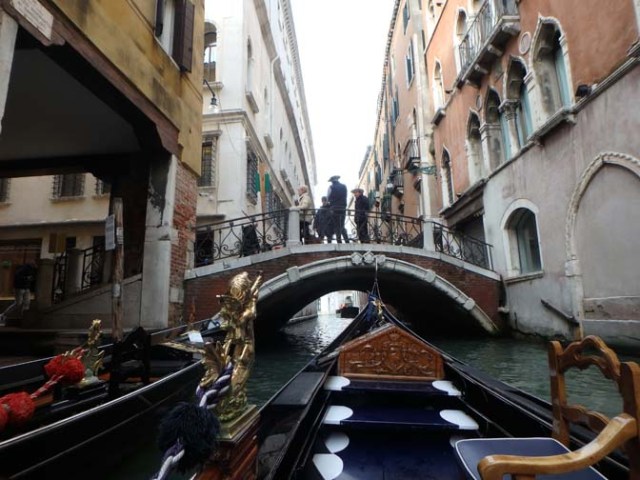
approaching a small bridge

We went under bridges we had walked over while wandering through Venice on foot. The route took a loop around some smaller canals and then back into the grand canal where he had to cross through an unending sea of oncoming boats to get to the other side before returning to the gondola stand where we got on. It was pretty amazing that he could make it through the neverending stream of boat traffic, but he did.

gondola stand

When visiting Venice a gondola ride is definitely a must-do. Besides being a major icon of the city, it’s fun to do and a great way to see the sights.

heading toward the Rialto Bridge

Copyright My Cruise Stories 2020
 

Posted in Europe, Lirica, MSC, Port Cities | Tagged , , , , , | 2 Comments

Ohori Park in Fukuoka, Japan

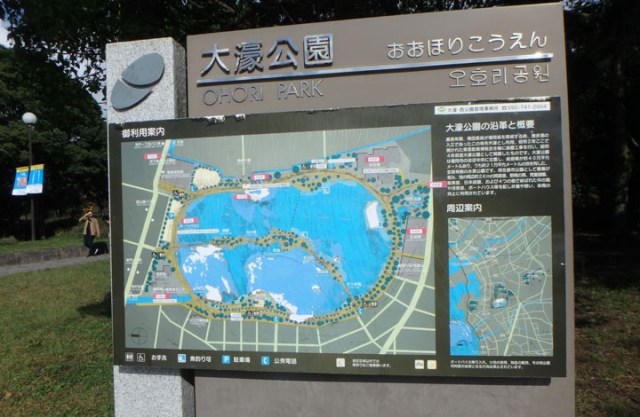
park map

map of Ohori Park at the park

Holland America Westerdam docked at Chuo Wharf, Hakarta Cruise Port in Fukuoka, Japan on what started out as one of those if you don’t like the weather wait 5 minutes days. For the most part it was overcast, but there were sudden bursts of sunshine, occasional short downpours, and sometimes a pretty strong wind kicking up. Waves bounced around the wharf kicking up whitecaps.

Ohori Park

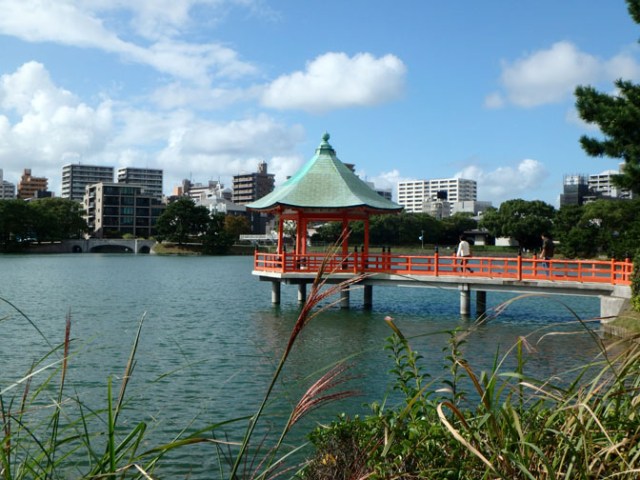
pagoda on the island at Ohori Park

There’s nothing much near the port in Fukoaka/Hakarta, but they did have free wifi and information and maps in the terminal. The port provided free shuttle service to City Hall in town with busses running about 1 every 20 minutes. We decided to see Ohori Park, which is just a couple subway stops away from Tenjin Station near city hall.

Ohori Park in Fukuoka, Japan

Ohori Park

The subway station has multiple entrances and an underground shopping center so it’s important to note where you came in so you can leave the same way in order to know where you are when emerging on street level. The stairways into the subway area often look the same, but they are all numbered. Take note of what number you came in on so you can find the right one when you want to leave. It’s also important to make sure you know which platform to go to for the train line you want and the direction you need to go. Ohori Park is on the Kuko line 2 stops away from Tenjin with a station called Akasaka in between. Since it was painted on the wall which station the train was coming from and going to knowing that is quite helpful in insuring you are on the right platform. The park is at Ohorikoen Station – koen meaning park. This station also has multiple exits so check what goes where to find the right one. (Take exit 3 for Ohori Park, exit 6 for the elevator, or exit 5 for Maizuru Park and the castle ruins.)

Ohori Park

sculpture on the side of the trail on the island

Upon surfacing to ground level from the subway we took a look around to make sure we’d recognize the area in order to find the station again. Which wasn’t hard as long as we left the park the way we came in since the park entrance was not far from the subway. Checking our surroundings we noted a playground near where we entered the park, useful for locating the correct exit to get us back to the subway station when it came time to leave.

bridge at Ohori Park

bridge across the center of the lake

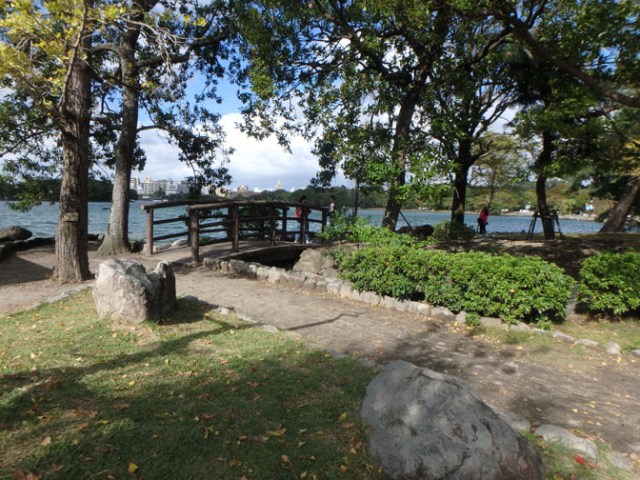
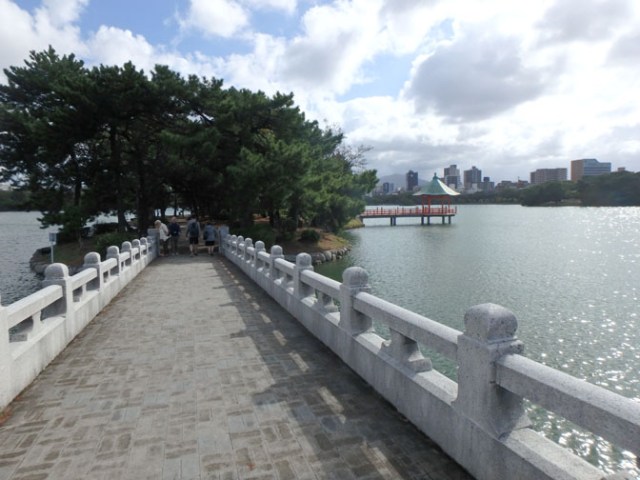
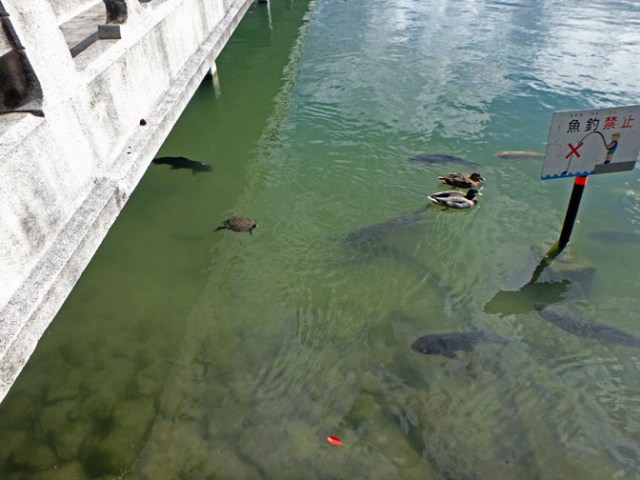
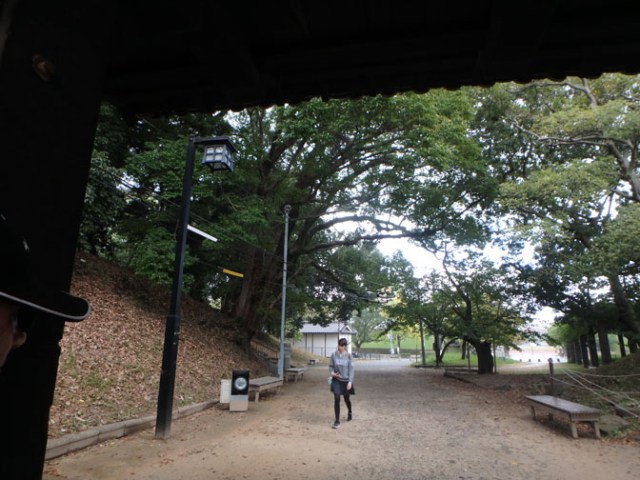
Ohori Park has a trail around a lake that was once a moat to a castle. Bridges to an island in the center make a shortcut right through the lake as well as a pleasant path to walk on. There’s a bike trail and running path around the lake as well. Some pretty good-sized fish clustered around a no fishing sign next to the bridge. Soon a turtle and ducks swam out from under the bridge together. A little red pagoda juts out into the water on its own dock on one side of the island.

no fishing Ohori Park

wildlife at the no fishing sign

Trails off to the side of the lake lead into a Japanese garden near the far end of the bridge from the subway station. Near the playground more trails lead into the area noted as castle ruins, though other than one of what used to be many towers there didn’t seem to be much in the way of ruins there. It did have a section with many little cabanas, some with outdoor furniture and others with picnic tables, and lots of barbecues. Whether those are always there or were just there that day for a race people were in the process of setting up for I can’t say.

homeless in Japan

homeless camp in Ohori Park

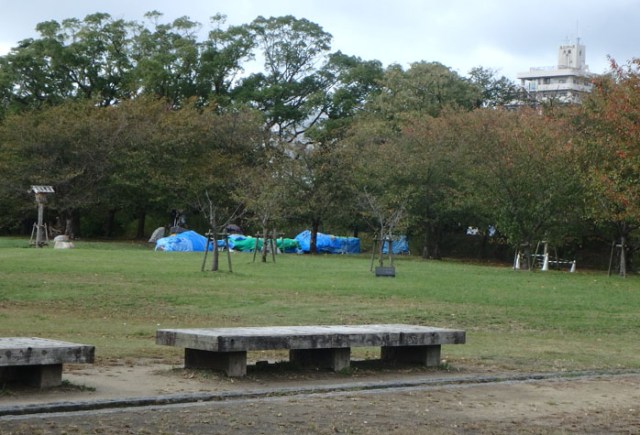
Off to the end of the field with the trail leading to the tower we saw what looked like a homeless camp with lots of cats. First sign of homelessness we’d seen in Japan, and we didn’t come across any anywhere else.

Fukuoka, Japan

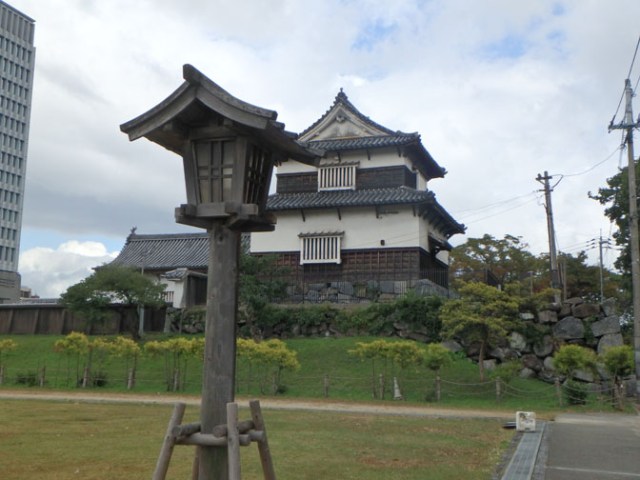
castle turret in Ohori Park

The lake had a cluster of swan boats and other little boats floating about, but it didn’t look like they were renting any out that day as nobody was using any of them. It may have been too windy for them to be used safely that day.

arch in the park

we found a handy arch to hide under and escape a torrential downpour

Fukuoka castle ruins sit fairly close to Ohori Park, but it started pouring down rain before we got through the park and this time the rain showed no sign of stopping so we didn’t go there. Instead we made our way back to the subway when we caught a brief break where the rain let up enough to emerge from the archway we hid under during the worst of the downpour. Since there is that one turret in the park we did at least see something from an old castle.

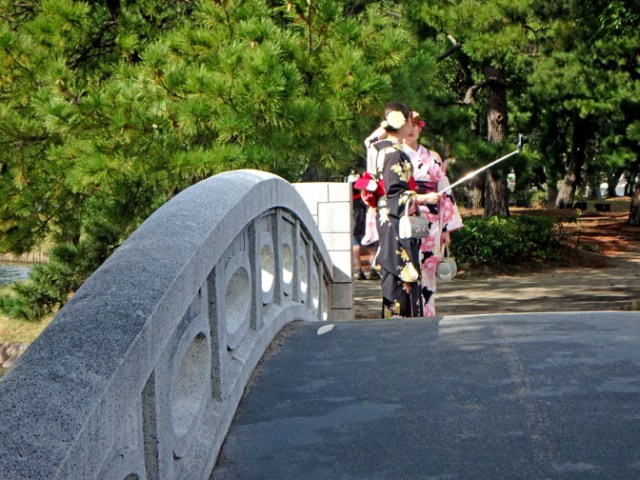
brides in Ohori Park, Japan

brides like to pose for pre-wedding photos in Ohori Park, in traditional or modern clothing

Overall Ohori Park is a pleasant place to spend a day, especially if the weather cooperates.

Copyright My Cruise Stories 2020
Posted in Holland America, Japan, Ports of Call, Westerdam | Tagged , , , , , , , , | 3 Comments

Exploring Zurich

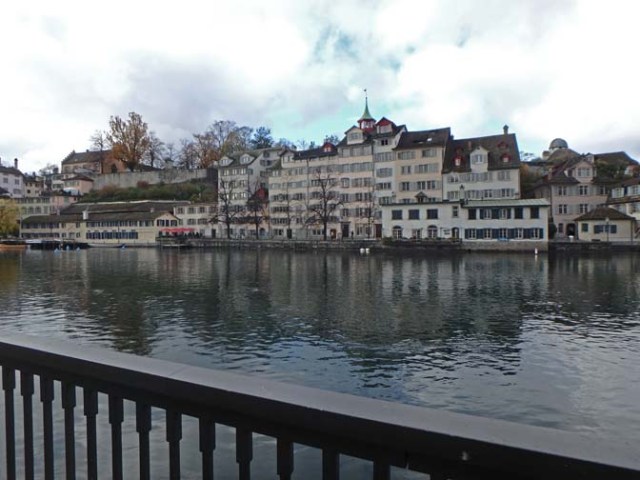
Zurich old town city view from riverside path

After our late arrival in Zurich due to our plane landing late at Heathrow resulting in a missed connection, we had just had one morning to explore Zurich before catching a train to Lucerne. Since we were staying in the old town area we just went out and walked around. First we went to the train station to store our luggage. The station was just across the street from the apartment where we’d spent the night and check-out time was in the morning and our train not until afternoon.

Zurich main train station

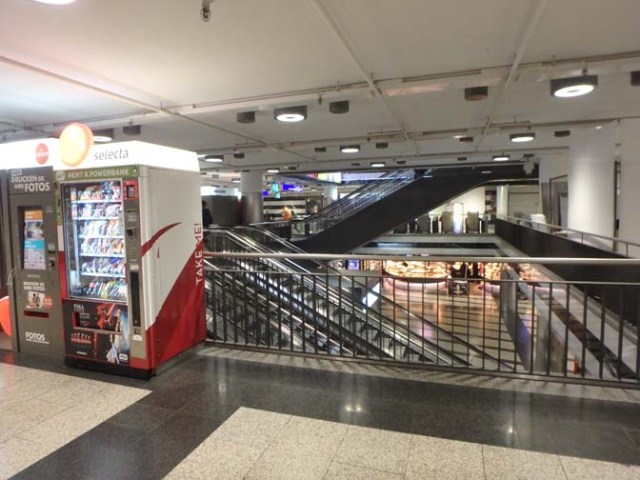
Zurich’s main station is a monstrous multi-level place with shops all over and numerous train platforms. It was much too early to see what platform our train would be on, but I did notice the trains to Lucerne were all on low-numbered platforms in the 6-8 range, which conveniently happened to be quite near the luggage storage locker area, just one level up. Restrooms are also near the luggage storage area, but you have to pay to go in so we never used them. The larger train stations all seemed to have pay restrooms, while the smaller restrooms at small stations were more likely to be free.

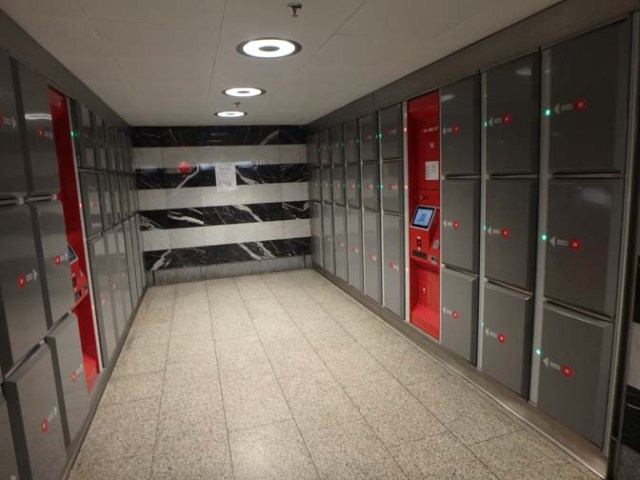
one of many luggage locker bays at the Zurich train station

My little carry-on size suitcase and backpack fit easily into one of their lower level large size lockers, but my husband had to work at getting his bigger bag in there, though it did work out in the end. You put stuff in a locker with a green light, then shut the door and it flashes red, at which time you pay on a nearby pad. You get a receipt and the light turns to solid red, locking your things in until you come back. Save the receipt because you need to  insert the end with a barcode into the slot they have on the pay pad for scanning it, which makes the door pop open. Very useful when checking out of your lodgings hours before leaving town when you don’t want to drag luggage around all day.

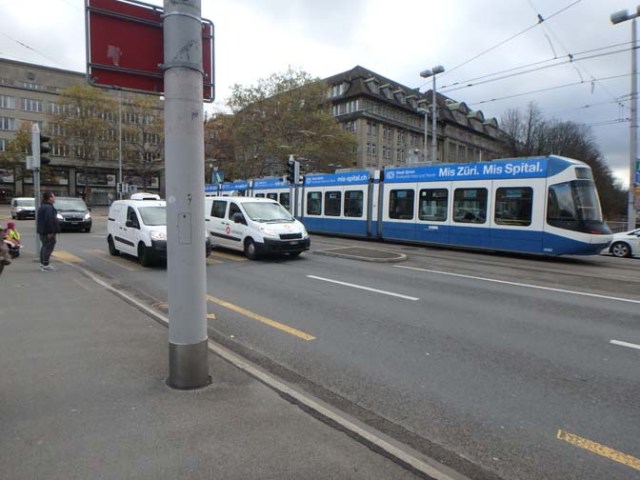
Zurich light rail

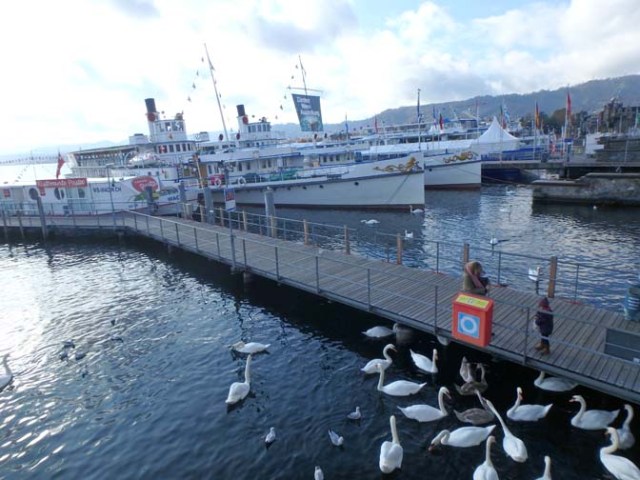
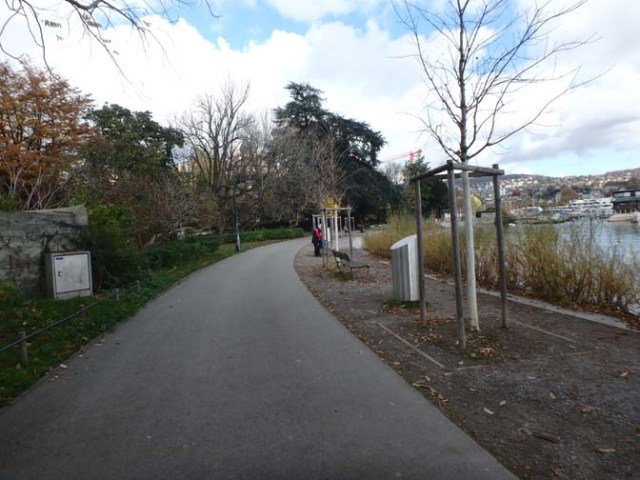
Zurich has a lot of public transportation. There were lots of light rail trains all over, as well as busses, taxis, and uber. We just walked along the river out one direction and back and then out the other way and back. There were trails all along the river and some parks. Lots of people were out for a run or pushing strollers or walking dogs. In the summer there are boat rides, but not in November when we were there.

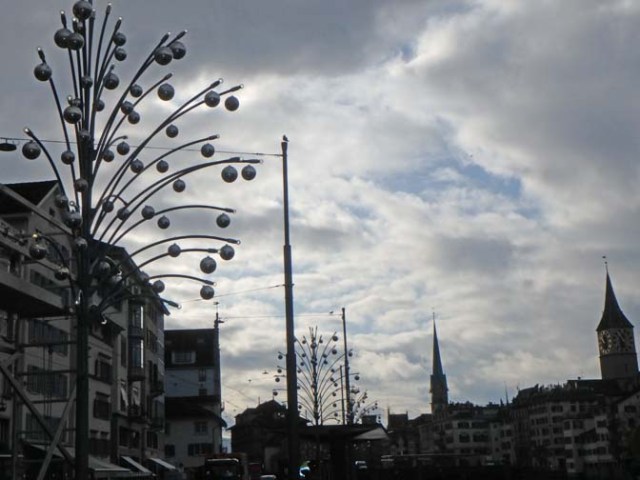
Christmas bobbles on light fixtures by the river

We saw people putting Christmas balls on light fixtures and some sort of carnival in the midst of being set-up. Where the river widened out into more lake size there was a pretty big marina. It started out with little boats on the end we got to first where the river hadn’t gotten as wide yet, then spread out to bigger boats as the river widened. There were a few ducks and a lot of swans.

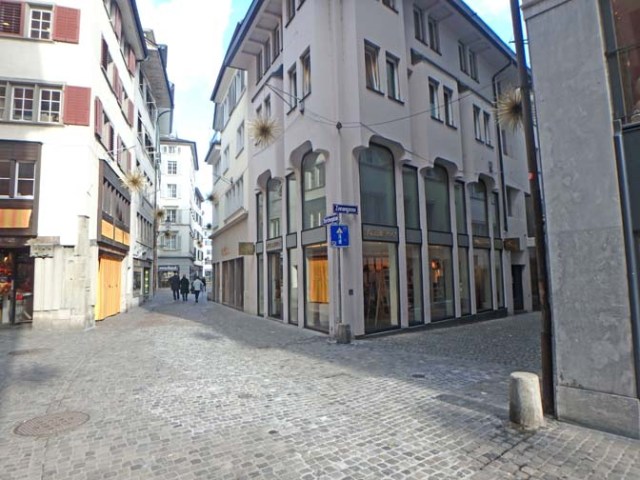
cobblestone streets in old town Zurich

The old town area has lots of interesting buildings. There are bell towers that all rang at 11am the day we were there. Old churches and cathedrals send spires skyward, and some buildings look like castles. The road is wide along the river, but if you go up a block into the old town there are narrow cobblestone streets and even narrower alleyways snaking their way between the buildings. Sometimes they open up into a sort of plaza or town square.

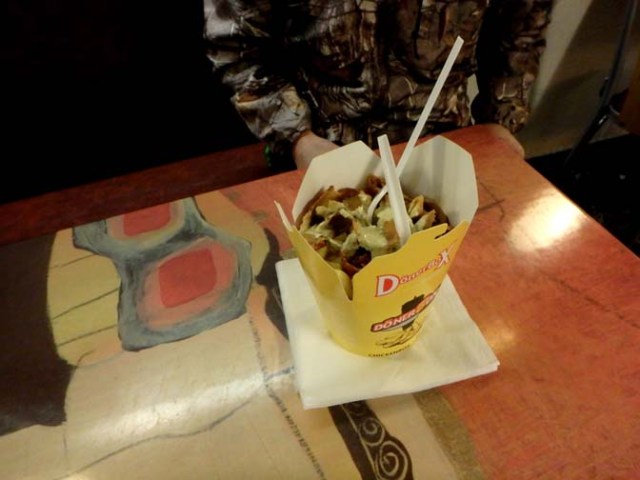
meal in a box

We stopped at a little shop for lunch that served something called a doner box, where they piled your meal into a box. Something we’ve never seen before, but we wanted to try something local and it was more affordable than most places around there. Meat choices were chicken or lamb, which was layered with French fries, a sauce of your choice, and a bit of lettuce, tomato, and onion if you wanted it. It was actually quite tasty, and made me wonder if the Canadian favorite poutine which I have never tried may not be as disgusting as it sounds. For anyone who has never heard of poutine, it consists of French fries topped with cheese curds and gravy in its most basic form, and may have other things like meat added. Food in Switzerland was very expensive. We could get two meals in Austria for about the same price as one meal in Switzerland so while we were there we mostly just ordered one thing and shared it. Luckily the portions were usually fairly generous.

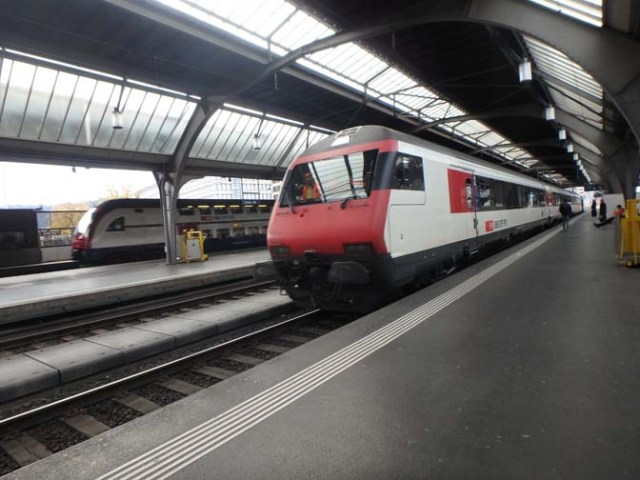
short train

We got back to the train station early enough to wander around a bit, though probably only saw a fraction of it as it seemed to go on forever in multiple directions. When the reader board said our train was coming on platform 6 we retrieved our luggage and went out to wait for it. A little short train arrived soon after. Nobody came out to say anything or take tickets, or even open doors, which did not open on their own. People just had to walk up to a carriage and open the door themselves to get inside. Our ticket said we could sit anywhere that was not reserved or first class and not seeing anything that looked like either we just picked some seats and sat down.

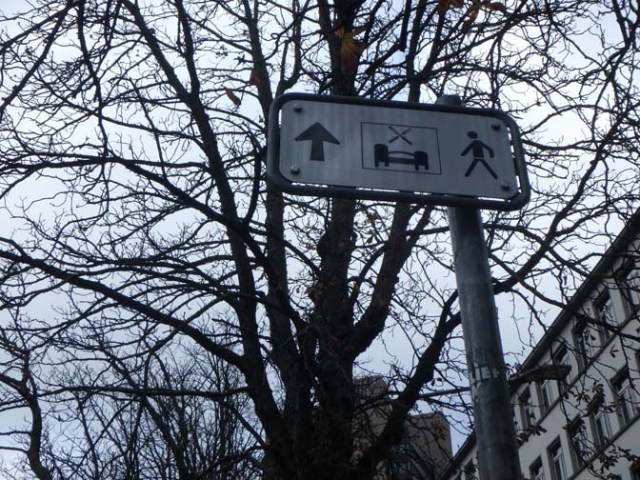
apparently sleeping is not allowed in the park in Zurich

Most of the trains we took had luggage racks above the seats that would hold our backpacks and small suitcases like mine, but only a couple of the longer distance trains had luggage racks big enough for John’s large suitcase. He has said since he would pack lighter if we were to travel around by train like that again. Even though we were visiting cold places pre-cruise and warm ones during the cruise I packed light and did laundry by hand along the way because I did not want to drag a big bag around on the trains.

marina in Zurich

After stopping at a couple little stations the train slowed down when there was a much longer one ahead of it on the track. It caught up and hooked into that train so we became the tail end of a long train instead of a little short train. The ride from Zurich to Lucerne was 50 minutes with a number of brief stops, but no need to get off or change trains. Lucerne was the end of the line for our small section of the train and everyone had to get off, but walking past the larger section, which had upper and lower levels in each car where ours had only one, we could see people sitting in there so they either didn’t have to get off or had gotten on very quickly. Perhaps the longer bit of the train ditched our small one there and the rest of it continued on to someplace else.

riverside trail in Zurich

Copyright My Cruise Stories 2020
Posted in Europe | Tagged , , , , | Leave a comment

Jenolan Caves

Jenolan Cave

Jenolan Caves

Deep into Australia’s Blue Mountains lies the extensive and impressive Jenolan Caves. These spectacular caves are well worth a tour. Visitors to Sydney without their own cars can get to the caves by taking a train to the mountain town of Katoomba and a bus tour to the caves from there. Katoomba itself is a touristy town with the Three Sisters rock formation as the best known sight there. Nearby Scenic World makes a great place to visit with the world’s steepest railway and a couple scenic rides.

Katoomba Hotel

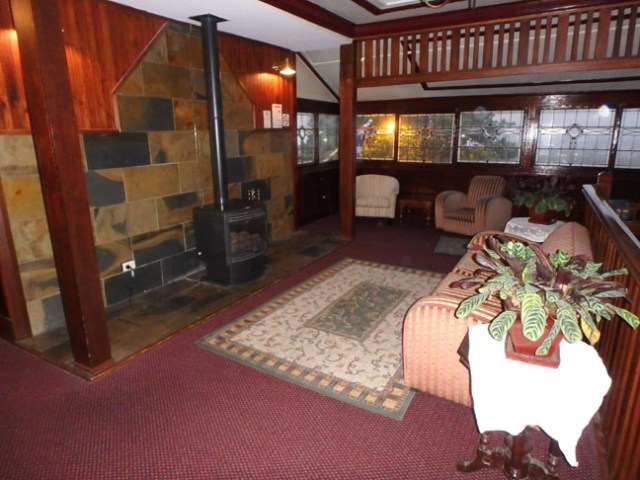
one of the sitting rooms at the Metropole Hotel in Katoomba

Katoomba has hotels for those wishing to overnight in the area. The historic Metropole, Katoomba’s oldest hotel, sits just across the street from the train station. Besides reasonably priced spacious lodgings this quirky hotel has little sitting room areas, a library, and a game room. Some meals are available for an extra charge. Katoomba has other hotels and resorts and lodging is also available in a hotel and other accommodations at the caves. There’s also the option of a day trip on a bus tour straight from Sydney.

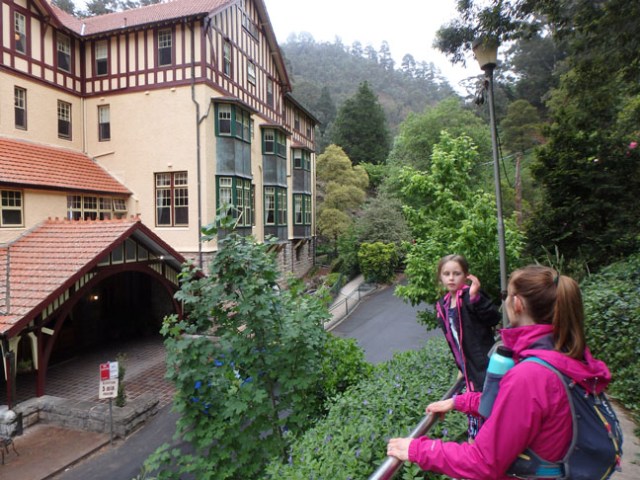
hotel at Jenolan Caves

Caves House Hotel at Jenolan Caves

The Caves House Hotel has a restaurant and café. At lunchtime they also have some outdoor food stands. The caves are in a large nature reserve and some areas around the cave have picnic facilities for people who bring their own food. There are outdoor tables by the food stands. There are also some bushwalking trails for anyone who likes to hike or needs something to do while waiting for their cave tour besides looking through a couple small gift shops.

bird in Australia

a little bird waited for crumbs left behind by diners at the outdoor tables

Cave tours can be booked online or by phone in advance, or on the spot at the ticket office near the caves. I’d recommend booking ahead to insure space is available on the tour of your choice, or on a busy day in any tour at all. We went on an off-day without prior reservations and found just one cave with any tour openings at the time we were there. We would have had to wait at least several hours for openings on any other tour.

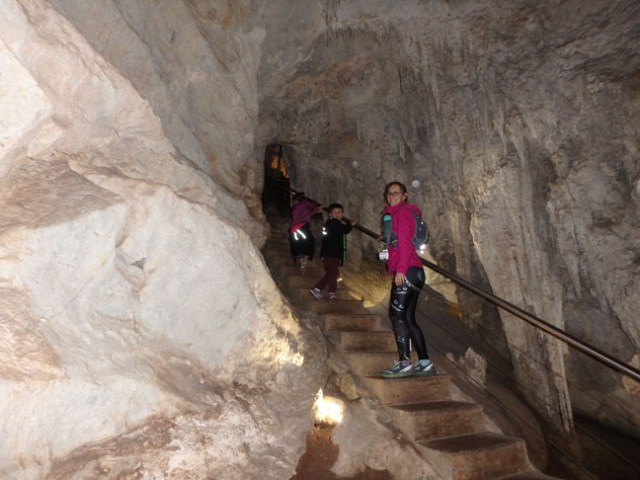
stairway in a cave

there’s a lot of stairways in Lucas Cave

Cave tours vary from the easiest caves with no age limit to some that require a bit more effort to get through with minimum ages of 6 or 10. For more adventurous sorts they do have adventure tours that require some actual caving through small openings and things. These have higher minimum age limits as well as higher prices. The show cave tours are all on pathways, some with many stairways going up and down throughout the cave.

Jenolan Caves

drive through cave and tour meeting spot

We toured Lucas Cave. The tour started at a set time by meeting the tour guide at the foot of a stairway on one side of the drive-through cave we passed through while entering into the caves area. Parking was on the other side of the hotel and other buildings where there is another road leading to the caves. They put the road on a one-way loop shortly after we arrived, which meant leaving by the other road for a longer drive back to our hotel in Katoomba.

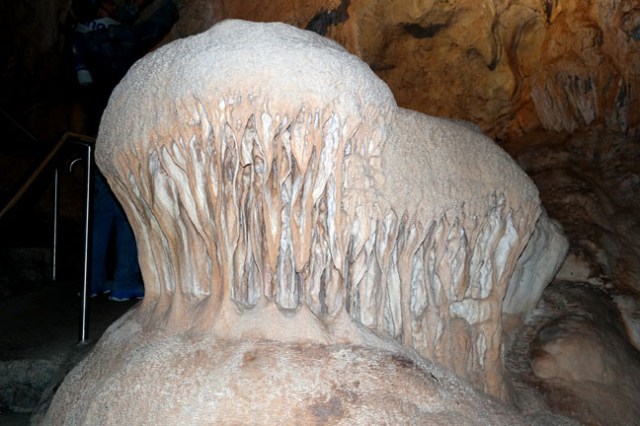
cave rocks

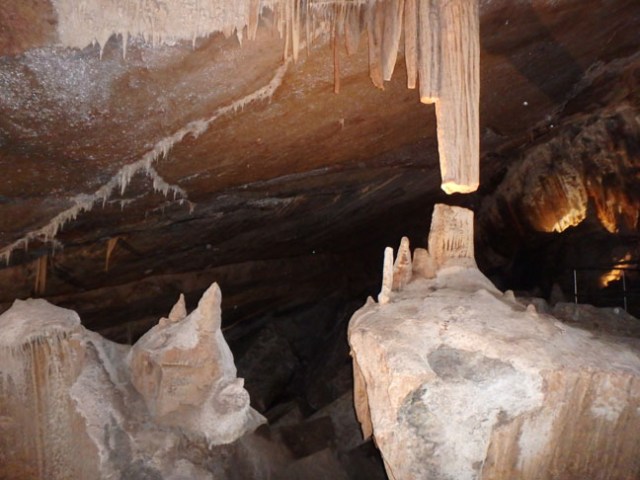
rock formation in Lucas Cave

The group on this tour was pretty large, probably the only reason it still had tickets available since it is a beautiful cave. Throughout the tour the guide stopped in various wide open spaces to talk about history of the cave and formations in that area. Between the wider openings pathways that were sometimes quite narrow snaked up, down, and around the cave, often up or down stairs. Lucas Cave has over 900 total stairs.

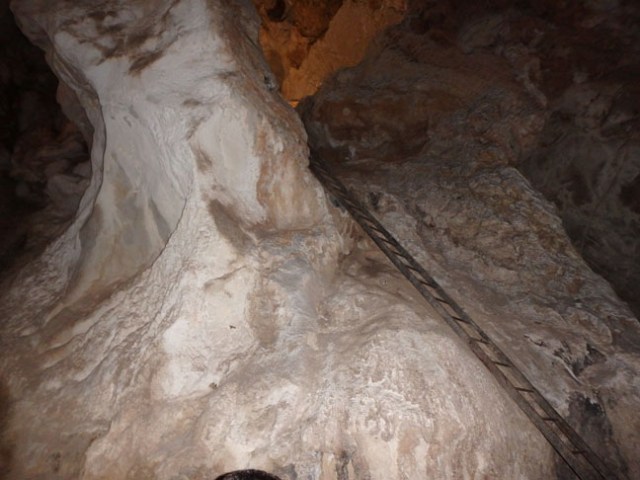
cave ladder

one small portion of a very tall spindly ladder

People sometimes have weddings in one chamber of the cave. Some places have old ladders, once used for traversing through the cave, but now used only to change light bulbs. Without the cave’s lighting system visitors would find themselves in complete darkness.

underground river

the water is a long way down from the bridge-path on the cave tour

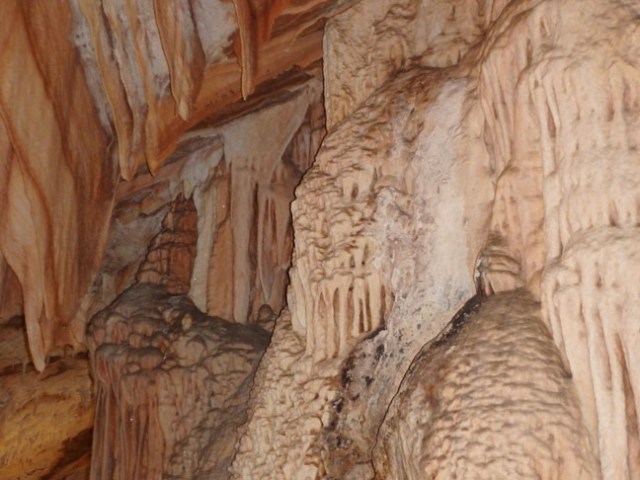
From the walkway in one place we could see far below to the river that had once dug its way through rock, hollowing it out into the system of caves. Later rainwater seeping through formed the stalactites and stalagmites. If you’re not sure which is which just remember that stalactites hold tightly to the ceiling.

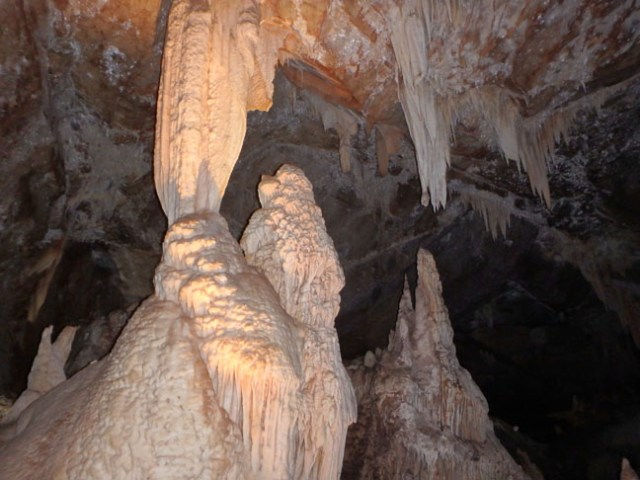
inside a cave

stalactites and stalagmites

As water drips through the stone the minerals within form into icicle-like pinnacles hanging from the ceiling. Drips off these stalactites land on the ground below piling up into stalagmites. Eventually as both continue to grow they join together and form a column.

broken column

broken column

One of Lucas Cave’s most famous features is the broken column, split by water flowing through the cave and now appearing offset as if by shifts in the planet’s surface.

cave snow

cave rock sparkling like snow

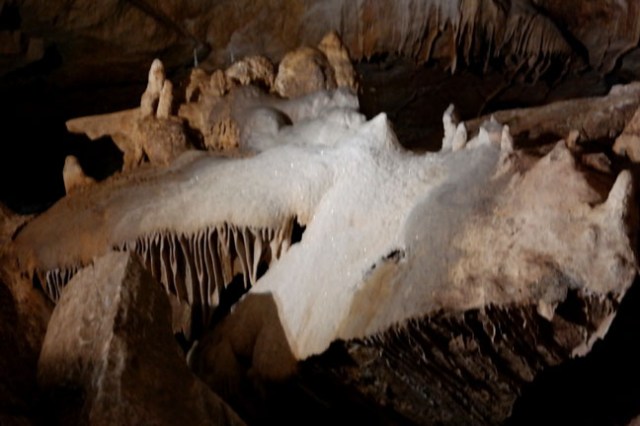
Some areas of the cave sparkle with the frosty appearance of newfallen snow, a look they obtain from the moisture of rain. Other areas have a thinner wet layer. All it needs is a bit of rain to sparkle for a year or so, but if it stays dry too long it loses the shine and looks more like a place where sealife once lived long ago. In fact actual sealife did live there long ago, but as the waters receded all they left behind were some fossils.

cave rock

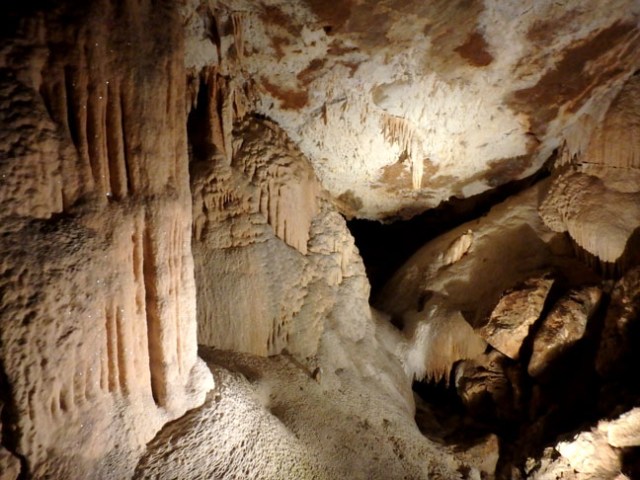
everything throughout the cave is similar yet different

Cave exploration decades ago was quite different than today’s tours. In one place that now has stairs they showed a smoothly worn area where people once slid down to the next level. Probably more fun than walking down stairs, but no longer allowed. In another place they called a flat-topped rock Picnic Rock and said people used to have picnics on it. They also had a tendency to break off small stalactites thinking they would take them home as souvenirs, but often dropping them somewhere else in the cave. Even with the current rules, pathways, and boundaries in place vandalism isn’t completely prevented. One chamber had graffiti spray painted nowhere near the path. It’s so sad that some people have no respect for our planet or the wonders it provides.

cave in colored lights

very unnatural cave lighting

In a couple places colored lights shone on some of the cave formations when the guide turned them on, but they look best in their natural color. The colored part near the end of the tour was above some sort of small animal skeleton lying on the rock.

cave view

the pathway in and out of the cave has a narrow ledge with a great view

Tours range from 1-2 hours in the show caves. Most tours pass through just one cave, but a couple of them include two. The way into and out of Lucas cave passed along a narrow ledge with a great view. One person tried to take a photo, but dropped the phone she was holding over the fence. The guide said she’d have to wait until the tour was over and talk to someone at the office because it wasn’t his job to climb the fence to try and get it back. Because it’s not worth risking his life over a cell phone, and of course visitors to the cave are not allowed on the other side of the fence so she could not try and get it herself even if she wanted to.

cave rock formations

although it flows too slowly to see motion shows in the formations

The road down to the caves is a bit narrow which is why traffic is limited to one direction during the peak of the day. It’s well worth the trip even if you just tour one of the many available caves.

Lucas Cave

rock formations in Lucas Cave

Copyright My Cruise Stories 2020
Posted in Australia, Explorer of the Seas, Port City Side Trips, Royal Caribbean | Tagged , , , , , , | 10 Comments
Touring San Francisco

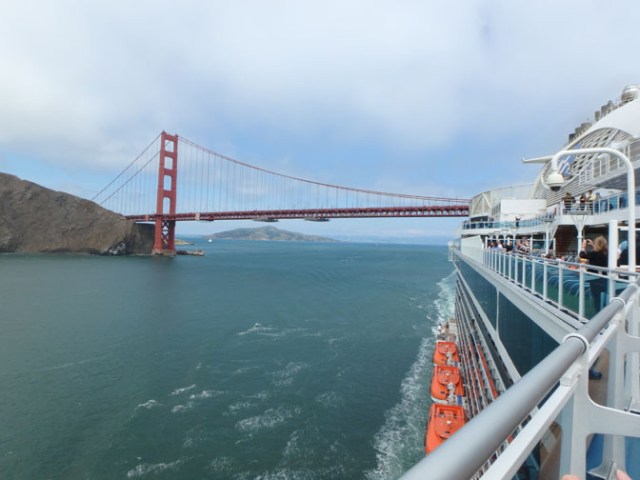
sailing in and out of San Francisco means crossing under the Golden Gate Bridge

After the Royal Princess docked in San Francisco, my sisters and I went out to the pier to meet with our cousin and her friend who live in the area. We hadn’t seen our cousin for quite some time so it was nice to have a chance to visit with her. They took us around to see the sights for the day. Our cousin’s friend is quite knowledgeable about the area and its history.

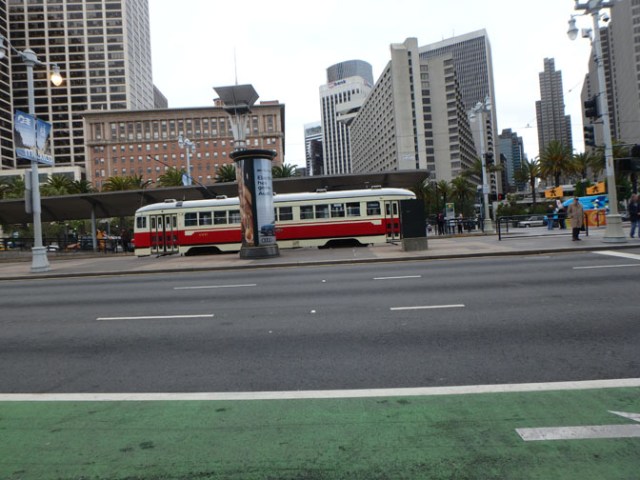
one of San Francisco’s historic streetcars

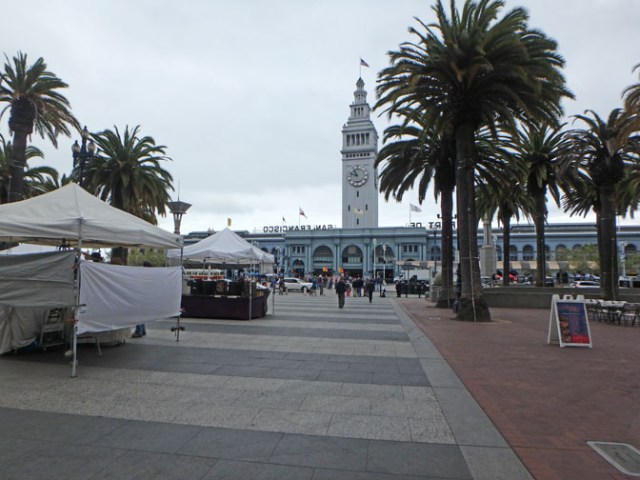
First we took a streetcar down to the ferry pier, which used to be a major means of transportation, but now is more of a mall with lots of shops and a greatly reduced ferry schedule, though it does still have ferries. Streetcars run along the waterfront and though they are a historic means of travel, they are not the same thing as San Francisco’s famous cable cars. The city has a collection of vintage streetcars from around the world. The fare is pretty cheap and it was fun to get a chance to ride on a piece of history. Streetcars run on rails and are powered by an onboard electric motor and have trolley poles attached to the roof to obtain power from an overhead wire.

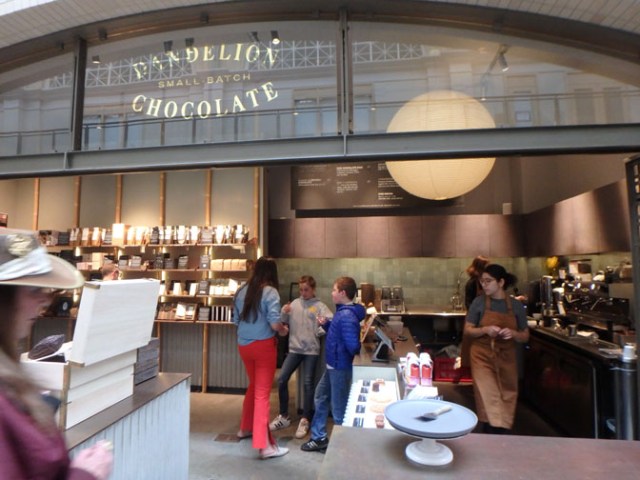
shop in the ferry terminal building

There are some interesting shops at the ferry pier, and it had public restrooms which we were told can be hard to find in San Francisco.

ferry terminal building and little booths across the street

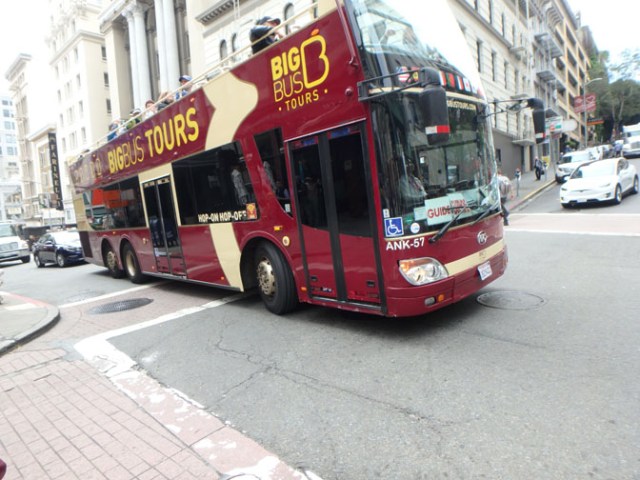
From there we walked a short distance past some little tent booths with things for sale on to a bus stop were we waited for the Big Bus tour, which is similar to the Hop on Hop Off bus, but the busses are bigger. City busses also use that bus stop.

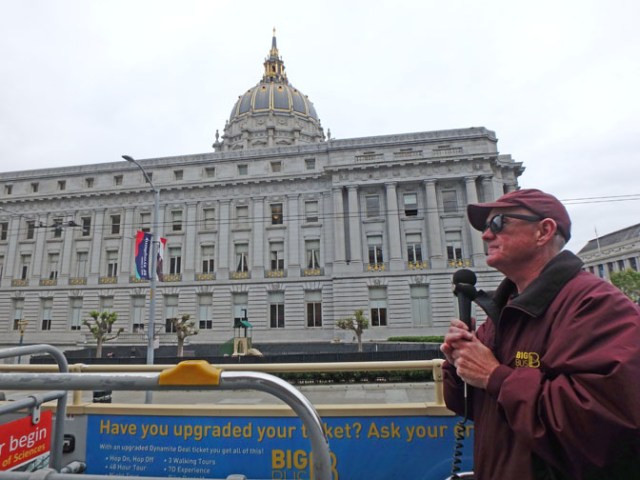
sightseeing on the big bus tour

While we waited a middle-eastern looking man came over to the bus stop and started yelling at us that blondes are stupid in some sort of lame attempt to start a fight or in his mind put a group of women in their place or something. We weren’t sure if he was high on some sort of drugs or just an extremely obnoxious person. We didn’t rise to his bait, though it was tempting to say something like stupid is as stupid does and we’re not the ones insulting strangers. I’ve been to a few countries in the middle east, and none of the people we saw there acted that way.

big bus double decker bus

We moved a bit, but he came back and started yelling the same thing again, insistant on harassing us until my cousin took out her phone and threatened to call the police. Then he left. In all my travels around the world I’ve never ran into anyone like that before. Other than pickpockets and thieves most of the people we’ve come across are generally either friendly and helpful or just ignore everyone they’re not with. Occasionally we’ve come across someone loud, rude, or pushy, but never before been intentionally harassed.

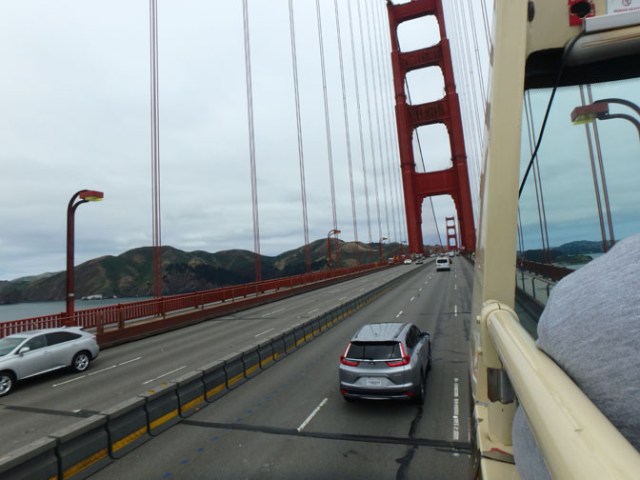
riding a tour bus across the Golden Gate Bridge

The bus came and in spite of it being cold and windy, which it often is in San Francisco, we went upstairs and sat in the open top section. We stayed on the bus for quite awhile seeing the sights around town and going over the Golden Gate Bride. So we went both under and over the bridge in the same day.

gateway into Chinatown

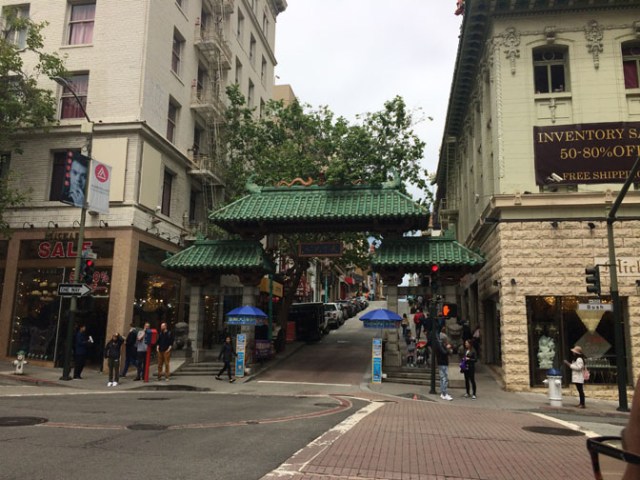
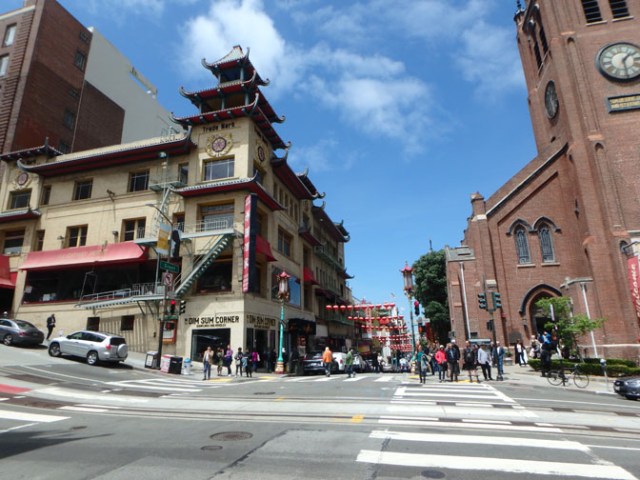
We got off the bus in China Town by the China Gate. The driver said San Franciso has 3 China Towns. Wikipedia says there are 4. This one had shops selling jade, giant statues, fancy carvings, intricate tables, and huge geodes just the other side of the gate. All manner of shops selling everything from cheesy souveniers to food, jewelry, and clothing followed. Down the road pagoda style towers on top a couple buildings and strings of Chinese lanterns gave the area a real Chinatown look. The very Chinese looking lamp posts added to the effect.

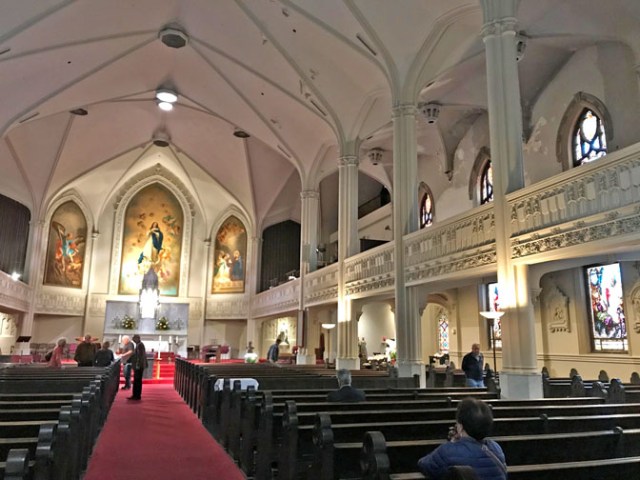
inside a beautiful, but definitely not Chinese church in Chinatown

We wandered through an old church in China town, which had a very beautiful interior and lots of gorgeous stained glass windows as old churches tend to do.

building with a pagoda on top across the street from the old church in Chinatown

We had lunch at a small Chinese restaurant with good food. My sister wanted to see Lombard Street and I wanted to ride a cable car. The bus driver had mentioned taking one from Union Square to the top of Lombard, which seemed like a good idea since we could cover both those things that way. My cousin called for a Lyft ride, but her app was out of date and she couldn’t specify the size of car. The one that showed up was too small for everyone so I called an Uber instead.

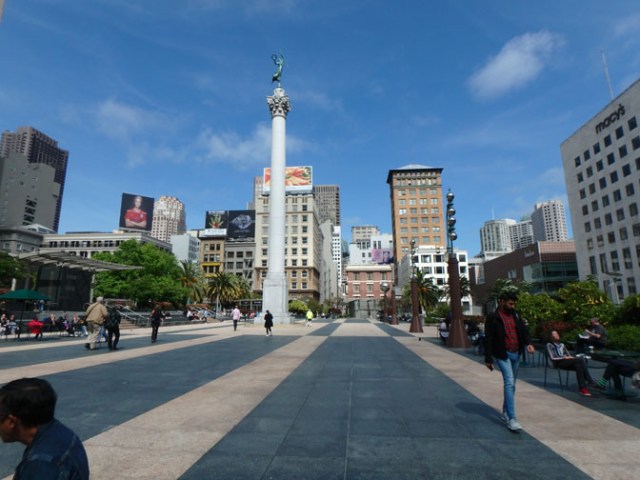
Union Square

It dropped us off in Union Square. There were repairs or issues of some sort with the cable cars in that location that day and they were only running farther up the track. A free shuttle bus picked people up at the cable car stop and went to the first station where we could catch the cable car.

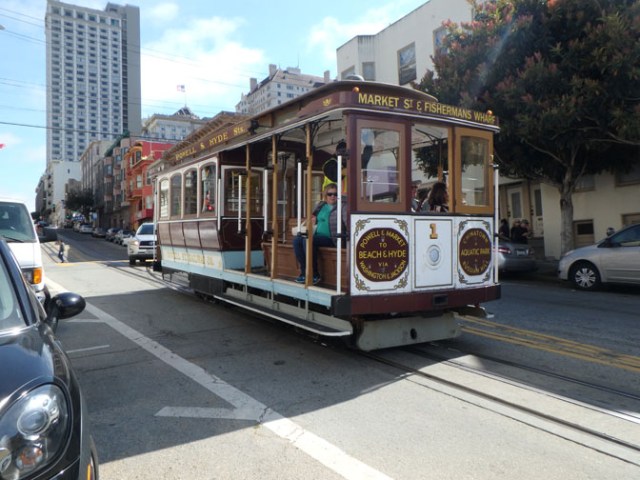
historic cable car in San Francisco

San Francisco’s historic cable cars are the last manually operated cable cars in the world and are a national historic landmark listed on the national register of historic places. The cable car was smaller than the streetcar we rode earlier. There is no engine or motor on the cable cars themselves. They are powered by electric motors that pull cables running through a trench beneath the street in a slot between the rails. These were originally steam-powered. The cables move at a constant 9.5 miles per hour. The cable car conductor (called a gripman) uses a lever when they need to manually make the cable car’s gripper grasp or release the cable. They need to grasp the cable to make the car go and release it in order to be able to stop. Foot pedals control the brakes.

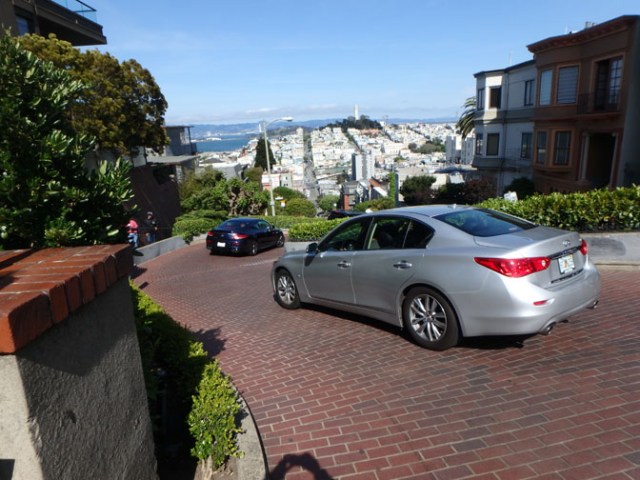
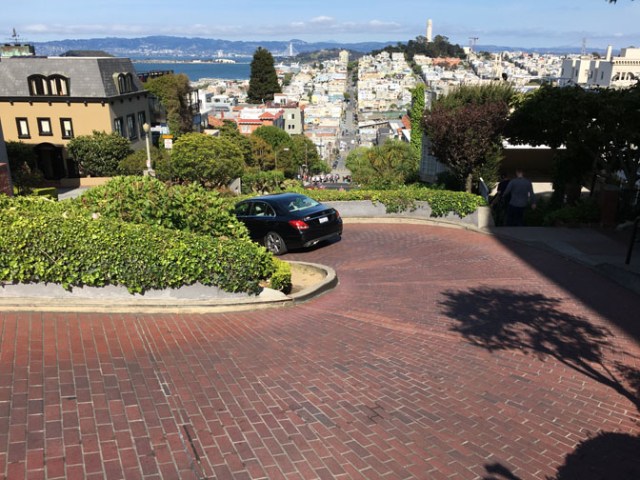
Lombard Street

We rode the cable car up and down some hills until it reached the top of Lombard Street where we got out. Lombard Street is famous for the winding section of switchbacks on a steep hill. On the way the conductor explained that the reason for the crooked street was that back when it was built the brakes in the model T cars people drove at that time couldn’t handle a straight road that steep.

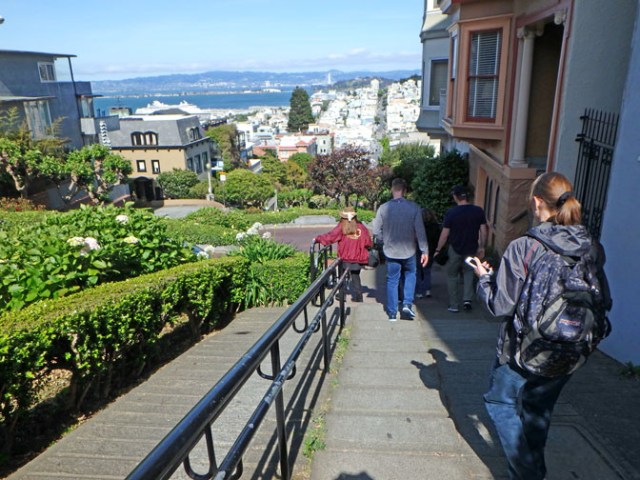
stairway for pedestrians on Lombard Street

The road snaked back and forth down the hill so the old cars back in model T days would be able to stop. It’s a narrow road and down is the only direction cars are currently allowed to take. There is a sidewalk with a series of stairways for foot traffic. There’s also a sign proclaiming it to be the world’s crookedest street.

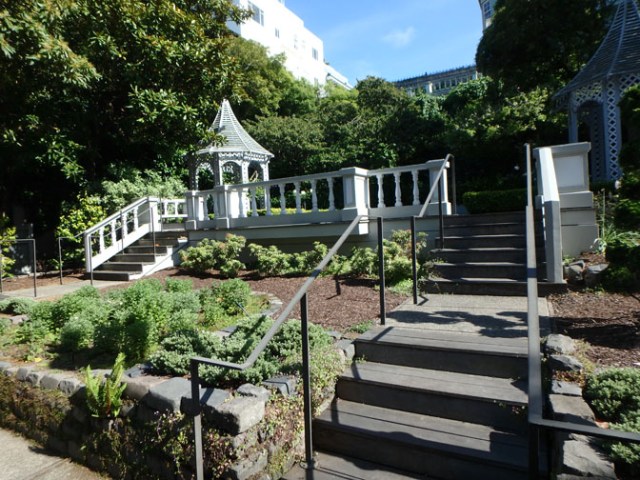
Fay Park

From there we walked down to Fisherman’s Wharf. On the way down we came across a little garden that looked like it belonged to a house, but had a gate to the sidewalk with a sign that called it Fay Park and stated hours that it was open to the public. One of my sisters had wanted to go to some sort of park or garden so we took the opportunity to go to this one. Though quite small it had some pathways and benches and lovely flowers. It looked like someone put quite a lot of time and care into creating and tending it. It was originally private property that was professionally landscaped. It was renovated by the city after it was given to them.

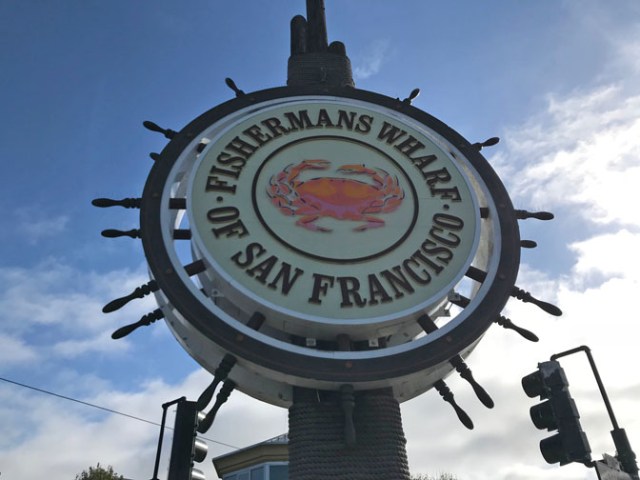
Fisherman’s Wharf sign

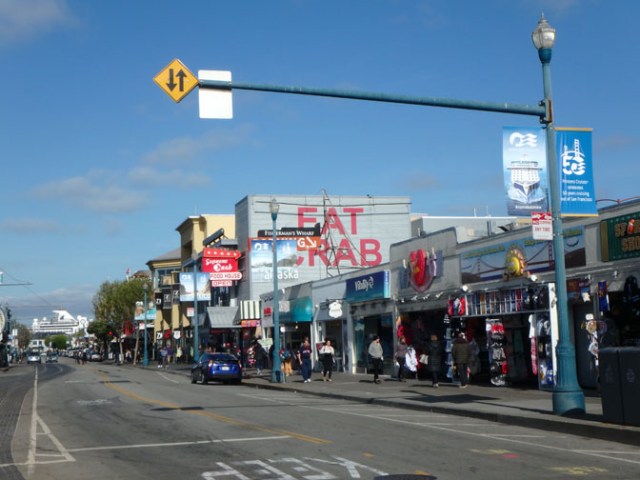
Once we got to Fisherman’s Wharf we did a bit of shopping before stopping for a snack of real San Francisco sourdough bread at Boudin Bakery, the home of the original loaf and holder of the mother sourdough starter. The fermentation process breaks down some of the gluten so some people with mild gluten sensitivities can tolerate sourdough bread even if they can’t eat regular wheat bread. Celiacs and those with gluten allergies or strong sensitivities still have issues with it though, especially since most commercial sourdough breads are higher in gluten than the old-fashioned variety.

Fisherman’s Wharf

We had intended to go to the part of the wharf where the sea lions hang out, but ran out of time to do that before our dinner reservation. While it would have been fun to see them, we have all seen sea lions before.

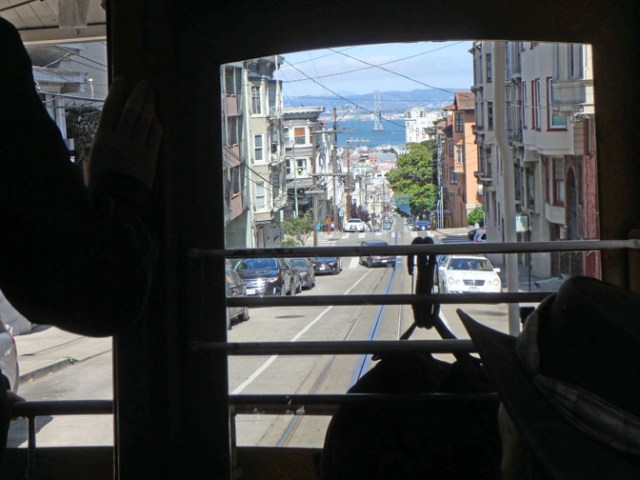
view out the back of the cable car

Another uber ride took us to a restaurant called Firefly, who’s nearly all gluten free menu gave us lots of choices of what to eat for dinner. We rarely eat on shore since we can have good food on the ship without the added cost, but since we were hanging with a cousin we rarely see we did it this time. Her daughter whom two of us hadn’t seen since she was a child also lives in the area and joined us for dinner so it was nice to have a chance to visit with her too. It’s amazing how fast a day goes by. Luckily we had no all-aboard time as the ship overnighted in San Francisco, but it got pretty late by the time we finished dinner so they all went home and we caught an Uber back to the ship.

Lombard Street

Copyright My Cruise Stories 2019
Posted in Port Cities, Port City Side Trips, Princess, Royal Princess, USA | Tagged , , , , , , , | 9 Comments