Gluten Free Molasses Cookies

molasses cookies

These gluten free molasses cookies taste just like the old fashioned molasses cookies I remember my mother making when I was a child even though most of the ingredients in this recipe of my own invention aren’t the same – and this one’s a whole lot easier to make.

INGREDIENTS

12 oz jar almond butter (1 cup)

1/2 cup molasses

1/2 cup brown sugar

2 Tablespoons cooking oil of choice (I used avacado/sunflower)

1 egg

2 teaspoons vanilla

1 cup millet flour

1/2 cup tapioca flour

1/4 cup almond flour

1 teaspoon baking soda

1 teaspoon baking powder

1 teaspoon cloves

2 teaspoons ginger

2 teaspoons cinammon

1/2 teaspoon allspice

DIRECTIONS

Stir all ingredients together in a mixing bowl until thoroughly blended. Roll each cookie into a ball and dip in sugar of choice (I use raw cane sugar or coconut sugar). Place sugar side up on cookie sheet lined with parchment paper, making sure cookie balls are well spaced. Bake at 350 degrees F for 13-15 minutes.

Copyright My Cruise Stories 2021

Posted in recipes | Tagged , , , , , | Leave a comment

3 Island Tour in Venice

Burano Island

We spent three days in Venice prior to boarding the MSC Lirica. We had enough time to wander around and see things, and to take a gondola ride. On our last full day in Venice we booked a 3 island tour through a local company called Alilaguna, which runs both public transport boats that use the vaporetto stops and booked tours that go to specific places with one group of people for the entire tour. Vaporetti are the Venice version of city busses, with stops along the grand canal and in some other places. The name means little steamer, coming from earlier steam powered versions of the public boats.

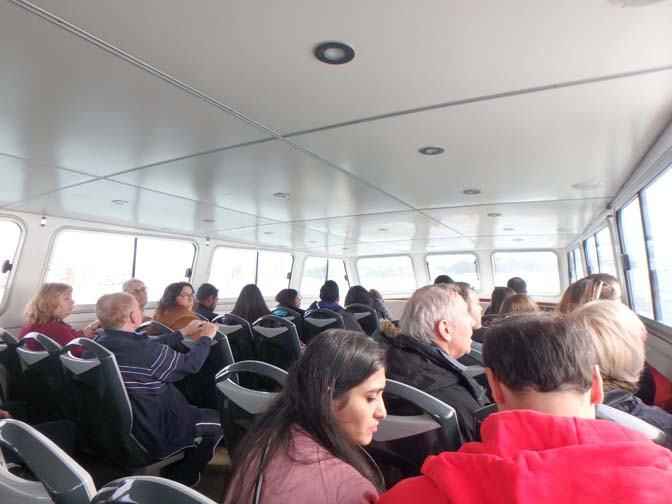
inside the Alilaguna tour boat

There’s more to Venice than just the main group of small islands connected by many bridges and Venice Mestre on the mainland which is connected to Venice proper by the bridge of Liberty. Within the lagoon where the main part of Venice sits there are numerous other more distant islands not connected by bridges to the main area of Venice. A long thin island called Lido where people go in the summer for its beaches may be the inspiration for the name Lido deck on many cruise ships, which is always the one with the pools. Many ships are built in Italy after all. While the lagoon looks like a wide open waterway, it is dotted with shallow areas where boats could easily run aground so the channels deep enough for safe travel are marked with rows of pilings like roads running through the sea. Knowing where the safe navigation areas were long before they were marked was what made Venice a safe haven for its early inhabitants as they could pass through, but even if would-be invaders had boats they could not.

waterfront by St. Mark’s Square

Besides many stops along the grand canal, the vaporetto public boats go out to some of the other islands. You can also get there by private boats or on a tour. Our 3 island tour with Alilaguna cost just 20 euros and lasted several hours with time to spend on each of the islands as well as traveling between them. The tour started from a far end of Piazza San Marco. There are boat docks all along the edge of the square for all sorts of different boats. Both Alilaguna and the vaporetti have docks in two different places at San Marco so we had to find the right one. It pays to get there early so you have time to find exactly where you need to be. The directions from the website where we booked the tour sent us to the wrong Alilaguna dock, but luckily one of their employees on a boat that came in there spoke English and was able to tell us where we needed to be.

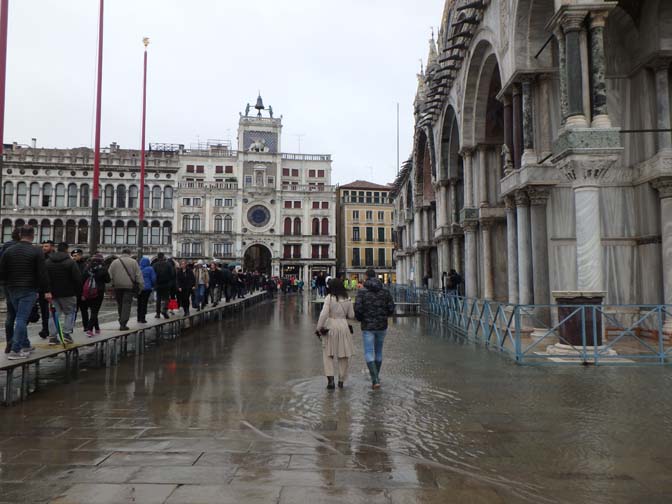
raised walkways by Doge’s Palace in St Mark’s Square

The first time we went to Piazza San Marco (Saint Mark’s Square) it still had a lot of water remaining from a recent flood, enough that portable raised walkways were needed in parts of the square. The day we went for our boat tour the square was dry.

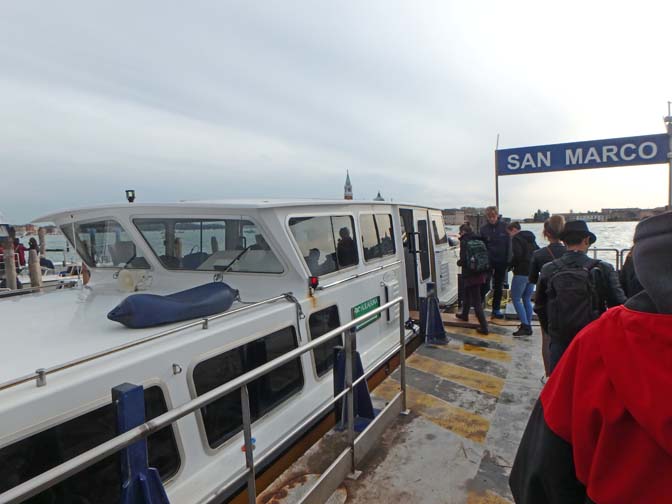
boarding the Alilaguna boat

Once we found the right dock we had a short wait to board. There weren’t many people waiting when we first got there, but the crowd grew quickly so we got on the boat along with a bunch of other people. The boats don’t look all that big, but they hold a lot of people. The one we went on had quite a few empty seats left after a everyone boarded even though looking at the boat and crowd from the outside it seemed like there were more people there than could fit inside. Our first stop was Murano, an island famous for its glass. Apparently the glass blowers were all moved out there centuries ago to keep their skills secret so nobody else could rival their glass art, which is quite skillful.

Murano Island glass blower

We went directly into a factory for a glass blowing demonstration. The artist had a long pole with a heated ball of glass on the end that he pulled and cut until it turned into a glass horse, but he never actually blew into the pole. It only took him a few minutes to turn a ball of molten glass into a little horse.

walkway on Murano Island

The glass factory had a shop that had all sorts of different glass figurines as well as jewelry. We had a bit of time to wander down the row of shops near to the factory, which also sold items made of glass. You would think prices would be cheapest at or near the factory, but we found a little shop on the rialto bridge that had some of the same things at about a third of the price.

canal on Murano Island

Most places in Venice you have to pay to use a public toilet, but the glass factory had restrooms available for free. It was the only stop on this tour that did, the other two islands just having the pay-to-go WC (water closets).

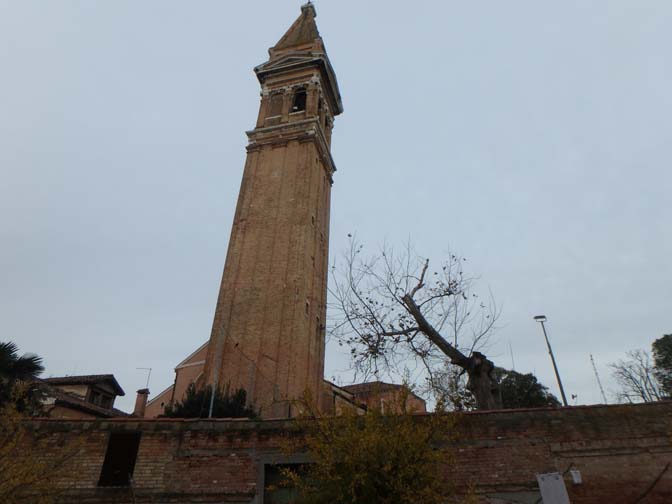
leaning tower on Burano Island

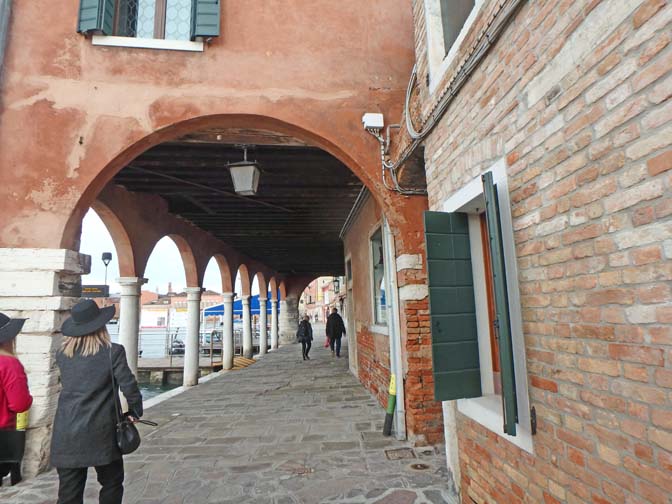
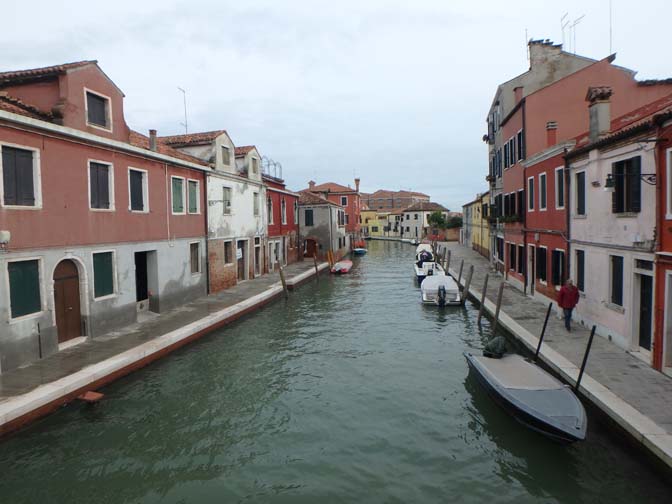
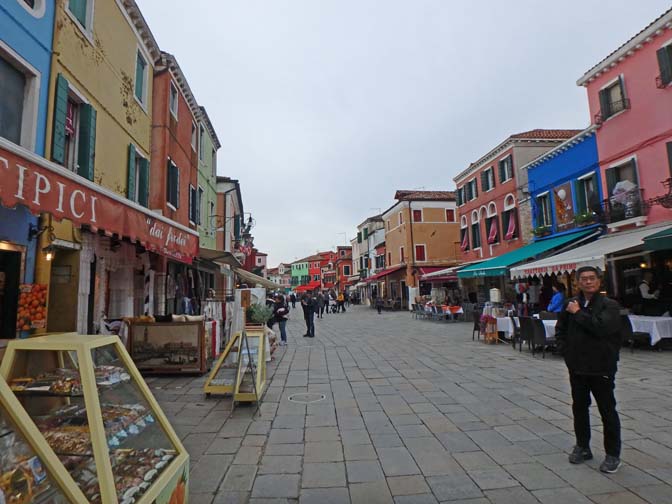
The next island on our stop was Burano, famous for fishermen, colorful houses, and hand-made lace. This island was smaller and less populated than Murano, but the town was very cute with a canal lined with little fishing boats running alongside all the brightly colored buildings through the center of town, and little wooden bridges crossing over it. There was also a church with a leaning tower. Not nearly so big, tall, or angled as the famous tower in Pisa, but leaning nonetheless.

Burano Island

Since we were not spending time watching a demonstration on Burano we had more time to wander about and look at things. It was hard to get a picture that captured the lean of the church tower though.

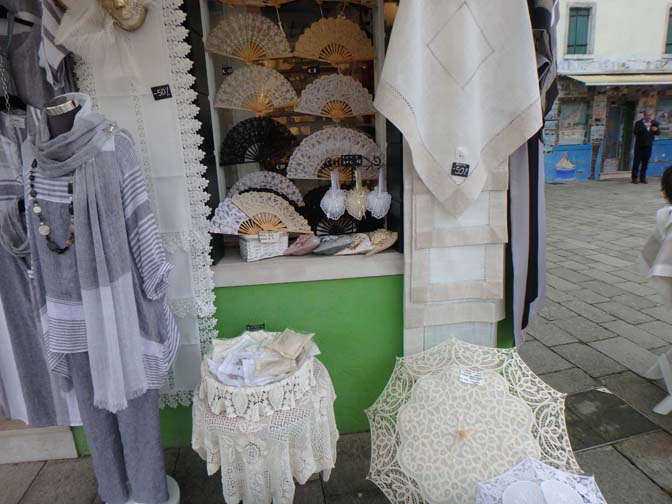
lacey things in a shop on Burano Island

A lot Burano’s shops had intricately made lace items ranging from small decorations to clothing or tablecloths, and anything in between that could possibly be made out of lace. There were also restaurants and cafes, and places selling Murano glass.

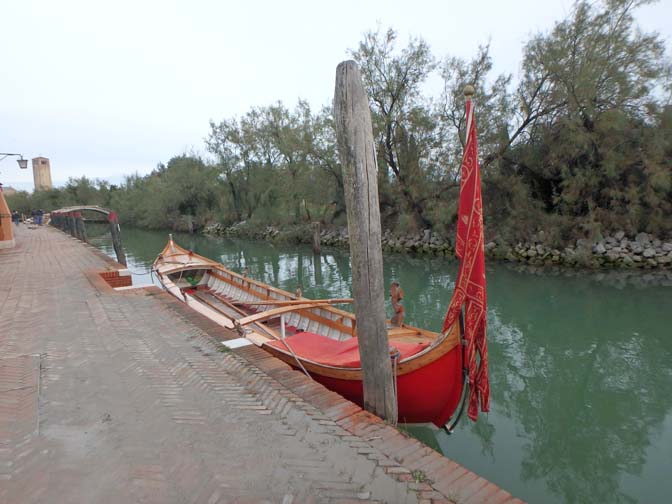
It’s a bit of a walk from the dock to anything on Torcello Island

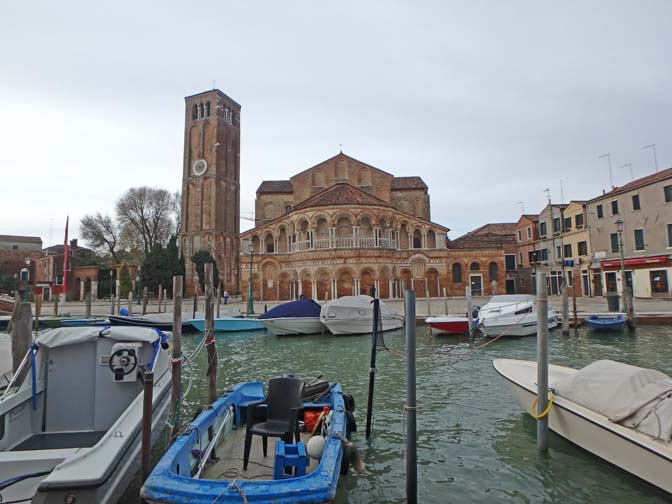
The islands got smaller as we went. Our last stop on Torcello was the smallest and most sparsely populated of all. It had been an important religious area up until about the 14th century or so. That island’s claim to fame is the oldest church in Venice, built in the 7th century. It had a group of several ancient churches at the end of the walkway from the dock. It was probably somewhere around a kilometer from where the boat docked to anything, but it was quite a scenic walk along a canal.

there’s a few little shops and eateries along the walkway

Torcello is the farthest inhabited island from the main part of Venice, though it is barely inhabited with only about 10 permanent residents. Centuries ago there were thousands.

old church

Walking in on a brick walkway from the dock on Torcello we passed by more greenery than we’d seen since coming to Venice, though the boat guide pointed out a different island in passing as being the one where most of their produce came from. Torcello had a few small shops and restaurants, and even a couple small hotels. It was a bit of a walk alongside (of course) a canal from the boat stop to the churches.

older church

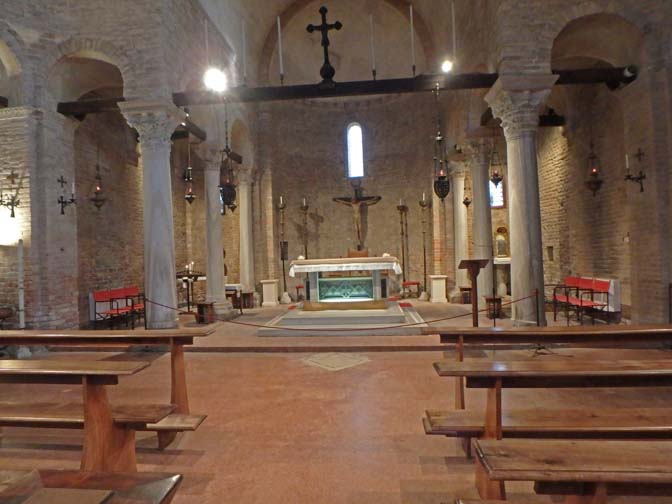
One of them was built in a different architectural style than what you usually see in Europe with the main part of the building round like a cake with ever smaller layers as it goes upward. That one was still functioning as a church, but people were allowed inside so long as there was not a service taking place.

mosaic throne and other oddities

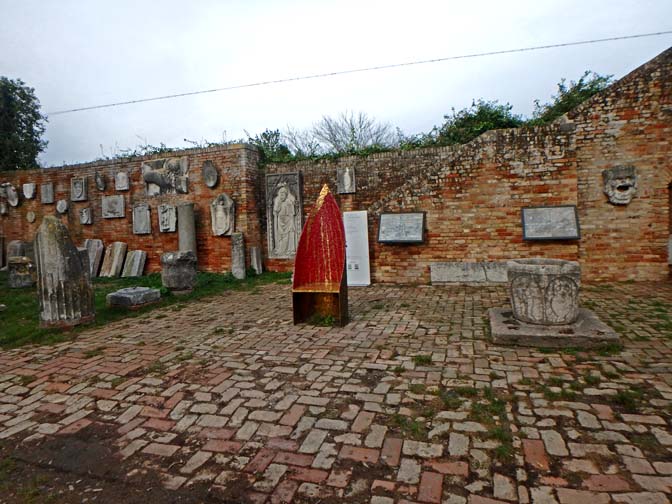
Another of the churches has been turned into a museum. There was a charge to go inside. A stone wall between two churches was covered with giant plaques. Stone monuments on and around it looked as if they could have come from a cemetery. Some were covered in mosaic patterns of shiny little tiles or stones, including a bright red one shaped like a throne. An old cemetery next to the church had many statue style monuments on the graves.

inside one of the old churches

Unlike the Swiss and Austrians who all spoke English quite well (especially the Swiss), not all the Italians do and the ones that can are often heavily accented. Even so, interestingly enough the boat tour was conducted in English, French, and Spanish – and NOT in Italian.

Murano Island canal

Copyright My Cruise Stories 2021
Posted in Day Trips, Europe, Lirica, MSC, Port Cities | Tagged , , , , , , , | 5 Comments

The Great Wall of China

Great Wall of China

Great Wall of China

Considering the distance from Tianjin port to Beijing, we booked a ship’s excursion to see the Great Wall. This all-day excursion started with a visit to the Summer Palace with a lunch stop at a jade factory between there and the Great Wall.

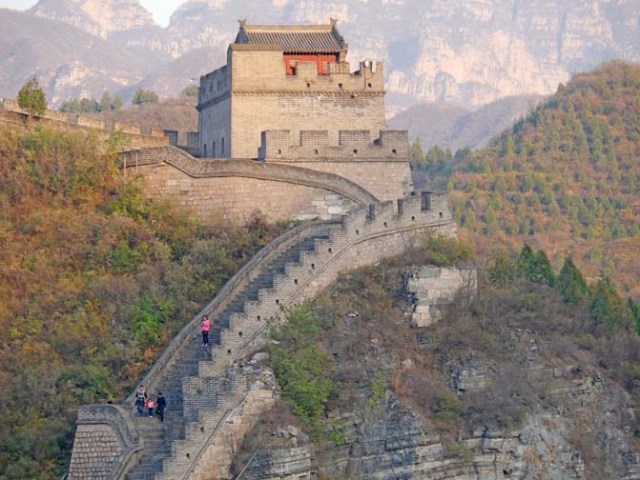
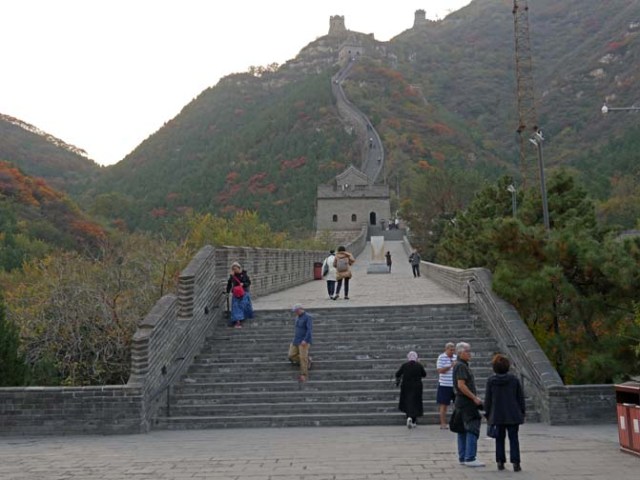
the Great Wall is not nearly as big as the mountains it stands on

Holland America‘s excursion information about the Great Wall said construction began as early as the 8th century BC, but it was the first Qin Emperor who extended this bastion against the northern barbarians. Construction reached its zenith under the Ming Dynasty. Today, the wall stretches some 3,600 miles. Your visit features a walk along a restored section of the wall’s battlements, which are wide enough to allow cavalry and chariots to pass. It went on to say after visiting the wall, re-board your motorcoach and transfer directly back to the ship in Tianjin — a drive of approximately three hours.

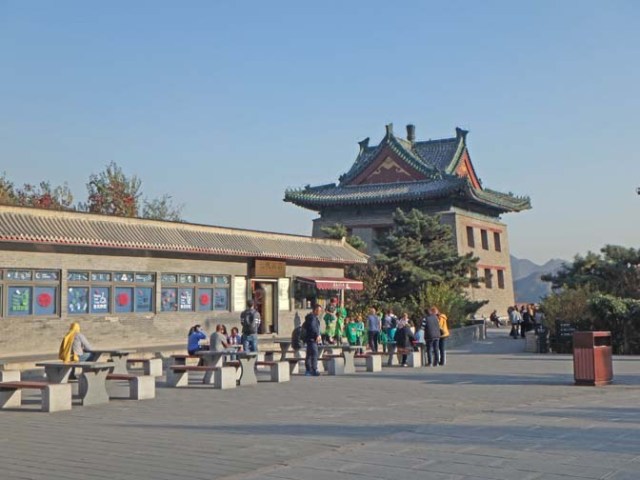
there are a lot of red pagodas at the Great Wall

GREAT WALL

About 7 hours into a 13 hour excursion, a good portion of which was driving time since the port is several hours away from Bejing, our tour bus finally pulled into a parking lot at the Great Wall of China. Since the wall covers thousands of miles this was just one of many places where people can visit restored sections of the great wall. While the impressive Ming Dynasty part tourists visit near Bejing built in medieval times is made of stone with a wide walkway and fortresses, the entire wall does not look that way.

red pagoda

Original early parts of the wall tended to be made of tamped earth, stones, and wood. Portions of the wall, some built over 2000 years ago, once encircled early cities, and over time walls were joined together as cities stopped warring with one another and sought to stop enemies from the north. The wall generally runs in an east-west line along China’s historical northern boarder. The sections tourist see have been restored, but other portions of the wall are neither as impressive nor as visible. Some are wild and crumbling with pathways wide enough for just one person, and other areas of former wall are so far gone they are hard to find. Not all areas of the wall are open to the public. Little remains of the oldest original walls, those having been built over and fortified by later inhabitants over the centuries or lost entirely with previously undiscovered sections sometimes coming to light.

people going up the wall down the road from where we stopped

Where our bus went, several large parking lots spanned areas on both sides of the highway with multiple entrances to the wall. We could see quite a lot of people climbing a steep stairway up the road a ways both on the same side and across the street near different parking lots than the one where we stopped. There was yet another lot directly across the road from where we parked.

giftshop near the parking lot at the Great Wall

Our group followed the guide through the turnstile and he got tickets for everyone. Once through he gave us an hour and a half and said people could choose to take a right turn to the pathway up the very steep stairway to the wall on that side of the road, take a left turn to the pathway that dropped down several steep stairways before coming to a section of wall crossing the highway and then going back up to walk along the wall on the other side, or just take photos from there and hang round the coffee shop and gift shop in the area near the parking lot.

The side where most people went

Most people went to the pathway leading to the wall and then split one way or the other. The sun was coming down behind the mountain on the right making very bad lighting for photos so we chose the left path. Even though it was sunny and about as clear a day as Bejing gets looking up toward that mountain the position of the sun pretty much just highlighted the haze in the air and silhouetted the mountain with the wall not really visible, where going to the left the sun was at our backs making for better pictures. In spite of that almost everyone took the right turn with just a few going left.

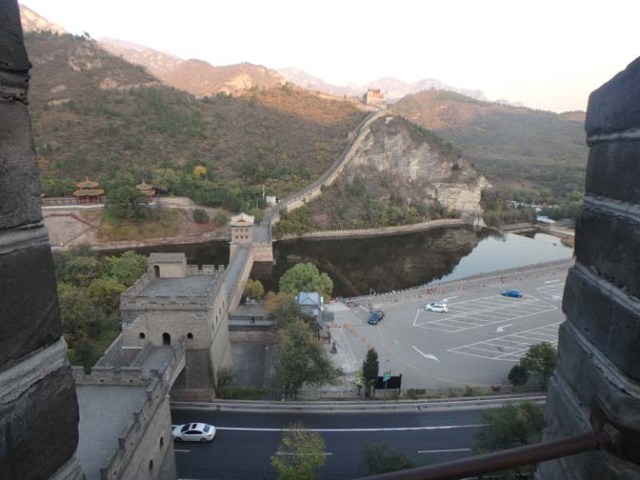
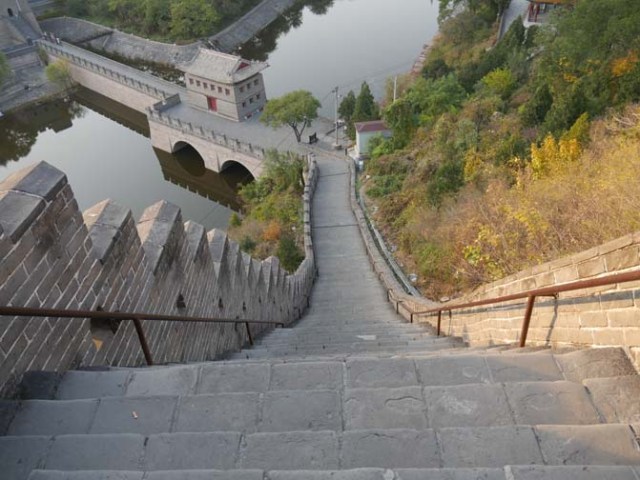
the Great Wall crosses over water and a highway

Finding the way down to cross the road involved entering a series of buildings each leading to part of the stairway. One of them had a bit of a maze to pass through before coming to its stairs. By the time we got to the part that actually crosses the road we were the only ones there, the rest who started out that way having given up and turned back to go the other way.

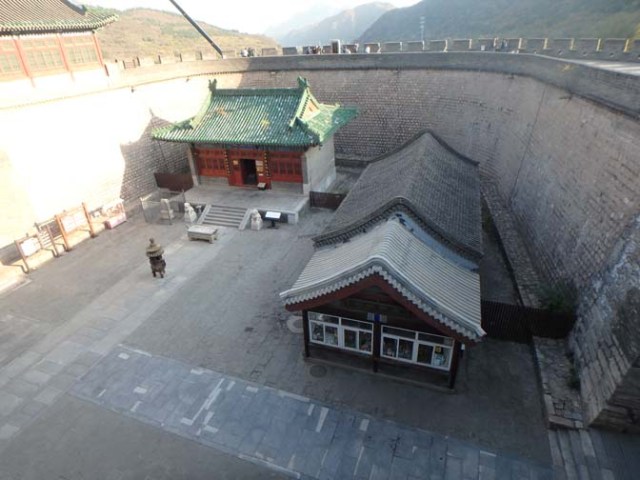
little buildings down in a hole surrounded by Great Wall

On the way back a couple other people from our tour had made it down far enough to see what must have been barracks down in a hole back when that area was one of the forts on the wall, but we never saw any of the others make it any farther. We walked past the barracks and found the bit of wall crossing over the highway. While that bit was level, the stairway beyond it was quite steep.

stairway on the wall

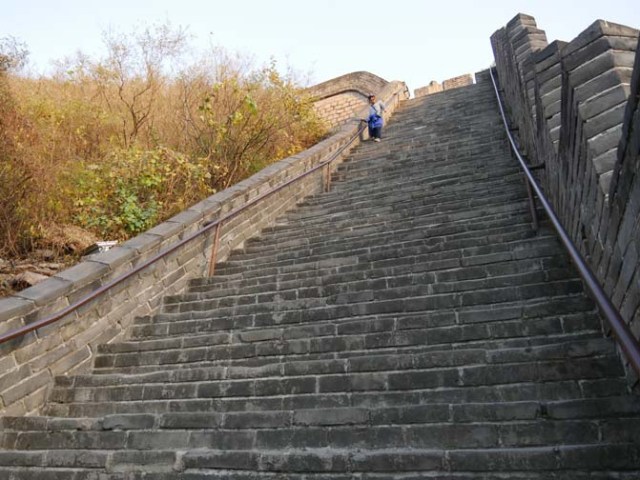
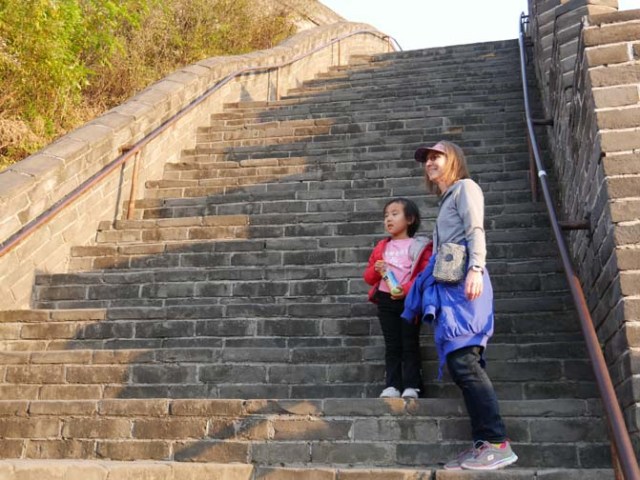
Stairs along the wall vary from just a few inches high to over a foot for just one stair. This variation doesn’t just occur from one stairway to the next, but also among stairs in the same stairway in some places.

it’s a long way up – or down

Some are wider than others as well. The railing on the steepest part of the stairway isn’t much more than a foot above the stairs if that, but the stairs are so steep it’s still reachable without bending over and sometimes useful in going both up and down.

It always looks like the next building is at the top of the wall, until you get there and see another one higher. Surely it’s the top, but no, arriving there reveals another one higher still.

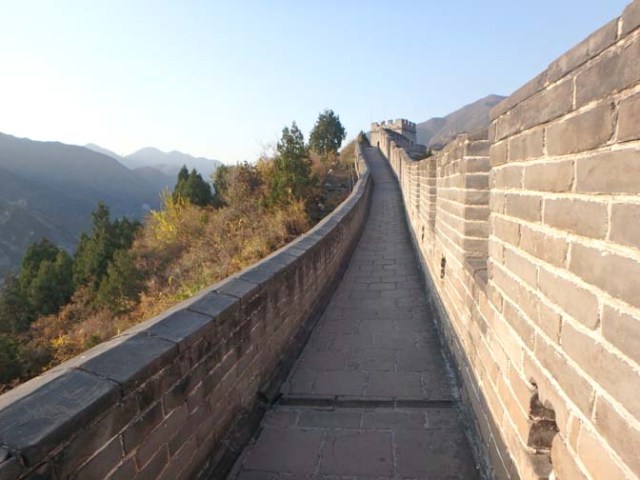
Each section we climbed ended with a little building. Though there were just a few forts along the wall, there were many guard towers so it’s not far from one to the next of those. It always looked like the next one up would be the highest point for that section of wall, but then when we got there the next one would be higher still. After we had gone quite a ways from the fort area the pathway narrowed to just the width of one chariot, which couldn’t have been much wider than the horse that pulled it. We wanted to keep hiking until we finally found a place where everything was down from there and nothing else was higher, but never got there in the time we had to spend on the wall.

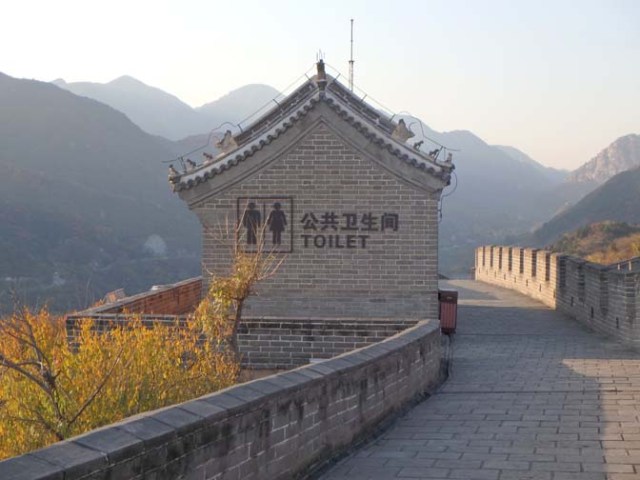
there are toilets on the Great Wall

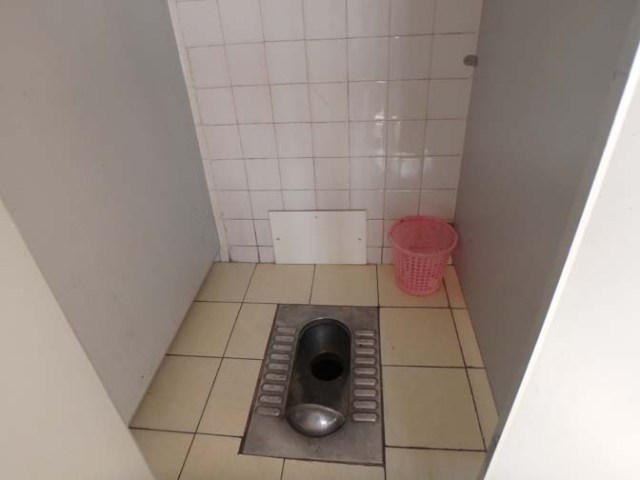
Our guide said there were no bathrooms on top of the wall, but apparently he had not gone up that side of the wall or at least not hiked it very far because after about a kilometer or so we came upon a building with toilet painted on the side of it. It may seem odd that it was written in English as well as Chinese, but a lot of the road signs were as well so seeing something written in English wasn’t that uncommon. They were of course the Chinese sort of squat toilets. It does make sense to have bathrooms there for the people who hike long stretches of the wall – or who run there. John’s Chinese aunt who lives in Beijing ran a marathon on the wall and it would be pretty tough to have a race somewhere with no facilities. Of course the soldiers of ancient times would have needed somewhere to go as well, though I have no idea if a restroom in this location was an original feature or an addition done during restoration. If it was original to the location it certainly would have looked far different in the past.

pit toilet squat toilet

In spite of being pit toilets so they still smelled bad, the wall had the cleanest squat toilets I saw in China. They may have been too far out on the wall for the average western tourist who can’t hit the hole to get to them since the floors and standing area around the toilet in these was clean and dry. There’s rarely ever any toilet paper in Chinese public bathrooms and these were no exception. When traveling in China it’s nearly always BYOB – bring your own buttwipe.

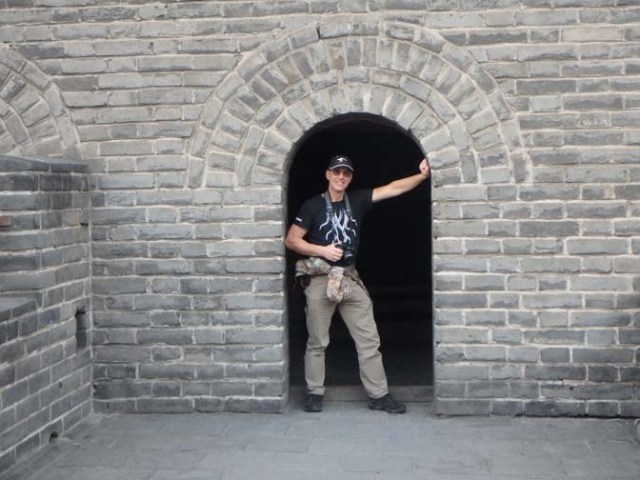
John in one of the little buildings on the wall

We would have liked to go farther than we did, but when half the allowed time had passed we turned back. We always seem to go faster on the way back, probably due to less photo stops, but not wanting to risk missing the bus or being the annoying people who don’t return on time and keep everyone else waiting we turned around short of reaching a little red building just a couple buildings down the way that actually did look like the highest point for that bit of the wall. Although had we made it there we may have found the next one still higher like we had with all the others. As with the Summer Palace that we also went to on this excursion, we would have liked more time to spend at the wall – a lot more time.

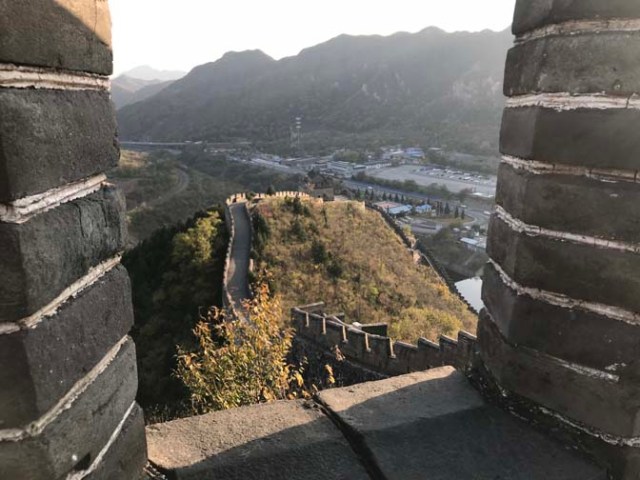
viewpoint on the Great Wall

From some viewpoints along that section of wall we could see construction going on for the new section of track for an expansion of their bullet train system that our guide had mentioned on the bus on the way there, though we had no idea where those tracks go to or from.

we took photos for the Chinese guy in red behind me

We saw very few people on that section of wall, but did come across a Chinese guy all dressed in red who wanted to hand us his phone to take a picture of him. You don’t have to speak the same language to understand when someone wants a photo.

posing with a little Chinese girl

Later we came across a family about to go up the very steep section of stairs as we were coming down it. At first I thought they wanted the usual for us to take a photo of all of them, but it turned out what they actually wanted was to take a photo of me with their adorable little girl. Apparently having a photo of her with a blond white tourist was a big thing for them. She was very cute and luckily John got a photo of me with her on his camera as well.

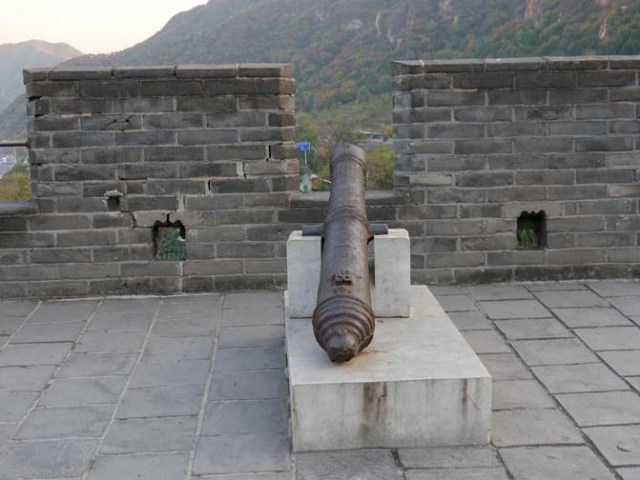
cannon above the barracks

After going back across the part over the highway we found a stairway down to the barracks area and a detour in the pathway that went around the other side of the barracks area with some cannons on it, neither of which we had noticed on the way out. There wasn’t anyone down by the barracks on our way out, but some people were down there on our way back. We didn’t take the time to go down there, but since we ended up making it back with about 20 minutes to spare we could have. We wandered through the gift shop instead, which mainly sold cheap tourist junk for inflated prices.

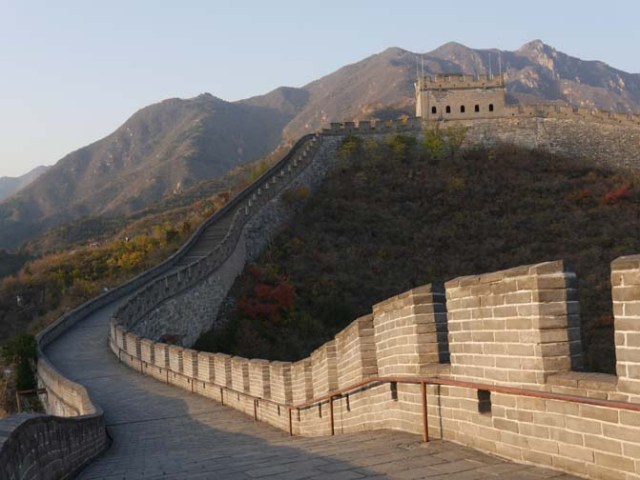
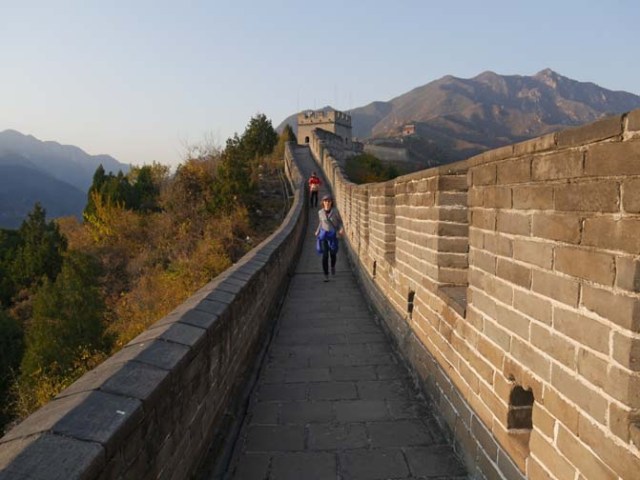
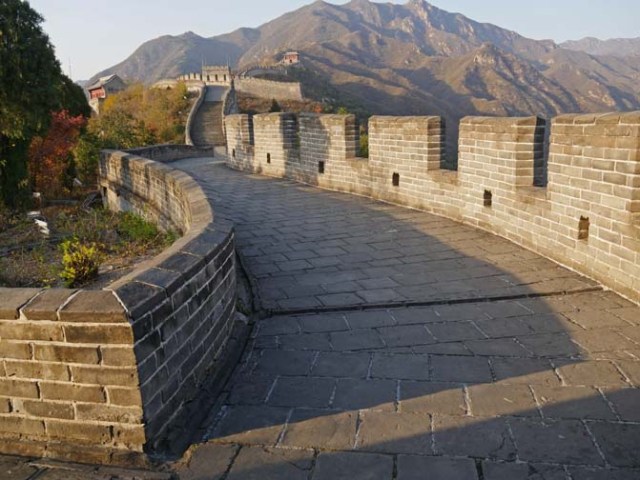
wide pathway on the Great Wall

Even though the cruise ship tour didn’t allow for as much time as we’d have liked to spend at either the Summer Palace or the Great Wall it was still worthwhile to get to see both of those things – and even though it came with a higher pricetag than any excursion we’ve ever done before it would cost a whole lot more to take another trip to China if we hadn’t seen them on this trip.

narrow pathway on the Great Wall of China near Beijing

Copyright My Cruise Stories 2021
Posted in China, Holland America, Shore Excursions, Westerdam | Tagged , , , , , , , | Leave a comment

Aqaba, Jordan Cruise Port

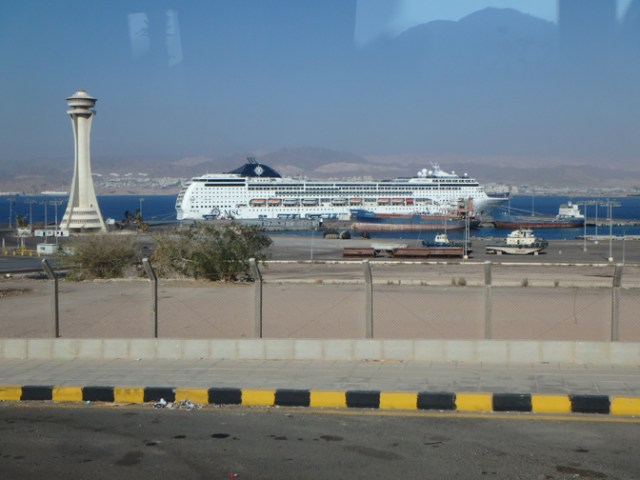
MSC Lirica in Aqaba

AQABA, JORDAN

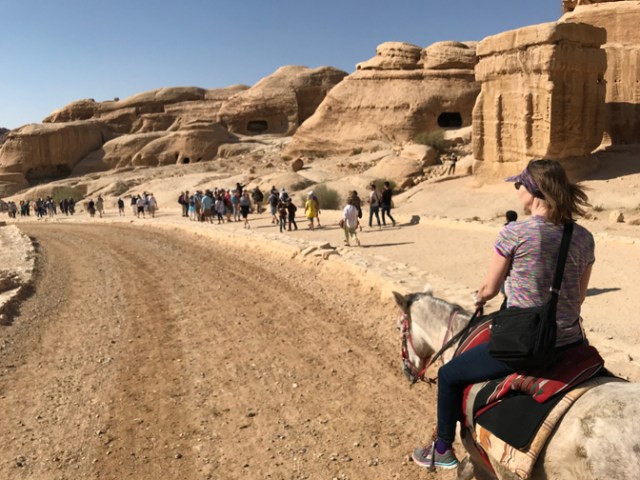
Aqaba is Jordan’s only seaport and the largest city in the Gulf of Aqaba in the Red Sea. It is a free-trade zone with lower taxes than the rest of the country. People from elsewhere in Jordan don’t get the tax break by shopping in Aqaba. There is a checkpoint on the way out where people from other parts of the country have to make up the tax difference on their goods. New development is springing up in areas surrounding the older part of the city with the population there having doubled in the last decade, and foreign investment fueling some of the construction. The most popular cruise ship excursion from Aqaba is to Petra about 2 hours away. Going to Petra was the main reason we booked our cruise on the MSC Lirica. Petra had been on my bucket list for years and while a port stop on a cruise ship only allows time enough spent there to see a small fraction of it, we at least got a glimpse. I’d still like to go back and spend more time there someday.

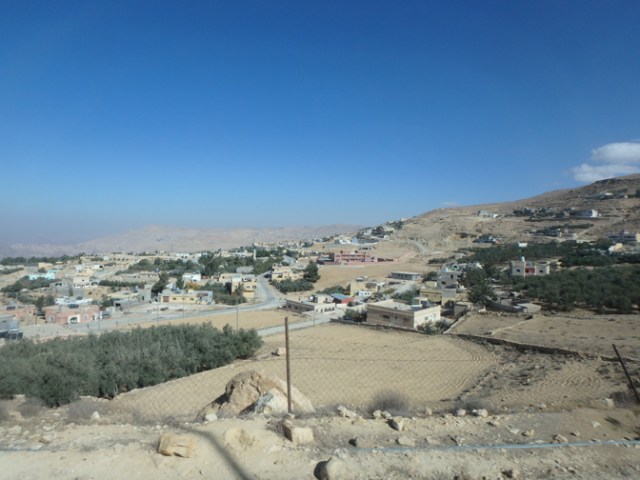
town in Jordan near Petra

The area has been inhabited since 4000 BC, and is home to the Islamic Aqaba Fort. The city sits at Jordan’s southernmost point and is very important to Jordan’s economy through trade and tourism. Its desert climate is hot and dry. Currency is the Jordanian dinar. One US dollar is worth about 0.70 dinar. Credit cards may not be accepted, but US dollars often are. The language is Arabic, but many people understand English.

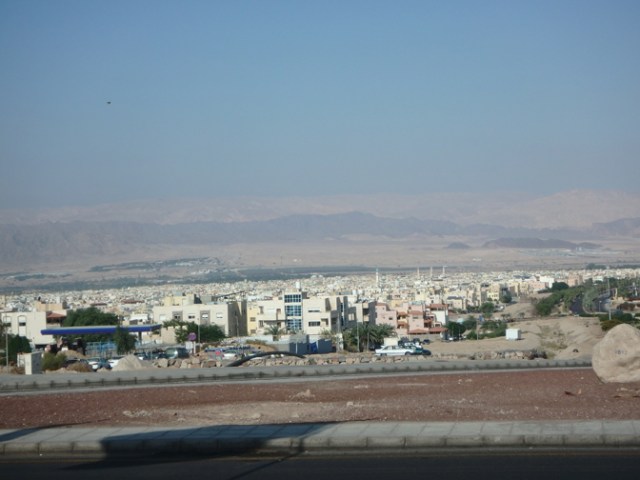
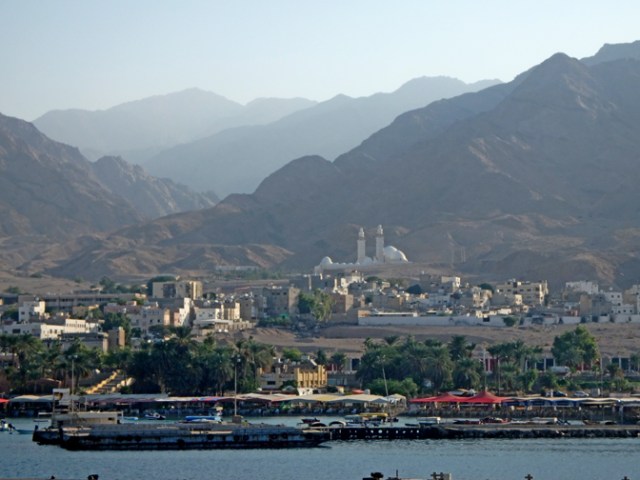
Aqaba

Aqaba was known as Ayla from pre-biblical times until the 14th century when it was renamed by the Mamluk Sultans of Egypt who ruled it at the time. Before that it was taken by the Romans in 106 AD who ruled the region until the Byzantine Empire took over in the 4th century. They were followed by crusaders in the 12th century and then Saladin of Egypt. Crusaders took over again followed by Muslims the following year. The Mamluk Sultans of Egypt built the Mamluk castle (aka Aqaba castle or fort). They were overthrown by the Ottomans who ruled for 4 centuries until 1917. At the end of WWI the British secured Aqaba for Jordan. It was a British protectorate from 1921 until 1946 when Jordan became independent. Their history with Great Britain is why many people there speak English as well as Arabic.

Aqaba

Jordan has many interesting sites for tourists to visit throughout the country, some of which are of religious significance. Two of their major sites are near Aqaba – Wadi Rum and Petra. A wadi is a valley, ravine, or channel that is dry except in the rainy season. Wadi Rum is the biggest one in Jordan. It is also known as the Valley of the Moon. Wadi Rum Protected Area is famous for its desert landscape with sand dunes, valleys, sandstone mountains, canyons, and arches. Lawrence of Arabia, The Martian, and other movies were filmed there.

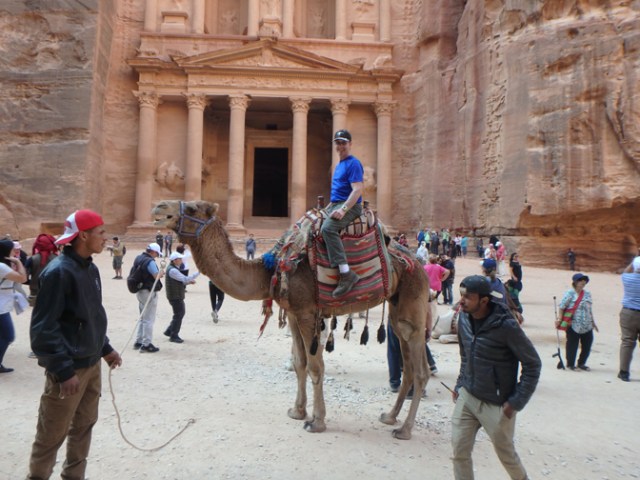
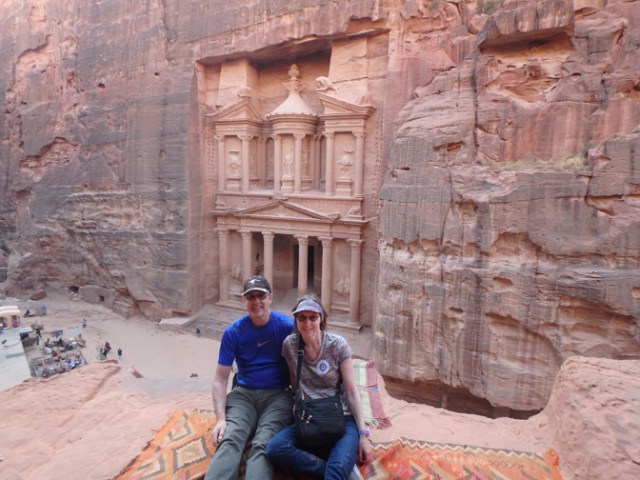
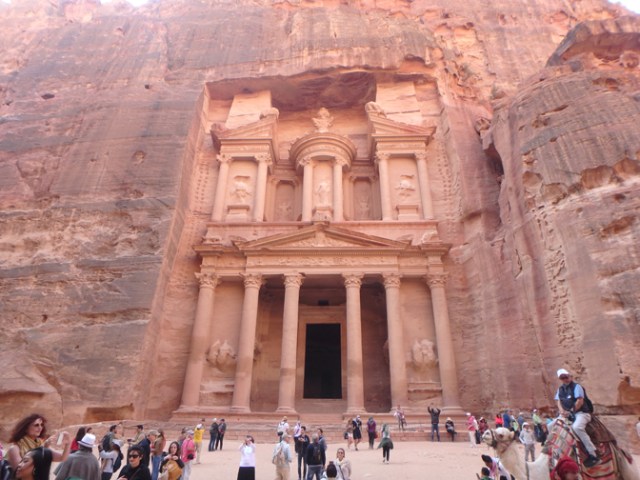
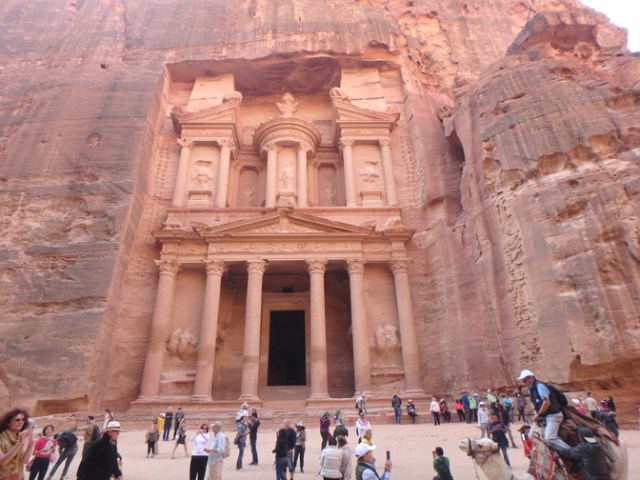
treasury in Petra

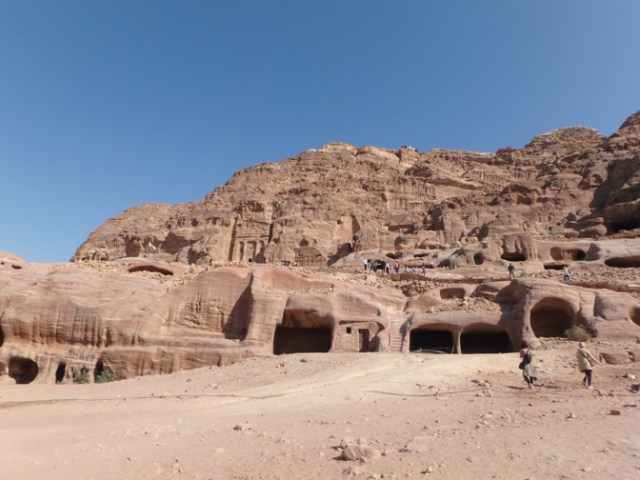
Petra is an ancient Nabatean Arab city where building facades are carved into the sides of  rock cliffs. It is an extensive site with many buildings, the most famous of which is the treasury, used in the filming of Indiana Jones and the Last Crusade.

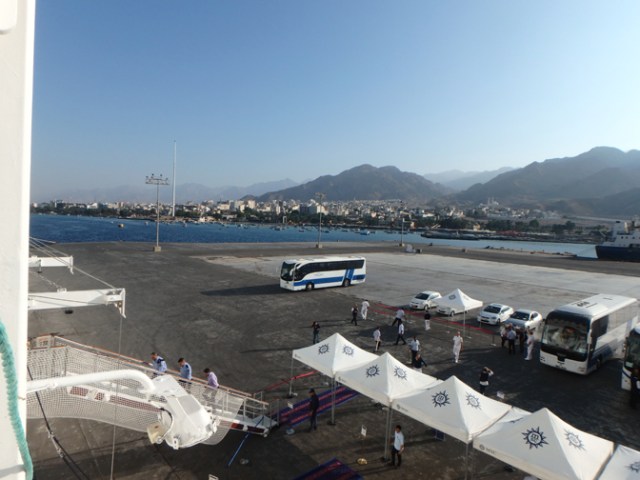
gangway from the ship and tour busses at the port in Aqaba

AQABA CRUISE PORT

Aqaba sits directly across a narrow inlet from Eilat, Israel where we had spent the previous day. Our ship spent the night between the two ports slowly circling around the bay to fill the time between the scheduled departure from Eilat and arrival at Aqaba. From the top deck of the ship at that port you can see 4 countries. Jordan and Israel of course, and in the distance Egypt and Saudi Arabia as well. We could easily see the port in Eilat and the place where we had docked directly across the bay.

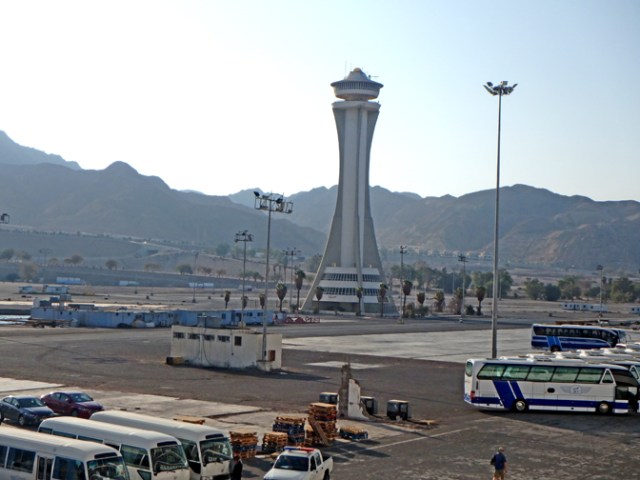
port view from the ship while docked in Aqaba

Ships in Aqaba dock at the main port about 3 miles south of the city center. This port has docking space for 23 vessels and anchorage for 8. Both cruise ships and commercial vessels use this port. Because it is a mixed use port walking through the port is not allowed, which is standard at any port with container ships. It’s a quick shuttle ride to the gate. Taxis are available there or it is a 15-20 minute walk to Aqaba Castle (Mamluk). Shuttles may also take passengers all the way into town (4k). Excursion busses pick people up at the port right in front of the ship and drop them off there upon return.

view from the ship in Aqaba

Getting off the ship in Aqaba was just as easy as any average cruise port, quite a difference from our previous day in Israel which had extra security procedures that made the disembarkation process for a port stop about as lengthy as it is for leaving the ship on the final day when the cruise is over.

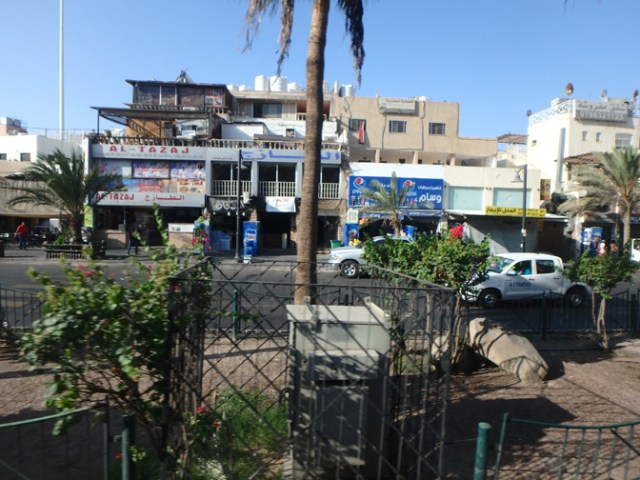
view from tour bus in Jordan

THINGS TO DO IN AQABA

Beach resorts, windsurfing, diving, Yamanieh coral reef in the Aqaba Marine Park, take an excursion to Wadi Rum or Petra, Mamluk Castle (seen in the movie Lawrence of Arabia), museums, beaches, diving and snorkeling, mosques, Berenice Beach Club, Aqaba Marine Park, ruins of the ancient city of Ayla, bird observatory, glass bottom boat tour, and old town.

Copyright My Cruise Stories 2021
Posted in Lirica, Middle East, MSC, Port Cities, Ports of Call | Tagged , , , , , | Leave a comment

Cabins at Decatur Head

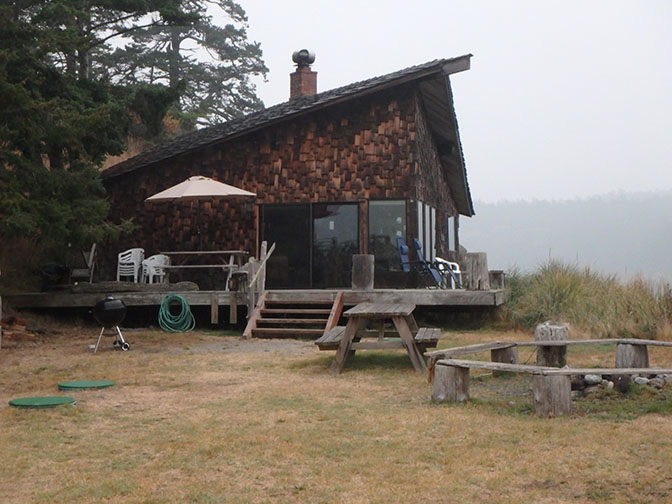
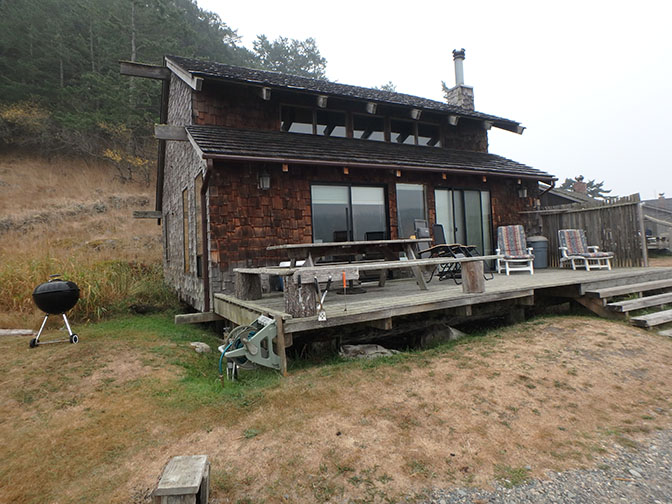
Decatur Head cabin 1

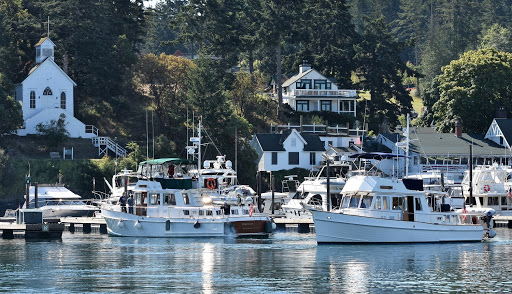
Decatur Island is a private island in Washington State’s San Juan Islands. There isn’t much public land, but it does have a public boat ramp and the beaches are mostly state property. There isn’t much access for anyone who isn’t staying there though so crowds are non-existent on the island. Much of the land is forested, but there are homes and vacation houses with gravel roads providing access around the island. There’s not a lot in the way of rentals other than a couple bnb’s. The island has a couple tombolos, which is a bit of land that would be a separate island except for a connection through a sandbar or narrow strip of land.

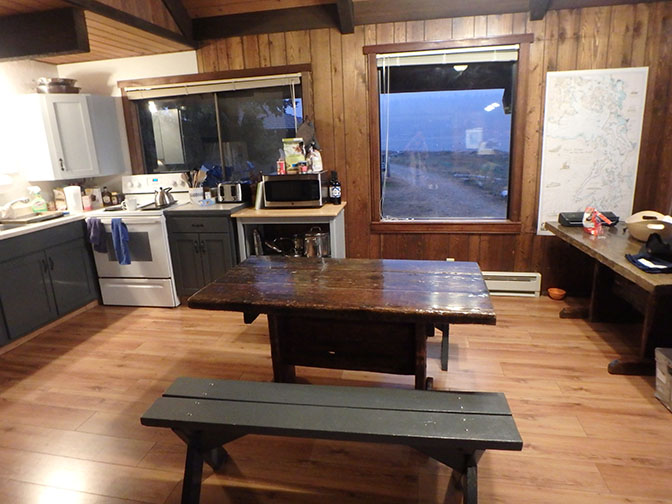
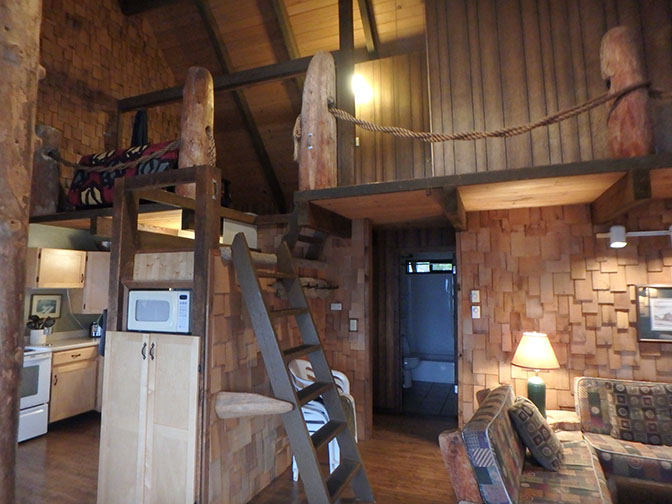
cabin 8 kitchen

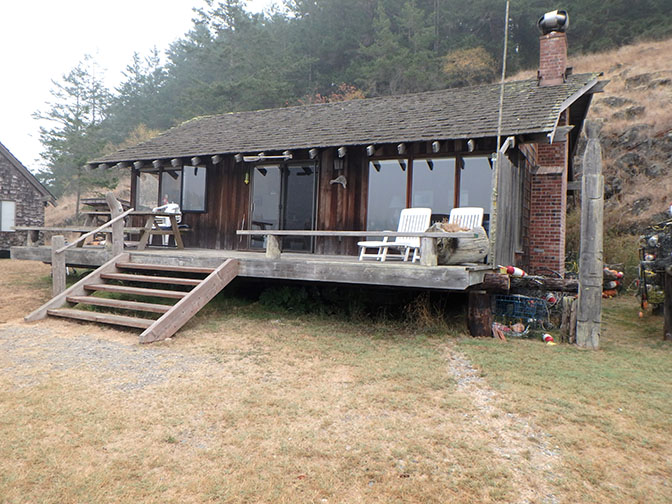
Decatur Head is one of those tombolos. The privately owned cabins there were built in the 1970’s and belong to the Decatur Head Beach Association, whose members use the cabins. There are 8 total with one for the caretakers to live in and 7 for the members vacation use. These cabins sleep from 4-10 people, but each of them have just one bathroom.

inside cabin 8

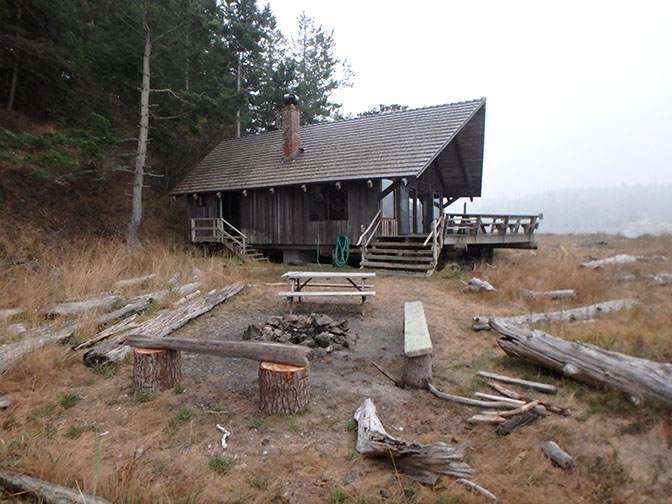
Although most people will never be able to stay there, it’s still fun to see the inside of some of these rustic cabins. Each one is different both inside and out. Local elements were integrated into the original decor and though some things have been updated over the decades since, things like driftwood furniture and sometimes stairways still remain.

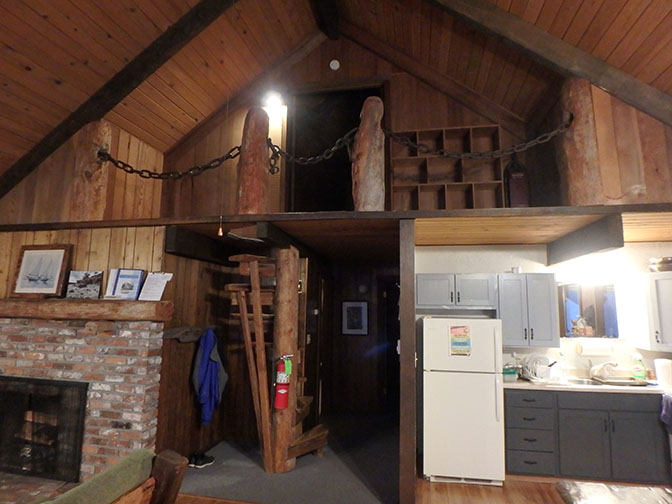
top of the stairway in cabin 8

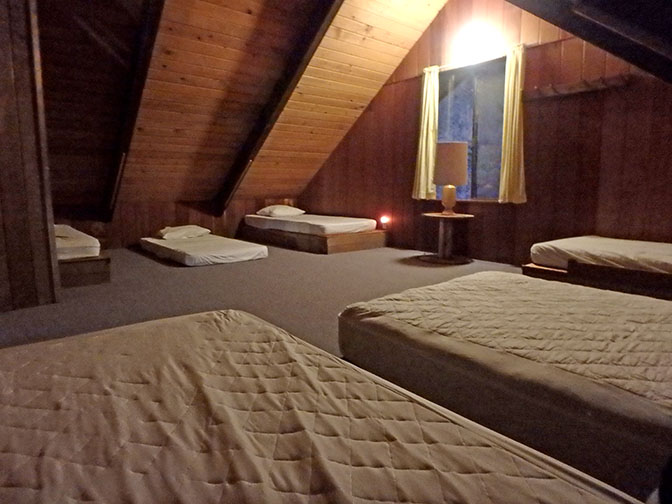
Cabin 8 is one of the larger ones that sleeps 10. It has 2 bedrooms and a loft with a bunch of mattresses on the floor.

loft bedroom cabin 8

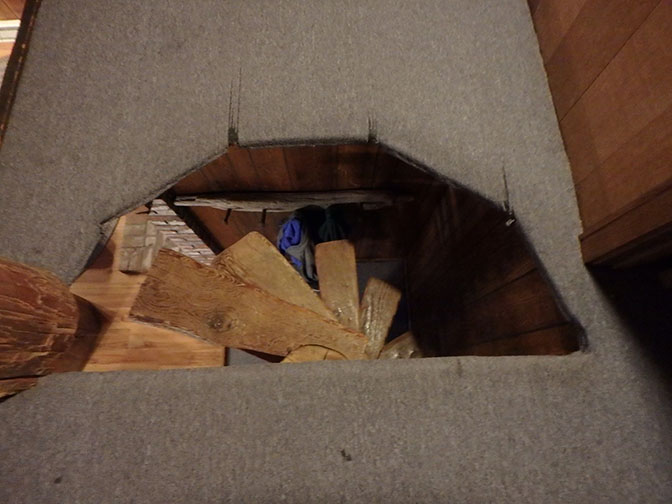
The stairway winds up through a hole in an open sided ledge with a doorway into the bunkroom. The one bathroom in the cabin sits on the lower level between the two bedrooms.

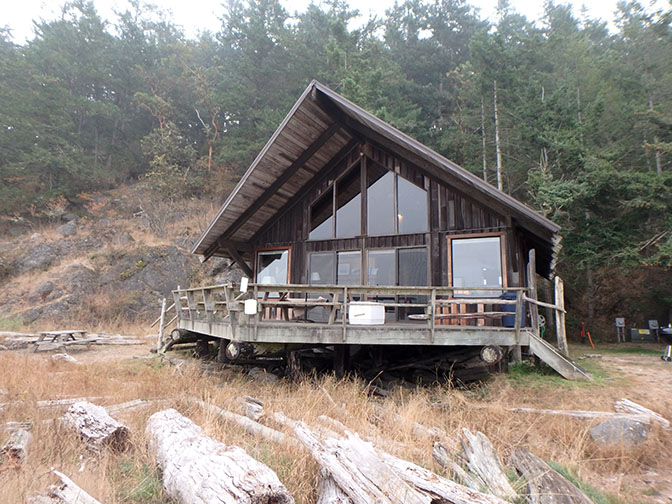
A-frame cabin

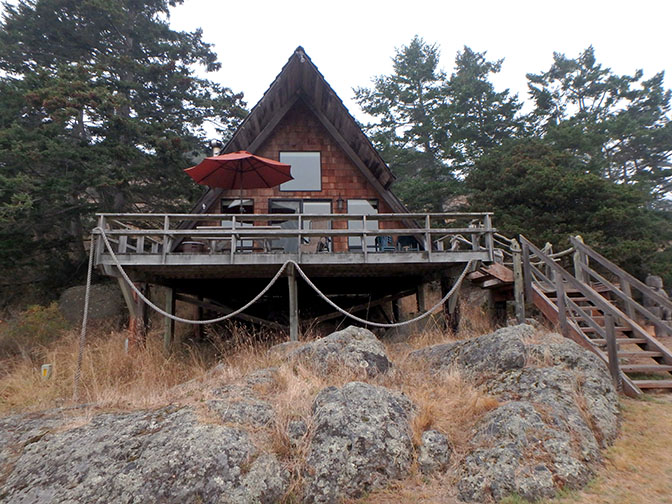
All of the cabins have the bathroom on the main level. Not all of them have upper stories. They do all have fireplaces except for cabin 2, the one A-frame style cabin which has a wood stove.

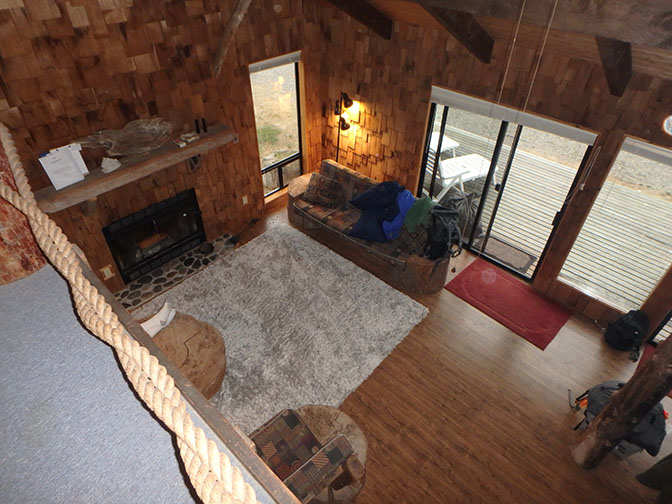
view from the loft in cabin 8

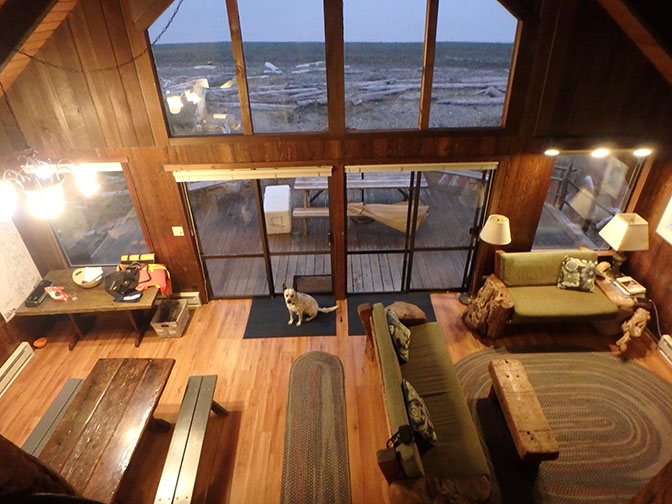
The living room has 2 couches and lamps mounted on rustic wooden tables. The full kitchen has a picnic table for eating space, and another one without the benches for putting things on. Dishes and pans and other kitchen essentials are provided, but people have to bring all their own linens and paper products as well as food and bedding. Access to the island is by private boat or island charter service. There is no garbage service so all garbage leaves with the guests.

cabin 6

Cabin 6 is another two story cabin. It’s a bit smaller than cabin 8, but also holds 10 people. Access to the second level in this one is more of a ladder than a stairway.

inside cabin 6

The upstairs has a bedroom and a loft area with a couple beds and a futon. Downstairs has 2 bedrooms as well as the bathroom, kitchen, and living room areas.

loft view of cabin 6 living room

This cabin also has a picnic table style table for eating on. It also has a couple couches and rustic end tables.

outside cabin 8

Outdoor areas by some cabins have fire pits.

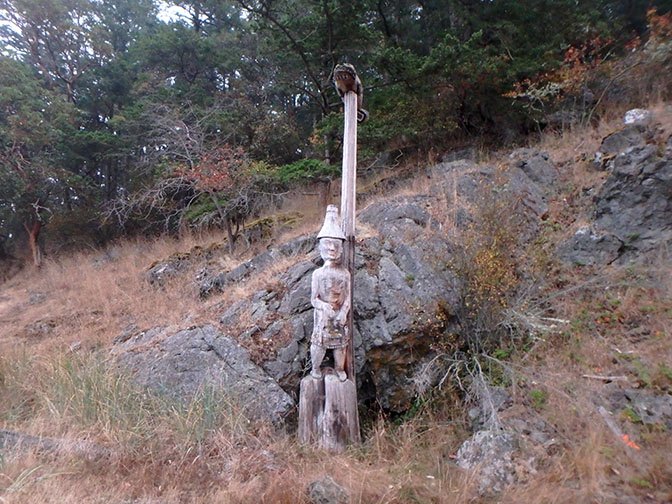
totem pole

Cabin 8 even has its own totem pole.

cabin 5 is just one story

Cabins 5 and 7 are just one story, which are similar in size and layout to the lower level of the larger cabins.

living room in cabin 8

Every cabin has its own unique character inside and out.

cabin 8 has a deck shaped like the bow of a boat

copyright My Cruise Stories 2021
Posted in USA, Washington | Tagged , , , , , | Leave a comment

Seabrook

first impressions

Years ago while my kids were growing up, we used to take our horses to the ocean every summer. We stayed in Ocean City at a little RV park about a block from the ocean. Up a very small hill behind the campground they had an old barn and corral with an open field where people with horses could camp. There was a horse-friendly campground closer to the water, but the tiny corrals there had very unsafe looking fencing where a horse could easily injure itself as well as no shelter for them so we never stayed there. I have no idea if either place still exists.

these people must really like birds

From the beach access road in Ocean City we would ride up north. The first year we went there the river running alongside the beach ended before the beach access road in Copalis. Extending ever northward, the river worked its way through that road at some point while we were still going there, and to this day the beach access road is still closed as they never built a bridge over the river like the access points south of there have. Our favorite area to ride was north of there as at that time horses were allowed in the water in areas where cars could drive, but could not pass through the clam beds in areas where they were not. Cars were allowed north from Copalis, but could not get there without the access road so we could ride in the water without worrying about any cars on that stretch of beach. When we were recently at the beach north of there the signs at all the access points gave seasonal times for cars being allowed, but none of them had any permanent open or closed areas. I don’t know if the entire beach is like that now or if the places further south still have open and closed areas. It was summer when we used to go there and all the places we saw recently had no cars allowed throughout the summer, where back then in the Ocean Shores area the beach was full of cars.

Seabrook town center

Back then I knew there were towns north of Ocean City. I’d heard of Copalis, Pacific Beach, and Moclips. I had never heard of Seabrook though until we took a trip out to Moclips recently. Turns out that’s because back in the day Seabrook did not exist. It’s a totally planned community first established in 2004, past the time we were bringing horses out to the sea. Which explains why I’d never heard of it.

Seabrook Map

We took a drive through Seabrook on our recent trip to the area. Strangely enough the first impression of all 3 people in our car was that the place was creepy. While it’s not what you would find in a scary movie, it was more the sameness of everything. Rows of homes all looking pretty much the same, and like they were all built at the same time. It reminded my sister of the Stepford Wives, a story where a perfect seeming town has replaced all the wives with robots. It reminded me of a fake Disney town. It also could have passed for a movie set because of the seemingly un-realness of the place.

street in Seabrook

Some of the first streets we drove down had houses solidly lining both sides of the street with no driveways or garages. A solid line of parked cars filled both sides of the road leaving a narrow passageway barely wide enough for one car to squeeze through on a two-way street. Farther into the development places were more likely to have garages or driveways. We went past a small crowded business area near the entry and found a tiny house cabin section, a dog park, and a playground farther up. We didn’t go far enough to find the stables that John’s sister and husband found when they went there to explore after hearing of our brief visit there. We thought the tiny houses were the cutest homes there.

tiny houses in Seabrook

Nearly the whole town is on the opposite side of the highway from the beach and most places have no ocean view. It does lose the initial creepy feeling after driving around there for awhile, but would not be my choice of a location to stay for a beach weekend. Apparently a lot of people like it though as the place is crawling with vacation homes and rentals. Buying one costs a fortune, but vacation rentals can be found for a reasonable price, probably due to the amount of competition.

houses in Seabrook

Online research of Seabrook shows homes must adhere to strict guidelines, which explains the sameness from one home to another. This planned community incorporated parks and trails into their design as well as shopping and an indoor heated pool, sports courts, and fitness center. It’s designed for residents and visitors to be able to walk easily throughout the town. There is beach access through several pedestrian trails as well as by road.

Seabrook houses

While this town seems to be many people’s idea of the perfect vacation getaway, we were far happier at the out-of-town place with an awesome beach view where we stayed in nearby Moclips.

Copyright My Cruise Stories 2021
Posted in Pacific Ocean & Islands, USA, Washington | Tagged , , , , | Leave a comment

A Couple Days in Vancouver

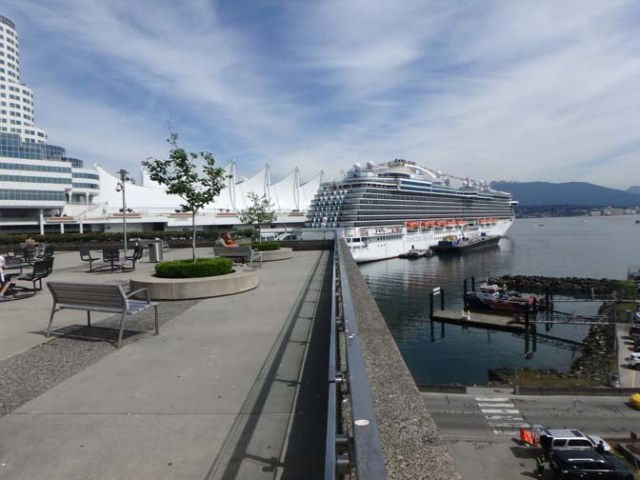
Vancouver view

view of Canada Place from Vancouver Lookout

VANCOUVER BC

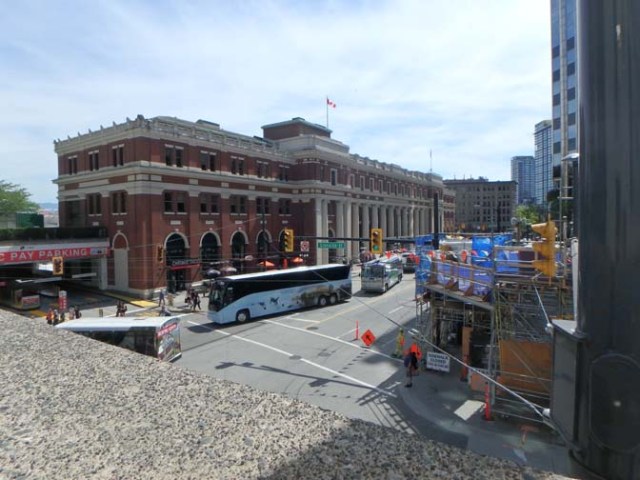
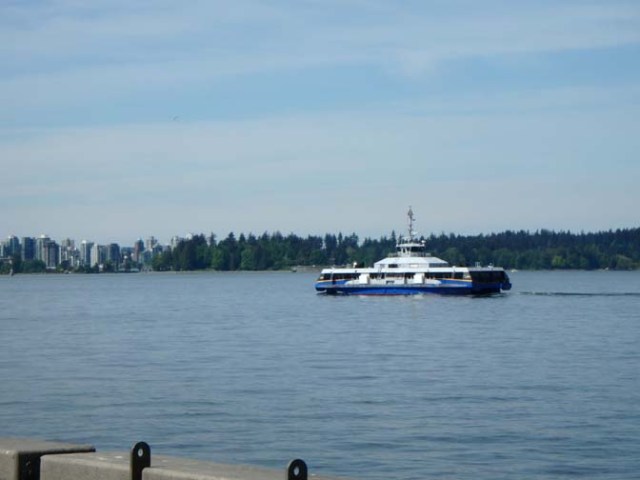
Vancouver BC has a popular cruise ship port with ships sailing mainly to Alaska docking there throughout the season. The port, called Canada Place, is a tourist attraction in itself as well as a cruise port. It’s also next to Waterfront Station where people can catch the sky train or seabus. City busses also stop nearby as do free shuttles to Capilano Suspension Bridge, or seasonally to Grouse Mountain. Of course ships aren’t the only way into Vancouver. People also come by car, bus, train, or plane. I’ve taken several cruises that started, ended, or both in Vancouver. While Alaskan cruises are their mainstay, my cruise that started there ended in Shanghai and the one that ended there started in LA. The round trip one was a typical Alaska cruise though. With Canada closed to cruise ships this year the port area will likely be a far quieter place than usual – with nearby merchants getting a major hit to the pocketbook.

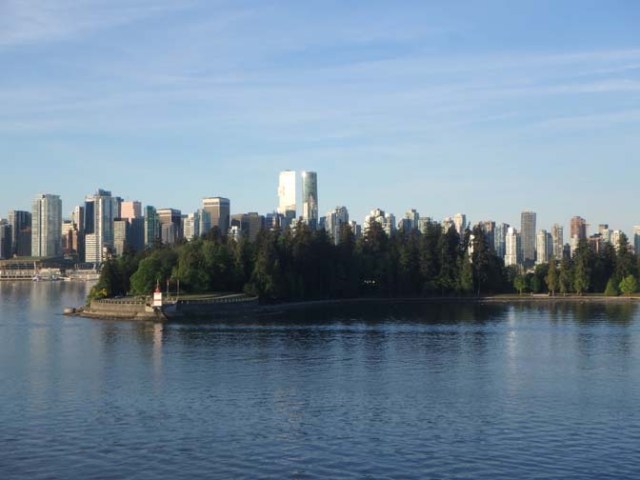
Stanley Park lighthouse

lighthouse on the seawall at Stanley Park

Vancouver is a great city to visit, whether as pre or post cruise stay or as a stand alone trip. There’s quite a variety of things to do there. I’ve taken the Amtrak there on one cruise and back on another, which is convenient since there’s a skytrain station across the street from where the Amtrak train comes in as well as a skytrain stop by the port. When my daughter was in town we took the Greyhound bus to Vancouver, which  I would not recommend even if the border was open and they were still running busses there.

kids at Stanley Park

girls in a tree at Stanley Park

THE GREYHOUND NIGHTMARE

When my daughter came to visit from Australia with her 2 kids two of her friends tagged along with 3 kids between them. Add us and that’s 10 people. Rather than take 2 cars we used public transportation for our road trip adventure, starting with a trip to Vancouver BC. While we would have preferred traveling by train, unfortunately it did not have any convenient departure times so my daughter booked us all on the Greyhound bus instead. About a month or so before the trip she got an email saying there was a change and to call them. No information about what changed or why. Since she was still in Australia at the time I called Greyhound for her. It turned out they had made the time for the return bus (which was already ridiculously early) even earlier, with a 2 hour layover at a bus station before the next leg. The service representative was not helpful and would not say whether or not there was an earlier bus for that next leg, just that if there was she could not change our tickets to it. If there was one she said we could ask at the counter to change, for a fee of nearly as much as the original ticket price per person – which really adds up when there’s 10 people. She said it was the counter person’s discretion whether or not to charge that fee, but the actual counter person said they can’t wave it. She also could do nothing to help Sheri’s friends as we were not listed on their ticket so they had to call after arriving in the USA. The person Sheri’s friends talked to about changing their tickets was just as rude and made it sound like she couldn’t help them at all, though she finally did end up sending an email with amended tickets.

Stanley Park in Vancouver BC

waterfall at Stanley Park

Once time for the trip came the counter person at Everett Station was very rarely at the counter at all. The one at the customer service desk just said she didn’t work for Greyhound and couldn’t help. Anyone needing help at the Greyhound counter had to send someone from the nearby coffee shop to the back room to find her. We did finally manage to check in and she said she would announce the bus when it arrived. She was not forthcoming with any information about the bus as time for it to come got near, just kept saying she would announce it when it arrived – something she never did. Time for the bus to arrive came and went with the only announcements of bus arrivals being for those headed to Seattle. No bus showed up on their bus tracker app and as more time passed when anyone could find her she would just give a later arrival time or say the bus was on the way and would be there soon. Finally she put up a closed sign and snuck out the back without a word to any of the passengers still waiting on that bus.

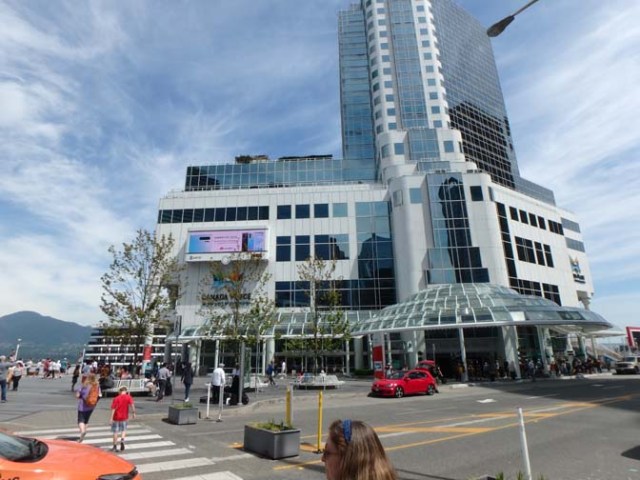
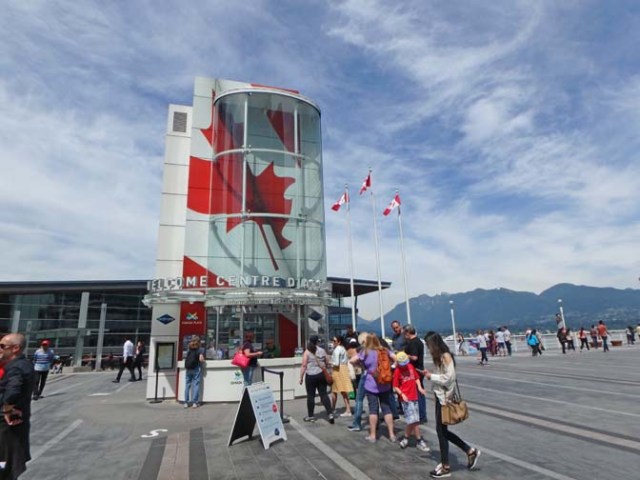
Harbour Centre

giant decorations at the entry to Harbour Centre

The girl at the Amtrack counter (who was very diligent about announcing Amtrack’s busses and trains) then said the Greyhound bus had come and gone. The next one came 3 hours later and if we didn’t get on that one we were going to switch to the train which left an hour after that. We met a college boy who had been standing out on the platform the whole time waiting for the same bus and he never saw it either. Though there is supposed to be a bus tracker on each bus so waiting passengers can follow its whereabouts on an app, apparently the driver has to turn the tracker on and that one did not. The second bus did have a tracker on, but at the time it was finally supposed to arrive a bus pulled in labeled Seattle – which from Everett Station is a southbound bus while we needed northbound. Upon asking the driver what happened to the bus to Vancouver BC he said this was it and he just hadn’t changed the sign yet. So apparently if our original bus didn’t skip that station entirely it must have come in marked as Seattle too so the guy on the platform didn’t get on, and if the counter girl bothered to announce it at all she announced it as Seattle so nobody waiting inside went out either. They did announce quite a number of busses for Seattle. Other than not changing his sign in a timely manner the driver was nice, but it’s no wonder that company may not be in business much longer when all of their customer service people are rude and unhelpful whether on the phone or in person, drivers only turn the tracker on if they feel like it, and they don’t even mark the destination on the bus properly or correctly announce where it is actually going from inside the station.

Stanley Park

seawall at Stanley Park

STANLEY PARK
Our hotel was about half a block from Stanley Park, which is a huge park on a peninsula at the edge of downtown Vancouver. Unfortunately there are no skytrain stops near there. It is within walking distance of Canada Place, though it is not close. From where we stayed we entered the park on a trail that led to the seawall trail near an area called second beach. The seawall is a paved walking trail with an adjacent separate biking and skating trail running along the water’s edge all around the outskirts of the park. There are lots of things within the interior of the park, but we walked quite a distance on the seawall passing under a bridge and past a lighthouse before coming to a little waterpark and a pathway into the interior of the park leading to the aquarium, train, and other things including a little restaurant called Stanley’s Bar & Grill. We sat down to order and the waitress said if anyone wanted to go on the train they should go there first because it would probably close down soon for wind. None of us had any plans to ride it before then, but she talked Sheri’s friends into it so they took off with their kids and went for a ride. The waitress said it would take about 15 minutes, but that was the train ride itself. Add on walking there and back and time for getting tickets and waiting to get on and all and it took quite a lot longer. They all had fun and were glad that they went though. Not far from the restaurant there’s a bus station where city busses come right into the park.

parkrun

3 generations at parkrun

RICHMOND PARKRUN
parkrun started in England and has spread to many countries around the world. These weekly 5K events provide free timed runs to participants and are ran by unpaid volunteers who work hard organizing the events. Anyone is welcome. You don’t have to be fast or even to run. Some people walk the course, some push prams (strollers) and a few bring dogs. There are courses in some places not suitable for prams or where dogs are not allowed, but Richmond is on a paved mostly flat trail and is not one of those. Sheri, Hannah, and I went to parkrun while everyone else slept in. We took the skytrain, which is part of Vancouver’s public transportation. Since there were no stops near our hotel by Stanley Park we took a cab to the nearest one before the run, but walked back to the hotel afterword. There’s a stop quite close to the course with a Tim Horton’s between the skytrain and the run. Many people from the run go there for breakfast afterword so we joined them. The course runs back and forth across a public trail along a waterway with an airport near the far side so you get a lot of views of the undersides of airplanes during the course of a run – though not nearly from as close as at Saint Martin’s Maho Beach. Richmond is a small parkrun that in normal times attracts more visitors than locals due to their proximity to the airport. People register online for their home parkrun, but can take their same barcode and run anywhere in the world where parkrun events take place. This was my granddaughter Hannah’s 50th parkrun so she got a shoutout during the pre-run briefing. People there were quite friendly and some of the faster runners stayed around after finishing to provide encouragement and congratulations to others as they ran by or finished their runs. Quite a few acknowledged Hannah for finishing her 50th. There are no parkruns near where I live so this was just my second having ran one prior in Australia. They get a lot of Australian visitors there, and Sheri and Hannah were not the only ones this run. There were also people from Europe, but I was the only one from the USA. It’s just starting to catch on there and not as popular as in some other countries. parkrun tourism is a thing among avid parkrunners, with some of them so dedicated they run a race in one part of the world and then hop a plane, cross the international date line, and run another on the same date somewhere like Richmond with a course near an airport. Our road trip took us to Leavenworth and then Seattle after Vancouver. Sheri, Hannah, and I stayed an extra night near Seattle after the others left and did another parkrun in Des Moines.

Vancouver Lookout tower

taking in the view at Vancouver Lookout

VANCOUVER LOOKOUT
Quite near Canada Place Vancouver’s lookout tower sits on top of the Harbour Centre building. It’s not just a tourist tower, but rather an office building with a tower perched on top. Entering at street level, we had to go down a floor to find the ticket counter to go up the tower. There are two dedicated elevators that just go up to the lookout, one for people with reservations at the restaurant on top, who can go up without buying a ticket, and the other for people with a ticket to the observation deck. The ticket counter is near the elevators and there is a giftshop next to them as well. The ride to the top takes 40 seconds in a glass elevator. As we stepped out of the elevator, a greeter posted there tried to hand the smallest kids little stools. Anxious to get to the window the kids walked by obliviously until they realized they couldn’t see out and went back for the stools. Visitors work their way around the circular viewing area stopping along the way for different views. Windows go all the way around the tower for a 360 degree view  of the area as you work your way around. Signs posted along the way give highlights about what you can see from that particular spot. It’s a good way to get oriented to the area and see what else you may want to go to nearby.

Capilano Bridge

Capilano Bridge in the dark

CAPILANO SUSPENSION BRIDGE

We found a free shuttle to Capilano Suspension Bridge, which has 4 stops around downtown Vancouver, including one at Canada Place. The bridge is on Grouse Mountain, but not as far up the mountain as the tramway, though you can catch a city bus between the two. We had plans to go to the bridge and then have dinner up on top the mountain because the price of a meal was about the same as the price of the gondola ticket, but if you have restaurant reservations you can ride up for free. We got to the bridge after dark, but it was all lit up with seasonal Christmas lights. The bridge was quite crowded. There were also trails around the surrounding area with a variety of light displays and a sleigh set up for photo ops. There is an entry fee to get into the bridge area. We caught the bus up to Grouse Mountain and got off to find that the skyride had just closed due to high winds. They said we could still get to the restaurant by bus, but since our whole point of booking the dinner reservation was to ride up the skyride we cancelled and got back on the bus before it left. Unfortunately that bus did not go all the way back to town so we had to get off by the bridge and take the free shuttle back. There were a lot of people waiting to get on so they were passing out tickets in order of arrival to denote whether you got the next bus or one later. We had next bus, but their every 15 minute schedule was off due to heavy traffic and it took it an hour to arrive. On the walk back from the shuttle stop closest to our hotel (which wasn’t all that close) we found a little family run Thai restaurant and stopped in for dinner. They didn’t have a table big enough for everyone so the kids got one table and the adults another.

Vancouver BC

city view from Vancouver Lookout

Vancouver is a great city to visit, with many other things to see or do than were mentioned in this blog.

Copyright My Cruise Stories 2021
 

Posted in Canada, Port Cities | Tagged , , , , , , | Leave a comment

Coral Beach in Eilat, Israel

somewhere on the way back from the snorkel beach we got a view of the ship in the distance

Eilat Isreal sits at the edge of the Negev desert, directly across an inlet from Aqaba, Jordan. MSC Lirica docked in the port next to giant cranes used for unloading the container ships that usually dock there. The port’s parking area was full of brand new cars and busses awaiting delivery to their new homes. Whether that is from that lot or via container ship we had no clue.

the snorkel trail at Coral Beach is a narrow strip of water between ropes and floats

Getting off the ship in Israel is something like initial boarding with all the security processes required for entering the country once you get there, and that’s not even the beginning of it since immigrations officials screen everyone onboard before the ship even docks. Only small groups of people are allowed to disembark at one time so the line inside the ship waiting to get out the door can get quite long and slow-moving. Once you finally get off the ship there’s another line to get into the customs facility and once through the building people are not allowed to walk into or out of the port so the options are either the free shuttle or a taxi.

There were a few taxis outside the door, but we took the shuttle only to discover that instead of dropping people at the entrance to the port as we expected based on what I read online pre-cruise, this shuttle took people all the way into town – the opposite direction of most of the snorkel beaches, which was where we wanted to go.

the corals at Coral Beach were pretty small

We saw some taxis parked in a lot just the other side of a raised garden from the shuttle stop in town so we hopped in one of those and asked to go to a snorkel beach. The driver didn’t know a lot of English and took us to the farthest one, Coral Beach Nature Reserve, which was 6K away. On the way we passed the road with a sign to a camel ranch, but it did not say how far up that road it would be, at least not in any language that we understand.

Coral World Observatory

Coral Beach was farther south than the dolphin reef where people can swim with dolphins, but closer than the Underwater Observatory Marine Park, which has a shark tank and aquariums with fish found in the Red Sea. We could see a tower at the park in the distance from the beach where we were.

shade houses at Coral Beach

Coral Beach has a fee to get in. Once inside, it has a gift shop, which you walk through to get to everything else, restrooms with showers, a snack shack, and a long stretch of beach with lots of little shade houses containing stacks of plastic beach chairs for people to use. These are just the sort of chairs you sit in. There are some loungers you can lay on, but it costs extra to have someone unlock the cord chained around those so you can take one off the stack. Some of the little shade houses have picnic tables too.

Coral Beach

There’s a roped off swimming area, some fenced off restricted areas where people can’t go in the water, and a snorkel trail running between a rope and a series of floats that resemble pipes along the length of a coral reef. You enter the water on a stairway at the end of a long dock. There were two of these docks, but one was closed when we were there. The snorkel trail pretty much runs the length of their beach, passing beyond the docks in either direction.

the reef runs parallel to the beach

On most of it the main reef is beside rather than under you, with just small corals below, though there are spots where the reef juts out into the snorkel area, or there is a larger bit below. All sorts of fish swim about, mostly medium to large ones for reef fish.  The reef is not a large one and the corals were fairly small, but some of the fish were very bright and colorful. The prettiest ones were also the speediest so the swarms of sergeant majors were about all that came out clearly in my photos.

diver swimming under the snorkelers

I saw some divers swimming down below deeper in the water along the snorkel trail, some under their own power and some with powered with a device similar to what we used once when we took a power snorkeling excursion.

kite surfers

It was pretty windy the day we were there. The next resort over had quite a lot of kite surfers with a few wind surfers in the mix. The water was a choppy with a current, but since you can go in either direction from the dock people can swim into the current since that will be the most difficult direction. That way they know the way back will be easier so however far they go out they can make it back. We have our own snorkel gear, but they did have rentals available for both snorkel gear and life jackets for anyone who feels the need to wear one when snorkeling.

a dry snorkel has a plug inside of a vented end piece that seals the tube when submerged

I have a dry snorkel, which means water can’t get into it. That comes in quite handy in choppy water as none splashes into the tube like it can with the open tube sort of snorkel preventing any sudden unexpected mouthfuls of water. With the open tube type snorkel you have to blow water out of the tube any time you dive under or if it splashes in. The dry snorkel has a plug inside of the end piece that closes off the end of the tube to keep water out. The drawback is that it is very buoyant making it much more difficult to dive under the water.

several different types of coral

I started out swimming into the current from the dock and swam to the end of the snorkel trail in that direction, which was the boarder of the next door resort. Coming back with the current was of course easier, so I went on down to the next dock. At the time I thought that was as far as the snorkel trail went, and with that dock closed I turned back into the current swimming back to the dock where I had originally gotten into the water. Thinking I had seen all the snorkel area they had I got out of what would be referred to as “refreshing” water by any cruise ship snorkel tour guide. That is what they say when the water is cold.

sergeant major

When the water is cold it always takes everyone a bit longer to talk themselves into going toward the water at all, and then once they arrive at the water’s edge to actually get into it. Which I totally understand because I’m exactly the same. I know I went there to snorkel, and I want to do it, it’s just hard to get into that cold water. Once in though it wasn’t too bad. After that initial chill you get used to it pretty quick. There were some waves, but my  dry snorkel kept the water out.

the dock had a stairway into the sea and a ladder going deeper for divers

Getting out of the water was freezing though. As soon as any part of your body lifts out of the water the wind hits, which feels that much colder when you’re wet. The plus side of the wind was it worked something like a blow dryer albeit cold if you walked around in it for a bit. After drying off  as much as I could and sitting in the beach chair wrapped in the towel to warm up for awhile, I took a walk down to the end of the beach nearest us, then turned and went to the opposite end to try and get my swimsuit dry. The second direction took me first past the open dock to the snorkel trail, then the closed one. Beyond that the snorkel trail curved inward toward land and there was an entrance to it on the beach so the snorkel trail did not extend quite the full distance of the resort’s beach in that direction. This meant I had not actually swam the entire length of their snorkel trail, but by then I was closer to dry than wet and not inclined to go back into the cold water so I missed that portion.

view of the shelters from the far end of the beach (after snorkeling with water spots on the lens)

We didn’t stay at the beach as long as we would have without the wind. John had decided not to snorkel at all in the wind and waves, so he just stayed in a beach chair while I snorkeled. He’d had about enough sit on the beach and relax time by the time I was done snorkeling and beach walking and I’m not much of a sit on the beach and do nothing person even when it’s warm so we decided to head back figuring we’d have a bit of time to check out the town before going back to the ship.

beach entrance to the snorkel trail

There were no taxis in the lot so we headed back on foot. The bonus of having taken the shuttle rather than a taxi directly from the port was knowing the location in town where it dropped people off. It was about a 3k walk back to the port. There was one open beach we passed by that seemed to be a public beach where people could go without paying, but it didn’t have much for amenities and we did not see anyone snorkeling there, just one guy fishing and one lady getting out of the water after having a swim.

Another beach we passed later seemed to be where all the locals go with quite a large and full parking lot, but there may have been a charge to use that one.

walking past the ship on the way into town

Most of the shoreline was fenced off either as pay to enter resorts, a private hotel beach, or industrial areas. Unfortunately walking back to the ship doesn’t mean you can actually get to the ship. You can’t walk into the port so unless you manage to flag down a taxi somewhere on the way, walking back means walking all the way to the shuttle stop. We wanted to see the town anyway, and while it would have been nice to be able to stop by the ship and drop off our snorkel gear and change clothes, even if we could have gotten into the port doing so also would have meant going through the whole disembarkation security procedure again, though by then there wouldn’t likely have been a line.

Along the way we came across two nice young men who looked local, but turned out to be students from the USA studying in Jerusalem and visiting Eilat for the weekend. We walked along with them for awhile. One said his parents were originally from Yemen. He had grown up speaking Arabic as well as English, and learned Hebrew and Yiddish in school. We’ve met a lot of Europeans who speak multiple languages, but not many Americans who do and that was the first time I’d ever met an Arabic Jewish person.

camel ranch sign somewhere between the port and Coral Beach

It was another 3k past the ship into town. The shuttle stop was next to a place with a shopping mall and a beach, which is their seaside promenade. The beach was pretty crowded, as was an open air café with tables along the beach so it looked like a good amount of people from the ship decided just to hang out there. Most of the people were on shore, but there were a few swimming in the water, nobody snorkeling. There was another of the pay beaches on the outskirts of town that may have had snorkeling, but we didn’t go into it so I don’t know for sure.

you can see Aqaba, Jordan across the gulf

After hanging out in the seaside promenade area a bit we went in search of the shuttle, which appeared not to come around very often. We waited awhile where we had gotten out that morning, but noticed an ever-growing crowd of obvious cruise ship passengers directly across the street waiting for it to come by going the other way. City busses came and went on both sides, and a couple private tour busses passed by, but for quite some time there was no sign of a cruise ship shuttle. There were people with crew badges among those on the opposite side of the street so eventually we crossed and waited there.

Finally a shuttle came along, stopping where we had gotten off that morning to let people off. There were a few waiting on that side and it did let them on before heading about half a block or so to a nearby roundabout and coming back the other way where it stopped for the awaiting crowd. It ended up having enough seats for everyone so nobody had to wait for the next shuttle, which was a good thing since boarding was a free-for-all with nobody knowing or caring who had been waiting longest. Obviously the other side of the street where it let people off would have been the better waiting place since the few people who stayed over there got on first. Especially important to know if it had been so crowded that not everyone got on since the wait between shuttles was so long.

dock at Coral Beach

Eilat is a resort town near the tip of the Aqaba Gulf of the Red Sea, directly across the bay from Aqaba, Jordan. By land it’s also near the boarder of Israel and Jordan and not too far from Egypt. It’s a nice place to visit and we’re always happy to add another country to the places we’ve been.

Copyright My Cruise Stories 2021
Posted in Lirica, Middle East, MSC, Ports of Call | Tagged , , , , , , | Leave a comment

Decatur Head

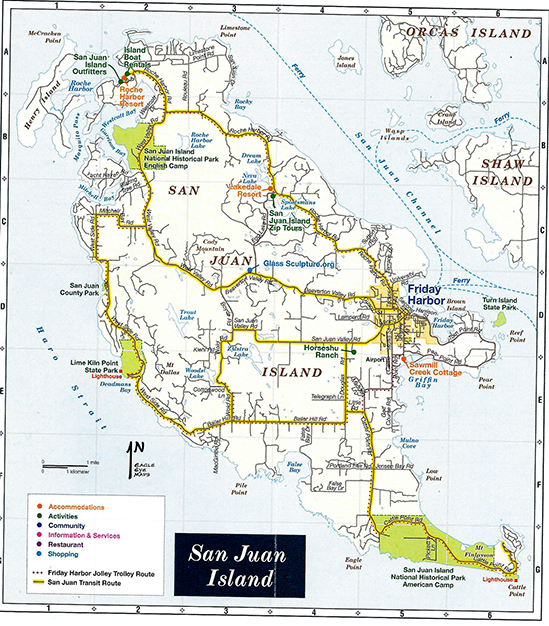
map of Decatur Island and Decatur Head

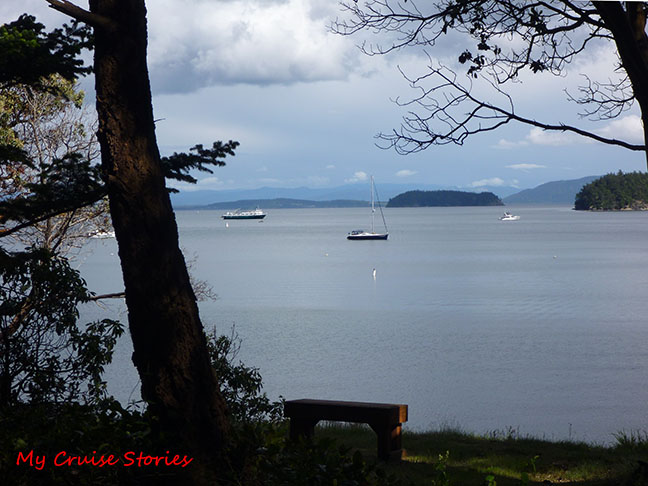
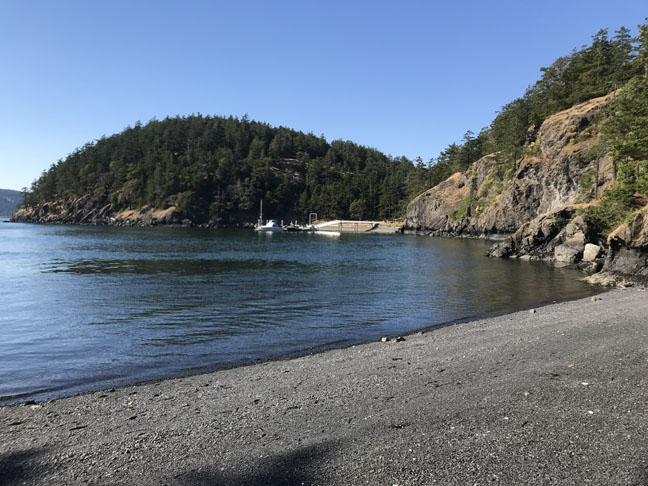
Decatur Head sits on the east side of Decatur Island, connected to the main island by a gravel road and a stretch of beach, which makes it a tombolo. Its rocky hill rises about 200 feet above sea level. James Island, an entire island state park, sits nearby just across the water in Rosario Strait. Decatur is a private island in Washington State’s San Juan Islands, with the only public facility being a public boat ramp.

Decatur Head

Since the 1970’s Decatur Head has belonged to the Decatur Head Beach Association, a group of 40 families that owns the 8 cabins there. 7 are for their use and one for the caretakers to live in. When extra cabins are available, members can bring other family along to enjoy the island too, which is how we get to go there sometimes with my husband’s sister.

looking down over a couple cabins to the dock

Each cabin is different. They sleep from 4-10 people, but have only one bathroom per cabin regardless of how many people can stay there. When the cabins were originally built driftwood and other beach items were incorporated into their construction. While all the cabins still retain some of their original charm, it’s no longer allowed to pick up driftwood off the beach so they lose some of it over the years to repairs and updates. Each cabin has some unique furniture made at least partially out of driftwood and some have things like stairs made from it as well.

pirate ship and merry-go-round

The association’s property extends to the other side of the tombolo where they have tennis courts on the mainland. Alongside the connecting gravel road next to the beach there’s a small playground with a pirate ship and small merry-go-round. The beach goes on for quite a distance (at least at low tide) below the cliffs of the main island while the gravel road goes up a hill passing by the one-room-school, store building, and solar panel power generating station. The entire island is about 3×2 miles with gravel roads to hike around on.

Piper on the dock at low tide

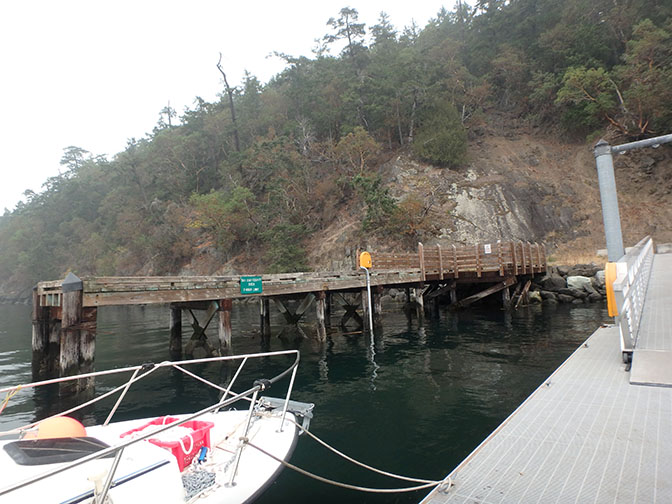
Besides the cabins, Decatur Head has two docks, one in the main bay and one in a saltwater lagoon. There’s also mooring buoys available for people who come by their own boat. The shoreline next to the main dock is lined with a row of rowboats belonging to members of the cabin association. One extra building between some of the cabins has storage lockers for them, and outside that building stacks of crabpots sit waiting for use when their owners come for a stay. Some of them have kayaks residing in racks on the property as well.

low-tide beach on Decatur Head

At low tide you can walk nearly all the way around the head on the beach, but at high tide many areas may have no beach at all. Usually there’s a bit in front of the cabins, but the rest of the head has mostly rock cliffs. Occasionally extremely high winter tides flood the road between cabins making small boats the only way to get from one to another for a few hours.

little trail going up Decatur Head

Small trails lead uphill to the top of the head where there’s excellent views on clear days. The top of the head is forested, like much of the area on most of the San Juan Islands. There, like anywhere on the island it’s possible to come across one of the island’s small deer. The island also sports a herd of wild sheep, but I’ve never seen them.

tree on Decatur Head

One day during our visit John hiked up to the top of the head with me. We came across a tree he said looked like something out of Harry Potter. It was gnarly enough to be the whomping willow, except for the fact that it’s not a willow.

view of James Island

Most of the time we were there on our most recent visit we could hardly even see much of Decatur through air thick with wildfire smoke, but that day we could actually see across the channel to James Island.

at high tide there’s no beach here

Quite a variety of seabirds dot the shores, along with some crows. Other birds inhabit the island’s trees. The mostly rocky beaches are filled with tidal creatures like starfish, crabs, snails, barnacles, sea anemones, and limpets.

Piper on the dragon log

On the side of the head where the cabins are there’s nearly always a bit of beach, but much of the rest of the beach surrounding the head disappears completely at high tide. Around the far side there’s a small indent in the rock with a tiny permanent sandy beach, much of which is occupied by a log that with enough imagination could be a dragon.

almost a view of the mainland from up on the head

The sandy stretch of beach along the road between Decatur Head and the rest of the island collects a lot of driftwood in winter storms and people like to build beach forts out of it. From up on top the head you can clearly see the bit of land connecting it to the main part of the island on nice days. When we were there while the entire western part of the USA was shrouded in wildfire smoke we could barely even see the main part of the island most of the time. Sometimes the smoke from those distant fires was so thick we couldn’t even see the water from the beach.

view of Decatur Head from the other end of the tombolo

Like pretty much anywhere in the San Juan Islands, Decatur is a nice place to go for a relaxing break. Although people live on the island, I’ve hiked all around it and rarely come across anyone.

row of rowboats next to the dock

copyright My Cruise Stories 2021
More Blogs About Decatur Island:

Decatur Island 2015

The Micro Cruise

Decatur Island 2020

Hiking Around Decatur Island

Posted in USA, Washington | Tagged , , , , , | Leave a comment

Venice

Venice Santa Lucia train station is one plain low modern building among tall old buildings

Our last train ride on our pre-cruise trip through Europe before boarding the MSC Lirica went from Innsbruck to Venice via a change of train in Verona Porta Nuova. Luckily it was a long train because it was quite crowded. There were people still hunting for somewhere to sit after it left the station so we were happy to have reserved seats.

public boats stop at the yellow and white vaporetto stations along the grand canal

The scenery was lovely passing through the Alps by train. Eventually snow gave way to the rolling hills and green fields of rural Italy. Nearly everyone on the train got off at our stop in Verona Porta Nuova. There we caught our final train of this journey, which unlike the one we had just left had plenty of open seats. Reminiscent of Australian trains, this one had a small electronic display at the front of the car that said the name of whatever the next station would be so there was fair warning before it was announced.

view of the grand canal from the train station

Our station at Venezia Santa Lucia turned out to be the end of the line. From that station you find docks with boats or watertaxis. To get to this station the trains cross a brick and stone causeway bridge across the lagoon. The Venice Railroad Bridge was completed in 1846. Cars cross the lagoon on a causeway called Ponte della Libertà (Liberty Bridge) built in 1933 next to the train bridge. Prior to that access was by boat only, which was the whole point of the earliest Venetians living there because they knew how to safely navigate deeper channels through the lagoon and their enemies did not. There are places to park near the train station, which is close to the cruise ship port. Once you go to the canal side of the station there are no more cars.

there’s lots of boat traffic in the grand canal and yellow and white vaporetto stations dot its banks

In Venice we booked an Airbnb rather than a hotel room. We wanted a place with a washer and dryer as there were no guest laundries on the ship we were about to board so we at least wanted to start the cruise with clean clothes. The Airbnb was an entire apartment, and gave us a little taste of living like a local since it was in a locals neighborhood rather than the touristy area where the hotels are.

vaporetto in the grand canal

Our Airbnb host had sent directions on how to get there from the train station which included riding one of the public boats called vaporettos. These boats are to Venice like busses are to most cities. We got off the boat at a station facing a church.

view from the bnb of the bridge next to it

The walk to the bnb included crossing 3 little bridges, passing by a museum which was only recognizable by a sign on the door of a building that otherwise blended in with the rest of the buildings, and walking through some “streets” that are really narrow alleyways to a door in one of those small alleys that was the entrance to the apartment building. Our apartment was on the first floor, which luckily was 15 steps up as a few days earlier in a storm and high tide our host said water had come up to the 4th step. The door to the building is at ground level so nobody could go in or out while the water was that high. There was no major flooding during the 3 days we stayed in Venice, but it flooded again soon after we left.

inside the Venice apartment

This apartment was a lot more liveable than the one where we stayed in Zurich. It had a separate bedroom, reasonable sized kitchen, and small area with a couch and TV. It also included a washer/dryer in the bathroom, that being one of the main reasons we booked that particular place as it would be the only chance we got to have everything clean before boarding the ship.

bedroom in the Venice bnb

This was the only place we stayed that had one whole bed instead of two pushed together, and regular sheets and blankets rather than the funny sleeping bag pod quilt and sheet combo things that all the hotels and even the Zurich apartment had.

even the narrowest of alleys in Venice has a street name

Venice is a very unique place. There are no land vehicles in the main part of Venice. Transportation is either over water or on your own two feet. Areas between the buildings run anywhere from alleyways so narrow you can touch the walls on both sides to wide open squares and everything in between.

you can’t touch both sides at once in all the walkways

You can walk down a narrow deserted alleyway, turn a corner and all the sudden find shops, restaurants, wider walkways, or an open square. The canals vary too from narrow strips of water between buildings to the busy grand canal.

one of the bigger bridges (because it crosses the grand canal)

You don’t get too far before coming to a bridge, many of them quite small with just a stairway up and a few feet of flat area to cross before coming to the stairway back down. Navigating through Venice would pose a major challenge to anyone with mobility issues.

neighborhood produce stand

We wandered around a bit our first night there and found a place to have dinner that turned out to be an Italian restaurant run by Chinese people. Since all of the other restaurants near there were also Italian – mostly pasta and pizza places – Chinese food would have stood out, but maybe nobody wants that in Venice. We didn’t come across a major grocery store, but did find little places that sold food so we got a few groceries to bring back to the apartment with us. There are a few small grocery stores and a lot of little stands and small stores that each sell one type of thing like produce or pasta.

fish market

There’s also a fish market that we wandered by a few times. You can smell it before you see it – even if it is closed and there are no fish there at the time.

yard with greenery

Venice is built on stone foundations over wooden poles driven into the ground on what were originally marshy islands in a lagoon so there is no natural ground and greenery in most areas is pretty scarce. A few places have a bit of a yard with some plants.

walkway with trees

Closer to the train station in the more touristy area there is a park and the walkways are often wider. We even saw one walkway there that had trees so it is not entirely devoid of plant life. Of course any plants in a flood zone would have difficulty surviving.

lowest levels are abandoned in buildings that flood frequently

Because Venice sits on ancient poles in water it has been slowly sinking over the centuries, and the rising oceans certainly don’t help matters there any, which is why flooding is a fairly common occurrence in high tides or storms.

making use of a flooded building for boat storage

The lowest level of some buildings flood frequently enough on high tide to have been permanently abandoned. When we took a gondola ride we even saw a boat stored on the bottom floor of one building – which did have water in it.

using google maps in Venice

Our first full day in Venice we intended to start out with a 3-hour free walking tour that would cover all the main attractions. We found our way to the starting point using google maps. Google maps or a similar mapping program is essential for finding your way around Venice.

bridge and canal

Without some sort of directions anyone unfamiliar with the city will feel like a rat in a maze in Venice’s series of often winding pathways between tall buildings with sudden and random changes from very narrow to pretty wide, interspersed with bridges, canals, and open squares.

grand canal

The lying phone weather app said it would not rain until after 1pm so we didn’t wear rain gear, but had umbrellas just in case. Nobody ever uses umbrellas at home regardless of how hard it rains, but I had one from a previous vacation in Florida bought in a downpour that I haven’t used since. It wasn’t raining when we first started out, but more people than not had umbrellas anyway. It started to get a bit drizzly, but until we got to the meeting location and had to stand around waiting after it started raining a bit harder I didn’t bother to open mine.

raised walkways left out from previous flooding

A small restaurant had a large umbrella over unoccupied outdoor seating so we decided to wait there and were joined by a couple girls from Romania, a French couple, and a couple from Australia. Time for the tour came and went and no guide showed up. After about 10 minutes the Romanian girls left. The rest of us waited another 10 minutes before giving up. One of the other ladies said someone from their hotel had booked a boat tour that they paid for and the guide never showed up so at least we weren’t out any money for this tour.

Piazza San Marco (Saint Mark’s Square)

We used the GPS to find Piazza San Marco (Saint Mark’s Square). The closer we got to the square the more little stands we saw selling raincoat style boots and umbrellas. In and near the square pretty much every little shop or stand had the boots. Quite a few people had bought them and were slogging around in puddles in the square.

people in puddles wearing their instant boots

Down near Doge’s Palace the water was deep enough on an incoming tide that platform walkways had been set up so people could cross over the water without getting wet. We saw a lot more of those portable raised walkways – some still set up and some not – in other areas that had recently flooded.

avoiding the flood on raised walkways by Doge’s Palace

Piazza San Marco had quite a lot of water in it that day, though it was not entirely flooded. If you picked the right pathway you could avoid the puddles in the main part of the square, and stay dry at the end by Doge’s palace using the raised walkways. Doge is not the name of a person, but rather a title used by ancient officials.

Doge’s Palace on a dry day

We came back to San Marco’s Piazza another day and things had dried up for the time being.

waterfront by St. Mark’s Square

This is the biggest public square in Venice. Other buildings around the square besides Doge’s Palace include Saint Mark’s Basilica and a clock tower. Some of the other old buildings currently house shops and restaurants. The waterfront adjacent to the square has lots of docks. There are a couple vaporetto stops there as well as gondolas and tour boats.

Rialto Bridge

From there we just wandered a bit and eventually came across a small grocery store so we got a few things and set the map app to find our way back to the bnb. The route it chose just happened to take us across the Rialto Bridge, so tic off another main site. Most of the bridges are just little walkways crossing small canals, but this one spans the grand canal. It’s big and even has shops on it.

shop window of a unique shop with wooden toys

If you’re going to have a shop in Venice, that’s the place to be. Besides the fact that the bridge attracts crowds of potential customers, those shops remained high and dry in the recent flood that so many of the ground level shops were busy cleaning up after. The current stone Rialto Bridge was started in 1588 and completed in 1591. It was preceded by two wooden bridges and the original pontoon bridge of the 12th century, which was the first dry crossing of the grand canal. There are 4 bridges over the grand canal now.

one of the wider canals in Venice

After stopping for lunch at the bnb we went back out and wandered aimlessly for the afternoon, during which time it did not rain proving the lying phone weather app wrong once again. There are canals, bridges, and old buildings wherever you go in Venice so anywhere has interesting things to see. We picked up a few groceries for dinner on the way back. Anyone planning to spend all day out and about in Venice might find it beneficial to carry some change because public toilets cost money.

gondolas docked near a bridge across from the park

Copyright My Cruise Stories 2021
Posted in Europe, Lirica, MSC, Port Cities | Tagged , , , , | Leave a comment