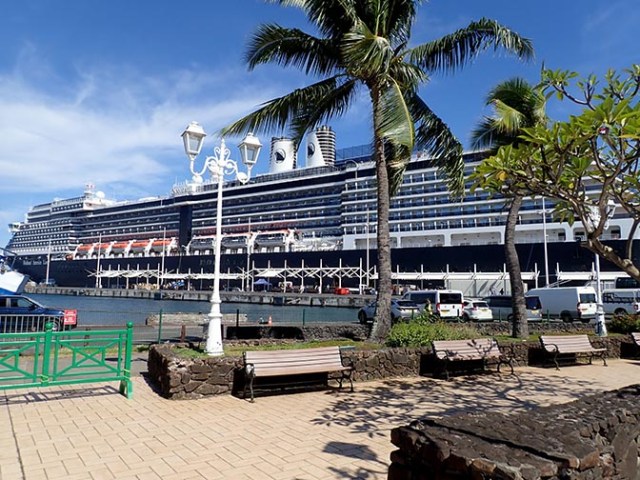
Noordam in Tahiti
Our cruise from San Diego to Sydney, Australia on Holland America Noordam had an overnight port stop in Papeete, Tahiti. We booked the cruise through Vacations to Go. When you book through Vacations to Go they offer shore excursions at some of the ports that are through local companies at that port rather than through the cruise ship. I’ve done a lot of snorkeling, but only one dive and that was years ago at the Great Barrier Reef. Like the one I booked in Tahiti, it was a beginner’s dive where someone looks after you the whole time and you don’t actually learn to read your air supply or how to do anything else on your own, unlike taking a certified diving course where you learn to do everything for yourself.
I don’t know who writes up the information they send people for these sorts of tours, just that it isn’t Vacations to Go, but somewhere more local to the tour. Unfortunately like so many others this tour advised people to bring insect repellant and sunscreen. There are of course no mosquitoes or any other sort of biting insects under the water so it’s extremely bad advice. I’ve never seen a mosquito at any tropical beach or reef either. Anything that kills insects also kills coral. When going anywhere that has coral, bug spray should be banned rather than recommended.
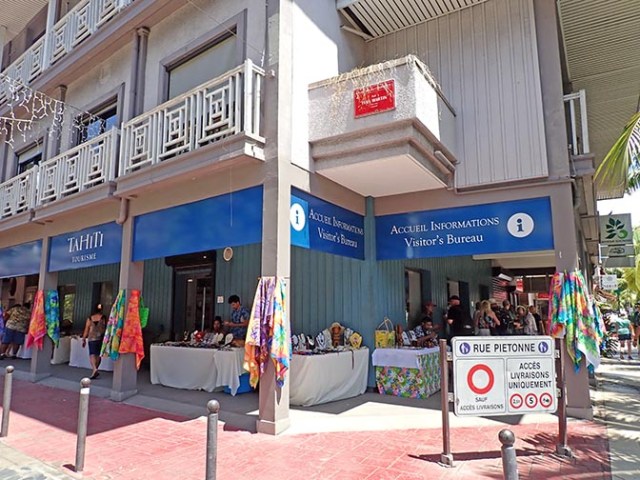
Visitor’s Center
As for sunscreen, when recommending that for any excursion venturing into tropical waters they should specify that it is reef safe because chemical sunscreens are harmful to coral. Coral has enough problems these days without the people who come to admire it unknowingly poisoning it. Most people don’t have a clue that those things are harmful. One drop of chemical sunscreen in the water volume of an Olympic sized swimming pool is all it takes to cause harm so bunches of tourists slathered in it while descending upon a reef are definitely a problem. Luckily mineral based reef-safe sunscreens are becoming much easier to find than they once were, though sadly I have yet to see one in an onboard cruise ship shop. (When mentioning that on the Noordam they said that the stuff in their shop was reef-safe even though the packaging didn’t say so, but the ingredients listed on the bottles said otherwise.) Even better than reef-safe sunscreen, wearing a full-body UV swimsuit prevents the need to wear any sunscreen at all over most of your body and it doesn’t wash off so it protects you longer than any sunscreen ever could.
One advantage of excursions booked through outside sources rather than through the ship is having a much smaller group of people. There were only 4 people on the dive excursion. The other 3 had booked through a couple of different sources. One of them got there on his own. The other 3 of us were picked up by the dive company, called Fluid, right outside Papeete’s Visitor Information Center, which is just across a busy street and down slightly to the right from the port. The one who wasn’t picked up was a certified diver, but the other 3 of us all did the beginner’s dive.
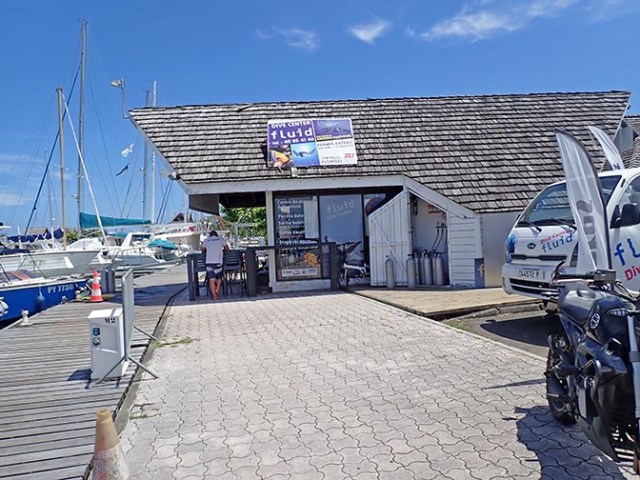
Fluid dive center on the dock
Before we got on the boat we were outfitted with wetsuits, masks, and fins. Both the mask and fins were nicer than the ones I have, but I don’t know what brand they were. Tahiti is a French-speaking country. None of the guests on that tour spoke French, but all of the dive crew spoke at least some English. The main guy spoke it best so he gave all the pre-dive instructions. Once you are under the water all the communication is done with hand signals so the language there doesn’t really matter as long as you understood the explanation and remembered what the hand signals were and what they meant.
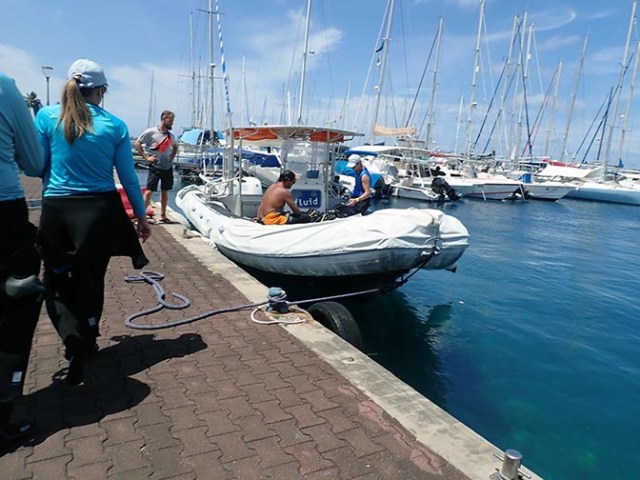
dive boat at the dock
They had enough crew to assign each guest their own guy. For the certified diver it was just a dive buddy because you never want to dive alone. For the rest of us it was more of a dive babysitter who each individually led us around to all the things to see under the water and constantly checked to make sure we were OK, as well as keeping an eye on the gages on our tanks. Most of the time I didn’t see any other divers while we were under the water, but sometimes I saw other people. Not all of them were from our boat.
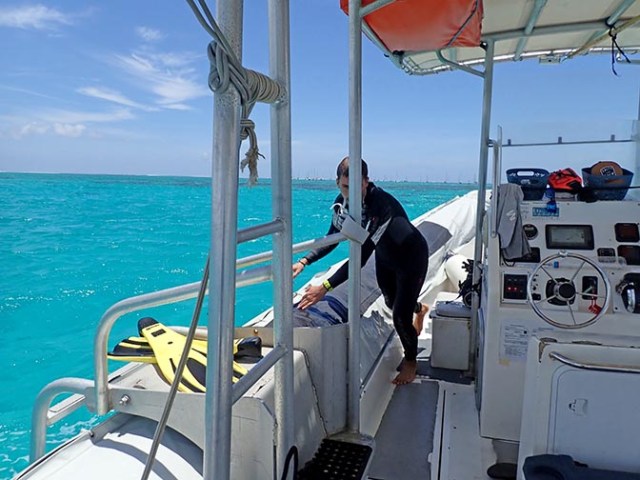
guide on the dive boat
Experienced divers can put their tanks on before rolling off the side of the boat, but for the three inexperienced ones our helpers each put the tank on their person after they got into the water. Before going under we practiced breathing with the air tank because they want to make sure you are comfortable with using it before you go under the water. I was comfortable with it right away so we didn’t spend much time at the surface before going under. It’s not that different from snorkeling except that you carry the air in a tank on your back rather than getting it from a tube above the surface. They also explained how to clear your ears every meter or so when going down initially or when going deeper once you have gone under. Otherwise your eardrums could get quite painful.
 The others went in on the opposite side of the boat from me so I didn’t see how they all went down or how long it took them to adjust to the breathing, but my guy took me to the anchor rope at the bow of the boat and we used hands on that to get under the water. At least I did. He probably just swam down. The tank was on a vest that could have air added or removed at the press of a button if he wanted us to go deeper or shallower. After we swam around partway down for awhile he added a couple weights on me and we went down to the bottom. It was mostly sand, but there were some small coral reefs, a crashed small airplane, and a couple of sunken boats. Oddly enough there was also a table and chair with something that looked like an open algae-covered laptop computer sitting on it.
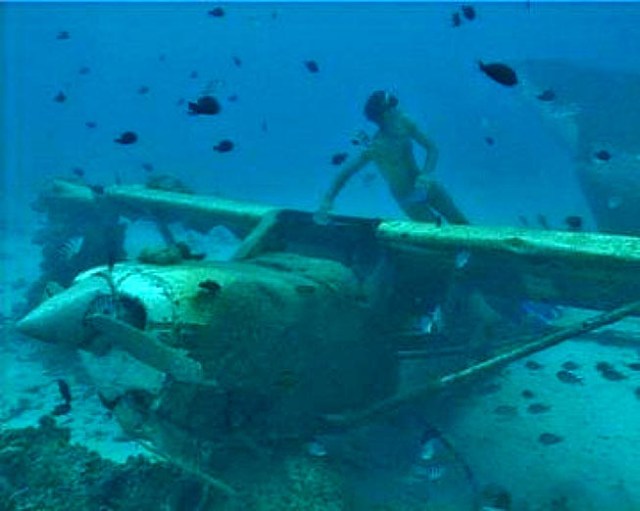
sunken airplane (internet photo)
The place we went was called the aquarium, but it was out in open water and not in a tank at an actual aquarium. Probably called that because of all the fish that live there.
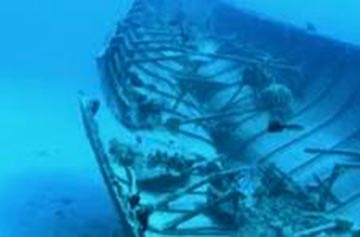
sunken ship (internet photo)
In one spot somebody had arranged dead bits of coral into a heart. Unfortunately coral worldwide is dying off and this was no exception with more dead bits of coral scattered about than live reefs. Besides bug spray and chemical sunscreen, reefs face many other dangers including damage from storms, pollution, and rising ocean temperatures. Things like overfishing affect them as well because there is a natural balance among the things that live on the reef and removing too many fish can allow suffocating algae to grow. Crown of thorns starfish also can damage reefs. Not all algae is damaging to coral. The small polyps that together make up the whole coral each live with a symbiotic algae that provides much of their food source, but becomes toxic when the ocean temperatures rise too high. Then the coral expels it and becomes bleached. It can’t live long without it though so if the water stays too hot for very long the coral dies. Coral reefs are the base of the food chain for much of the other life in the ocean.
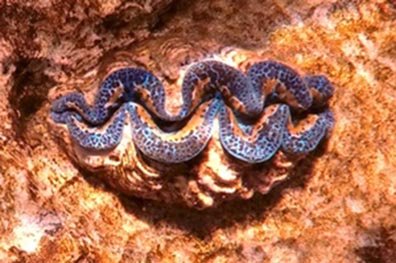
clam (internet photo
I saw lots of fish below the sea. Some brightly colored, some not so much. Some were parrot fish and some were puffer fish, but I don’t know what all the rest were. I saw a couple hermit crabs in snail shells, the first pointed out by my guide and the second I just spotted. The other people did not see those, but one of them saw a clam.
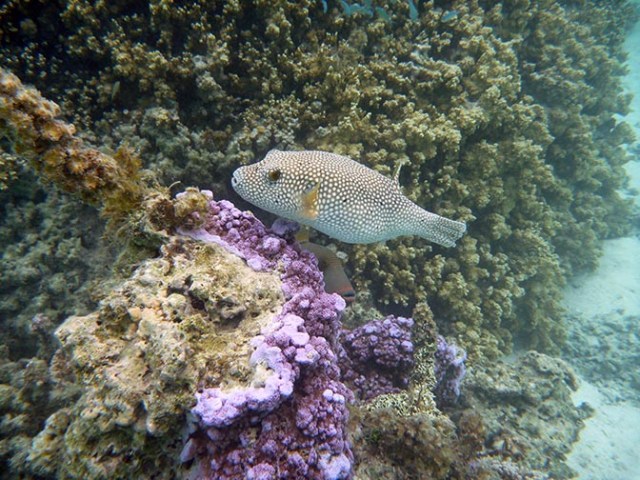
puffer fish (photo from snorkeling in Morea, but I saw the same kind of fish on the dive)
My guide found a dead sea urchin shell on the bottom, and later I could see some of the spines of a live one hiding in some coral. I didn’t take my camera under the water because I didn’t know if the dive would exceed the limit of how deep the camera can safely go. I thought there’d be a lot more photos of the unique objects at that site online than there actually are.
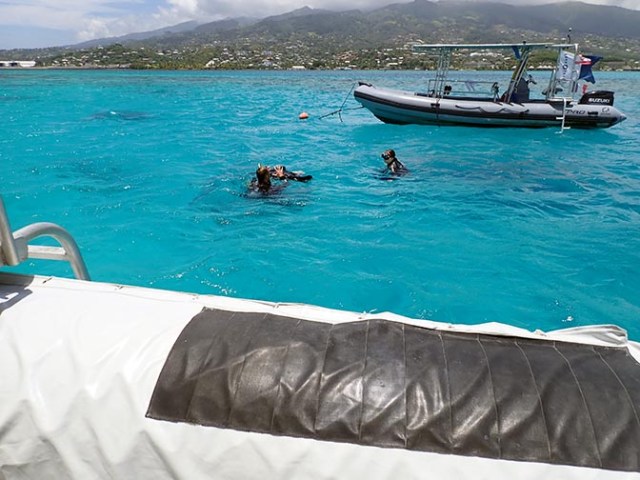
people returning to the boat after diving
After surfacing they took our tanks off in the water so we didn’t have to climb up into the boat wearing them like an experienced diver would. Once onboard we were offered pineapple juice and cookies before heading back to shore. It’s a fun way to have a chance to go scuba diving if you are not a certified diver.
Copyright My Cruise Stories 2025


