Food on Holland America Oosterdam Antarctic Cruise

parmesan crusted chicken

Food is always a big part of cruising. There are a lot of consistencies when sailing on the same line from one cruise to another, but even on the same ship there will be some differences whether due to the itinerary, the current head chef, or changes made by the cruiseline. Often all three. Some chefs are just better than others, some meals are itinerary specific, and cruiselines like to switch things around sometimes.

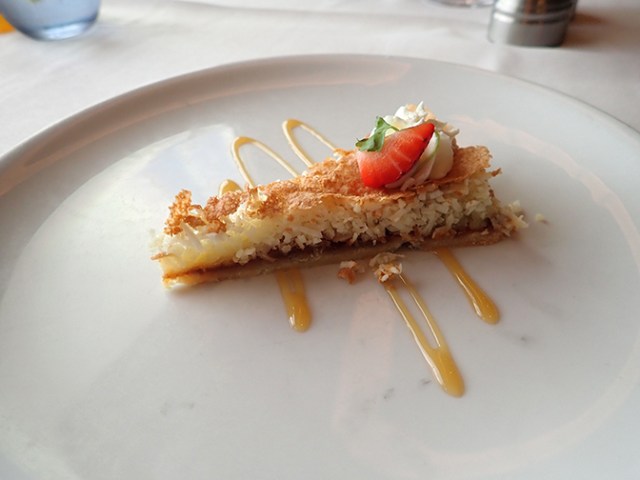
this chef never made gluten free pie crust

Differences in chefs are especially noticeable when requesting special diets. Gluten free for instance, sometimes they just send out food with no sauces or any other sort of topping and have maybe one thing available for dessert that is the same every day. Other times you get a gluten free version that is pretty much the same as whatever the regular one is. Some of them can make some pretty impressive desserts with something different every night too. Others not so much. The best we ever had was on Symphony of the Seas when ships first started sailing right after covid and there was hardly anyone onboard. The chef on that ship made different special desserts every night that were both gluten and dairy free. He even made a gluten and dairy free Grand Marnier soufflé and it was fantastic. The next year we went on Wonder of the Seas and the chef on that ship did not make any gluten free desserts. There we were told even simple gluten free desserts were impossible for them to make. One extreme to the other on similar ships both from Royal Caribbean, a line which normally has a gluten free section in the buffet, but on Wonder it did not.

pastry squares

Our cruise to Antarctica for the most part had different pastries at breakfast than what are the usual standard on cruise ships. The were denser, not as soft, flakey, or good as the usual ones. They also had a little blob of filling in the center on top rather than having filling inside of the entire pastry. They did still have normal croissants and pains au chocolate, which were better than the new type of pastry. It may be that the regular ones aren’t available in South America rather than that the cruiseline made changes. Some of the usual sort did appear at the very end of the cruise after a port where they onloaded new supplies.

serving soup in the dining room

On Holland America the main food onboard is the free food options at the main dining room, which is open every day for breakfast and dinner and on sea days at lunch and the buffet which serves breakfast, lunch, dinner, and a late-night snack daily. Breakfast is same menu every day. Dinner has some things that are the same every day and some that change from day to day in both the dining room and at the lido buffet. The lunch menu also varies, but the buffet has some everyday items then too.

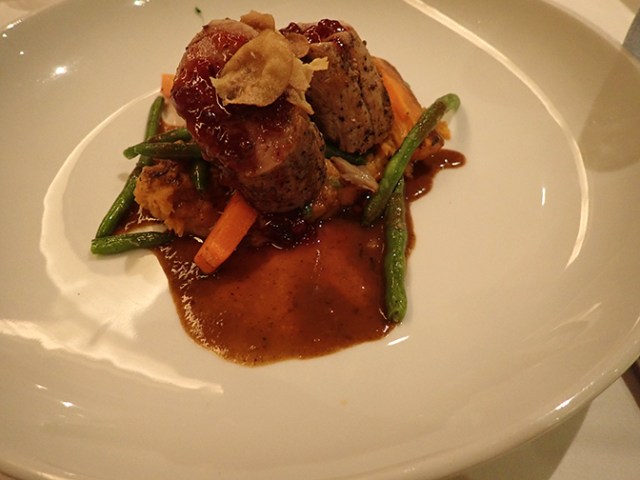
duck starter in the dining room

Free food is also available at the dive-in poolside burger grill which is open noon to 6, and a taco bar next to the dive in. There are also sometimes free pastries or cookies available at the Crow’s Nest bar, but the drinks there cost extra. Premium eateries on the Oosterdam are the Pinnacle Grill which serves breakfast and lunch at an extra cost, and Canaletto which serves Italian food at dinner for a fee in a reserved section of the Lido buffet.

nachos from the taco bar

At the Dive-In you don’t have to order the burgers specified on the menu. You can add or subtract toppings or change the patty to one offered in a different burger like if you want chicken instead of beef. They also have the option of substituting beyond meat patties and gluten free buns for what’s on the menu. Food is free there, but milkshakes cost extra.

4 renditions of flourless chocolate cake

Special diets can order meals ahead in the dining room. Mostly they do a good job, but sometimes they aren’t accurate. No salt meals sometimes came salted and requesting small portions often came with larger portions than people who didn’t. They weren’t very good at gluten free desserts. Mostly anything involving cake was just some sort of rendition of their standard flourless chocolate cake and anything involving pie meant a bowl of the filling served pudding-like with no crust. Once they made what was supposed to be pecan pie with a chocolate cake bottom that wasn’t the flourless one which proved they can actually make a gluten free cake or something that resembles a slice of pie, but that was the only time they ever did anything like that. It was the best gluten free dessert of the entire cruise and I didn’t get a picture of it.

this is what you get when ordering gluten free pie

If you have more than one person on a special diet, make sure they give you separate papers to request it on. They tried making us use one paper with person A and person B the first night, but the result was if both people ordered the same thing we got one serving. And one of those happened to be that pie that was the one and only really good gluten free dessert that they made during the entire cruise so we had to share one little piece. They can accommodate special diets at anytime dining, but it works out better with a set time and table so you always have the same waitstaff who know what your needs are.

afternoon tea

Afternoon tea is available in the dining room. People are seated with random other people in the order they enter the room. Waiters pour tea for everyone and little stands of goodies are placed on each table for people to eat what they want from them. Tables with more people get more stands of goodies. There are tea sandwiches on the bottom, scones in the middle, and sweets on top. None of that was gluten free.

hot drink and pastry at the Crow’s Nest

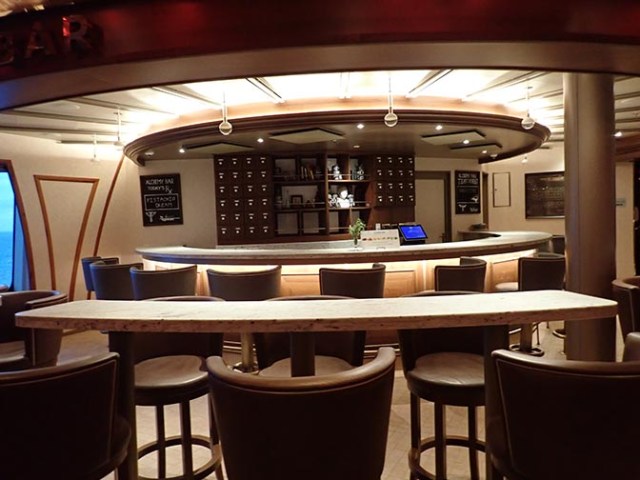
Some things to drink are available at the Lido 24 hours a day. Pastries are available at the buffet earlier than when the rest of the buffet opens. There’s just one coffee bar in the Crows Nest for specialty hot drinks available at any time of day, but the Pinnacle Bar serves coffee in the morning.

Mariner Lunch

Sometimes there are special food events. There’s normally a Mariner Lunch at some point during any Holland America cruise. This is a special lunch in the dining room where anyone who has previously sailed with Holland America is invited. So everyone who is not on their first cruise with Holland America. The menu on this cruise had several starters to choose from, 3 mains, and everyone got the same dessert. Starters were soup, salad, or shrimp and mains were beef, fish, or vegetarian.

all kinds of cakes

One day they had an event called Cake Me Away with one station full of cakes in the Lido buffet at lunchtime. For about the first 15 minutes after lunch started they had had the cake station roped off so people could take photos of all the cakes before they started serving them. It wasn’t too crowded then, but once it opened it was a madhouse with people crowding the entire area anywhere near that station.

mini cupcakes at the chocolate surprise

On the same evening of the day with the cakes they had their chocolate surprise event. Since this was a long cruise with a lot of sea days it seemed like pretty poor planning to have both of their special dessert events on the same day. Especially since they also had a Carnival games event that very same afternoon featuring popcorn along with the games. The chocolate surprise evening is when groups of kitchen crew bring out trays of various chocolate goodies and pass them out to whoever is in the area. Finding the door where they come out with the trays is a better way to score a variety of options then hanging out where the cruise director says to be. The lounge where he said to wait on this cruise was quite a ways away from where the people with trays came out. After about 10 or 15 minutes past when the event was supposed to start a couple people with trays finally made it to that lounge. I figured it would be the same with other items so went down the hall in the direction they came from, past another lounge full of people, and on to a nondescript door in the wall where I happened to see the next batch come out. Waiting by that door was the place to be. Each time it opened a group of about 15 or so came out, all with trays of the same thing. Later another group would come out with something different. There weren’t a lot of batches of different things on this cruise, maybe 5 or 6 items. Chocolate options that I saw were mini cupcakes, chocolate with what looked like peanuts dusted in cocoa powder, white chocolate rice krispie bites, and chocolate covered cheerios. Those looked like chocolate covered raisins, but the people with the trays said they were cheerios. That was the last thing to come out and apparently not very popular because unlike the other items where people returned with empty trays, this group came back with a lot left.

too much chicken

Dinners in the dining room (and lunches too) have 3 courses with starters, mains, and desserts. Sometimes the starter portions are just a bite or two and sometimes a lot more. Mains are often way too much food. Regular desserts are generally a small portion, but for some reason they made the gluten free ones way too big. Even when asking for small portions I was usually served way too much.

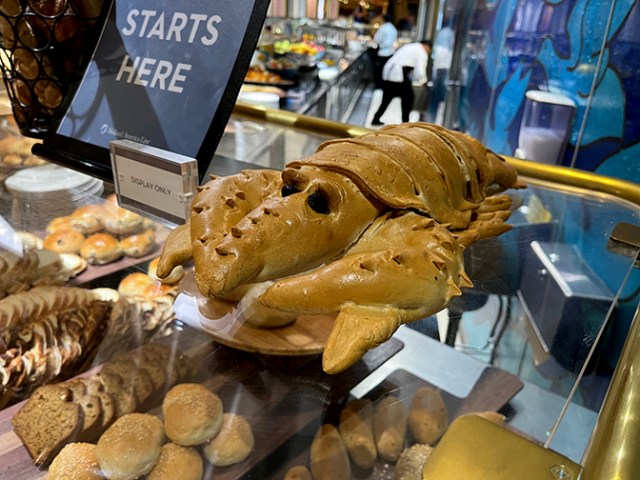
breakfast breads at the buffet

Food on Holland America is generally pretty good and the Oosterdam met expectations.

Copyright My Cruise Stories 2025
Posted in Cruise Food, Holland America, Oosterdam | Tagged , , , , , | 1 Comment

Thanksgiving on Viking Skirnir

roast turkey

We weren’t sure if Thanksgiving would be celebrated or not on our Viking cruise since it is a European cruise line in Europe where that’s not even a holiday. Many of the passengers on our cruise were from the USA, with Australia second in number. Thanksgiving is not a thing in Australia any more than it is in Europe, but they did have Thanksgiving dinner food on the menu along with other options.

one of many Christmas markets in Vienna

We happened to be in Vienna on Thanksgiving so we spent the morning touring through the city. Vienna has lots of historic buildings and beautiful old churches. It also had an abundance of Christmas markets.

The menus each night on the Viking ship include a few options they serve every day, a selection of local foods from wherever we happen to be, and some items served just for that night. The one night only things served on Thanksgiving were items usually served on Thanksgiving in the USA – or in Canada because they celebrate Thanksgiving too, but not on the same day. Theirs is in October.

potato soup

The Thanksgiving offerings included corn fritters for the starter, which is not something I would associate with Thanksgiving, but maybe some people do. Or they just had to have something and thought that sounded American. The Austrian option for the starter was potato soup by a very foreign sounding name since it was in German. The soup is what everyone at our table ordered.

turkey dinner

The main course included turkey, mashed potatoes, sweet potatoes, stuffing, gravy, and green beans, so a pretty typical Thanksgiving dinner menu. Everyone at our table ordered that including the two Aussies (Australians, not Austrians). The Austrian option was a trio of dumplings. Austria and Australia are two very different countries, but some people must mix them up because there was a lot of merchandise like t-shirts and hats and things in Austrian gift shops proclaiming that there are no kangaroos in Austria.

Sachertorte

For dessert the Thanksgiving selection was pumpkin pie while the Austrian one was Sachertorte, an Austrian chocolate cake. I ordered the Sachertorte and everyone else got the pie. The torte was delicious, very moist and fudgy. They all thought the pie had too much nutmeg. I might have liked it though. I like nutmeg.

pumpkin pie

A full roast giant turkey sat at the station in the middle of the dining room where they set up the buffet during breakfast, but it was turkey roll on the plates they initially served. Later during the meal when people were getting pretty full they brought around a plate of fresh carved turkey from that roast so people did get to try a little of it. I’m guessing that they don’t have oven space for more than one turkey and that isn’t enough for everyone because that is the only thing that makes sense for serving turkey roll as the main course and tidbits from the actual turkey later.

Overall it was a good dinner. It was nice to have a Thanksgiving dinner even though we were in a country far from home that doesn’t actually celebrate that holiday. While a full serving of actual roast turkey would have been better than turkey roll I’m guessing they did what they could and it was nice that they made the effort. As far as I know none of the crew were American or even Canadian.

Copyright My Cruise Stories 2025
Posted in Cruise Food, Europe, Skirnir, Viking | Tagged , , , , , , | 1 Comment

Aruba by Land and Sea

Casibari Rock Formation

Aruba

Aruba’s motto is One Happy Island. There are lots of beaches on the 70-square-mile island. The country is an autonomous member of the Kingdom of the Netherlands. Prior to 1986 it was part of the Netherlands Antillies, but gained partial independence and is now self-governing. Aruba has a dry arid climate with mostly warm sunny weather year-round. Annual rainfall is about 15-18 inches per year.

Aruba Cruise Port

Ships dock at the Aruba Cruise Terminal in the capital city of Oranjestad. There are 3 docks. Usually there are no more than 3 ships docked at the same time, though the port has capacity for 5. There are some shopping booths at the port which may or may not be open. It’s a short walk into town from the dock. There’s a free trolley that runs to town on a continuous loop for those who would rather not walk. There will likely be taxis available at the port for taxi tours or to take passengers to a beach.

Casibari Rock Formations on the Aruba by Land and Sea tour

Excursions offered in Aruba on Nieuw Amsterdam included Atlantis Submarine, certified scuba dive, off-road 4-wheel drive adventure, 4×4 to natural pool for swim & snorkel, snorkel & beach, sailing & snorkel, hidden gems of Aruba, Aruba by land & sea, natural wonders of Aruba, Kukoo Island Discovery & beach (Kukoo is the name of the bus, not another island), Aruba walk & taste, eagle beach express, discover scuba diving, colors of Aruba, and Aruba town & countryside

semi-sub

Aruba by Land and Sea

For our port stop in Aruba on Holland America Nieuw Amsterdam we booked a shore excursion through the ship called Aruba by Land and Sea.

Ship’s Information About the Tour

Information provided by Holland America for booking this excursion said a ride on the Seaworld Explorer semi-sub provides views of the wreck of the German freighter Antilla and the land portion of the tour visits the Casibari Rock Formations and the Baby Natural Bridge. The tour was said to explore the full beauty of Aruba on a tour that takes you around the island and under the sea.

The Seaworld Explorer is a semi-sub which does not fully submerge. View the ocean from the hull of the vessel 5 feet under the surface of the water. Must be able to descend 10 steps into the vessel. View amazing sealife and the Caribbean’s largest shipwreck through large clear windows.

Return to shore for a panoramic drive to the California Lighthouse where you can admire the magnificent view of the crashing waves of the windward coast and tranquil waters of the leeward shore. From here continue to the awesome Casibari Rock Formations and climb the rock gardens to the highest boulder. You will then visit the Baby Natural Bridge – a bridge of rock formed by the wind and the sea. Finally keep an eye out for the gold mill ruins at Boca Mahos en route back to Oranjestad, Aruba’s capital.

stairway up the rock

The Actual Tour

The Aruba by Land and Sea tour started out meeting in front of the port building shortly after the ship docked. It was early in the morning so there weren’t any lines to get off the ship. Nothing was open yet so the only people who had any reason to leave were those with early tours. After checking everyone in and getting on the bus we headed to our first destination at the Casibari Rock Formation. This little rock mountain and surrounding rock garden reminded me of the Baths at Virgin Gorda, but without the pools. It looked a lot like batholiths, but actually consisted of tonalite boulders. Tonalite is an intrusive igneous rock, meaning it forms from magma that cools slowly beneath the Earth’s surface. These are often a component of batholiths, but batholiths which are also formed from slowly cooled magma form deeper in the earth and contain other types of rock. Tonalite forms from one magma intrusion whereas batholiths form slowly over millions of years and combine multiple intrusions. Both surface through tectonic uplift and erosion. Batholiths cover a larger area above and below the surface.

you have to go through this hole in the rock

There is a stairway up to the top of the Casibari Rock Formation. At one point people have to duck down and go through a hole in the rocks. The guide warned us to keep our heads down, but the rock got some people anyway because as you approach the end of the tunnel the overhanging rock is just a bit lower than what you are already ducking for, right about the spot where you think you’re just about out and people are more likely to start lifting their heads up rather than ducking down farther. Plus if you are already ducking down you’re more likely looking down than up and may not see that lower hanging bit of rock.

people on top of the rocks

At the top of the rock hill there’s a sort of flat spot. It’s not level, but not so steep as the hill either. Kind of a little bit of ups, downs, and uneven spots in what would otherwise be a somewhat flat, but slanted hilltop with fantastic views all the way around.

view of Hooiberg and someone coming up the down stairway

It’s not the only high spot in mostly flat Aruba. From the top you can see Hooiberg, a conical volcanic hill that is Aruba’s second highest point at 541 feet (165 meters) above sea level. Though it is a volcanic formation, Hooiberg is not active. There are no active volcanoes in Aruba. The highest point is called Mt. Jamonta which stands 620 feet high.

dogs don’t read signs

A different and more direct stairway takes people back down. Near the bottom of that there’s another stairway leading up a lower little rock hill. The surrounding area has gardens and pathways and more giant rocks. There were a couple dogs there who apparently didn’t see the no dogs sign before they came in. They didn’t belong to anyone, just stray dogs who came in on their own.

pathway to more rocks at Casibari Rock Formations

Though the place was fairly small, there was more to explore there than we had time to see on a brief stop on a cruise ship excursion.

a smaller rock formation

Whenever the bus was traveling the guide, who was a wealth of local knowledge, told us all about island history and lots of information about things we passed by as well of things we went to see. His local knowledge version of island history passed down through the generations differs from official versions where the names of the original inhabitants’ tribes are either lumped together under a different name or left out altogether and there are inaccuracies in the official version of interactions between the original local tribes. Official versions are from the view of invading Europeans whereas the islander’s version comes from their ancestors’ side of the story.

collapsed natural bridge

The next stop brought us to a natural bridge. The island has others, but she said this was the only one currently accessible by motor vehicles. There used to be two in that spot, but the larger one has collapsed and now just looks like enormous rocks lying on the beach.

Baby Natural Bridge

The small one, which is actually quite large, is still intact, though she said the collapse of the larger one weakened it putting it that much closer to its own eventual collapse. The water pooling under it was full of seaweed.

stacked rocks

There were multiple piles of rocks all over the area where tourists come and build rock stacks. According to our guide, two of three species of lizard native to the island have gone extinct because they lay their eggs under the rocks and when people pick those rocks up to stack them all of the eggs blow away. So don’t be the tourist that stacks rocks without being aware of the environment and any harm that it might cause. This isn’t the only place where rock stacking tourists damage the environment.

transport boat to the semi-sub

After the first two land stops the bus brought us to a pier where a boat picked us up to take us out to the semi-sub. This one was run by Atlantis, the same company who has the Atlantis subs, which are actual submarines that dive down deep into the water. Semi-subs have a top portion that stays above the water and a below-water-level window-lined chamber passengers descend into to view fish and whatever else is under the water through the windows. The submarine tour in Aruba cost a lot more than the one we took on the semi-sub.

a piece of the shipwreck

Unfortunately the destination for the semi-sub on this tour was the wreck of the German freighter Antilla, which I have already seen twice on snorkel excursions on previous trips to Aruba. There are other wrecks in the area as well as reefs. This is biggest wreck. It would be nice to see something different, but I always end up at the same one. At least the semi-sub went to a different part of the wreck than where the snorkel boats go.

fish ID chart in the semi-sub

The water was pretty hazy so there wasn’t a clear view of anything that didn’t come right up to the window. It also didn’t help that maneuvering the vessel meant an explosion of a cloud of bubbles from a little propeller on one side or the other that looked much like the sort of portable fan people use to cool their homes and we were sitting at windows right next to them. The little propellers were even in little cages that looked just like the ones around a free-standing fan.

snuba people exploring the wreck

The wreck is 80 feet long and in pieces so you can never see all of it at once. The people getting the best view were the scuba divers and also some people doing snuba, which is sort of a combination of scuba and snorkeling. They have a hose going to a surface air supply rather than carrying a tank on their back like scuba divers or getting air from just above the water’s surface through a tube like snorkelers. Our ship did not offer snuba, but they likely came from one of the many hotels near the dock where we boarded the boat that took us out to the semi-sub.

fish outside of the semi-sub

There were lots of fish near the wreck and sponges growing on it. Also lots of people snorkeling, though they were in a slightly different area of the wreck than the semi-sub. The divers and snuba people came closer since they were at or near the bottom rather than on the surface. The snuba people would need to watch for boats though since their air is surface supplied. They did not get close enough for the semi-sub to interfere with their equipment.

snorkeler from the semi-sub crew diving under the water

One snorkeler did come close, but he was from the semi-sub crew, giving people something to see with his antics and feeding the fish so a bunch would come close to our windows. Some blue tangs had already come up to the window, but he brought in schools of snappers and sergeant majors as well as some other fish. He was able to free-dive all the way to the bottom with just a snorkel where you can only get air at the surface. Apparently he could hold his breath for a long time since he stayed down there quite awhile.

Near the end of our time in the semi-sub a turtle swam close enough for us to see it. It was clearly visible, but a bit too distant for cameras or phones to get a decent photo of it. Then our time there was over and we had to take the ladder-like stairs back to the surface and wait for the boat to arrive and return us to shore.

California Lighthouse

The last stop on the tour was the California Lighthouse. It was not named after a place, but rather after a ship called California that sunk there before it had a lighthouse to warn it away. Of course, the ship could have been named for a place. Like many lighthouses in earlier times a lighthouse keeper had to man it, but it’s automated now. The former keeper’s house got turned into a restaurant. There was also a food bus next to the lighthouse.

Lighthouse Keeper’s house turned restaurant

People can climb to the top, but we only had 15 minutes at that stop and you have to pay to climb it so we just took photos from the ground. We saw lots of birds landing on cactus there, pecking at it so it must be a food source for them. A couple tiny lizards ran from a barren rocky area into some groundcover vegetation to hide. There were not any stacks of rocks in that area. Probably too much cactus for people to look for any rocks they can stack, much to the benefit of the lizards or perhaps that species might die out as well.

birds by the lighthouse

It was very windy at the lighthouse with enough sand blowing around to turn the air the color of sand. Our guide said people can order a meal at the top of the lighthouse. It comes from the restaurant in the keeper’s house so the server has to walk all the way from the restaurant to the lighthouse and then up all the stairs to the top to get the food there.

We did not have to show our ship cards when embarking or disembarking the vessel this cruise, they just scanned our faces. We still needed the cards for room keys, onboard purchases, and to get through security at the ports though. One lady fell asleep on the bus on the way back and then when the port security guy came onboard it took her forever to find her card after someone woke her up so we sat at the gate for a very long time when otherwise it would have just been quickly hold up the cards so the security guy can see them and be on our way.

We enjoyed this excursion. It was a different view of the wreck than from snorkeling and I hadn’t seen any of the land sites that we went to before. My sister hadn’t even been to Aruba before so everything was new to her.

Copyright My Cruise Stories 2025
Posted in Caribbean, Holland America, Nieuw Amsterdam, Ports of Call, Shore Excursions | Tagged , , , , , | 4 Comments

Vava’u Tonga Cruise Port

Noordam and tenders at Vava’u

Neiafu, Vava’u Tonga

Neiafu is the second largest city in Tonga with a population around 4000 people. It is located in the island archipelago of Vava’u, which encompasses about 50 islands in the north of the Kingdom of Tonga and a population of around 14,000. The area is popular for water sports and whale watching. Its sheltered waters make one of the best sailing spots in the south pacific. The average daily temperature is 79 degrees F, with annual average rainfall of about 83 inches. Currency is the Tongan Pa’anga. One Tongan Pa’anga is worth about 40 cents on the US dollar.

tenders at the dock

Vava’u is a tender port. The distance from ship to shore by tender was a bit farther than the previous tender ports on this cruise. The water wasn’t as rough as some of the other tender ports though so the journey from ship to shore was pretty smooth even though it seemed as if the tender drivers from our ship needed quite a lot more practice, especially when it came to docking.

shore excursion meeting place

Near to where people disembarked the tenders there was a long narrow shelter where people stood with numbered paddles waiting for guests with shore excursions. From there people getting off the tenders could find the person with the number matching the one on the sticker they’d been given on the ship when checking in for their excursion. Once the entire excursion group checked in the person with the paddle led them to their transport, whether that was a bus at the port or a boat at a dock down the road a bit.

buildings at the port

It rather looked as if it’s either hard to find a car in good condition, or there aren’t any places on the island that do body work, or maybe most of the people just can’t afford a good car. The majority of the vehicles that went by looked as if they had been in a wreck or had gotten quite old and worn out. Nearly all of them had dents, missing windows or other bits of the car, or just looked rather banged up. The busses looked pretty ancient too. They did announce onboard that anyone going on a bus tour could expect neither air conditioning nor bathrooms on the bus. Bathrooms are rare in shore excursion busses in most places, but they are often equipped with AC, which more often than not they have turned up way too high.

dancers at the port

The port had a number of craft booths set up as well as a couple shady areas for people to sit and listen to a band play and/or watch some native dancers.

fruit market near to the port

Early in the morning there were locals out with signs for last minute tours, but once their vehicles filled they were gone so the tours were only available to people who got off the ship early enough to get there before they were full.

bar near the port

Tendering off the ship took a long time for anyone without a shore excursion or an early tender ticket. The queue for the line to catch a tender back took nearly an hour in the early afternoon when shore excursions started to return.

building where the band played

We saw someone on a scooter zip down outside the fence around the port area and then try to come into the middle of the tender line through an opening in the fence by a bathroom, but she was turned away from the line so she went into one of the little shelters to listen to the music instead. Having previously seen this same person yell at both the ship’s official photographer and crew members who were actually part of a show out by the back pool to get out of her way because they were blocking her view we knew she was quite the entitled person and were happy to see her not get her way that time. At the show both the photographer and the crew people had moved for her.

line for a return tender

Excursions offered from the ship at this port included several snorkel options and several land and beach tours. In the afternoon the line to get on a tender and return to the ship ran all the way from the tenders to one of the buildings, then made a right angle and headed on outside of the gate into the port.

Copyright My Cruise Stories 2025
Posted in Holland America, Noordam, Pacific Ocean & Islands, Ports of Call | Tagged , , , , , , | Leave a comment

Grand Turk Beach Day at the Port

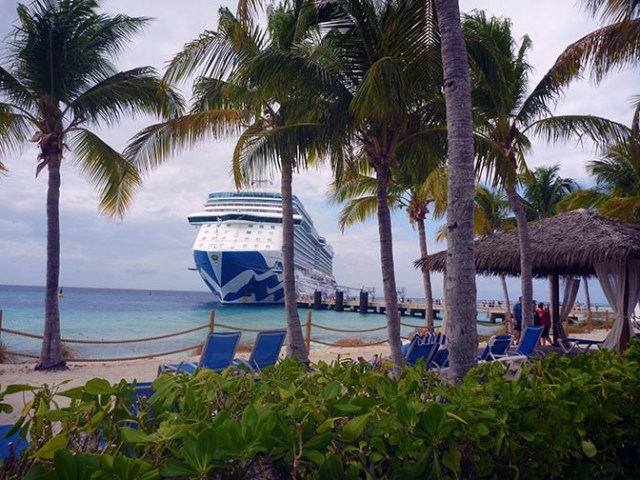
Enchanted Princess at the dock in Grand Turk

Grand Turk is the largest and capitol island of the Turks and Caicos, a British overseas territory. Divers come to the island for spectacular wall dives on its nearly 7000 foot wall. Tourist attractions on Grand Turk include an 1852 lighthouse, 1823 church, a salt museum, and Cockburn Town. Feral donkeys roam the island, descendants of those who once worked the salt ponds.

shops at the Grand Turk cruise port

Cruise ships dock right at a nice sandy beach. You have to go through a duty-free shop to get to shore. Only people from the cruise ships can go through the door on the dock side of the duty-free store. You have to have your ship ID to pass through security there. The port has some of the usual cruise port shops, some other shops, and a crafts market.

swim-up bar in Margaritaville

The most popular hangout is Margaritaville, which has a pretty extensive shallow pool with swim-up bar. There’s also an indoor bar there where people can get drinks without getting wet.

space exhibit at the port

The port has a little historical exhibit with space stuff from the 1962 apollo splashdown there after John Glen became the first American to orbit the earth.

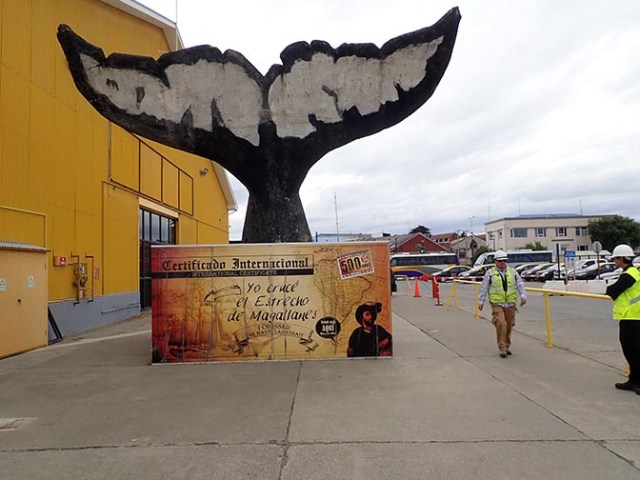
whale statue

There’s also a whale statue on the beach. Most people pose briefly for photos with it then go someplace else, but the guy in the picture stood there obliviously forever so I gave up on him ever leaving and took a photo anyway.

whale statue and Enchanted Princess

The whale statue is conveniently located where you can get pictures of it with the ship in the background. When we went back to the statue later the guy had finally left.

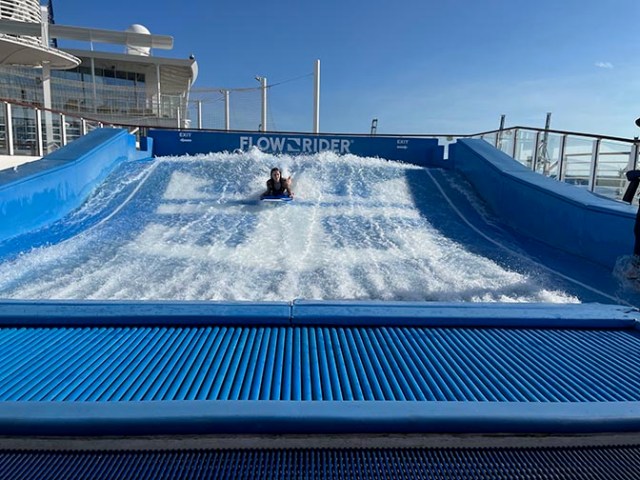
flowrider

The port has a flowrider, which people can go on for a price.

last minute tour booth

The port area also has a taxi stand where people can get island tours or taxis. Tram tours are available there too.

things to do at the beach

The chairs on the beach on the far side of the dock from the main beach were free, but all of the ones on the main beach had a charge to use. There are a lot of little beach bars along the beach just beyond the cruise port area, each with its own set of chairs. A sign at the edge of the first one advertises all sorts of things people can do for fun. They all cost money of course. Other bars down the beach also have chairs available and stuff to do.

fish at Grand Turk

It’s free to put a towel on the beach to sit on, and to swim in the roped-off area allowed for swimming. If you have your own gear you can snorkel there for free too. If not you can rent it at the beach. There’s not much in the way of coral, just tiny bits here and there. There is a lot of rocky structure though, and fish like structure. Near shore the fish are small, but out deeper they get bigger. The biggest ones are out beyond the area where people are allowed to go.

fish

On our visit to Grand Turk on the Enchanted Princess we hung out at the beach, which turned out to have the best snorkeling of that trip. The water was nice and clear there so the fish were easily visible. The next time we went to Grand Turk on the Nieuw Amsterdam there were some trampoline things in what had previously been the best snorkeling area so the snorkeling then was pretty limited. On the plus side there were more free beach chairs that visit, but all of them were out in the sun.

Margaritaville pool

It’s a good port for people who just want to get off the ship and hang out. The beach is right there for anyone wanting a beach day, or the pool at Margaritaville for anyone who prefers pools. Plus with shopping, bars, and restaurants it has stuff to do for people who don’t want to get wet.

Copyright My Cruise Stories 2025
Posted in Caribbean, Enchanted Princess, Ports of Call, Princess | Tagged , , , , , | 2 Comments

Carnival Luminosa

Luminosa in Tahiti

Carnival Luminosa first entered service as Costa Luminosa in 2009. In 2022 the ship was refurbished with some of Carnival’s standard amenities and moved from Costa to Carnival, now sailing as the Carnival Luminosa. Unlike most of Carnival’s ships, the Luminosa does not have self-serve guest laundries or some of Carnivals other features available in most of Carnival’s ships. The ship can carry 2826 passengers and 1050 crew. It has 1130 passenger cabins. Luminosa is 965 feet long, 106 feet wide and has 12 passenger decks. It lacks some of Carnival’s signature eateries found on other ships and has no waterslides or splash parks. It does have a sliding dome over the main pool which would be quite useful in inclement weather if they ever actually used it, which they did not on our cruise even when it was rainy, windy, or cold. Not even when it rained hard enough that some of the crew had to constantly mop up rainwater.

carved watermelons at the buffet

The buffet had smaller stations than standard, but rumor has it on the next drydock it will be redone. For the most part the buffet was somewhat lacking compared to other ships, but it did have the salad bar separate from the hot food line during lunchtime so people just wanting salad didn’t have to wait in a long line behind people who didn’t even want it. The buffet covers a lot of ground and has different options at each station. Some do not offer much like the hamburger grill which had beef only or the Mexican one which had no chips of any kind even though it had a salsa bar. Though each station didn’t have a lot, there were a lot of stations which did make for choices in what to eat. The cakes in the buffet were some of the best we’ve ever had on a cruise ship. They were moist and flavorful and had good frosting.

Red Frog rum bar on the Lido deck

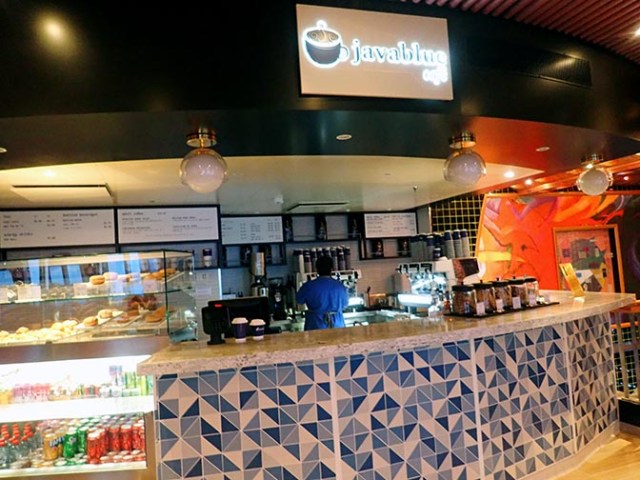
Luminosa has numerous bars, including a coffee bar called Java Blue. There isn’t a forward lounge with windows, but various bars around the ship have seating by windows that people use regardless of whether or not that particular bar is open.

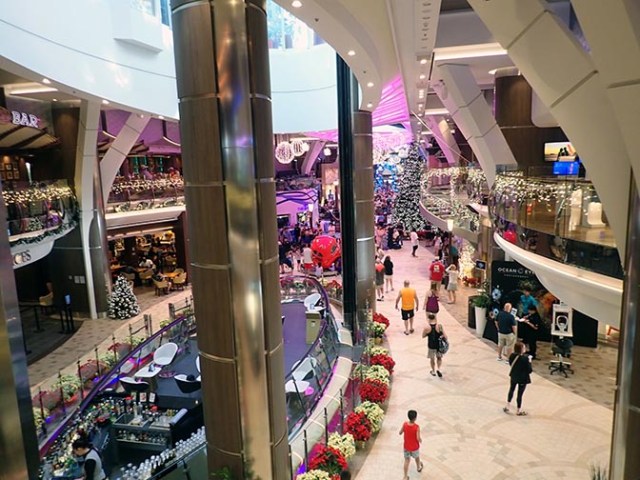
Ocean Plaza

Ocean Plaza on deck 2 was a popular hangout spot for people when it wasn’t in use because it had a lot of space for people to sit and play games or work on projects. It was also one of the main duck hiding areas of the ship.

duck under a deck chair

The decor on this ship didn’t have a lot of places for hiding cruise ducks so decks 2 and 3 got a lot of them. Other public areas like hallways, stairways, and decks 9 and 10 got some too. Duck hiders and hunters were plentiful. Carnival is where cruising ducks originated and has more people participating than what we’ve seen on other lines.

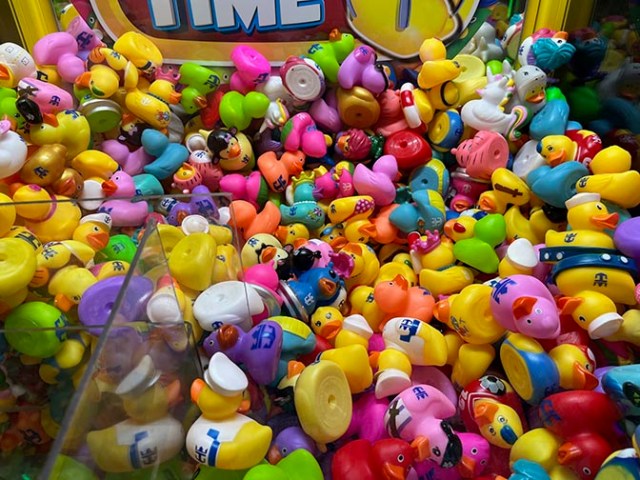
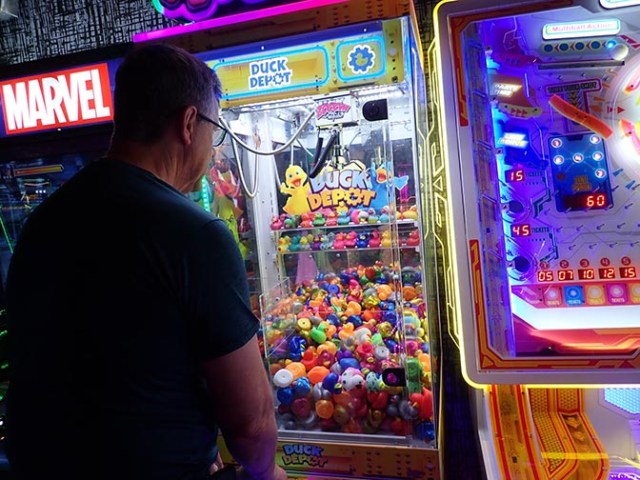
duck machine in the arcade

The arcade has a claw machine full of ducks and you get to keep trying until you get one so a lot of people who didn’t bring ducks with them get ducks to hide from there.

atrium bar and tiny stage

At the center of the ship on deck 3 the Supernova Atrium has an open area that goes all the way up to the top of the ship with glass elevators running up one side. Opposite the elevators there’s a bar with a tiny raised stage behind the bar where singers perform in the evenings. There’s a statue of a large women laying on her stomach in front of the elevators with the color worn off her butt where people rub it. There’s some seating in that area and enough open space for people to easily walk through. Stairways link the lowest level of the atrium with public areas on the deck above. The steakhouse on deck 10 encircles most of the area at the top of the open central space.

atrium

There are no waterslides, but there is a small mini golf course. There are lots of 2-person pods around the upper decks that will provide some shade as long as the back of the pod is to the sun. Also lots of deck chairs. They are not all the same from one area to another with some of the pods having better cover than others and some of the deck chairs having thick cushions while others have none at all depending on their location on the ship.

mini golf course

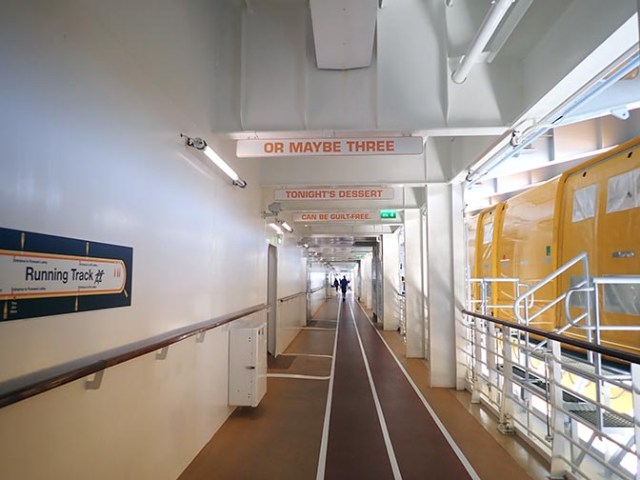
The promenade deck does not go all the way around and the top-deck track is ridiculously small. People tend to walk all the way around the outside of the ship on deck 11 rather than using the tiny track, although anyone wanting to avoid smoke wafting up from the open smoking area near the back on deck 10 will need to turn at the track rather than going all the way around the ship.

tiny top deck track

Typical of Carnival ships there was smoking allowed in the casino, which is wide open and spreads smoke throughout a considerable amount of the rest of the ship. That was the reason we quit sailing on Carnival years ago, but the Luminosa was the only ship doing a transpacific at the time we wanted to go. Unfortunately Australia’s no indoor smoking on any ship applies only to ships sailing out of Australia rather than including those sailing into it. The buffet has handwash sinks at the entrance and the gym has alcohol wipes to clean the equipment after use, but the casino has nothing in spite of the fact that everyone in there touches stuff that multiple other people touched. Besides the cigarette smoke that is bad enough in itself, anyone smoking in there touches their cigarettes with fingers that touched things everyone else touches, then puts them in their mouth, then touches things with hands that touched their mouths. Not to mention when they blow out the smoke they blow out any germs they have along with it. So it’s not surprising that some sort of nasty virus with a bad cough quickly spread. Which adds people coughing all over things like slot machines that others then touch without any cleaning in between.

casino

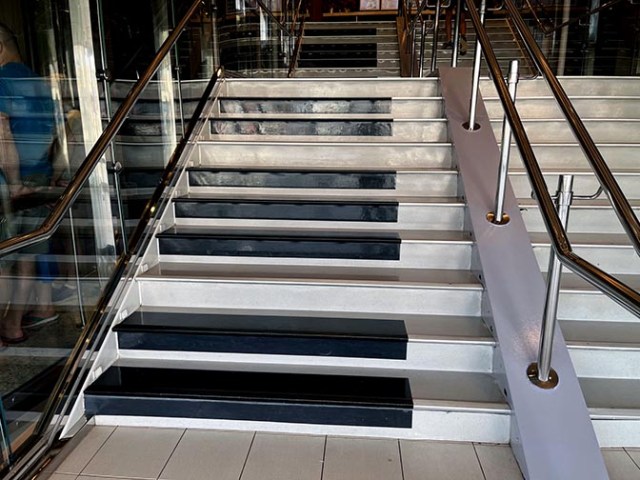
The ship’s décor is somewhat tacky in some places, particularly on the stairways.

stairway decor

The thermal suite at the spa in this ship was the best that we have seen anywhere. It had a thermal pool, heated ceramic chairs in both a dry room and a sort of steamy one, a steam room, a dry sauna, and two relaxation areas. One of the relaxation areas had thickly cushioned and very comfortable loungers and floor to ceiling view windows. Both relaxation areas are supplied with pitchers of plain water as well as water with fruit in it, usually oranges. The gym is one floor above the main spa and on the same level as one of the spa relaxation areas, but each one has its own locker rooms.

steamy ceramic chairs

Free food is available in the dining room and buffet. Luminosa also has a steakhouse restaurant that costs extra and some of the stands at the buffet have things like wings or seafood you have to pay for. Carnival also has items that cost extra in the dining room as well as some of the pastries at the coffee bar. Unlike other lines that provide a variety of flavored and herbal tea bags, Carnival has only Lipton or green tea available for free. Anything else costs extra, even at afternoon tea. A lot of people bring their own tea bags. People on your time dining had to check in on Carnival’s HUB app and could not go into the dining room until the app said there was a table ready for them. Breakfast, brunch, or lunch also required reserving a table on the app even when hardly anyone was there.

one of the better stairway art pictures on the ship

Tables could not be booked more than 10 minutes in advance of when the dining room opened – and only for seating as soon as the table is available, which is a lot better than some cruiselines that allow reservations for their anytime dining that then leave those reserved tables empty for the majority of the time the restaurant is open while other people can’t get a table at all until late. The whole system worked better when it was just first come first served, let people in until it is full. We didn’t like the hassle of having to reserve the table and then wait for it to show up on the app before you could go in, but on the next cruise where we had set time dining we missed the interaction with other random passengers that you get with shared tables on anytime dining.

pork dinner from the free menu in the dining room – this one could have used less meat

Meal portions on this ship were generally a lot closer to a reasonable size than what some other lines serve. A change from the last time we were on Carnival some years ago when the portions were often humongous. Nice to see they are not wasting quite as much food now, though there are always the people who will order multiple dishes in the dining room and waste a lot of it or pile a mountain of food their plates at the buffet and throw most of it away.

spa balcony cabin

Our cabin had a pretty good amount of storage space, but only one American and one Australian outlet, with those two crowded right next to each other where only a fairly slim adapter would allow use of both. There are some USB ports on one of the nightstands. Carnival’s spa cabins are usually shown in pictures as having a blue and green color scheme, but ours was red and yellow. Probably because it was not originally a Carnival ship.

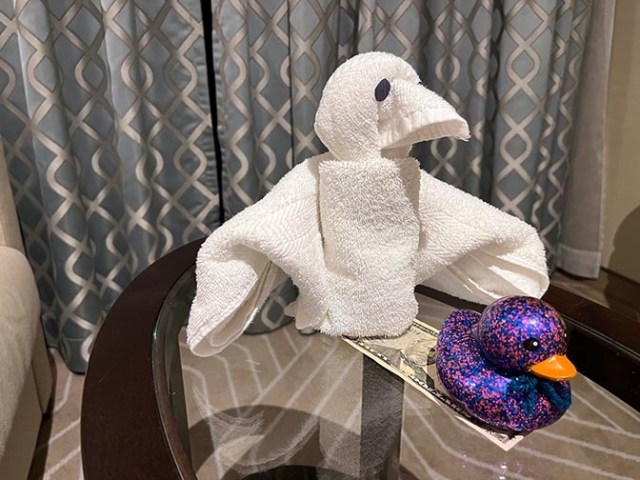
one time the daily towel animal the steward made was reading the Fun Times

The Fun Times still comes out in paper version daily with a list of activities available for that day as well as open times for shops, bars, the casino, and all of the various food venues. The information is also available in the Carnival HUB app, as are the menus which you can see for the whole cruise by picking whatever day you want to see the menu for. People can still get paper menus for the current meal in the dining room if they want one. Even if you don’t buy an internet package for other uses you can use it free for the app. The app is fairly useful onboard, but not so much when you are off ship. The app has a chat feature, which would be a lot more useful if it would alert people when a chat was sent to them regardless of whether they had the app open at the time or not instead of only alerting when the app is opened.

theater

The theater was nice. Seats in the balcony had enough of a drop from one row to the next that heads of the people in the row in front of you were low down enough not to block the view. The gym had quite a lot of equipment with treadmills being the most popular with the early morning crowd. Off and on during the first hour or so after the gym opened sometimes somebody had to wait to get one while a lot of the other things sat empty. The row of treadmills spanned the window across the front of the gym, which is one of very few places on the ship with a forward-facing view. The locker room showers are nice with a small changing area for each shower as well as the shower itself behind a solid door. The gym locker room had a free sauna so there was one available for people who do not have a pass to the thermal suite.

Looking over the Serenity deck

Crossing the Pacific on the way to Hawaii we saw a lot of garbage floating past the ship pretty much constantly, something we have not seen on prior ocean crossings. Perhaps we were passing through the current that takes things to the north pacific gyre – AKA the great garbage patch. On the 4th sea day we started seeing flying fish, something we always enjoy watching when sailing through warmer waters even if most of them do look like little white specks from the ship. Sometimes there are bigger ones or whole bunches at the same time.

Lido deck pool

Some people down the other end of the hallway at the far end of the ship from our room had a pipe running through the top of their balcony burst in the middle of the night early on in the cruise. They woke up to a flooded room with several inches of water on the floor and were told there was nowhere else for them to go so they spent a good portion of the cruise in a cabin with an overturned couch and big dryers on the floor. Later in the cruise the main Lido pool leaked into some other cabins and had to be drained and closed for several days while the pipes were fixed and most of them were not given other cabins either. The plumbing crew onboard definitely kept busy fixing pipes.

promenade deck

Overall this cruise was generally better than we expected from Carnival. The food for the most part was pretty good, we loved the thermal suite, and there’s a lot more duck hiding activity than on the lines we usually sail with. The biggest improvement they could make would be to contain their indoor smoking within a fully enclosed area that kept it from spreading about the ship. Too bad other countries aren’t smart like Australia in just banning indoor smoking.

Copyright My Cruise Stories 2025
Posted in Carnival, Luminosa | Tagged , , , , , | 5 Comments

Anne Frank House

photo of Anne Frank and her quote

At some point in my childhood I read a book called Anne Frank, Diary of a Young Girl so I knew of the story of Anne Frank and her family during World War 2. Though not fresh enough in my memory to remember all the details of the book, the main story is not the sort of thing that is read and then forgotten like most childhood books. Of course this one was not fiction either being the true story of a Jewish family living through terrible times in the words of a girl who lived it.

Anne Frank House

Our river cruise on Viking Skirner ended in Amsterdam. During the time leading up to the cruise they sent out information on booking a tour of the Anne Frank house, in case people wanted to do so in order to see it after disembarking there. The instructions were that it could not be booked until 6 weeks before going there – and that it filled fast so booking it right at the 6-week date was recommended.

random person at the door to the Anne Frank House

Our friends that we sailed on that cruise with live in an earlier time zone and said they would get tickets for the four of us as soon as it opened to them. They were trying for disembarkation day, but ended up with the day after which worked out fine since we were all staying in Amsterdam for 3 days. On the day we went there someone in the hotel said they’d seen a long que there the previous day and that all of the people in the que had tickets. Someone else said they had gone and got right in.

museum entrance

We found the house, but the entrance for the Anne Frank Museum, which includes the house, is in a new-looking building around a corner. What looks like separate buildings on the outside are now all one building on the inside, though that was not the case back in Anne Frank’s day.

Anne Frank at the wax museum

There were 2 lines to get in. One for people going straight to the museum and the other for people who had tickets for the introductory program, which ours included. For that program you have a specific entry time and can’t come earlier because you would miss the introductory part. If you come late you can still go into the museum, but will not get to see the introduction, which was in a sort of classroom that had some photographs and a few artifacts from Anne’s life. There was also a timeline with dates and photos from her birth to her death.

timeline of Anne Frank’s life

The introduction there included some history before the story begins as well as the sad ending. She was actually born in Germany rather than in the Netherlands, but the family fled Germany early in Hitler’s reign in hopes of escaping his wrath against Jewish people. They were not an especially religious family and her father was a decorated veteran of the German military in World War 1. One of the things Anne said at some point during her ordeal was that she looked forward to the time they could go back to just being people rather than Jews. Something she never got to experience.

annex from the classroom window

Pictures are allowed outside the house, and were allowed in that room, but no photos are allowed once you enter the museum itself. There was a window from the classroom where a photo could be taken of the annex where the family hid, which can’t be seen from the road. The house seen from the road is the front house and the annex is behind it, though the two are connected. There is nowhere else in the museum tour that you can see the actual annex from, only that window in the classroom.

When the family first moved to Amsterdam they lived a normal life, but once Hitler took over things got worse and worse for Jewish people. The Jewish children were sent to separate schools from the other kids and all of the Jews had ever increasing restrictions put on them. Otto Frank ran a business in the lower floors of the house with a warehouse at the bottom and offices above. The warehouse extended into the back house or annex, though the top two floors and attic of that building were unused. The family lived in a different house at the time as that building was just used for the business.

artifacts in the classroom

Knowing that things would only keep on getting worse for them, Otto made plans for going into hiding in an unused portion of the annex building attached behind his workplace along with the family of a Jewish employee. A select few of his non-Jewish employes and some of their family members were the ones who enabled the hiding to happen by bringing them food and other necessities throughout the more than 2 years they stayed hidden there.

Things got worse for Jewish people in the Netherlands with a roundup of the first unlucky people taken and killed to serve as a warning for the rest. When summons began to come for others, one of the ones summoned in the first group was Anne’s sister Margo who was just 16 – 3 years older than Anne. Rather than sending her to certain death the family went into hiding the next day along with another family of 3. Later one more man joined them.

bookcase at the wax museum

A revolving bookcase hid the entry between the annex and the business below. On the lower floors the warehouse extended into the annex building beneath the previously unused upper floors where the families were hiding. Most of the people working there had no idea about the hidden people so they couldn’t make any noise or run any water during the day while the business was open. They also could not look out the windows or have any light show through to the outside at night so that nobody would know they were there.

After they had spent over 2 years in hiding the war was nearly over. They were just waiting for the allies to work their way up to Amsterdam so they could finally be free. Nobody knows how they were found or who turned them in, but one night the Nazis came and arrested them all. They were sent out on the very last train to Aushweitz. After being separated and most eventually sent to other concentration camps, Anne’s father Otto Frank was the only one of the 8 people to survive. One of the people who had helped them hide found the diary, one of the few things not taken by the Nazis, who cleared out all the furniture and anything else they thought had value. The actual diary Anne filled up early on, but she kept writing on whatever paper she had available, which an employee who had helped them found scattered about and saved for when Anne returned along with the diary. Since she never returned it was given to her father, who published it as that had been Anne’s wish to publish the story of their time in the secret annex.

poster at the wax museum

People are given audio boxes before they get into the actual museum, which have different things to say in the various rooms you pass through. Most of it is also written near pictures or items in the rooms. Once you get to the actual secret annex there is no more audio until leaving the annex into additional rooms of the museum. The annex is mostly empty rooms because it was left as it was after the Nazis took everything. The tour does of course exit through a gift shop as do most tourist attractions everywhere. There is a display there of many different versions of the diary published over the years in quite a variety of languages. There’s also a book available of Anne’s fictional writings from her time spent in the secret annex.

Up until recently I found it hard to fathom how one psychopathic leader could get so many people to support them. Unfortunately, not everyone learns from history. There’s an old saying that those who don’t learn from history are doomed to repeat it. The atrocities of World War 2 started by dehumanizing Hitler’s chosen scapegoats and getting others to believe those people are responsible for all of their troubles. Eventually when there are enough people who believe the lies and no longer see that group as fellow human beings, but rather as perpetrators of whatever horrendous deeds are attributed to them it opens the door for terrible things to happen. Those tactics are still at work.

Anne Frank House

Although pictures were not allowed at the Anne Frank Museum, Madam Tussaud’s Wax Museum in Amsterdam has a figure of Anne, in a room that contains a few furnishings that may be similar to what were in the house. Since the Nazis took everything the replicas are probably not exact. There’s also a wax replica of the bookcase used to hide the entry to the annex and pictures are allowed in the wax museum.

Copyright My Cruise Stories 2025
Posted in Day Trips, Europe, Skirnir, Viking | Tagged , , , | Leave a comment

Flyover at Canada Place, Vancouver BC

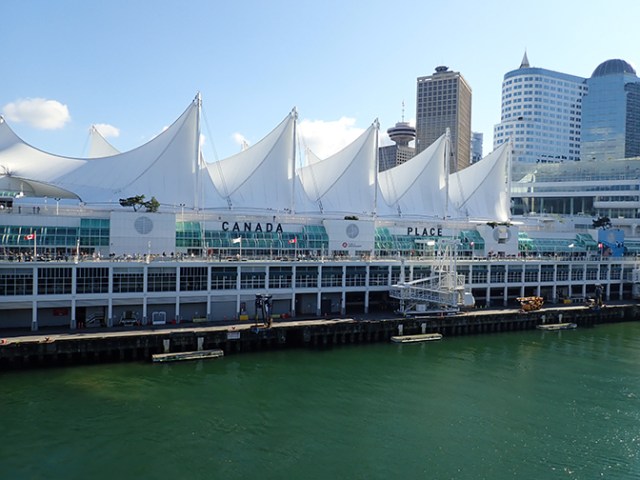
Zaandam at Canada Place

When cruising out of Vancouver BC, the train is an easy way to get there for people coming up from the south if they happen to live close enough to the Amtrak Cascades route from Portland, Oregon to Vancouver BC. The morning train north is supposed to arrive shortly after noon at 12:30 pm. Since cruise ships often don’t start boarding before noon it’s pretty convenient when the train arrives on time. The train station is not near Canada Place where most cruise ships dock, but the sky train is just across the street from the train station and the Waterfront Station skytrain stop is just 4 stops away. From there it’s a very short walk to the parking garage at Canada Place, which is where cruise passengers enter for boarding. People can also opt to take a taxi or uber from the train station to the ship. You do have to take the right exit from the underground skytrain stop to come out at Canada Place since the station does have more than one exit.

view of Vancouver between ships at Canada Place

Unfortunately the train doesn’t always arrive on time. When we took the train up to Vancouver for our cruise on Holland America Zaandam our train arrived at the station quite late. Once it stops you have to wait first for the luggage to be unloaded, then for the car you are in to be allowed to go. Ours happened to be the last car dismissed so we were at the very end of the customs line. It was about 2:30 by the time we left the station. Our all-aboard time was 3:30 so had we been boarding that day we still would have made it to the ship on time, but probably would have been pretty stressed with worry about not making it near the end of the train trip and while waiting to be allowed off. We went a day early just in case of the train getting there late. Our hotel was not that close to the sky train so we tried to take an uber. Some sort of traffic delay due to construction and a closed road was keeping all the ubers from getting to the train station, though there were taxis there. As our uber kept getting farther and farther away and the people next to us said their third uber had just cancelled on them we gave up, cancelled ours and took one of the waiting taxis as did the other people who couldn’t get an uber to arrive. We got to the hotel just before 3, but had we been going straight to the ship and taken the sky train we would have arrived sooner. Already being in town the next day we were of course able to board much earlier.

Canada Place

The weather was nice that day, but by the time we got checked into the hotel and all it was past 3 so kind of late for most tourist activities. We walked to Canada Place and around the waterfront area a bit before dinner, and made plans to go to Grouse Mountain on the day we got back. The downside of the train is that there is not a convenient southbound train for cruise ship travelers. The morning train south leaves Vancouver at 7am, which is about the time ships start disembarking. Ours wasn’t even scheduled to dock until 7am so we had no chance of catching that train since it takes awhile after the ship docks before they let anyone off, and customs for the train closes about 15 minutes before its scheduled departure. The afternoon train leaves at 4:45, so there’s a lot of time to fill between disembarking the ship and catching the train. You can take a bus, but none of them had times any more convenient than the train.

view of Canada Place from the Zaandam as it returns to the dock

Pan Pacific, the hotel at Canada Place, will let people check luggage for the day. At the time of our cruise it was $5 per bag if picking them up before 3pm or $10 if later. Previously when storing luggage there they had limited the amount they would take to the space in their closet by the desk at the entry, but this time when we got back to pick up ours they had rows of it strapped together outside of that closet so apparently you don’t need to rush off the ship to get your luggage there before space fills up anymore.

view of Vancouver from the Zaandam just before docking

The day our ship returned it was pouring down rain in Vancouver, unlike the day it left when it was nice and sunny. We’d already spent all of our port days on the cruise in the rain so we decided not to go to Grouse Mountain. The people at the visitor center said that was a good plan since it wouldn’t be a good place to go in the rain. Even though it doesn’t take up a lot of time we decided to do Fly Over Canada instead. You don’t actually fly over Canada, it’s a motion ride at Canada Place. It’s inside and dry, other than the ticket booth and entrance which are on the outside of the building. There is at least a roof over the area just in front of the ticket booth and entrance.

Canada Place

The ride didn’t open until 10am, which was also the opening time for the aquarium at Stanley Park where we might have gone instead if it opened sooner. There’s not a whole lot of places for just hanging out waiting for stuff at Canada Place or anywhere to sit that doesn’t belong to the hotel or a food spot. There’s a little café on the main level and another café up by the Fly Over. Underneath the main part of Canada Place there’s an entire food court, which is where you find the most seating. Since it’s all intended for eating it’s not the most comfortable furniture around, but seating there is plentiful. Entering from the ground level of Canada Place it seems like the food court is underground, but the other side of it opens up to the outside across the street where it has a below street level outdoor fountain you can look down to from the sidewalk.

flyover entrance where you wait to go in just before the ride starts

The visitor’s center inside of Canada Place sells discount tickets to attractions in Vancouver. You can get tickets for the flyover there cheaper than buying them directly from the flyover, but it’s just a voucher so you still have to go to the flyover booth to get a time stamp for a session with space available. The flyover entrance is up on the third level outside of their gift shop. Up there we found out that in addition to Flyover Canada they also had Flyover Iceland. The Canada one was by far more popular, but we decided to do the Iceland one since we have seen various parts of Canada, but never been to Iceland.

the first room

It starts in a room where you watch a screen on the wall that is initially stars, but once the video starts it has a computer-generated troll narrating a troll’s view of the early history of Iceland. There were only a couple other groups of people there, a mom with two young kids and another couple. One of the kids was scared and pretty whiny throughout the introductory movie. When that was over we lined up in a hallway waiting for a safety video before entering the main theater. The kid got really upset there screaming that she wanted to go home and eventually they left. I don’t know if that was by choice or not, but if the kid was carrying on like that on the ride besides ruining it for everyone else it wouldn’t have been safe for her if she squirmed out from under the seatbelt and fell off the ride so they may have told them to leave.

the screens on each side of the first room are a starry sky before the video starts

When you first walk into the ride it is seats with an aisle and a metal wall between the seats and a screen showing mountains in the background. There are nets under the seats to hold people’s belongings during the ride. Once everyone is seated and belted in the wall folds away and the seats rise up and out into the space in front of the screen. Everything goes dark so you don’t see exactly how it all happens. When there’s light enough to see again the row of seats is suspended in the air. While a movie of scenery plays the seats move as if you are actually flying over whatever is in view at the time. It flies over mountains and lakes, rivers and fields, wilderness, glaciers, and a city. Sometimes it’s just scenery, but sometimes there are boats or a small plane, animals, or people within view. In one river there’s a sinking kayak. Another scene has horses which initially looks like a herd of wild ones until you hear a dog barking and see that one of the horses has a person on it.

people on the flyover ride (internet photo)

In some places the ride seems to drop down to where you feel like you could just about dip your toes in the water. Other times it flies up the side of a mountain. Usually there’s nobody there, but on one mountaintop it almost seemed as if we were going to kick a climber right off the top until at the last minute the ride veered away. The motion effects are very real, not just visual. On some motion rides the effects are mainly visual so if you get queasy you can close your eyes, but on this one that doesn’t really help. The chairs have quite a bit of actual motion in them so if you start feeling nauseous closing your eyes removes the visuals, but it doesn’t stop the motion. It’s not a good ride for people who are prone to motion sickness, but for those who are not it’s a great one. The scenery is beautiful and ever-changing and it truly does feel as if you are actually flying over it. The whole experience takes just over half an hour, but the ride itself is only minutes. It feels much longer if the motion upsets your stomach.

They needed a place where people could sit and recover where the ride exits if they’re feeling a bit nauseous, but other than their café at the gift shop there is nowhere to sit anywhere in the vicinity. As with just about every attraction everywhere the ride exits into the gift shop, which has the café to one side of it. Our ride vouchers included a coupon for a free cookie or slushie there though if your stomach is barely holding things in when exiting the ride neither is appealing. I don’t know if everyone gets that voucher or just if you buy the ride at the visitor center. Unfortunately photography is not allowed during the ride so I don’t have any pictures from it.

Besides Amtrak, busses and Canadian trains stop at Pacific Central Station

If you’re taking the Amtrak after a cruise and killing time in Vancouver while you wait and run out of things to do or the weather is too horrible to go out and do anything, hanging around Canada Place through lunchtime is better than going to the train station before lunch because Canada Place has that entire food court while the train station just has a few places. When we were last there all that was available at the station was a coffee shop, a sushi place, and A&W hamburgers.

Copyright My Cruise Stories 2025
Posted in Canada, Holland America, Port Cities, Zaandam | Tagged , , , , | 3 Comments

Regensburg Walking Tour

Regensburg

Regensburg, Germany

Regensburg is located at the confluence of the Danube, Naab and Regen rivers, the Danube’s northernmost point. It was listed as a UNESCO Heritage Site in 2006 for its old town, the best-preserved medieval city in Germany. It has about 1500 listed heritage buildings of which 984 are in the UNESCO World Heritage Old Town. There’s also a 12th century stone bridge with 16 arches crossing the Danube River into the old town. Regensburg is the 4th largest city in Bavaria and 8th largest on the Danube River, also the oldest city on the Danube. It has a population of over 170,000. Younger residents generally speak English as well as German since it is taught in their schools.

stone bridge

Regensburg has comfortably warm summers, cold winters, and often clouds. The temperature typically ranges from winter lows in the mid 20’s F to summer highs in the upper 70’s F, but it does sometimes get colder or hotter. Average rainfall is about 25 inches, 3 inches less than Germany’s average of 28. The warmest month is July and the oldest January. Snow can occur from November to March. July is generally the rainiest month averaging nearly 3 inches.

Viking Skirnir in Regensburg, Germany

Regensburg River Cruise Port

In Regensburg our ship docked right in town just a short walk away from some of the town’s major sites like the gothic cathedral that towers over everything else, the 12th century stone bridge, and the famous ancient sausage kitchen restaurant. The ship was only docked there for a few hours, then it had to back out of that area and head into a small canal to go through a lock in order to bypass the stone bridge, which is too low for the ship to pass under. It was nice to have the ship right in town where people could come and go as they wished during the time it spent in port.

riverside walkway

Regensburg Walking Tour

On a very cold foggy early December morning Viking Skirnir docked in Regensburg, Germany. The included excursion at this port was a walking tour, which started right at the ship with no need to take a bus anywhere. At several degrees below freezing even warm winter clothes weren’t quite warm enough, especially for the standing around waiting for everyone to get off the ship so the tour can start part.

It’s a catfish?

The first stop on the tour was a statue not far from where the ship docked. The guide asked for guesses as to what people thought it was supposed to be. People guessed tadpole and other similarly shaped things. Not one person said catfish, which is what she said it is intended to be, though it really does not look like one.

little open square between buildings

Viking provides little audio boxes to all of the passengers, which are tuned to a specific channel for the guide you are assigned to. The guide has one for speaking, everyone else one for listening. The guides are locals who choose their own path through the city, ending at the ancient gothic cathedral that towers over the rest of the city even though some of the other buildings are quite tall.

street corner

Other than one end of the old historic 12th century stone bridge, Regensburg escaped the bombings that destroyed so many other cities during World War 2. Buildings in the old town are from generally from the 11th to 13th centuries, but there are buildings dating all the way from Roman times to the 16th century.  Like all of the small German towns, there are many churches. They aren’t the only places with tall towers though.

mostly empty tower

The rich merchants of past centuries built stone towers next to their homes to display their wealth even though most of the tower just held empty space rather than useable rooms. There is still just empty space in some of those tall towers. The stones the towers are built from had enough value back then that the towers were somewhat of an investment in that the owners could increase the height to show off ever more wealth or decrease it if the need to sell off stones happened to arise.

the cathedral towers over the other buildings

Narrow cobblestone streets lead through the pastel-colored buildings as they wind their way through town. Sometimes more space opens up on a small square or wider road. The largest open space we saw was set up as a Christmas market just down the road a bit from the giant gothic cathedral. Like many of Europe’s tall ancient buildings it was partially covered in scaffolding as renovation and restoration seems to be constant to maintain these structures.

inside Saint Peter’s cathedral

The inside of the gothic cathedral was beautiful, but quite plain compared to the excessively ornate churches in some of the other towns. This one mainly had stone pillars and giant stained-glass windows. I personally prefer stained glass windows to all the gold-plated stuff. Anything is better than the one that had coffins and skeletons on display at Melk Abbey in Austria.

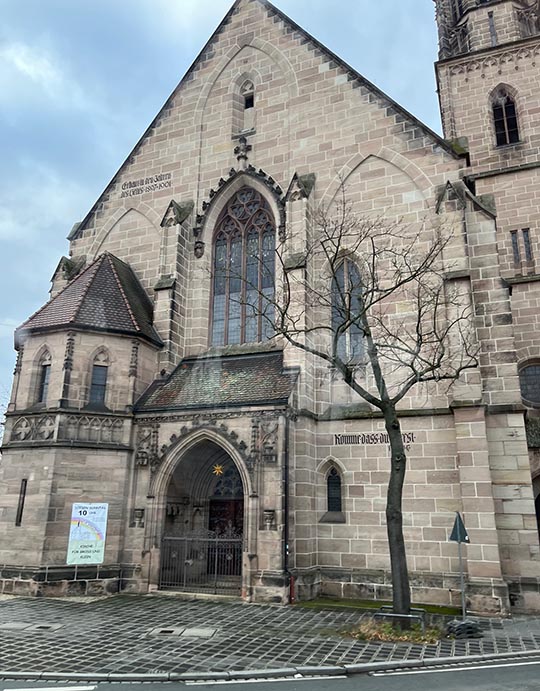
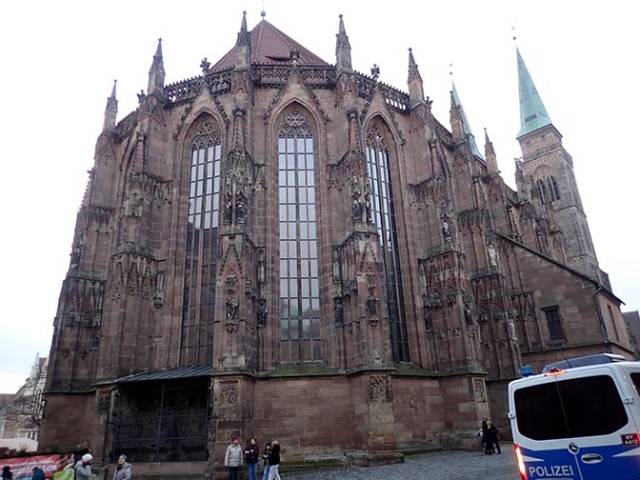
Saint Peter’s Cathedral

The cathedral is called Saint Peter’s. It has been in existence since about 700 AD, but due to several devastating fires was rebuilt in the current gothic style with construction beginning in 1273. At nearly 350 feet high the church’s towers are taller than the building is wide or long. Gothic style churches reach for the heavens with towering pointed arches. The stained-glass windows were mostly installed in the 14th century. The outside of the cathedral is quite intricately detailed.

Christmas market

The Christmas market in Regensburg had a lot more booths that looked like their merchandise might actually be handmade rather than mass produced then some of the markets we saw in other towns. It was by a church, but not the gothic cathedral.

buildings on the other side of the Danube

As is standard with these tours so far it ended at a church, this time the gothic cathedral. The guide had said the next service wasn’t for awhile so people could go inside to warm up and listen to the choir practice, but it was a Sunday morning and when we went in there was a mass in progress so we didn’t stay.

wiener dog museum

On the way into town we had passed a wiener dog museum, but it was closed.

gift shop in the wiener dog museum

On the way back it was open so we stopped in and checked out the gift shop. They packed a lot of stuff in that tiny gift shop. It cost extra to go into the museum so we didn’t see that part.

ancient sausage kitchen

That street came out near the stone bridge and ancient sausage kitchen which is the oldest in the world. They not only make sausages there, but also serve them since it is a restaurant. Like many places alongside rivers in Germany, it does suffer periodic floods. The guide said that the sausage kitchen handles the flooding by flooding the building themselves with clean water so that the dirty river water can’t get in. Then they just have to let the water out when the river subsides rather than having a massive cleanup.

riverside walkway and stone bridge

From there it wasn’t too far back to the ship, and a lot faster going on our own than the slow meandering of a guided tour. Since the sausage kitchen is right on the riverfront it’s easy just to follow the river back to the ship.

Copyright My Cruise Stories 2925
Posted in Europe, Skirnir, Viking | Tagged , , , , , , , | 1 Comment

Patagonia Nature in Depth

trees along the trail

At Holland America Oosterdam’s port stop in Puerto Chacabuco, Chile we booked an excursion called Patagonia Nature in Depth. This excursion promised a walk through the Aiken del Sur private 5 square mile park with superb views of lakes, rivers, hills, and mountains along with a typical Patagonian barbecue lunch.

lake view at the end of the hike

It said a 15-minute bus ride would bring us to the park on the shores of Lake Riesco with clear transparent water. First a visit to the information center with interpretive stations on the geography, history, and biology of the region. That is followed by a walk down the River Trail passing over bridges and through forest, prairie, and swamp zones. Plants include wild fuchsia. The return trip is on the Waterfall trail passing the 65-foot tall Old Man’s Beard waterfall. This is followed by lunch.

parasitic flowering plant that hummingbirds like

There was a warning to dress warmly in layers and wear sunscreen and insect repellent and that the guide may not speak English very well. Our guide spoke English pretty well. We saw very few bugs. It was a nice warm sunny day. Since the guide said this region of Chile only gets around 50 sunny days a year and over 200 rainy ones we got lucky on the weather. It is about a 15-minute bus ride from the port to the park. There were 3 busses from our ship. Overall it was a good excursion, but one thing they could have done better would have been to send the first bus on its way once it was full and same with the second instead of waiting until all of them loaded and then traveling together. The last one to load pulled out first and then the second so the first people on the bus ended up last for everything.

stairs on the trail

On the way to the park the guide on the bus gave out information about both the area and the park as well as some of the plants we would find there. He was quite knowledgeable. The bus first stops briefly at a visitor’s center which has a very small number of restrooms for such a large group. Another reason why having the busses come one at a time would have been preferable. They also had water available so people could have a drink before going for the hike. Although there were 3 busses, the hike went in 4 groups so there was one additional guide besides the ones on the busses.

trail guide

Most people went with the guide from their bus, but the random guide’s group left first and we happened to be outside and ready so we went with the first group rather than the last, which was the rest of our bus. They waited long enough between each group starting out that the groups did not run into each other along the trail. From start to finish the hike was about 3.5 kilometers or just over 2 miles, though they said it was 2 kilometers before we started out walking. That must be the standard number they tell people on hike excursions because we did another hike in a different port where they also said it was about 2 kilometers and that one was more than 4. I was happy with the longer hikes since I regularly run farther than that, but some people who aren’t accustomed to walking much thought it was pretty far.

plant sign

There were a lot of interesting plants along the way. Many had signs next to them saying what they were. There were also some larger signs about the flora and fauna of the area.

wild fuchsia

Wild fuchsias grew in the forest. Also a pretty little orange bell-shaped flower that the guide said was a parasitic plant, but hummingbirds like it. There were foxgloves too, but those are not native to the area.

bridge on the trail

The trail was mostly river rock between logs, and relatively flat. There were some stairways and quite a few bridges along the way. In several spots a fairly large tree had partly fallen and leaned far enough over the trail so people had to either duck under the tree or step off the trail to go around it.

foxglove (digitalis)

Every now and then the guide would stop and talk about something particularly interesting along the trail. Mostly plants, but he did like to talk about pumas, the top predator of the area. There are also foxes and the world’s second smallest deer living in that park along with other species. There were some plants that are used locally for medicinal purposes, like a tree with a powdery substance on its trunk and branches that locals use to heal burns. There were also some edible plants and berries, one of which had giant leaves and thick stems.

cow rib fern that doesn’t look that much like a fern and baby trees that look just like ferns

One plant that looked sort of like Oregon grape with the leaves stretched out and flattened was called a cow rib fern. It looked nothing like ferns that I am familiar with. There was another plant that looked similar to bracken fern, but was not a fern at all, but rather baby trees.

blades of grass – blade being the key word on this plant

A plant that looked a lot like grass was the only thing native to the area that he said we shouldn’t touch. It wasn’t poison or anything, but the edges of the leaves are so sharp they use it as a knife so people could easily get cut from that plant.

tree with a hole burned through it

Other than a few trees that the guide called mother trees that survived the fires, the whole area was burned about 80 years ago by early settlers who were given whatever amount of land they could clear for farmland. Burning it was the quickest way to clear it so that’s what they did with no thought to the environment or ecosystem. The mother trees were larger than the other trees. One that the guide said had survived because of being covered in snow at the time of the fires had a hole burned through it.

standing nurse log

There are also some trees growing from nurse logs, which is not unusual for a forest. Generally the nurse log is a fallen log laying horizontally on the ground that trees grow out of. In this forest there were some standing dead logs that living trees grew around. There was also one tree sprouting from the top of a stump with roots growing down around the stump. That is not so unusual as an upright nurse log. The guide said they called that one the octopus tree.

tree killing fungus

One tree had a fungus that resembles fingers on the trunk. Or at least that’s how the guide described it. They look more like worms to me.  The part you see isn’t the actual fungus, but rather innards of the tree that the fungus living inside of the tree forces it to expel. It eventually kills the host tree. Not all fungus is bad though. The underground fungus network that connects the forest allows the plants to share nutrients and communicate with one another. That is with all forests, not just this one.

Old Man’s Beard Falls

Much of the trail was paralleled by a shallow stream. In one place the trail came out by a waterfall named Old Man’s Beard Falls. We had previously passed a tree with some lichens that were also named old man’s beard. The guide said that particular type of lichen could only grow where the air is clean and pure.

hiking on the trail

At one point the hike crossed a dirt road. There was a bus waiting there for anyone who wanted to ride it the rest of the way rather than hiking to the end. It waited for all of the rest of the groups though so they did not get there any quicker than the people who walked. Most people walked, but there were some who took the bus. Along the way we saw some berry bushes called Calafate. The guide said they had two types, of which one was good to eat and the other more bitter and seedy. One had thorns on the leaves and the other type had thorns on the stems. On the bush they look somewhat like blueberries. The guide mentioned that most people think of Patagonia as more open land rather than forested, but he said that is Patagonia in Argentina. In Chile it is different.
passing through a meadow

Most of the hike was on a forested trail, but we did pass through a meadow when we were getting close to the end.

building at the end of the trail

The trail ended at a lodge sort of building with a view of Lake Riesco. There was a tiny gift shop and some restrooms as well as a large room full of tables set for a meal. There was a fireplace with meat smoking over the fire in the center of the room. A bar at the entrance to that room held many glasses of a local cocktail in a couple of different flavors. One was a pisco sour and the other a Calafate sour made with berries indigenous to the region that we had seen on the trail. These drinks did not have the egg white foam on top that is traditionally found on a pisco sour. Probably to prevent any chance of giving cruise ship passengers food poisoning from raw eggs. People could have more than one drink if they wanted. Food was not served until all of the groups had arrived.

lamb smoking over a fire

The meal started with a small plate with a couple empanadas and a roll, followed by a bowl of corn, asparagus, and lima beans served cold like a salad. The main course was a giant plate of lamb and potatoes that was way more than enough for one person. Nobody at our table finished it. The lamb was the same as what was smoking over the fire, just from an earlier batch.

dessert

After all that there was more to come with a cake with some sort of berry topping. All of the pieces had a bit of whipped cream on them except mine – like somehow they knew fresh dairy products aren’t friendly to my stomach, though in reality they probably just forgot to put it on that one piece and it was just chance that it ended up with someone who would actually appreciate that rather than be disappointed by it. The blurb about the excursion when you book it did say you could let them know in advance about any dietary considerations, but we hadn’t actually bothered to do that.

dancers

During dinner entertainment was provided by an old man with an accordion and two dancers dressed in traditional local clothes. At one point the dancers brought out some of the guests to dance with them.
Oosterdam anchored near Puerto Chacabuco

All of the busses went back together. For a tender port seemed as if that would overwhelm the tenders and people would have to wait, but it turned out that they had two at the dock and as soon as one left another pulled in so the line kept in constant motion getting everyone loaded up and onboard. We quite enjoyed this excursion as did most everyone else that we talked to.
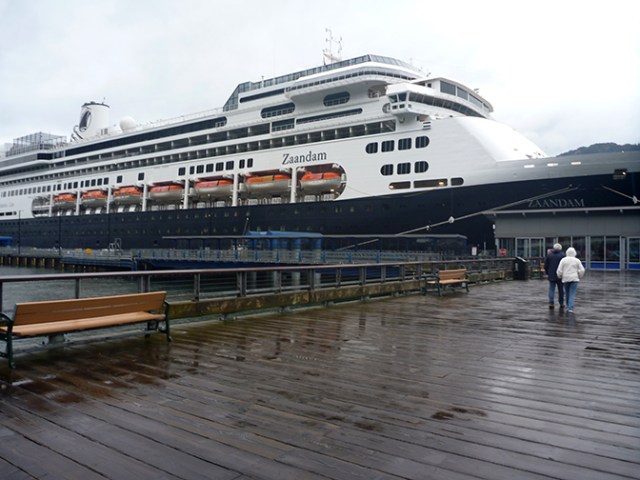
Copyright My Cruise Stories 2025
Posted in Holland America, Oosterdam, Ports of Call, Shore Excursions | Tagged , , , , , , , , | 1 Comment