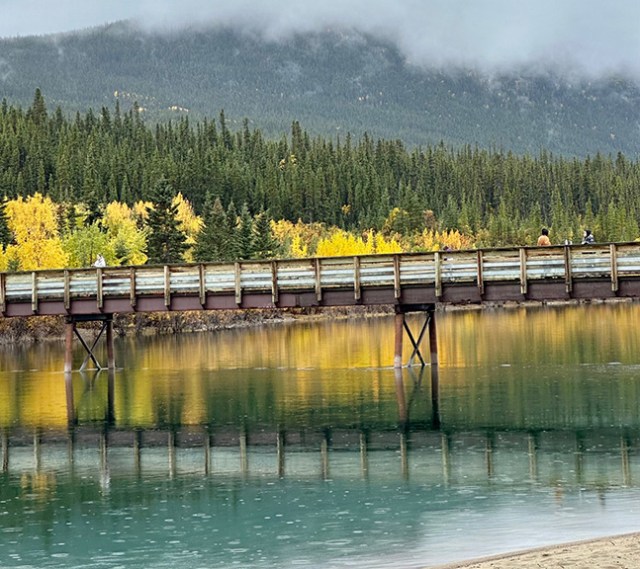
footbridge in Carcross, Yukon
The White Pass Railroad is by far the most popular excursion in Skagway. The main one goes up to the top of the mountain just over the Canadian border and back down again without ever leaving the train, though there are options that go farther with a bus in one direction. I took one of my earliest cruises with my son and grandson when Justin was only 6. It stopped in Skagway and the highlight of the train ride for Justin was an old rusty engine we saw out the train window, lying on its side between the train tracks and the river after derailing decades earlier. The second time I went with my sisters. That old rusty engine had been moved to the train yard, but was still lying on its side visible from the tracks.
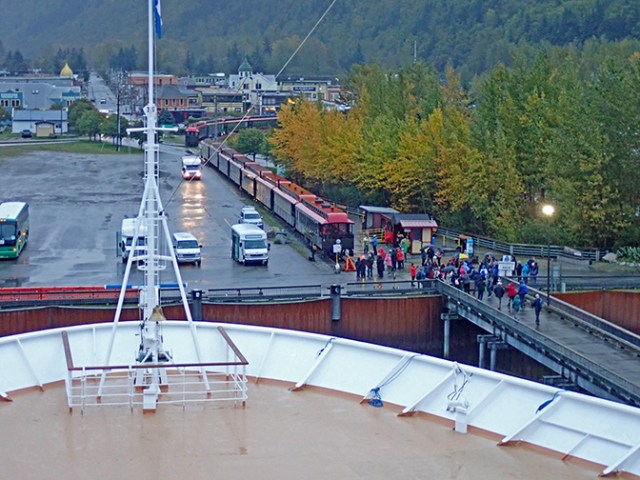
train at the port in Skagway
Having already done the White Pass Railroad a couple times we opted for something different on our port stop in Skagway from Holland America Zaandam. We docked next to Grand Princess, who was at the dock that had been blocked by a landslide last year when our cruise on Quantum of the Seas got diverted to Sitka since its berth in Skagway was inaccessible. That dock sits next to a steep hillside, which was bearing a vegetation-free scar where the landslide had been, though the dock was totally clear for this visit. The train for that dock goes all the way down the pier to the ship since it is a longer dock and farther from shore. Zaandam’s dock was closer to shore so the train parked in front of the ship on land rather than on the pier next to the ship. That pier didn’t even have tracks, but it’s a short walk up the pier. Busses for other excursions meet in the same area as the train. There was a little booth for booking last minute excursions with a list of a variety of things to do, and a couple covered sheds where people could stay dry while waiting for ship’s excursions to start.
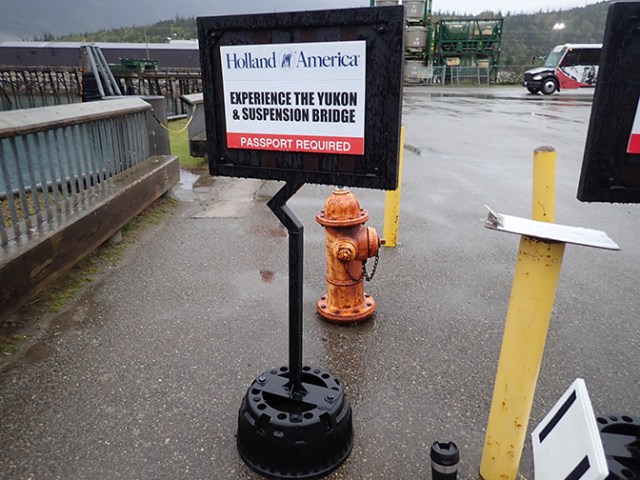
excursion meeting point sign – people checked in there, then went to the sheds to wait out of the rain for the bus to arrive
Experience the Yukon and Suspension Bridge
The bus showed up for our Experience the Yukon and Suspension Bridge tour with people already sitting in the seats in the first few rows other than the very front which had reserved signs on the seats. Excursion busses are normally empty before the ship’s passengers start to board, but either the Princess ship only had a few people wanting to do that excursion or they had a few too many and Zaandam didn’t quite have enough because they were joining us from the Princess ship. We sat just behind the last of them and the bus filled behind us.
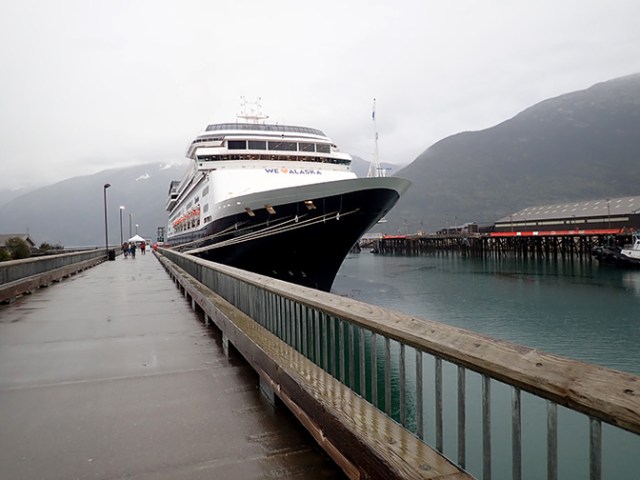
Zaandam in Skagway
Before we even got going a lady behind us burst into a seemingly non-stop coughing fit. It seems like wherever we go we always end up sitting near to someone with a major coughing problem, which you never know if they have some sort of chronic condition or a contagious disease. Once the bus was loaded and only the front seat on one side was taken by someone with mobility issues the driver said the other one was open if anybody wanted it so we jumped on the chance to get farther away from the coughing lady. Up to that point nobody else had coughed, but shortly after we moved both someone behind us and one of the people in the other front seat started to cough, and did so periodically through the tour so apparently we are unable to escape it. Meanwhile the original cougher finally stopped and didn’t cough again for the rest of the tour.
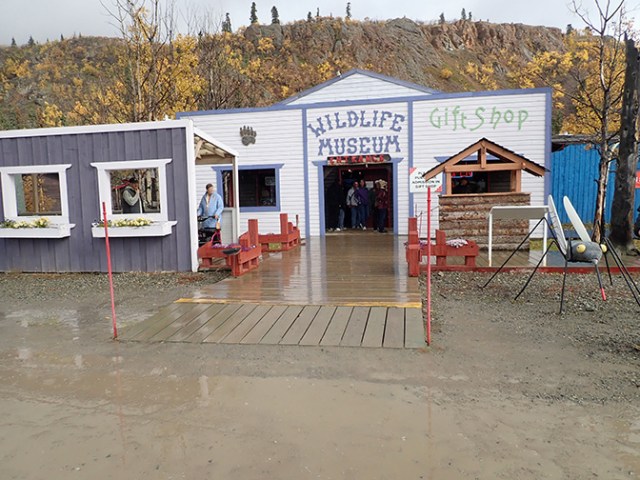
buildings at Wild Adventure Yukon
The bus went up the mountain parallel to the tracks for the White Pass Railway, on the other side of a canyon. We have seen vehicles driving on that highway when riding the train, but just saw the train tracks occasionally from the road. No trains went by on our way up. On the way back we saw a short little train pulled by a steam engine chugging along on some tracks beyond where the train ride that just goes to the top of the mountain goes, but we never saw any the trains from cruise ship excursions.
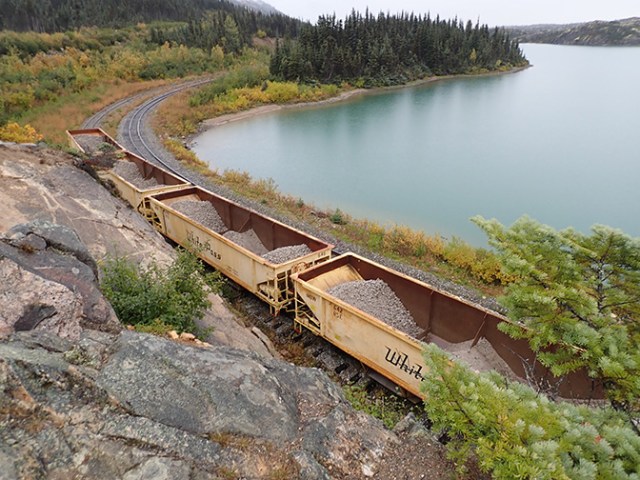
train cars full of gravel
There were several stops at lookout points along our way. At one of them we could see train cars full of gravel parked on the tracks. That place had more than one set of tracks so trains could still go by, but the train cars sitting there were not going anywhere. Further down the highway there was a bit still covered in gravel from a recent landslide that the bus driver said had closed the road for several weeks and work to clear it away had just recently finished. He didn’t know where the gravel from that clean-up effort had gone so it’s possible that is where the gravel in the train cars came from.
Near the top of the mountain the rain began turning to sleet and eventually snow. It didn’t snow hard enough to stick to the road, but it did snow hard enough to see white snowflakes swirling in the air and snowflake shapes in any that landed on the bus windows.
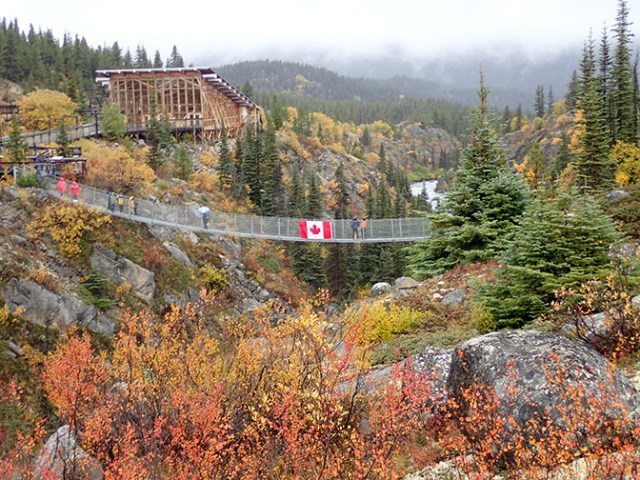
Yukon Suspension Bridge
Our first major stop was at Yukon Suspension Bridge. As with the rest of the tour it would definitely be better on a day with nicer weather. The suspension bridge is a tourist attraction out in the middle of nowhere. It has a café and a gift shop and lots of displays and models of historical things from the area as well as its main attraction of the bridge.
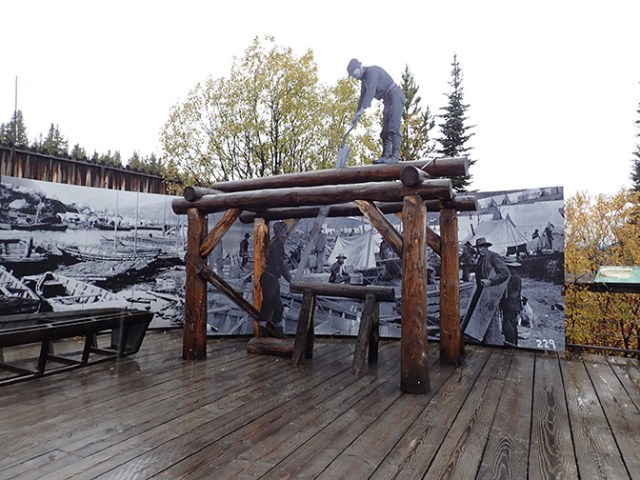
logging display on the way to the bridge
The walkway down to the bridge entrance passes through several displays about history and animals of the area.
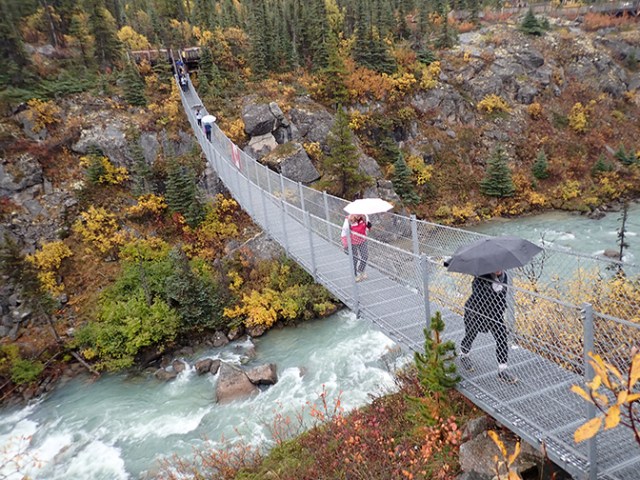
people crossing the suspension bridge in the rain
The suspension bridge has a woven sort of metal decking and cables stringing it from both sides of a canyon over a river. Fall colors lent to the beauty of both scenery around the river and scenery along the road and at the various viewpoints where we stopped.
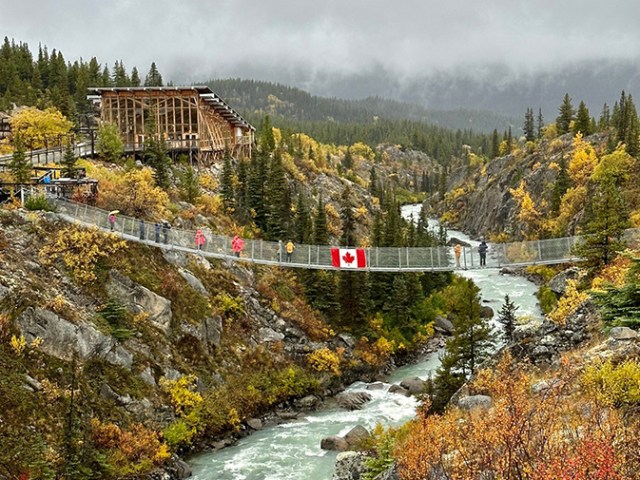
view of the bridge from the far side
The bridge is the sort that can get a bit bouncy if there are very many people on it, or if you ever got to be the only one there you could jump up and down a bit and make it bounce, but there was never nobody else on it to give that a try.
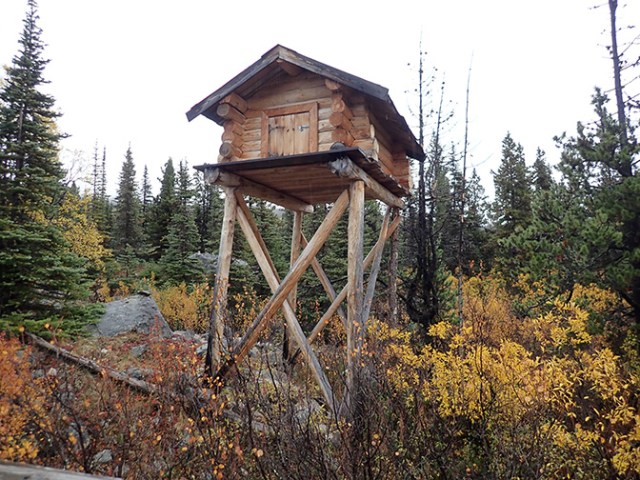
example of a historical supply storage cabin,
On the far side of the river wooden pathways led to a viewpoint of the bridge and the buildings on the other side. There was a display of an old gold rush or trapper’s cabin and a tiny cabin on stilts where they would keep their supplies safe from bears.
The next stop was a brief photo stop at a viewpoint overlooking a lake. A lot of trees were starting to turn color, sporting bright yellow fall foliage. Yellow was definitely the dominant color for fall leaves in that area of the Yukon.
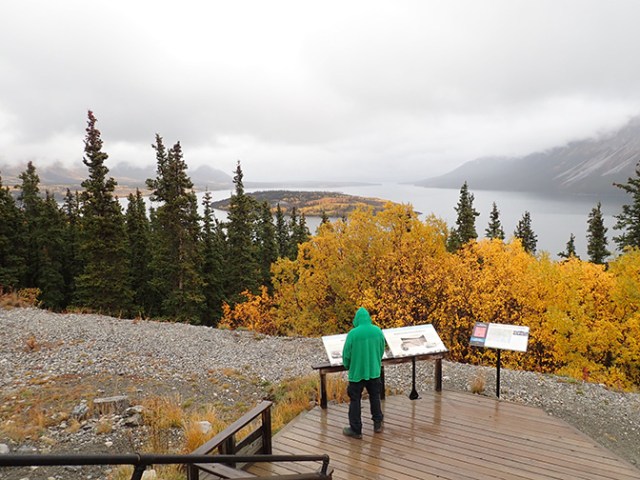
viewpoint at a lake
The bus driver had many stories and some information on the places we passed along the way. Different bodies of water ran next to the road, sometimes rivers or sometimes lakes. One lake he said held a monster along the lines of Scotland’s Loch Ness. This one he said was too shy to show itself so they called it Too Shy Lake (actually spelled Tutshi.) Soon we made another scenic stop at another lake.
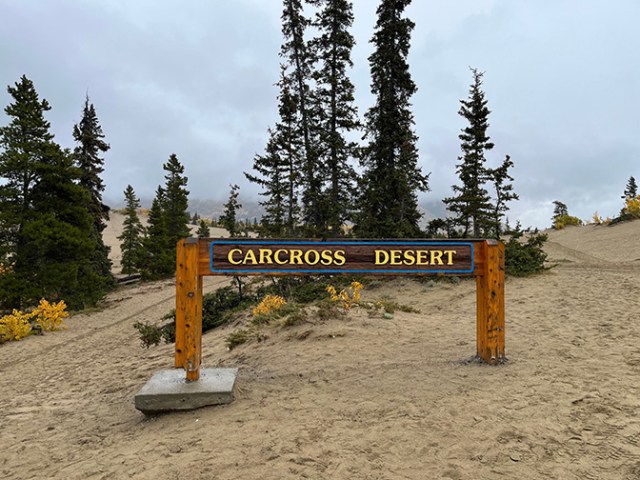
Carcross Desert sign
The next stop was also a brief photo stop at a place called Carcross Desert. This area is an ancient lakebed that for some reason stays mostly sandy with just sporadic small groupings of trees and other plants here and there. It’s mainly sand dunes made of silt deposited in ancient glacial lakes that have long since dried up. Wind keeps the dunes exposed.
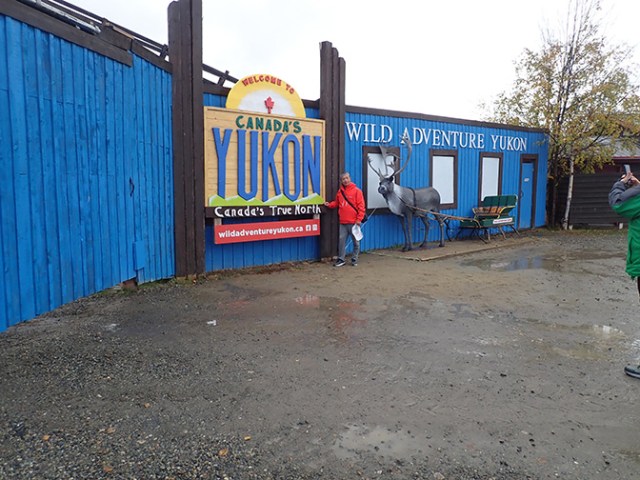
Wild Adventure Yukon
The main stop for this tour is called Wild Adventure Yukon. There we had a chicken barbecue lunch which was quite tasty. There was a Mountie Museum and a taxidermy museum with many sorts of animals. Mostly the sort that are still living, but some prehistoric ones like a mammoth. Then again you probably can’t get an actual mammoth so maybe at least some of them were models of animals rather than actual preserved dead ones, which would be a whole lot better.
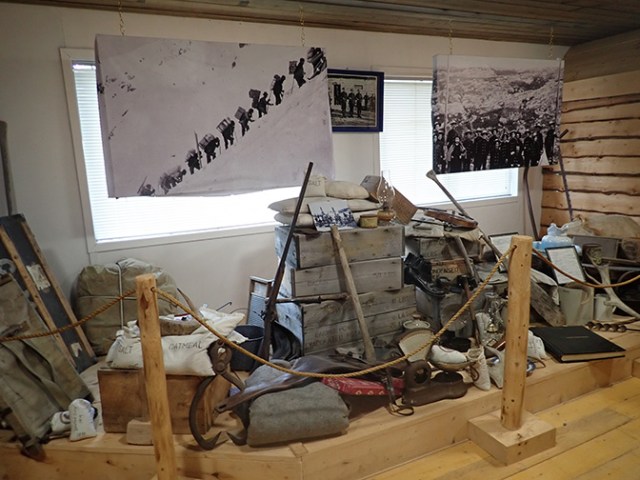
what a ton of late 1890’s gold rush goods looked like
The Mountie Museum included a display of a ton of goods, which is what the gold rush people were required to have to enter Canada. The Mounties had an outpost near the boarder to watch over the gold rush stampeders and make sure they complied with that rule. The most-used routes into the Yukon for the Klondike Gold Rush of 1897-1898 were the White Pass trail from Skagway and the Chilkoot Trail from nearby Dyea, a town that no longer exists. The train was not built yet so they had to bring that 1000 pounds of goods up the mountain bit by bit on their backs or those of pack animals. So many horses died along the White Pass trail it has a place called Dead Horse Gulch where their bones still lie at the bottom. Horses weren’t the only ones to die. Would-be miners died of hyperthermia and avalanche. Once they got their year’s worth of goods to the border, which took an average of 3 months, they traveled by boats they made or bought for the remaining 500 miles to Dawson City. Those who could afford it had an all-water route to Dawson City, avoiding the months of mountain trekking with all their goods, but the majority didn’t have enough money to take that route. The gold rush was over by the time the White Pass Railway was completed.
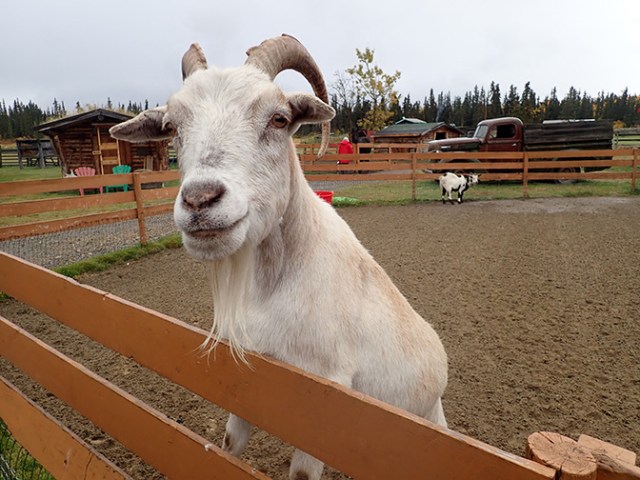
a very friendly goat – just a barnyard goat, not a mountain goat
There were also live animals at Wild Adventure Yukon. The petting zoo included a very friendly goat as well as some other goats, some alpacas, a horse, chickens, and sled dogs. For an extra $45 people could book a 15-minute ride in a wheeled sled dog training cart pulled by actual sled dogs, but since the weather was alternately pouring, raining, or drizzling we opted to skip that, though I would have done it if the weather was better.
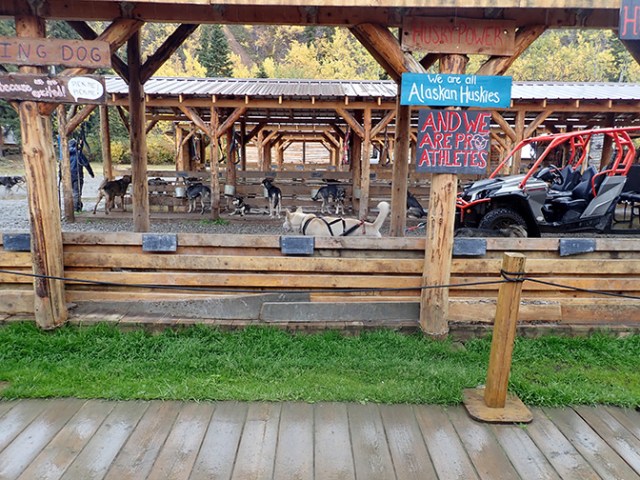
sled dogs at Wild Adventure Yukon
After looking at their website, I’d have been pretty disappointed if I’d spent the money for a dog cart ride thinking it was going to be a small cart with just one or two passengers and a driver pulled by a lot of dogs. It’s actually a 12-person motorized monstrosity that looks in the photo like a few dogs in front of a dune buggy sort of thing.
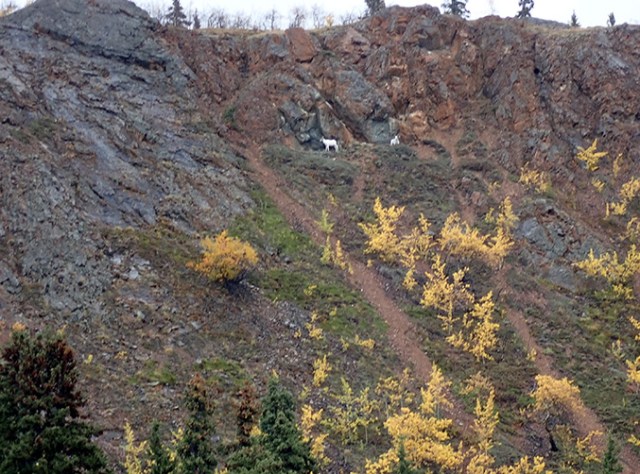
fake mountain goats
The dog cart ride would have been about as disappointing as the mountain goats on the hill above the adventure park. The bus driver acted like he spotted actual mountain goats, but as soon as everyone got all excited over getting to see them he said that they are always there and never move because they aren’t actually real live mountain goats, just fake ones put there so people think they saw some.
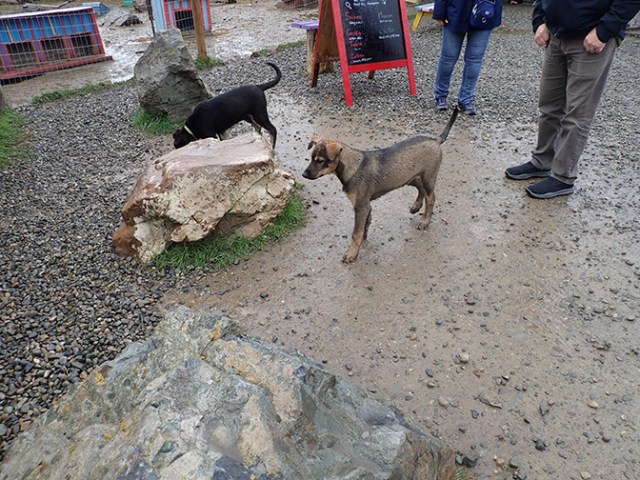
wet puppies out in the mud and the rain
They had some sled dog puppies, but they were outside in a muddy pen so instead of nice clean dry puppies to cuddle these were dirty wet ones that got mud all over anyone they put their paws on. Some of them were in a pen where people could go along with a short-legged little dog that was definitely not a sled dog, though one person joked it was for short runs. The puppies that weren’t in the pen where visitors could go were in a pen next to it where a couple of them were whining loudly for attention, probably wishing they could go out where the people were in hopes that someone wanted to pet wet muddy puppies.
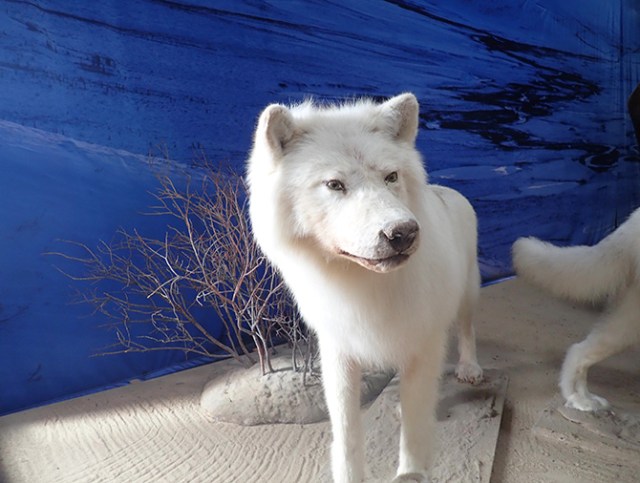
not a live wolf
There was a vending machine for alpaca snacks, but all of the other animals including the puppies had signs saying not to feed them. The gift shop spanned two rooms in the main building, which also housed the Mountie museum and non-living animal exhibit. The gift shop had a lot of local products.
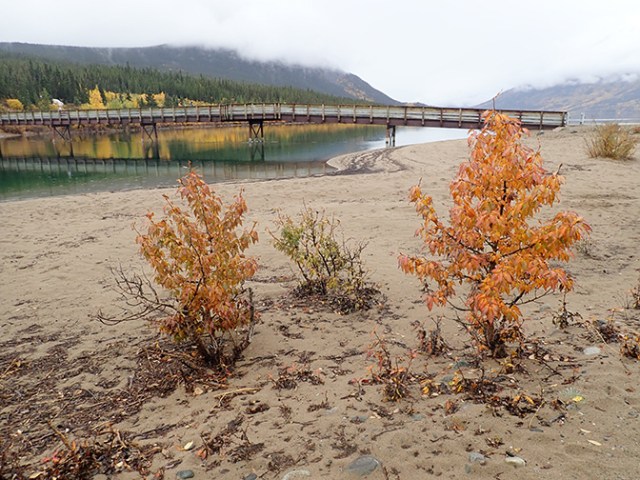
Carcross foot bridge
Our last stop of the day was a tiny town called Carcross. It was originally called Caribou Crossing, but according to our bus driver there were a lot of towns called Caribou Crossing so the mail kept getting mixed up. They shortened the name to Carcross to avoid confusion. A mountain near there is called Caribou Mountain due to the huge numbers of caribou that once lived there. Now there’s just a statue of one where you turn off the highway toward the town. The bus driver said he didn’t know where all the caribou went, but since all of the gold miners passed through that area it’s highly likely that a bunch of them got eaten.
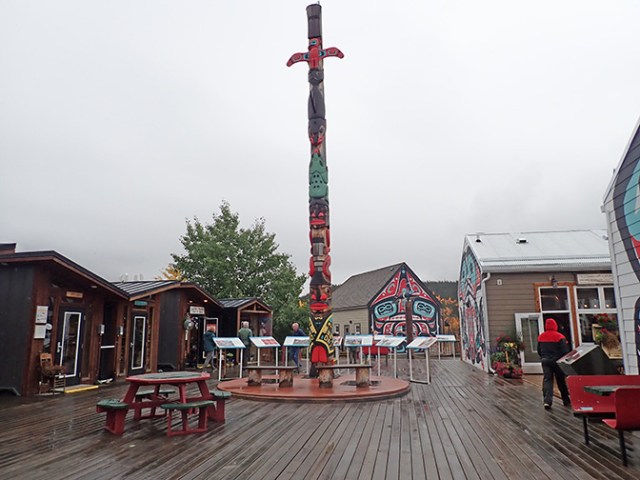
Carcross tourist shops
Carcross had a new-looking set of shops where the bus stopped. The driver recommended one that sold syrups. It was a small shop with shelves of things for sale around the outer edges and a counter with samples of the things sold there. The guy behind the counter handed out samples of various syrups and different flavors of maple butter to anyone who wanted them. The shop’s specialty was maple syrup aged in whisky barrels, but they also had fireweed and birch syrups too.
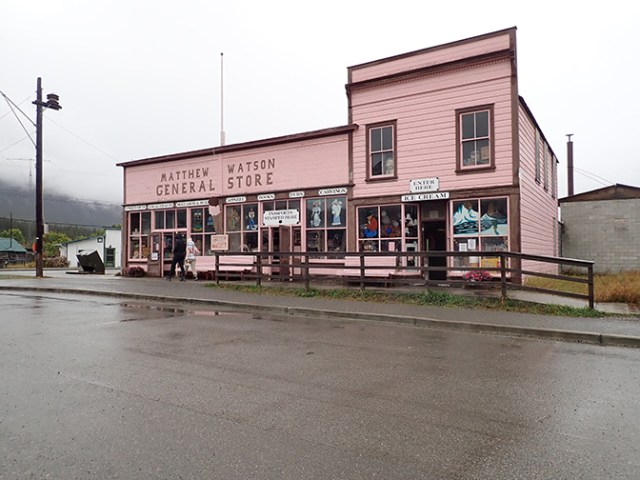
Carcross General Store
Near to those shops an old church stood alone, and a short distance away an old pink general store was said to be the oldest one in Yukon. Inside of that one it was sort of part store part museum with relics of the past hanging on the walls behind counters of items for sale.
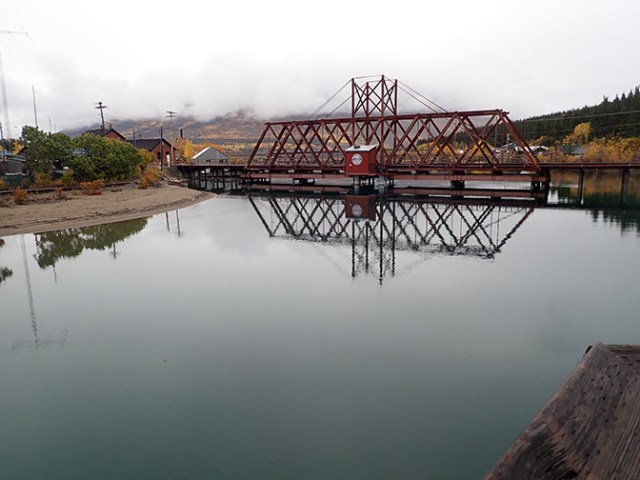
Whitepass Railway bridge in Carcross, Yukon
Kitty-corner across the street from the old general store the town had a bridge from the White Pass Railway. Just down the river from that was a foot bridge, which a little trail slightly above a small sandy beach led to. Both bridges were quite photo-worthy. The train bridge reflected into the still water below, easily photo’d from the foot bridge. Trees in yellow fall color reflected into the water on the far shore, also begging to have their picture taken from the foot bridge. Nobody else from the bus wandered out that far so they really missed out. The bridges and surrounding scenery were the best thing in Carcross. It even stopped raining while we were there and the sun peeked out a bit so at that stop we could wander around and stay dry.


 Cruise Stories