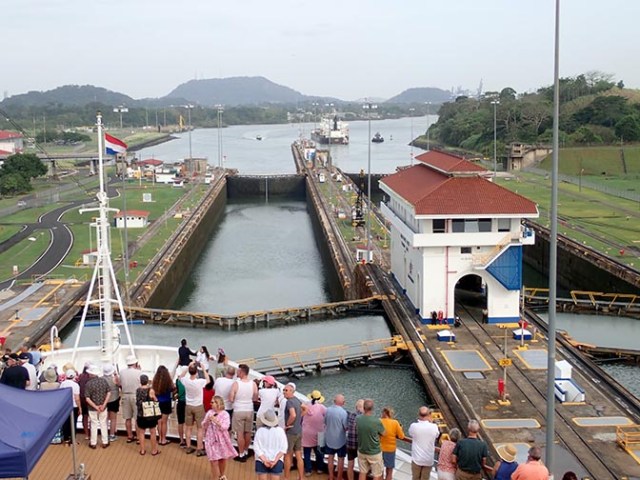
Miraflores Locks
Our Holland America Nieuw Amsterdam cruise transited the Panama Canal on Easter Sunday. There wasn’t much Easter stuff on board. A few decorations, some Easter food options, and a couple church services scheduled. Since we spent the day going through the Panama Canal most people were focused on the canal rather than the holiday.
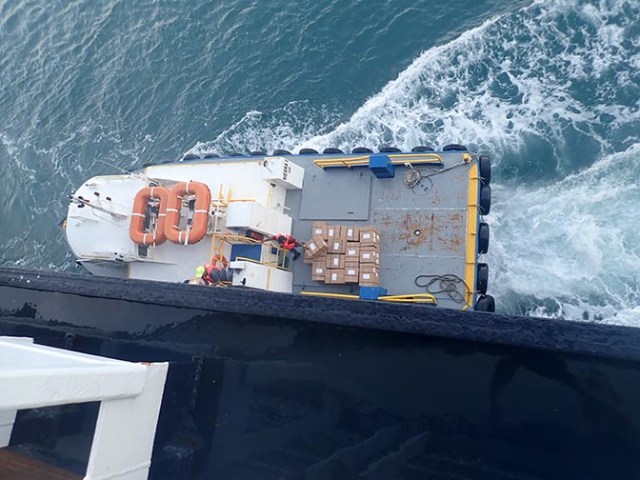
mystery boxes
The pilot was late getting on our ship so we had a late start before even arriving at the canal. The commentary for the transit included that there would be 3 pilots onboard with the other two arriving later in order to have 2 pilots on the bridge and 1 at the stern watching the back end of the boat as it passed through the canal’s locks. After the pilot boat dropped off the first pilot another boat pulled up alongside and unloaded a stack of boxes. I have no idea what was in them or what they were for.
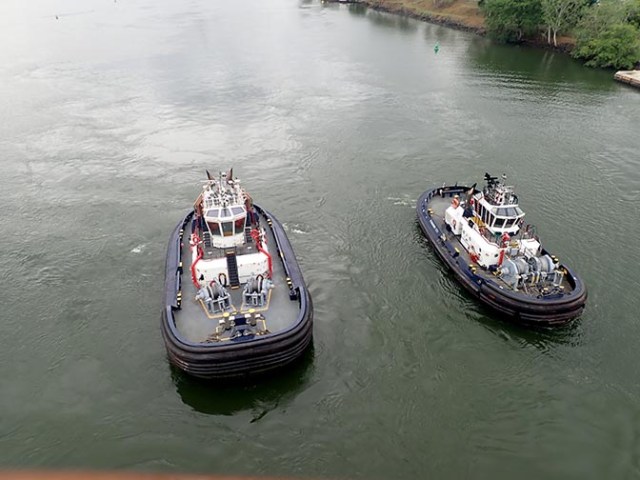
tugboats behind the ship
Going from the Atlantic side to the Pacific side was the opposite of my previous trip through the canal on Celebrity Infinity in 2015. Back then the Panamanians were busy building new locks for bigger ships. At some points during that transit we could see ongoing canal construction. The new locks opened in 2016 so this time those were in operation and had been for quite some time. At both ends of the canal the new locks pass through separate channels from the original ones so you don’t see a lot of one from the other.
Culebra Cut
During the construction they also widened the Culebra Cut according to our ship’s commentary. That was probably necessary to accommodate the larger ships that don’t fit into the old locks, but can now transit the canal through the new ones. The new section has 100 years of advancement in technology over the old locks which includes water-saving chambers to re-use much of the water so it doesn’t just all go downstream with the ships. The new locks are fully automated with horizontally sliding gates.
approaching the Atlantic Bridge
Traffic control was also updated. Originally there was just a sometimes hard to see arrow pointing to which lock chamber a ship was to enter and a series of land-based markers along the channel for navigation through the canal. The land-based markers were still there the first time we went through the canal. Now it has advanced navigation and monitoring systems and ship tracking capabilities. Command control has real-time information available for enhanced safety and better efficiency. Even the weather is taken into account within the new system. This affects the entire canal, not just the new parts.
passing under the Atlantic Bridge
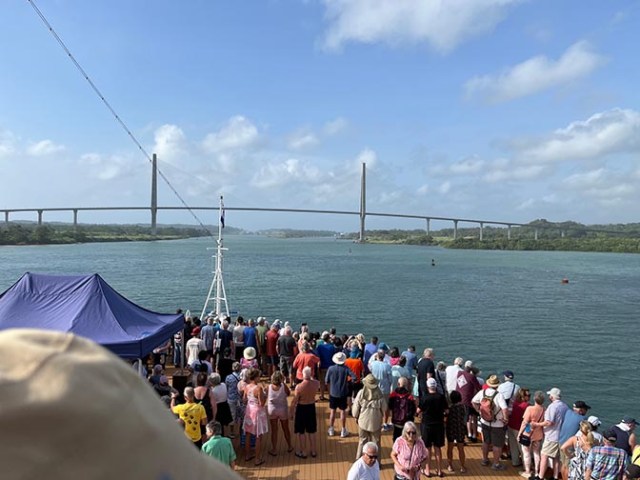
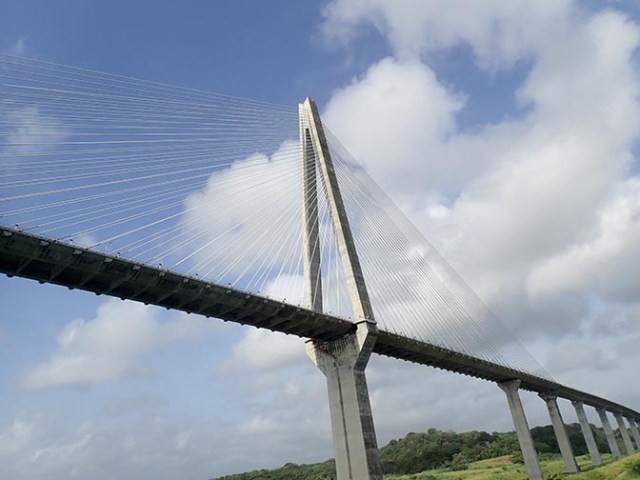
Entering from the Atlantic side we first passed through Lincoln Bay from the Caribbean Sea, passing under the Atlantic Bridge which spans the canal entrance at that end. That bridge opened in 2016. Just beyond the bridge what looks like a little river off to the right is actually the bit of canal that the French dug way back in the 1800’s that would have been way too small and narrow for today’s ships even if they had managed to finish it. That bit was not used by the Americans back when the original canal was built starting in 1904 and finished in 1914.
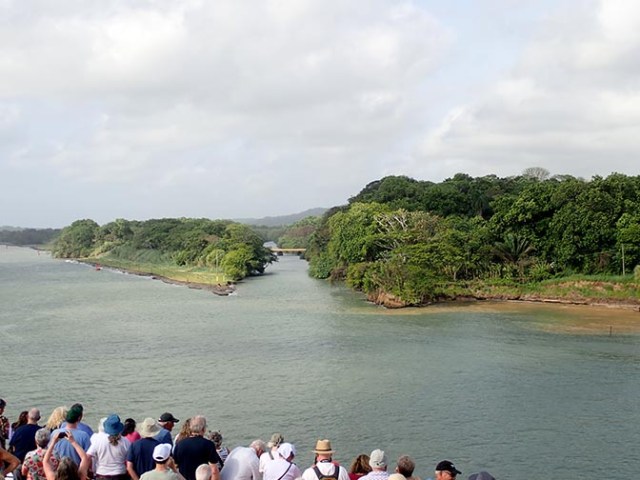
entrance to what would have been the French canal had they been successful in building it
I was hoping to see the new locks since I had already been through the old ones on the previous trip, but we went through the old ones instead. My sister was happy about that as she had not been there before and that was the section she wanted to see. The old locks at the Caribbean end of the canal are called Gatun Locks and the new ones Agua Clara Locks.
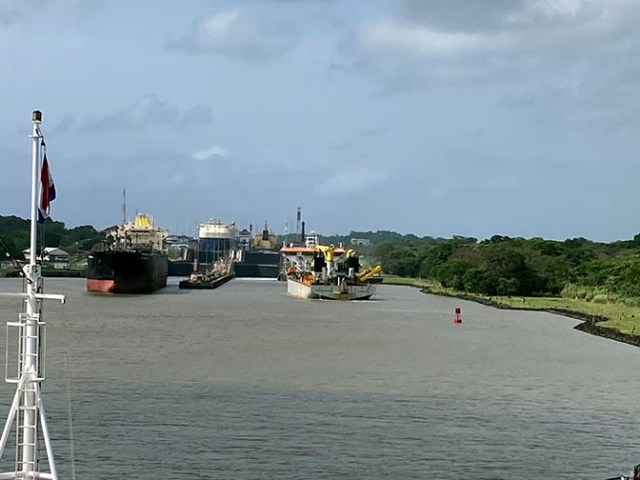
ship exiting the canal and dredger blocking our lane
Though a lane was open in Gatun Locks as we approached it took quite awhile before we could enter because there was a giant dredger in the way vacuuming up mud to keep the canal clear. Daily dredging is required to maintain a navigable depth for the ships passing through the canal. The canal is open 24 hours a day so dredging has to be done while it is open since it is never closed. More work is done at night while there is less traffic, but we were there early in the morning and the dredger was hard at work. It kept looking like it would move out of the way, but then not actually doing so until eventually it finally actually did.
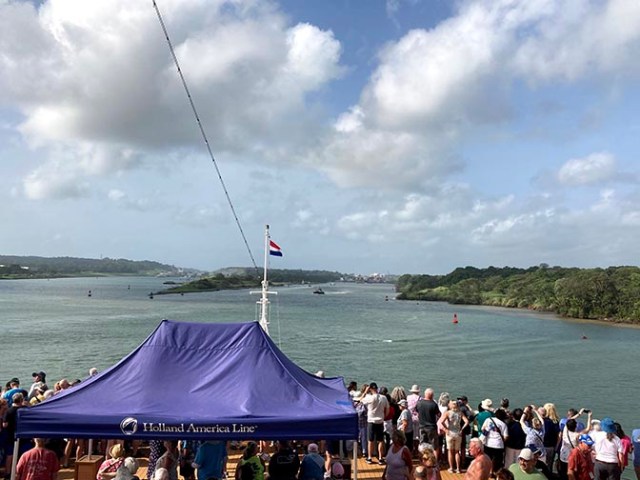
right channel goes to the old locks and left channel to the new ones
Gatun Locks has two lanes. Each lane has 3 chambers so it takes awhile to get through all 3. We went out to the big open bow on deck 5, but it was too crowded to see anything so we ended up on the smaller bow on deck 6. It was not as crowded, but still had a lot of people. At the entrance to the canal there’s a split around a bit of land where the right side goes to Gatun Locks, which as previously mentioned is the original smaller set and the left leads to Agua Clara Locks, the new one Panama built at the Atlantic end of the canal. There is an Agua Clara visitor center highlighting operation of the new locks.
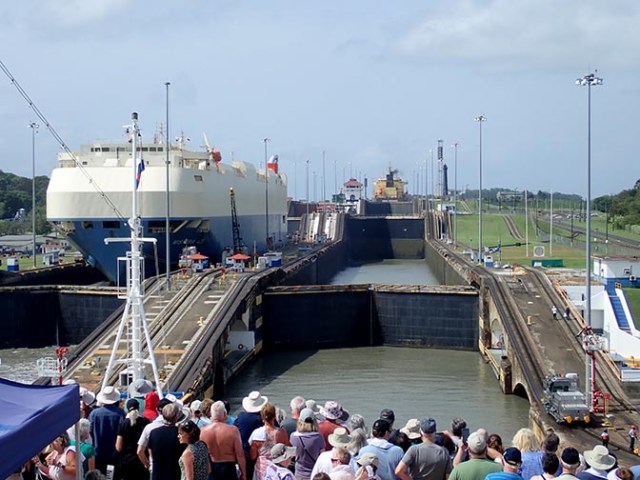
entering Gatun Locks
Both sets of locks on that end of the canal have 3 chambers each. Gatun has 2 lanes and Agua Clara has one. It can accommodate 9 large ships at a time if there is one in each chamber of each of the locks, with 6 of old Panamax size in the three chambers each of the two lanes of the old locks and 3 larger ones with one in each chamber of the new set. Neopanamax is the new maximum size for the canal for ships too big for the old locks that can fit through the new locks. More than one ship can go into the same lock chamber at the same time if they are small enough. We did see 3 small sailboats go in together at one of the locks later in the journey. They barely took up any space in the lock whereas our ship took up an entire chamber by itself.
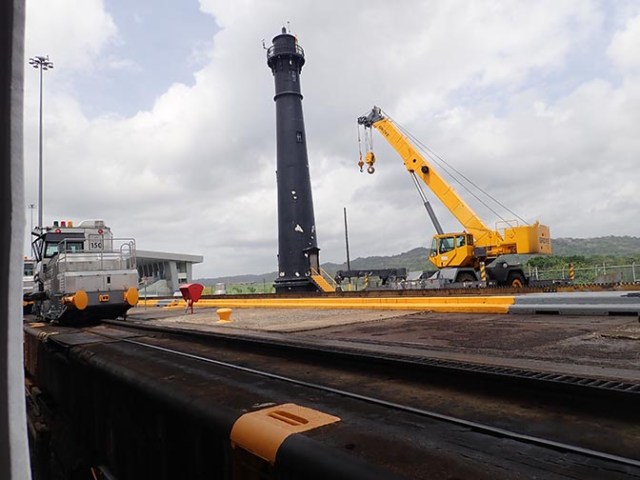
black lighthouse
There was a black lighthouse at Gatun Locks. It’s painted black to indicate that it is no longer in use.
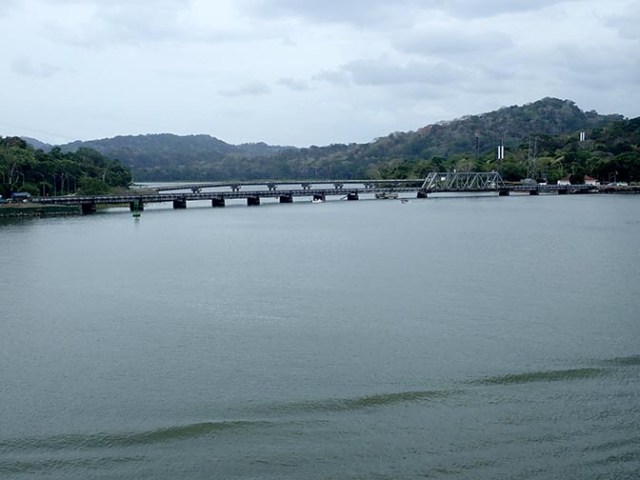
train bridge over the Chagras River
Exiting those locks ships pass into Gatun Lake, which was created through damming the Chagres River to make a reservoir to run the locks. The dam there powers electricity for operating the canal and the reservoir serves as a municipal water source as well as water to fill the chambers in the locks.
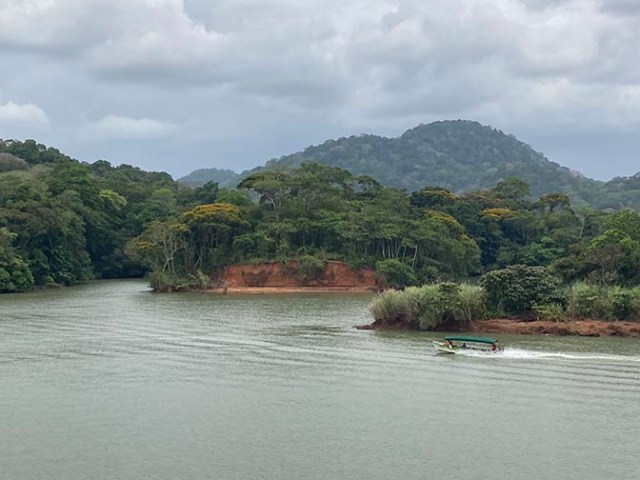
Gatun Lake
Islands in the lake are the tops of what were hills before the manmade lake filled with water. Ships can easily pass by one another in the lake. When we transited the canal the first time all of the boats went the same direction with one way passing through in the morning and the other in the evening, but this time some areas had ships going both directions. Even the first set of locks had a ship coming out of one lane before we went into the other one. It was long gone before the dredger got out of the way. The next one coming out of that chamber had to wait for the dredger to move before it could come out just like we had to wait for it to move before we could go in. Between that and the late pilot we were at least an hour behind our scheduled time by the time we finally got into the first lock.
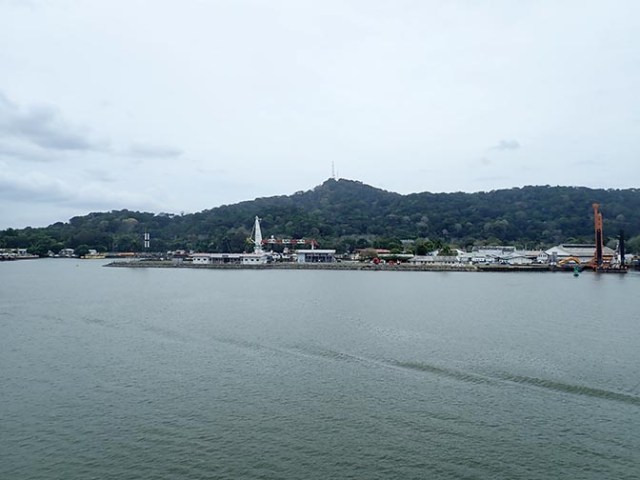
Gamboa
Even though the lake is wide there is a set path ships take along the original course of the Chagres River. It meanders between the islands that were once hilltops. At the far end it narrows into a channel that passes by a town called Gamboa which is a base for dredgers. The canal’s dredging division has been based there since 1936. Before we ever took a cruise that did a full transit through the canal we took a partial transit tour as a shore excursion from MSC Divina in 2013 that ended in Gamboa.
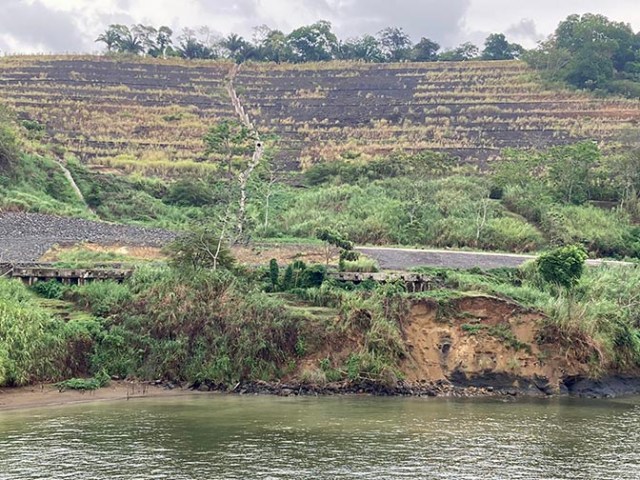
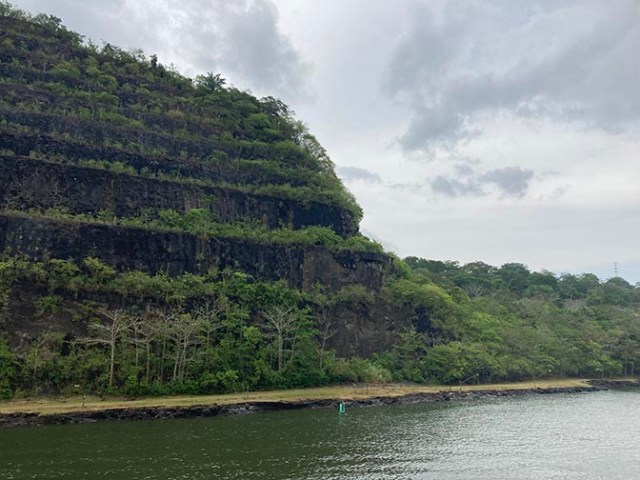
slide in the Culabra Cut
The Culebra Cut is a man-made channel through the continental divide. Many of the sidewalls are terraced, some edged with rock reinforcements. This area was widened as part of the Panama Canal expansion which included the new sets of locks at either end to accommodate more and larger ships. Besides dredging to keep the channel clear some parts are prone to landslides so there’s a lot of maintenance involved. Areas of new digging or recent slide repairs were evident along the sides of the channel. Slides in that area were one reason why the French were unsuccessful with their early attempt at canal building. Landslides and disease killed a lot of their workers.
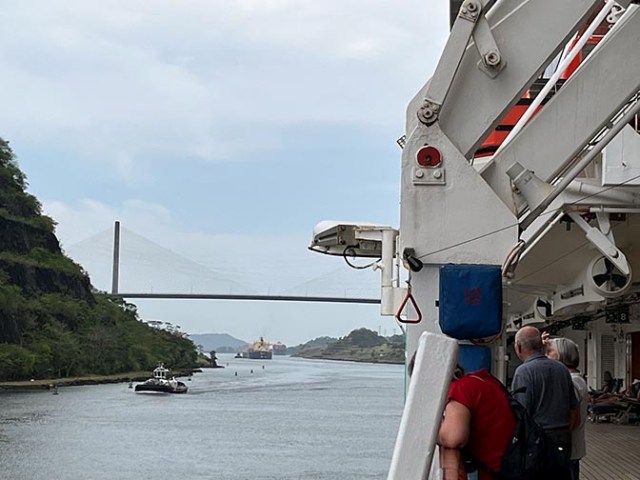
heading toward the Centennial Bridge
A full transit of the Panama Canal is an all-day thing so we were in different places around the ship throughout the day, intending to be at prime viewpoints on the ship for things like locks and bridges. Sometime in the afternoon we were relaxing out on the promenade deck with a daiquiri each (mango for me, strawberry for Linda). According to where the shipfinder app on my phone positioned our vessel it looked like we had some time to go before we got to the Centennial bridge until there it was looming large nearly above us. I had wanted to go under that from an upper deck at the back of the ship because it’s fun to watch a ship approaching a bridge where it looks like the ship is way too tall and will never fit under until you get there and go under, then looking back it looks as if you couldn’t possibly have fit.
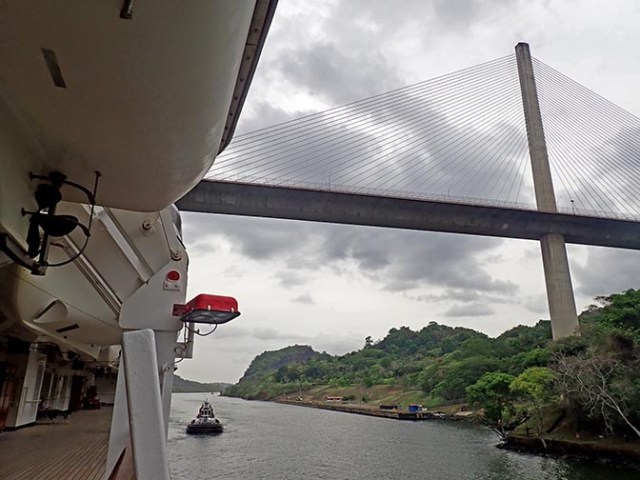
nearly under the Centennial Bridge
We didn’t have time to get to the stern on an upper deck before it would pass under the bridge so we just saw it from the one side of the promenade deck where we already were. It still looked like the bridge was a lot lower than the ship and like the ship’s bridge would smack right into the side of the Centennial Bridge, but of course it sailed smoothly right under it.
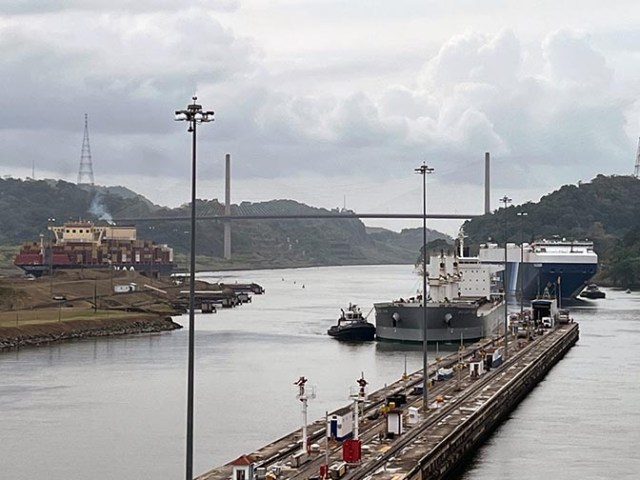
Pedro Miguel Locks
We did go to the back for the next lock, which was Pedro Miguel Locks. At that end of the canal ships using the old original channel pass through two sets of locks while those in the new lane have just one. Pedro Miguel has just one chamber that lowers the ship 30.5 feet (9.3 meters). After that lock the lane for the new locks is raised well above the level of the lane for the old one since ships there haven’t gone through any locks yet. From our lane we could see an MSC container ship well above us in the new lane.
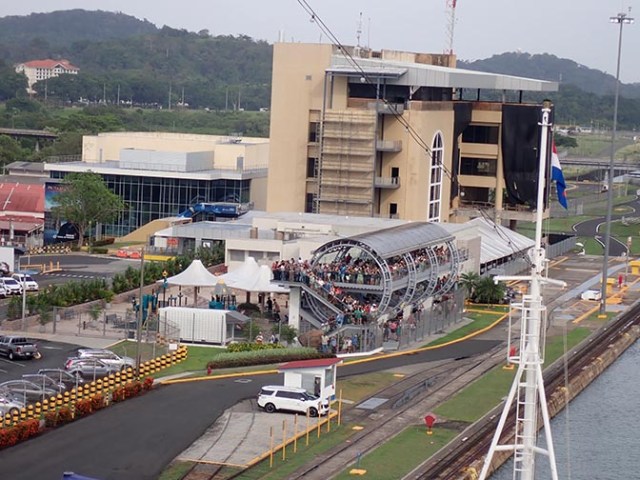
The tall building is the old visitor’s center. It had several levels of viewing areas, now mostly behind a black tarp. The new visitor’s center is behind it with the new viewing area next to the canal.
Miraflores Lake sits between Pedro Miguel Locks and Miraflores Locks at the far end. The locks there has a new visitor’s center right next to the old one. The old building was either undergoing some sort of repair or being prepped for removal because it was partially covered in plastic and looked to have some sort of work going on. The new stand for people to watch ships go by is smaller than the area they had to watch from the old building. There’s an exhibit on the canal’s history in the new visitor center.
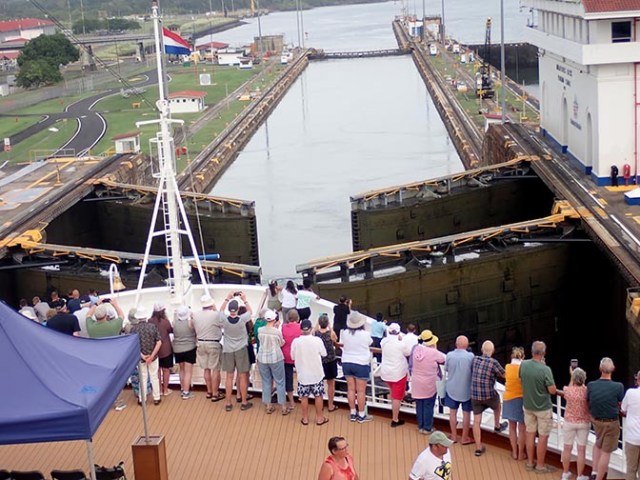
people on the deck 5 bow and a few crew on the deck 4 bow watch the gates open in Miraflores Locks
Not a lot of time passes between Pedro Miguel and Miraflores locks, but we had enough to go back to the bow. Since we started from deck 9, we went down to the one on deck 7 first to assess the crowd on the lower bows and found that there wasn’t one. We had a good view from there so we just stayed. As we got closer to the lock more people came out on decks 5 and 6 as well as 7. Previous Holland America ships I’ve sailed on had the big open bow on deck 4, but Nieuw Amsterdam has a crew bow on that deck. Instead of just a small bow on deck 5 it has one that comes closer to the end of deck 4 than the other ships have from deck 5, but not all the way to the end so it’s smaller than the big bow on other ships. It just has small bows on 2 other decks instead of 3 so there’s less total space for passengers to see the scenery on a ship that holds more people. A bonus for the crew since they get the one on deck 4, though most of them are working when the ship passes through scenic areas and don’t have the opportunity to use it.
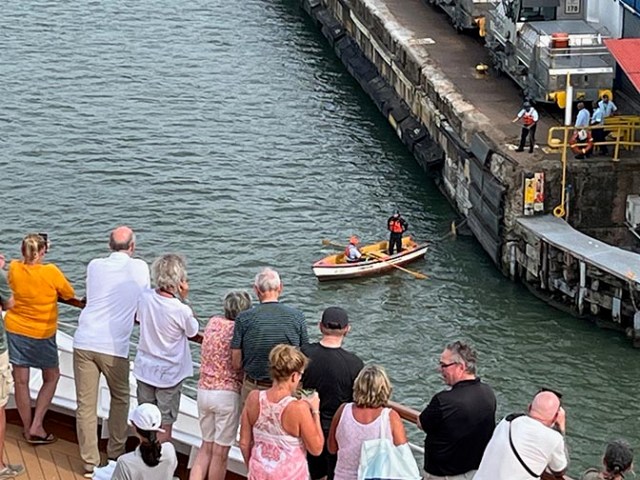
little rowboat at Miraflores Locks
As we approached Miraflores locks we saw the little rowboat come out with the linesman bringing the lines to the ship. They do that at each lock, but we couldn’t see them through the crowd at the first lock or from where we were at the back on the second one.
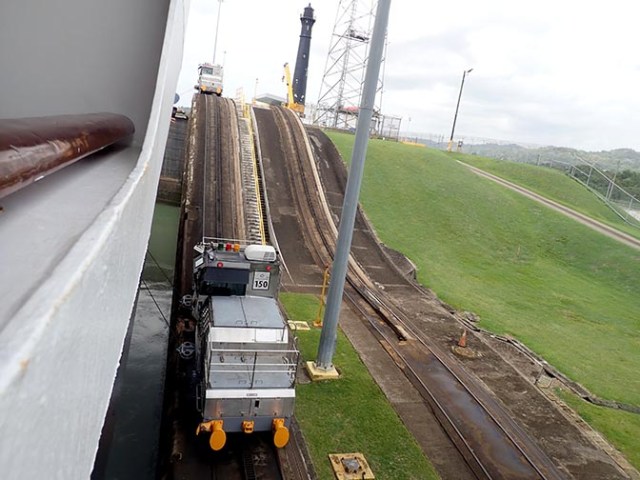
one of the little locomotives in Gatun Locks
After the person on the tiny little rowboat throws the lines to the ship they are connected to several little locomotives on each side of the lock that will hold the ship and move with it through all chambers of that lock.
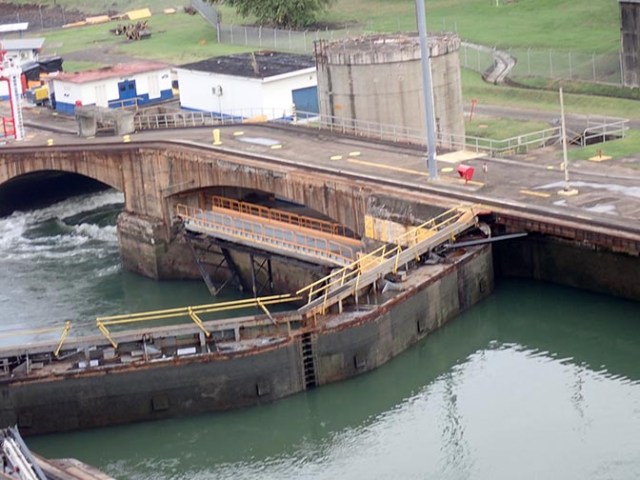
the little road section of the stayed flat against the wall since it is no longer in use
Miraflores Locks has two chambers. I remembered cars driving across when the gates were shut the previous time we went through the locks. That’s a thing of the past now. The little road sections of the canal stayed flat against the sides of the chamber and never closed across the lock.
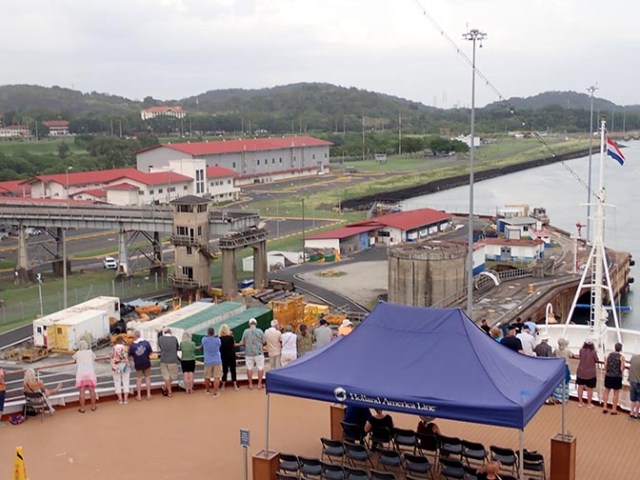
road to nowhere on the side of the locks
The road leading to it on both sides ended abruptly where the road had been chopped off so it would be a long fall to the ground from the current end of those roads, which are now roads to nowhere. The cars used to come out under the archway that the road bit is tucked into. I guess people have to go to one of the 3 bridges to cross the canal now.
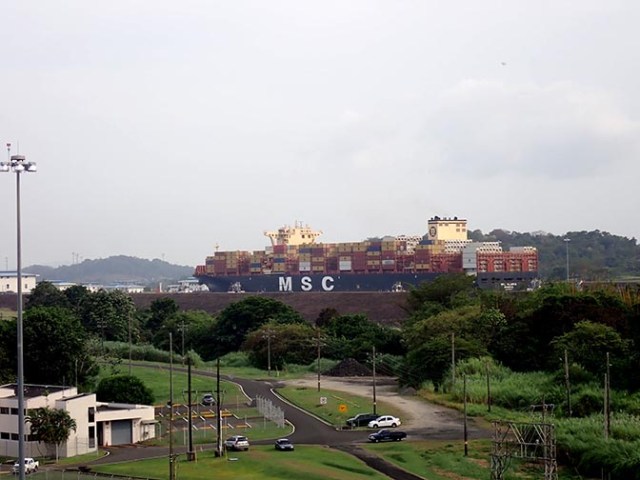
MSC container ship in the new lane
On the approach to Miraflores Locks we could see the MSC ship in the new lane heading for Coccoli Locks that would take it all the way down to the Pacific Ocean in one set of locks rather than the two we went through in the old lane. Coccoli Locks has 3 chambers so ships there still go through the same amount of steps. It’s just done all in one lock rather than two separate ones. All of the canal expansion projects including both sets of new locks were built by Panama. The new locks at both ends opened in 2016 using the newer technology with water reuse basins so it takes less water to run the new bigger locks than it does the old smaller ones. We could not see the actual new lock, just the MSC container ship passing through the lane above the level where we were and then lowering down so that we could see less and less of it when it got into the lock.
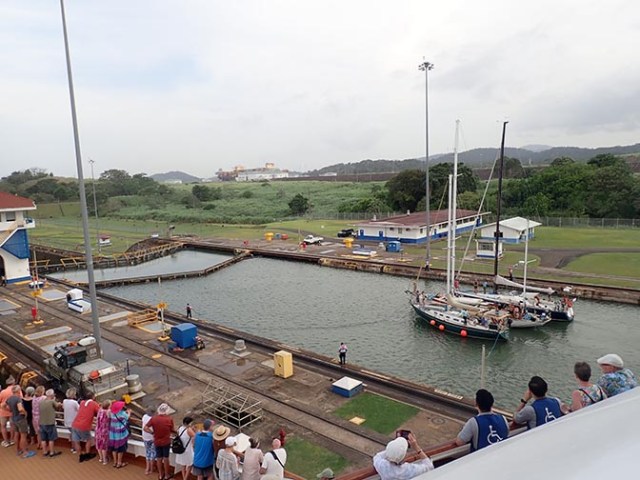
3 little sailboats in the other chamber while we went through Miraflores Locks
At the far end of the canal the ship passes under the Bridge of the Americas. We had set time dining on this cruise and since the ship was running late on its transit it hadn’t quite finished the last chamber of Miraflores when it was time to go to dinner. From the dining room we could see the lock chamber all around as the ship lowered to the level of the Pacific Ocean, and a rear view of the bridge through the back window. It’s a bit different view seeing walls all around you out the windows of the dining room. Passing through the Panama Canal is quite different from going through the Suez Canal since the Panama Canal has locks at either end and the Suez Canal is all at one level. The scenery is quite different too since Panama has a lot of tropical jungle and Egypt has sandy desert.


 Cruise Stories