
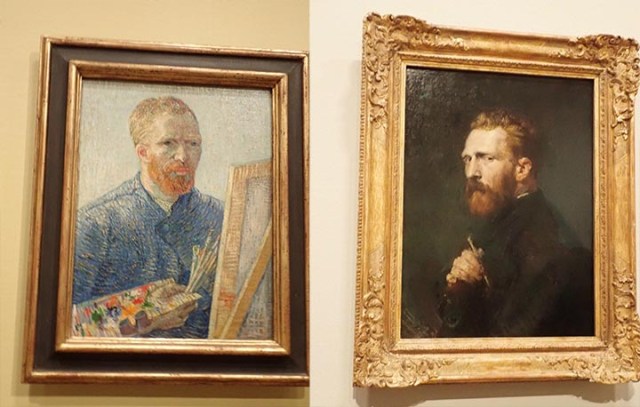
two self-portraits of Van Gogh
Vincent Van Gogh was born March 30, 1853 in Zundert, Netherlands and died July 29, 1890 in Auvers-sur-Oise near Paris, France. He was the oldest of 6 children. Working as an art dealer’s apprentice starting at 16 brought about admiration of some painters and his interest in art. Rejection by a London girl and an unfulfilled desire for human affection and to serve humanity eventually brought about his dark side. He worked for a time as a teacher, preacher, and missionary before giving away all his belongings, sinking into despair, and discovering his calling as an artist.
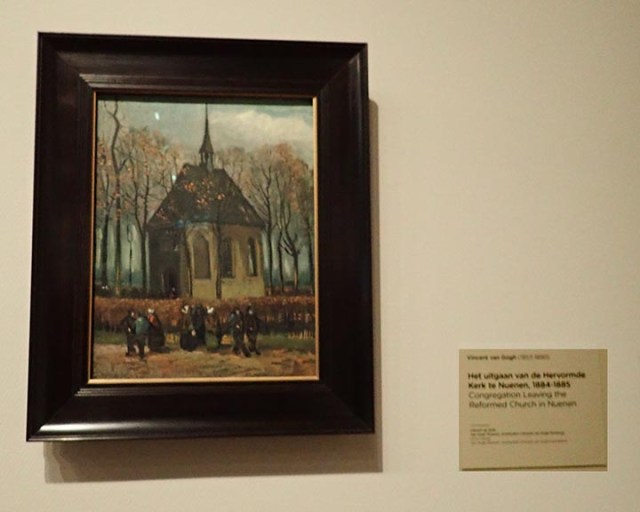
church painting
His style changed over the years through both learning and the influence of other artists. Color was very important to him and his understanding of it improved through observing other artists in France. Some disturbing letters at the museum show a women hating or fearing side of both parties, him and a person he mentored.
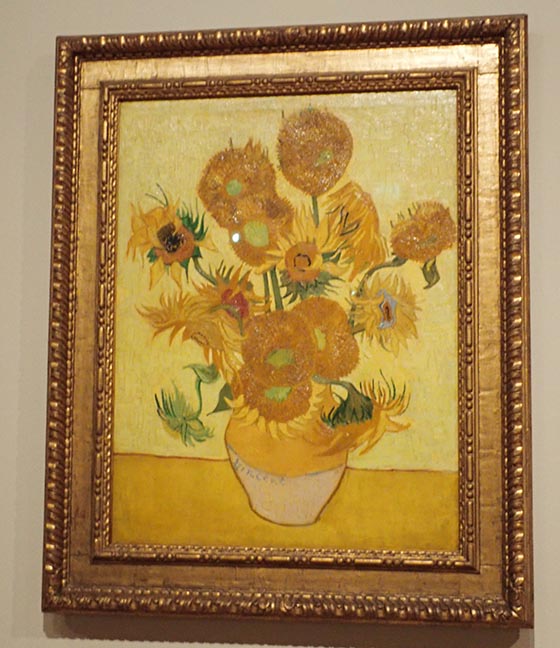
sunflower painting
During time spent in a mental institution he painted a lot of pictures from what he could see through the bars of his cell when he wasn’t allowed to go outside. The sunflower paintings which are among his more famous came from time he spent living in a yellow house in Arles, France. There are sunflower paintings displayed at the museum in Amsterdam. Paul Gaugin lived with him in that house for a short time and two of the 5 sunflower paintings hung in his room.
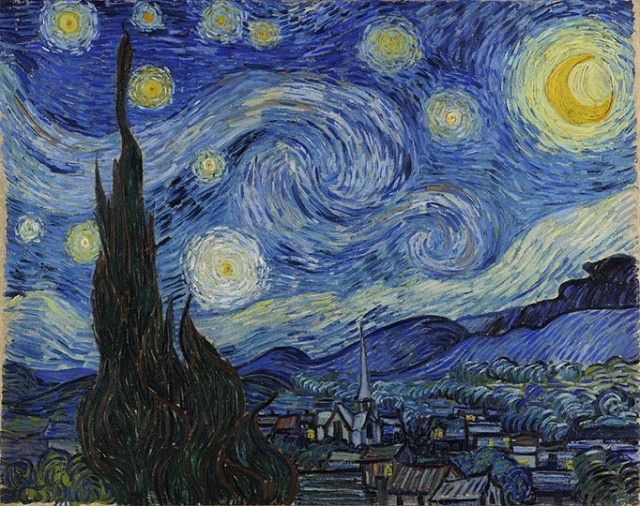
The Starry Night (internet photo)
The starry night which is one of his most famous paintings was done in the mental asylum in France. This painting is not at the museum in Amsterdam. It is displayed at the Museum of Modern Art in New York. He spent a year in the mental institute where treatment consisted of baths twice a week.
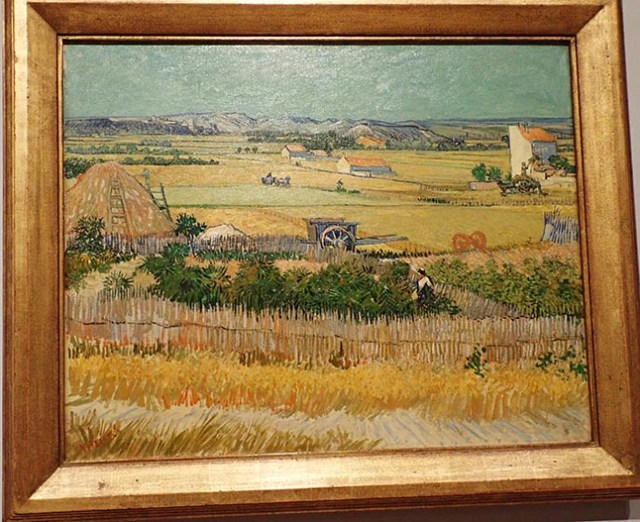
painting of a farm and field
The museum sticks with the long-believed tale of Van Gogh cutting his own ear off after a fight with Paul Gaugin who was living with him at the time, but in the 1990’s, letters were found about a pact of silence between Van Gogh and Paul Gauguin opening up a new theory that it was actually Gauguin – an accomplished swordsman – who cut off Van Gogh’s ear. According to this theory it was due to shame on Van Gogh’s part for attacking Gauguin in the first place and guilt on Gauguin’s for cutting off the ear that they never said that it was actually Gauguin who cut off Van Gogh’s ear with a sword.
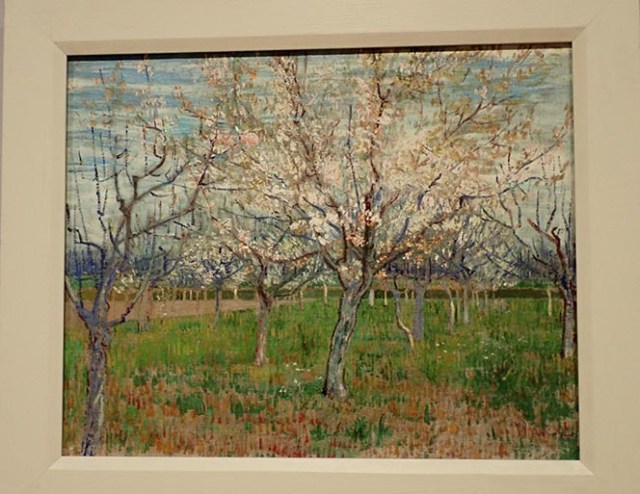
painting of a tree
At the end of his life he lived with his brother Theo, who is the person he was closest to throughout his life and the one he corresponded with the most. Theo was an art trader. While living at his brother’s house, Vincent Van Gogh painted 75 paintings in 70 days then shot himself in the chest and died a couple days later. His brother Theo died of illness a year later. Theo’s widow is the main one who sold his paintings and made him famous. His art career only spanned one decade, but he made hundreds of pictures.
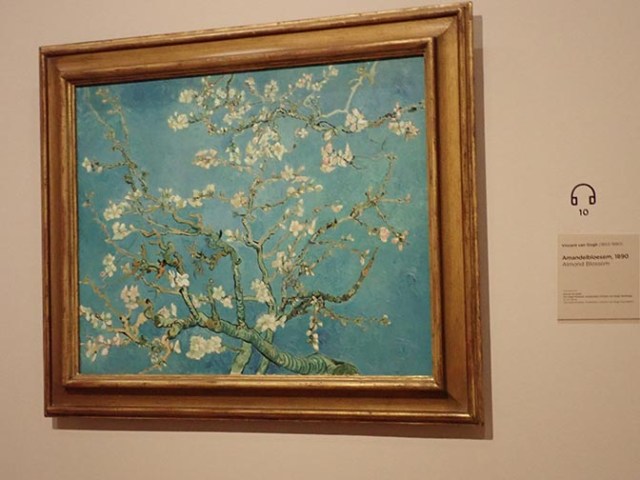
almond blossoms
His almond blossom painting was done for his newborn nephew, son of Theo and his wife Jo. This painting is at the museum in Amsterdam. Not all of the artworks in the museum are his. Some are from people who influenced him or were close to him.
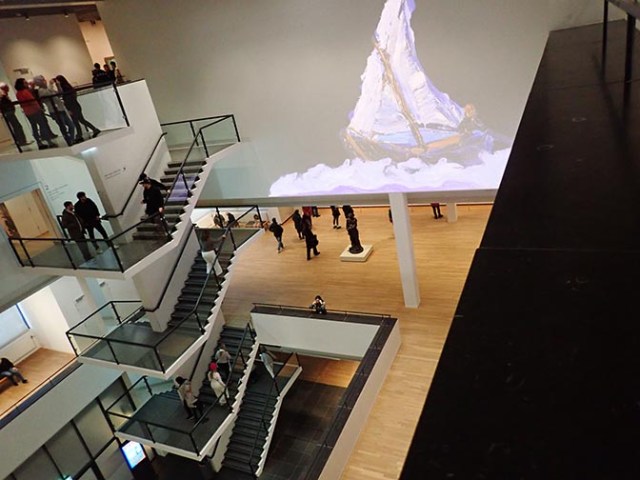
central stairway
The museum has an open center with a stairway running up through the levels. There’s also an elevator available. The gift shop is on a lower level, with paintings on the top 3 levels of the building. In the open space in the center different paintings take turns being projected onto a wall.
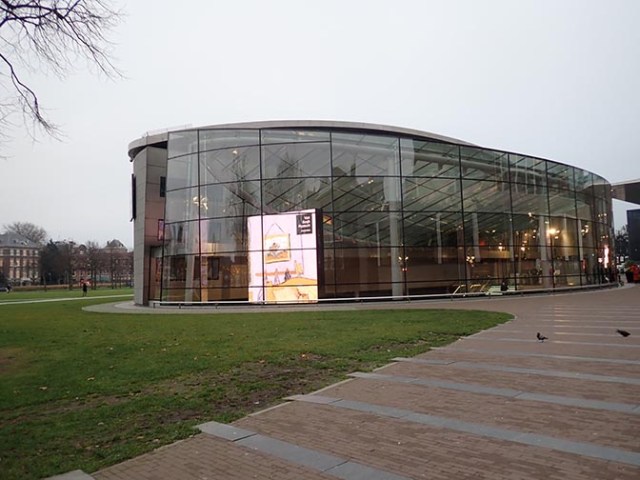
Van Gogh museum
The outside of the museum it is a modern glass building. You can rent a headset for audio or just go through the museum without it. There is something about the paintings near all of them. With some it’s just a small sign saying who painted it, but at least one in each section has either part of his life story or an explanation of how those paintings relate to him if they are not his own. There’s a little headphone symbol anywhere that has audio available.
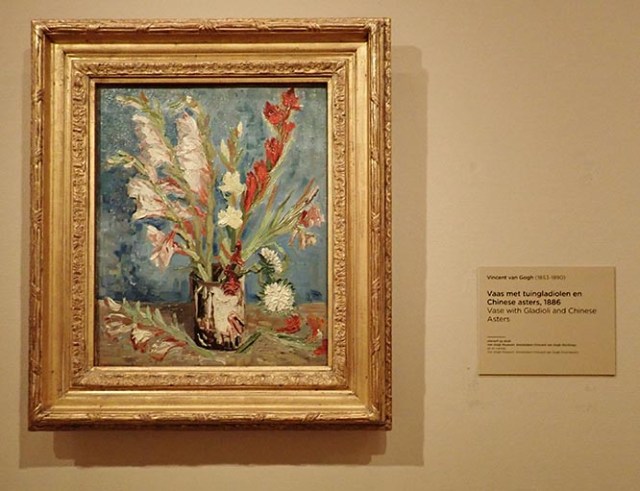
vase of flowers
Some exhibits are not paintings. There’s a microscope that shows things close up, like sand mixed with the paint on one scene. You don’t have to actually look through the scope to see it as there are real-time lighted displays of what is in the microscope on the wall that are whole lot bigger than the microscope view.
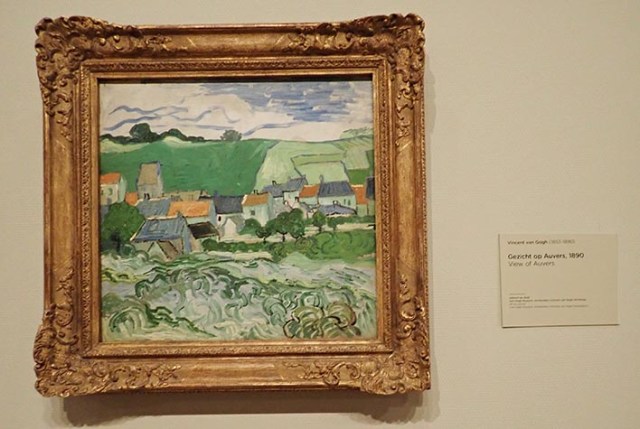
View of Auvers
Another exhibit is about colors. It talks about him learning how to use them and shows yarns that he used to determine color for a painting without wasting expensive paint to decide. One room of the museum had self-portraits of Van Gogh.


 Cruise Stories