
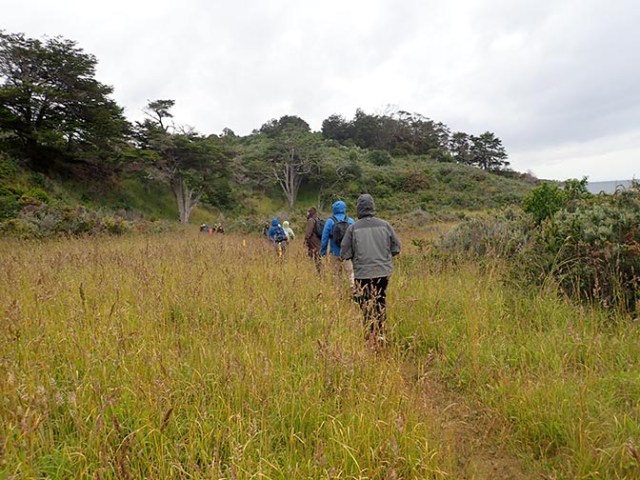
hike at Magallan’s Strait Park
In Holland America Oosterdam’s shore excursion descriptions the hike at Magellan’s Strait Park is billed as a visit to a national monument at Fort Bulnes and a walk through a native forest and coastal shores. Fort Bulnes is the first Chilean settlement on the Strait of Magellan, located 40 miles south of Punta Arenas. The drive is one hour each way from the port. Bulnes was founded in 1843 by 22 adventurers who claimed the Strait of Magellan for Chile and named the area after the president of Chile at the time, Manuel Bulnes. The fort was originally built to protect Southern Chile and the Strait of Magellan from getting claimed by other countries. The fort tour includes a visit to a church, chaplain’s quarters, the jail, powder magazine, post office, and stables.
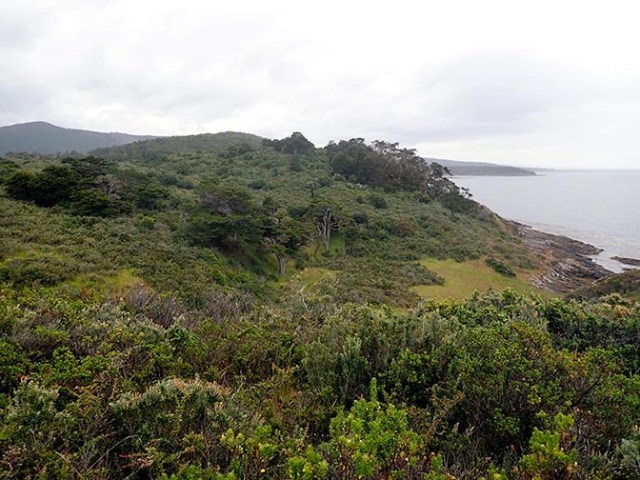
view from the trail
The excursion blurb said the forest walk passes through the best viewpoints of the area. It ends at a visitor’s center with great views and will provide a drink which is a specialty of the region called a calafate sour. It didn’t mention that the drinks provided on cruise ship excursions don’t contain the traditional egg foam on top – probably so as not to sicken people with raw eggs.
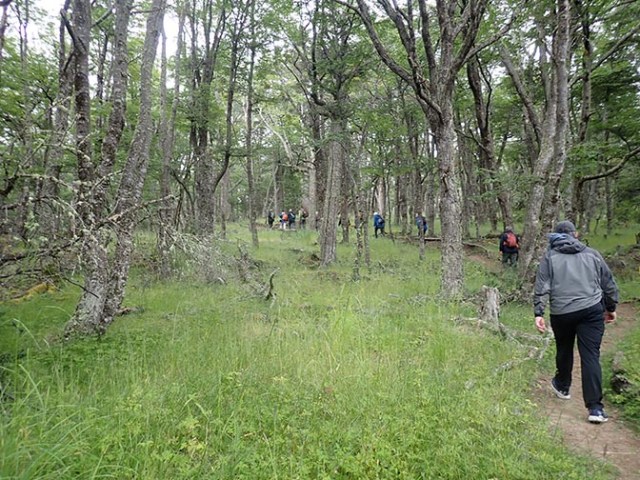
hiking through the woods
The advisory notes say to wear comfortable walking shoes and dress warmly in layers for unpredictable weather. Waterproof and windproof clothing is recommended along with hat, scarf, and gloves. The minimum age is 12. We saw very kids on the ship younger than that onboard. Actually we saw very few kids of any age on this cruise.
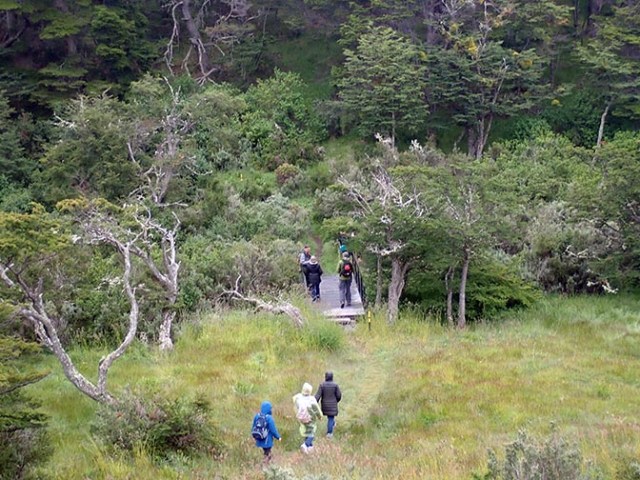
bridge at the bottom of a steep hill
The weather forecast on the day of our hike was for rain and wind, though not so much wind as the gale expected on the day we were scheduled to visit that port. The itinerary changed to go a day early as it would be too rough to tender to shore the day we were supposed to be there.
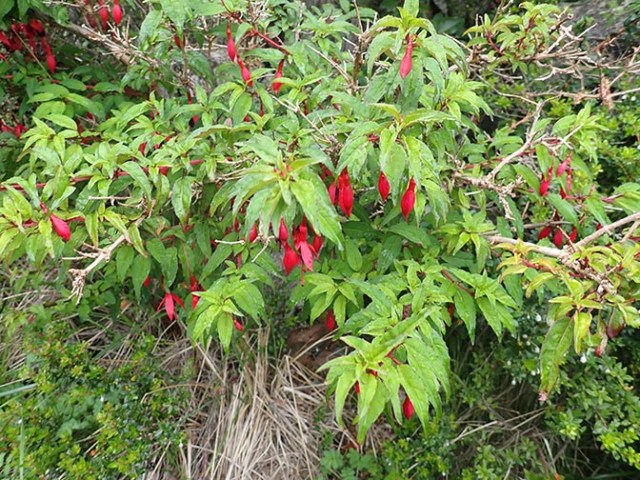
wild fuchsia
We dressed per the forecast figuring even if it didn’t rain, raingear would work as a windbreaker as well. The weather was cloudy on the way over in the tender and during the bus ride to the fort, which was about an hour away. The road ran along the shore. First we passed by a bunch of rusted out hulks half sunk along the shore. Then we went by a whole bunch of what looked like abandoned hulks rusting offshore. The guide said those were actually Chinese fishing vessels who were there to wait out the coming storm. They aren’t allowed to fish in Chilean waters or come ashore, but they let them sit out storms there because they would sink in open water. They do their fishing in international waters.
Along the way the guide gave us little bits of history. We passed by a monument that was a marker of the center of the country of Chile – if you count Antarctica as part of Chile. Apparently they had claimed it as their own before the international treaty was signed for it not to belong to any country. Though they did sign that treaty along with everyone else they still kind of consider it part of their country. There was also a statue of the Virgin Mary there because she’s their patron saint of the sea and he said pretty much everyone living in that area works on ships at some point in their life.
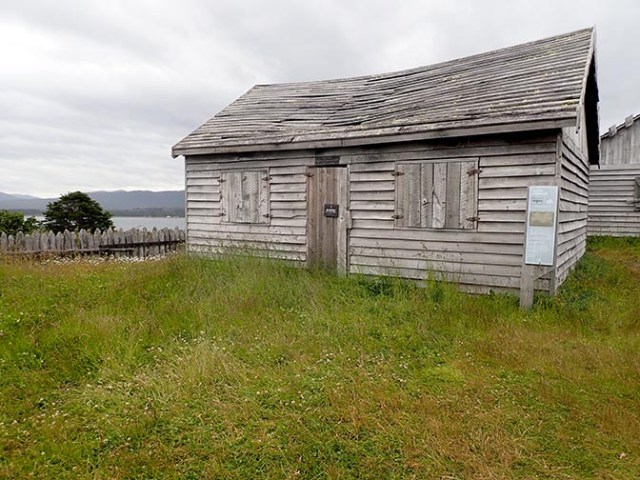
saggy roofed building at the fort
We passed by a lot of pretty good-sized fishing boats up on shore. Some for maintenance and repair, but others just for storage. The guide said they put them on shore when not in use. They don’t have cranes or anything to get them there either. Just a lot of people and maybe a pick-up truck with a rope.
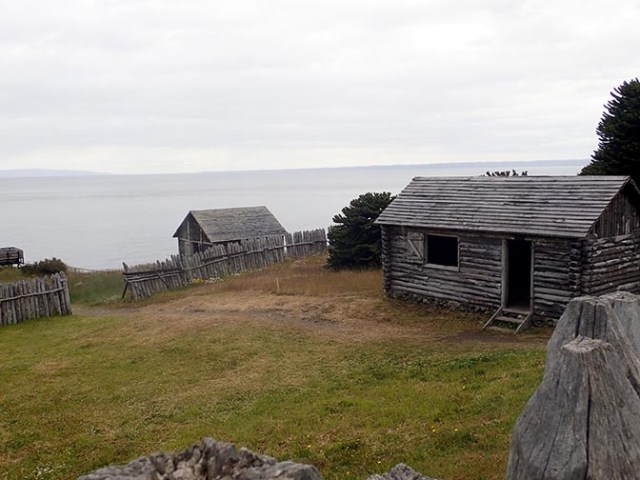
view from the fort
The fort is a replica of the original because the first one was burned down by a mutineer who went there on his way out of the country just to do that. He got caught later because instead of leaving the country straight away he stopped again to do further damage elsewhere. At that time the punishment there for mutineers was public dismemberment.
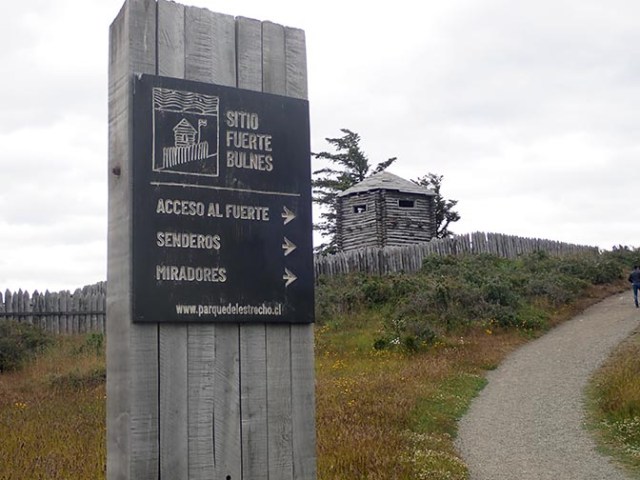
fort entrance and the original building
The original fort was built to defend Chile’s claim to their part of Patagonia and the Strait of Magellan. The first people to arrive used up a lot of the wood they had brought with them for building a fort in repairs of their ship along the way so they had just enough left for one building – and no nails. They had an engineer from a Nordic country along with them who taught them how to stack log walls by making grooves in the corners where they could fit one log into another. Much like the Lincoln log toys only on a much larger scale. That is how the stronghold was made, which was the first building at the fort.
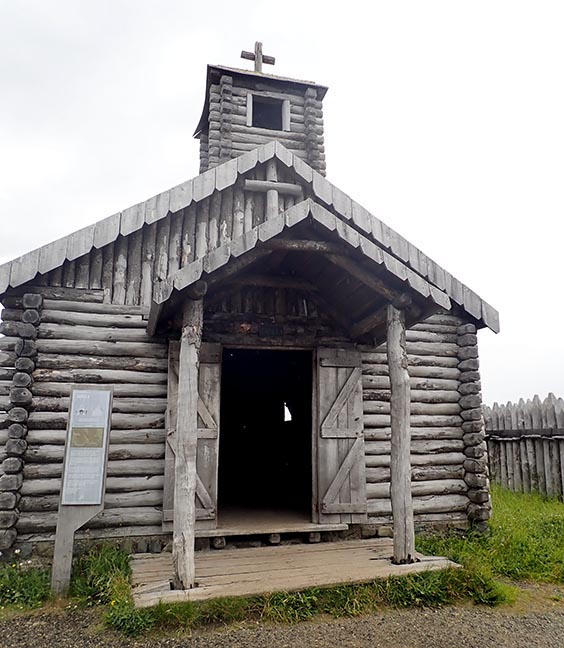
church at Fort Bulnes
Later other people came with more supplies so most other buildings are made in a more traditional manner. The church is still registered as an operating church. People can rent it for a wedding venue if they want. It would have to be a pretty small wedding since it’s a very small church.
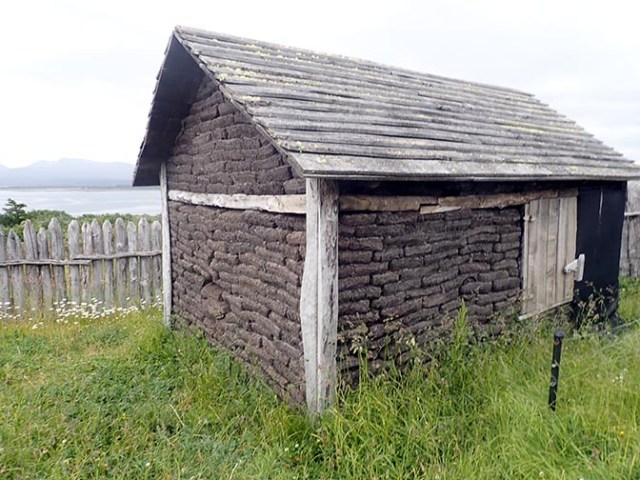
sod building at Fort Bulnes
At some point the settlers learned how to make sod buildings by drying bricks cut from the soil and stacking them. There’s still one small building like that there, though some of the sod does not look to be in the best of shape.
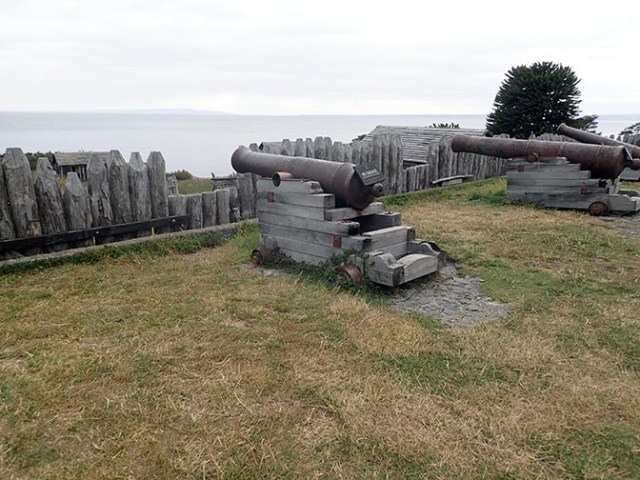
cannons and the monkey puzzle tree
There was a tree that looked like what’s called a monkey puzzle tree at home. The guide called it something else, but said it was the same tree. Something not native to that particular spot, but a sacred tree to the original inhabitants of the area. It comes from the high mountain regions of Patagonia. The one there was planted by the early settlers. In Chile it’s called pehuen. It is also known as piño araucaria and pino chileno. The scientific name is Araucaria araucana. I don’t remember which name the guide used.
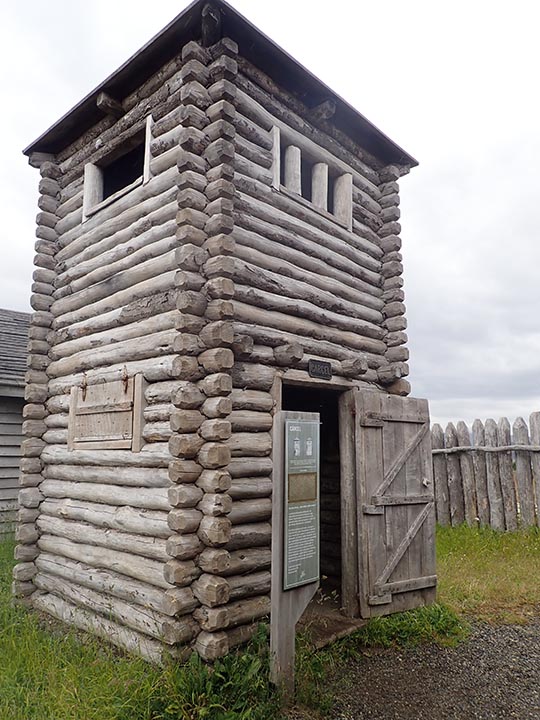
stockade
A tall skinny building was the jail or stockade. It’s made Lincoln log style like the first building which was also tall and thin, though not quite so much as the stockade. The guide said the most infamous prisoner was the fort’s blacksmith whose original crime was not wanting to do much work. Considering the people there were generally cold and starving and had a long walk just to fetch water it’s pretty understandable that one would not feel like working too hard. His punishment was to work double shifts and sleep in the jail. After awhile his wife complained about it and got in a shouting match with the person running the fort. He kicked both her and the husband out of the fort. The blacksmith was a violent man so fearing harm to the wife people went looking for them and found her dead by the river due to a blow to the head with a blunt object. The blacksmith was then sent back to the city as a murderer.
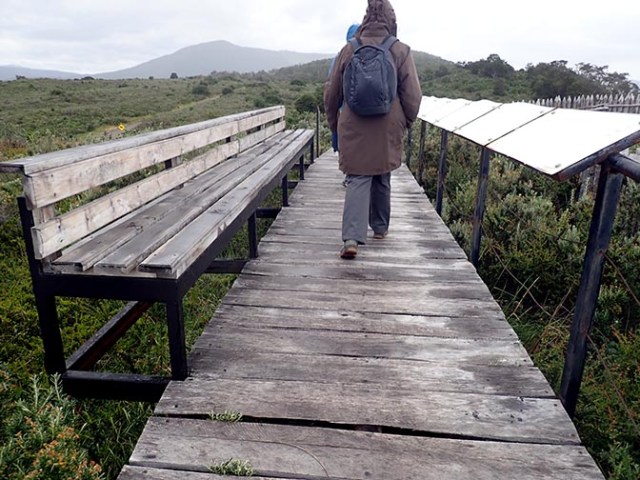
boardwalk leading from the fort to the trail
After about half an hour at the fort the group was gathered up to start on the hike. Anyone not wanting to walk was given the option of taking the bus to the visitor’s center. Some people actually took them up on that even though the hike was the main part of this excursion and there was a different tour that just went to the fort and visitor’s center without the hike. One guy said it he booked it intending to hike, but couldn’t due to an injury. Maybe the others just didn’t like the weather as it had been raining on and off while we were at the fort.
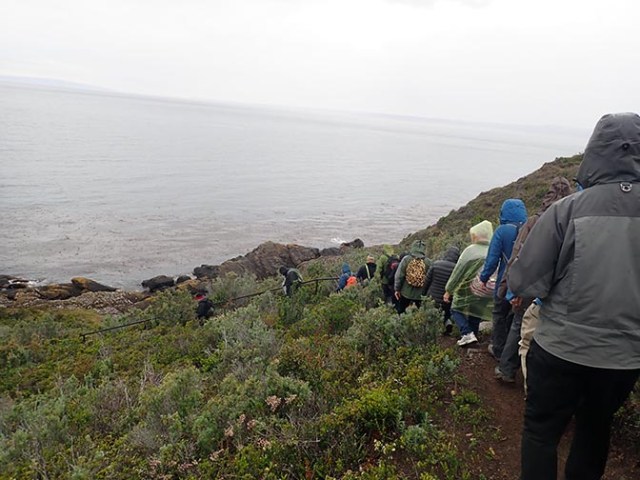
start of the trail
The hiking trail was mostly a narrow single file sort of trail through the woods. There was a very short level bit before the first steep downhill. It was mostly up hills and down hills from there. At the start of both this hike and the one we took at the previous port stop in Puerto Chacabuco we were told the distance was about 2K, but the first one was over 3K and this one more than 4. I didn’t mind since I often run farther than that on hilly trails, but it was farther than what some of the people were accustomed to walking.
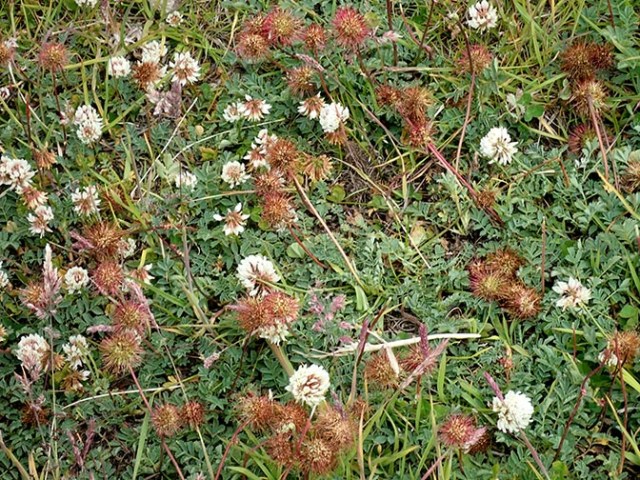
clover and burrs
Some of the vegetation resembles familiar things. What looked like an ordinary patch of clover turned out that all of what looked like dead blossoms were actually burrs. They stick onto whatever they touch, but were soft rather than prickly like they looked and were easy to pull off. The clover may have actually been clover with the burr plants growing within it.
There were daisies that the guide said are native that looked exactly like the non-native invasive oxeye daisies we have at home, though they are not actually the same variety of daisy. Everything is native somewhere. The oxeye ones came from Europe. There were also dandelions or something that looked exactly like them. Dandelions are not native, but are an invasive plant in Patagonia. They also had some sort of species of beech tree. Fuchsias grow wild there too. There were also all sorts of plants that don’t resemble anything familiar.
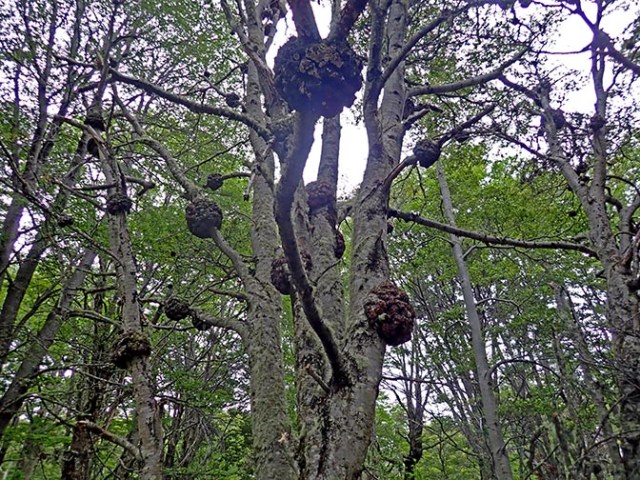
burls in the trees
Some of the trees had big burls on them, which the guide said were caused by a fungus. The tree encapsulates it to protect itself, then the fungus works its way out so the tree makes another capsule. They can pile up into pretty big burls, which the guide said make beautiful ornamentation for wood products when split open.
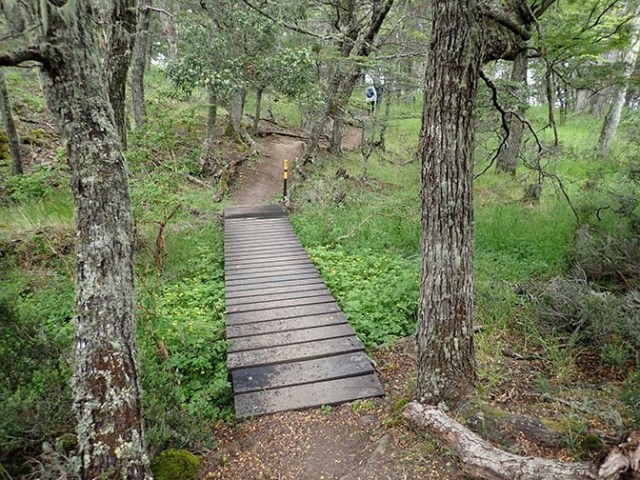
bridge on the trail
At the hike we took in the previous port of Puerto Chacabuco there were two types of calafate bushes, one with thorns on the stem and the other with thorns on the leaf. One was a darker shade of green than the other. One made sweet berries while the other had berries that were kind of sour and seedy, though they were still edible.
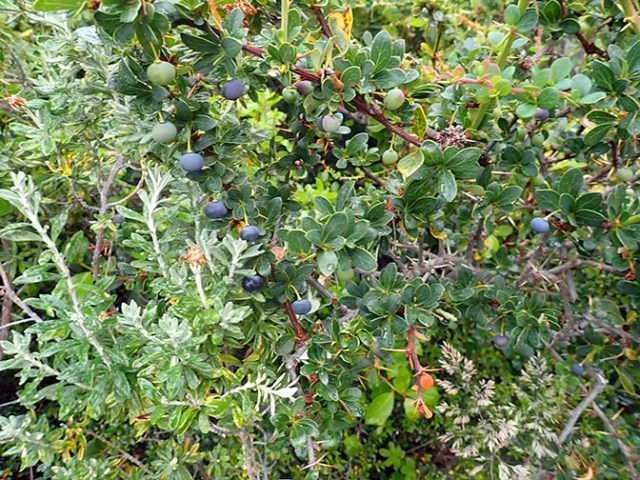
Calafate berries
On these tours the guides always stop here and there to talk about things. One of the stops on this tour was at a Calafate bush. The tale from the indigenous people of the area, of which there were several different tribes, was that a girl named Calafate from one tribe fell in love with a boy from a rival tribe. When the two kept sneaking off to see each other even though it had been forbidden a shaman from the girl’s tribe turned her into a bush. When the boy saw that the berries were the unusual color of her eyes (something like a blueberry) he died of sadness right next to the bush. The shaman then felt badly because it was true love and not just a passing teenage fancy.
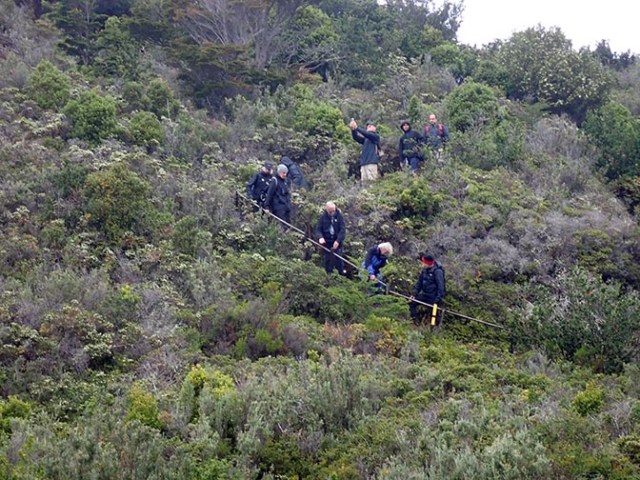
steep hill on the trail
I thought he was going to then say that the girl was the bush with the sweet berries and the boy turned into the other type of calefante bush that we had seen at the previous port, but apparently that area just had one type because he never mentioned the other one. The tale just ended with the boy dying by the bush.
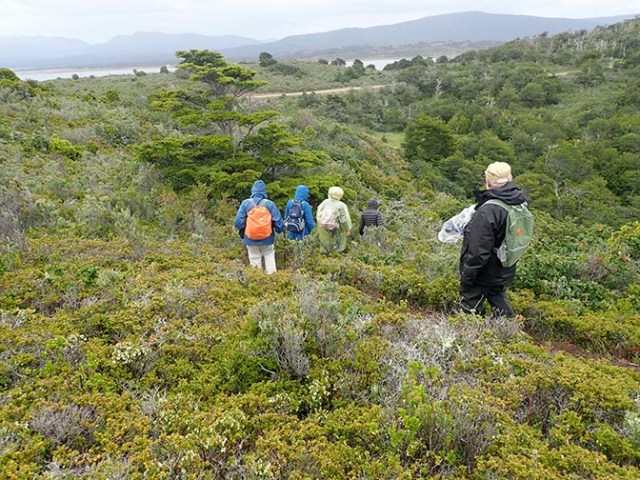
on the trail
During most of the hike it had stopped raining and the expected wind hadn’t kicked up so it was a bit warm in raingear even though I did not wear a heavy jacket or anything underneath since the temperature wasn’t all that cold. It did rain off and on though. Usually about the time I took the hood off and unzipped my coat it would start to rain and then stop shortly after zipping back up and putting the hood on again.
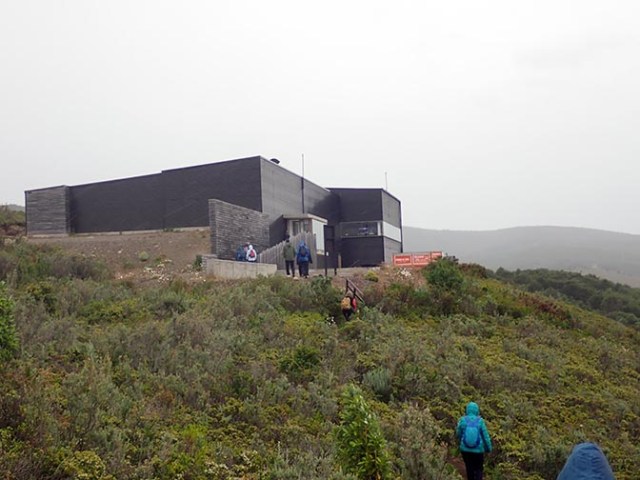
visitor’s center
Near the end of the hike after leaving the shelter of the forest we hiked on a very narrow trail at the edge of an exposed hillside overlooking the water. We were getting close to the visitor’s center when the expected wind finally kicked up along with heavier rain than we’d had previously. That was the sort of weather we had expected and dressed for. Even though there was just a short distance left anyone without raingear was soaked through by the time they reached the visitor’s center. From then on it kept on raining fairly heavily until we got back to the ship, but once we made it into the visitor’s center we were inside other than when going back to the bus and then from the bus to the tender.
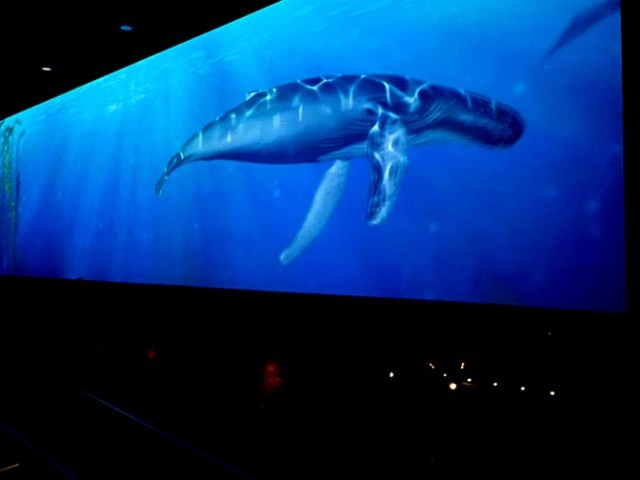
whale exhibit in the visitor’s center
From the trail there was a ramp up to the visitor’s center. It was quite dark when first going inside. Turning left into a hallway, we passed a giant lighted whale display, which explained the darkness of the surrounding area. A different hallway in the visitor’s center had glass cases with models of sailboats.

gift shop
The main room had a gift shop in half and a café in the other half. Of course it had a gift shop. Every attraction everywhere exits through the gift shop even if you’re outside in the middle of nowhere. At the far end of the café on the opposite side of where people order stuff they had a table set up with the promised calefate sours, a local drink made with the berry from the bush. The alcohol in it is pisco, a local brandy to Chile and Peru. Snacks provided were little empanadas and filled croissants.
It rained the whole bus ride back including a rainy walk to the tender. Since it rains a lot in that area hitting some during the trip is to be expected. We got lucky in Puerto Chacabuco with one of their 50 or so sunny days for the year. In spite of the rain it was still a fun and interesting tour. Wearing the recommended rain gear for the hike definitely paid off.


 Cruise Stories
Wow, what an adventure! The mix of history at Fort Bulnes, the lush forest hike, and those calafate berries sounds amazing. Love how even a rainy day didn’t dampen the experience and those views and stories make it feel like a true Patagonian adventure!