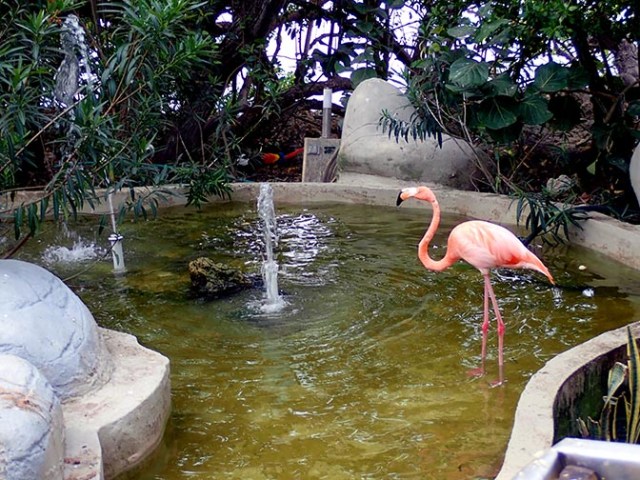
flamingo at the Cartagena cruise port zoo
Cartagena, Columbia
Cartagena’s tourist draws include the 16th century walled old town and its beaches. Temperatures in Cartagena generally stay with lows in the mid to high 70’s F to highs in the high 80’s to low 90’s year-round. Annual rainfall is nearly 43 inches per year with October the wettest month. The official language is Spanish. Money is the Columbian Peso. At the time we were there the exchange rate was 4099,45 pesos to one US dollar. Value of the US dollar compared to other currencies worldwide has dropped over the last year. Now one US dollar is only worth 3,768.63 Colombian Pesos.
Having been to Cartagena previously and finding that when you walk around in the town there are multiple cigar vendors and people who buy those cigars and smoke them on the spot, I had no desire to leave the port in that city. I’m allergic to tobacco smoke and was feeling very ill from all that cigar smoke everywhere by the time we got back to the ship on my previous visit.
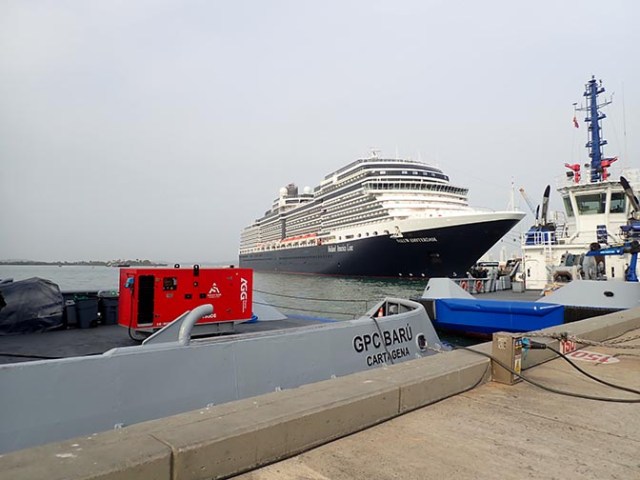
Nieuw Amsterdam in Cartagena
Cartagena Cruise Port
In Cartagena, cruise ships dock in a container port. Unlike most container ports you can walk out of this one. The container area is separate from where the cruise ships dock alongside a very long pier. Other ships of various types are docked at that pier as well, Busses for excursions wait right outside the ship, as do shuttles to the terminal. You have the option to take the shuttle or walk. We were told in cruise ship announcements the walk would take 8 minutes, but it took us less time than that. There is a pathway clearly marked for pedestrians that is the safe path to walk on from the ship to the terminal. That is the only place where people are allowed to walk. Straying from the marked path is not allowed.

macaws at the cruise port zoo
Excursions offered in Cartagena by the Holland America Nieuw Amsterdam included snorkeling, a cooking class, rum & coffee tasting, a beach getaway, sightseeing & local food tasting, a bay cruise with coffee tasting & a visit to the walled city or a bay cruise with old town & an emerald museum, best of Cartagena with a folkloric show, aviary and mud volcano, secrets of Cartagena, Cartegena by land and sea (harbor cruise with old town & fort), salsa dancing in the walled city, emerald crafting, jewelry making, a visit to a monastery & museum, a historical tour, sightseeing and museum visit, a ticket for the hop on hop off bus, or a visit to the old town walled city. Most of these excursions included a stop somewhere to walk around town.
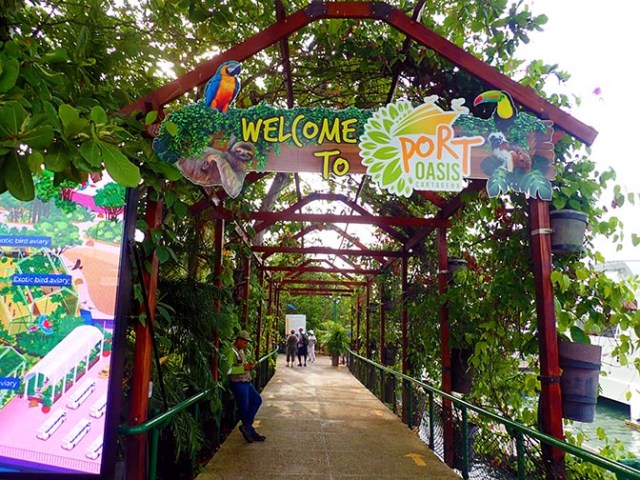
entry to the eco-park at the Cartagena cruise port
Port Zoo
The port in Cartagena has a little zoo right at the port, something that I have not seen elsewhere. It’s called Port Oasis Eco-Park. The 10,000 square foot park and garden is designed to be a rehabilitation and recovery space for the animals, though there are some that are there voluntarily that can come and go as they please. Access for people is limited to cruise ship passengers docked at the terminal other than the people who work there. The last time we were there we just walked through briefly on the way to and from the taxi stand just outside of the eco park. This visit the zoo was the only thing we went ashore to see.

pathway blocking peacock
There are many free-range peacocks and peahens everywhere in that little zoo. They are on the pathways, in trees and on rooftops, and in the pens of other animal exhibits. The peahens just wander around and are neither afraid of nor trying to interact with people. The peacocks on the other hand often want to make themselves get noticed. They like to stand in the middle of the pathways and spread out their tails to gain the admiration of passersby. Sometimes one blocks the entire pathway, but they do like to turn around and strut their stuff in a circle to anyone or anything who might be around them so when they turn sideways to the path you can get by even one with a full widespread tail without ruffling his tailfeathers.

strutting his stuff when he’s got no stuff to strut
Sometimes two of them get into a fight. The losers of bad fights are running around the park without their big fancy feathers and not much of a tail to spread at all, but they still try to spread whatever scraggly feathers they have left. They probably don’t look any more impressive (or less pitiful) to the peahens than they do to the people. Some were just missing a few feathers, but others barely had any tail at all. There were a few white peacocks and peahens running around the zoo as well as the usual blue and green ones.
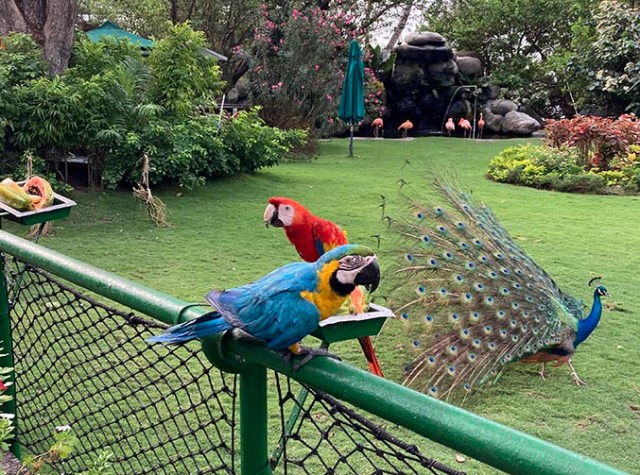
macaws on the fence of the flamingo pen
The second most noticeable birds in the zoo are macaws, which are all around the park in abundant numbers and various colors. These are also free-range, flying wherever they please. All of these birds probably stay there voluntarily due to the food they are given daily. Why work hard for it when somebody offers it up for free.
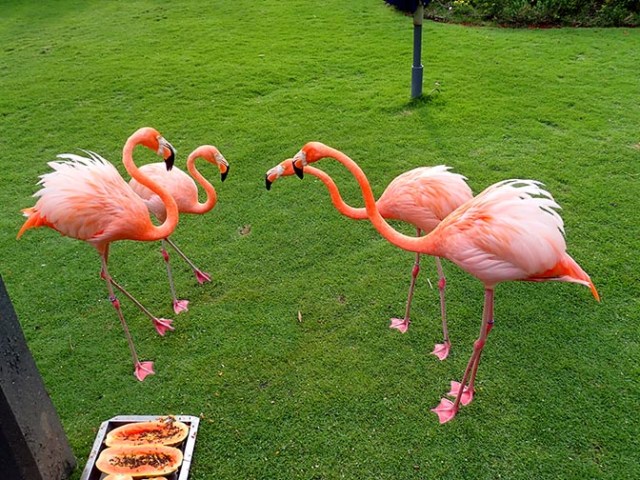
two flamingos want the food two other flamingos were eating
The first pen you come to upon entering the zoo has flamingos. All of the flamingos were in the pen. There weren’t any of them running loose around the park. Our ship docked early with people disembarking at 7am. This must have been feeding time as all of the creatures had something to eat. The flamingos had papayas, and there were some on the fence around their pen as well.

parrot
Parrots and macaws ate from the ones on the fence and flamingos from the ones in the pen. The food was up near the fence with some flamingos on it and others at the back of the pen.

two flamingos leaving while two others take over their food
Two of them were happily eating a papaya when two others came up behind them. The first two ran away and the new ones took over the food.
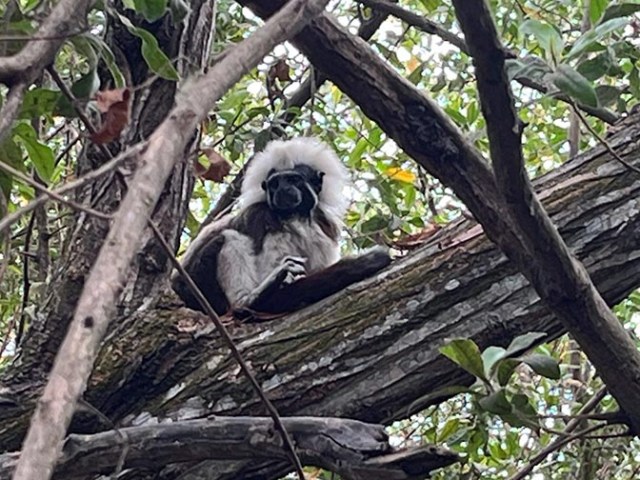
tamarin monkey
Tall trees towered over the little jungle area with branches spreading into one another making a canopy where tree dwellers could easily move from tree to tree. We saw two types of monkeys, some squirrels, and lots of birds in the trees. Mostly peacocks and macaws, but there were others too. There was a sign saying there were sloths in there somewhere, but nobody spotted any while we were there. Later back at the ship we talked to one crew person who had spotted sloths, but only because someone told her where to look. She had distant photos of them, but even in her picture it was pretty hard to distinguish sloth from tree branch. They blend in so well it would be quite easy to look right at them and never see them.
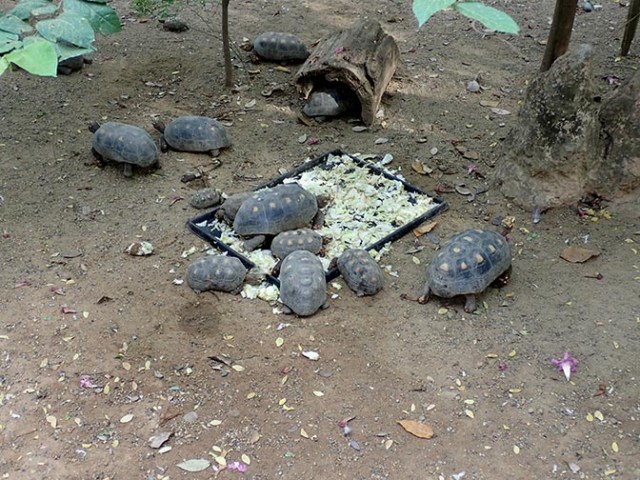
tortoises
We found one pen full of little tortoises. Not the giant sort unless they were all babies, but they didn’t have any water to swim in so they were more likely that then turtles. Turtles probably would have been given some sort of water feature in their pen.

black swan and a tortoise in the aviary
A couple of enclosed aviaries held some different sorts of birds than the ones that were not inside of enclosures. We saw several different types of toucans, some black swans, a few types of ducks, birds that sort of resembled a larger version of sandpipers, and some that looked like brightly colored bin chickens (ibis). All of the ibis we’ve seen before were always white. Bin chickens are what they call ibis in Australia because there are wild flocks of them there that like to hang around garbage bins. Google says they come in other colors though so that’s probably what they were. There is a type called scarlet ibis.
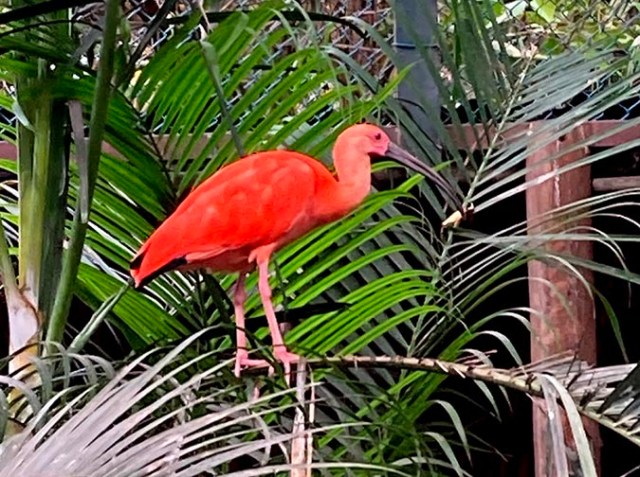
scarlet ibis in the aviary
One pathway we walked down had a couple little green parrots standing on it, speaking to each other in Spanish. Or at least they were both saying Spanish words so it quite looked as if they were having a conversation whether they actually were or not.
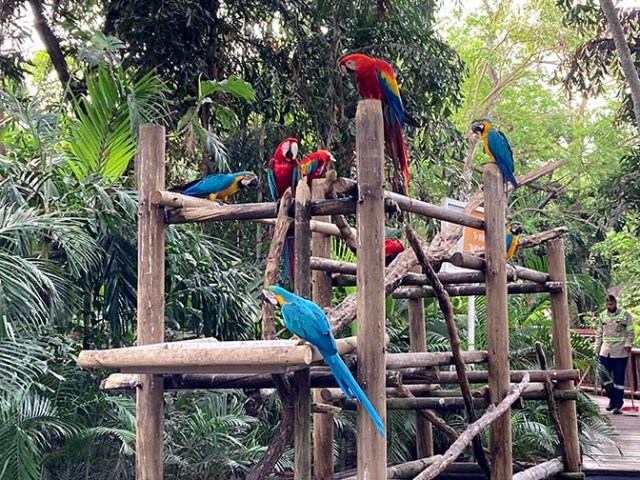
macaws
A tree next to a structure that was probably intended for macaws to roost on and as a place to feed them made an easy entrance for monkeys and squirrels to run down and steal food from the macaws. We saw both do exactly that. A sign said those were red howler monkeys, but none of them howled while we were there. The other fluffy little monkeys were a type of tamarin.

red squirrel
The squirrels were just called red squirrels. They were very fast.
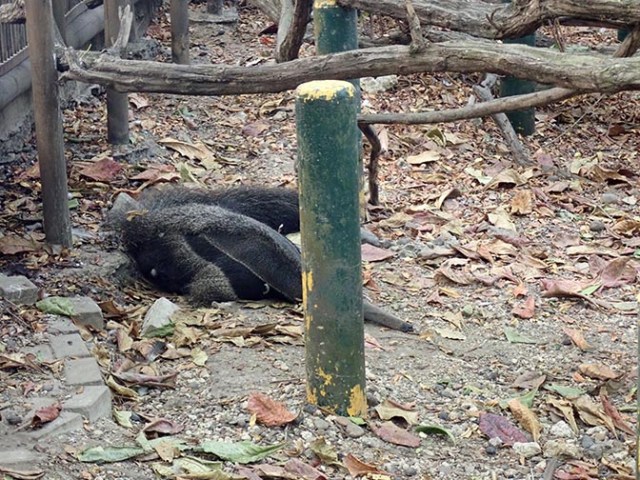
anteaters
We saw a couple of giant anteaters in a large pen, but only because one of the park workers we passed by on the wooden walkway pointed to their pen and made it plain there was something worth seeing there even though we couldn’t understand much of what he said since it was all in Spanish. They were hard to spot. When we finally found them, they were asleep looking a lot like logs.

iguana
On a road at the outskirts of the park area where cars leave the port there was a huge iguana next to a garden. It sat there posing for photos until a worker came by wheeling a noisy bin that scared the iguana back into the bushes.
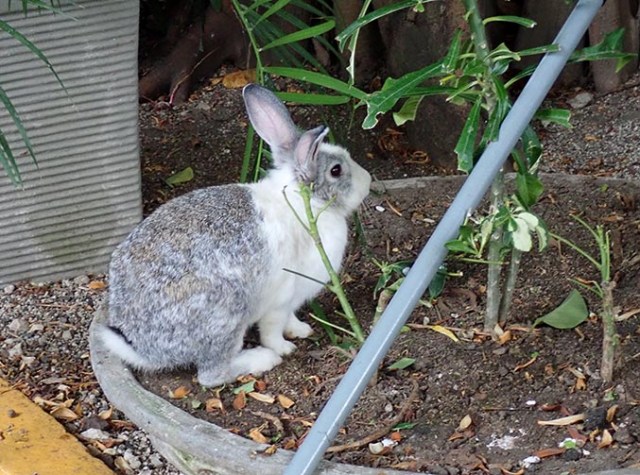
rabbits run around free in the park
We also saw cats and rabbits hanging around in the park. A little pickup came by trying to leave the port area on a road full of peacocks, but it didn’t have to dodge them for too long because a worker came out and chased them off the road telling them to vamoose.
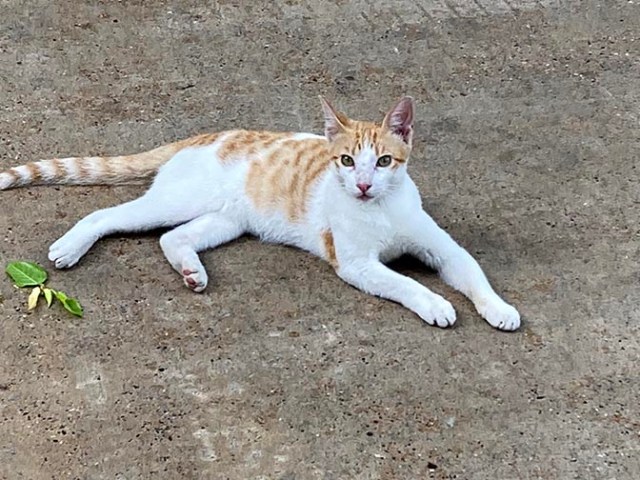
cat in the eco-park
Besides the animals there’s also a coffee shop, restaurant, and gift shop in the port. At one point near the taxi stand that is just outside of the zoo some cigar smoke came wafting through the air so even there we weren’t entirely safe from it, but at least it was just that once in all the time we were there and not constant or everywhere.

toucan
The little zoo is a nice place to spend some time on a port stop in Cartagena as well as a way good way to avoid all of the cigar vendors in town. It’s also free unless you decide to buy something. Port stops can get expensive on a cruise with a lot of them like our Nieuw Amsterdam Panama Canal cruise had so it’s nice to find one with something fun to do for free.


 Cruise Stories
Very interesting post. I have often wondered about visiting Cartagena. I also wonder what you think about Holland America. They have some great cruises but we are always wondering if the ships are too old. What do you think, when compared to other cruise lines? We like Celebrity and Princess. Thank you!
I don’t recommend visiting Cartagena unless you are not bothered by cigar smoke. Like most cruise lines, Holland America has some newer and some older ships. Most are pretty nice. The thing I liked best about them was no indoor smoking, but that is no longer the case as they have started to allow it in the casino over the past year. Kind of like Princess that used to keep it contained in a cigar lounge, but now turned those into arcades and allows it in the casino which spreads into the piazza and beyond. All else being equal, Celebrity would now be my first choice since as far as I know they still have no indoor smoking. Unfortunately none of the cruises that I currently have booked are on Celebrity.
That’s good to know! We have a Princess and Celebrity booked and will probably book Celebrity again. Thank you!
You’re welcome. I hope to book Celebrity again sometime too.