
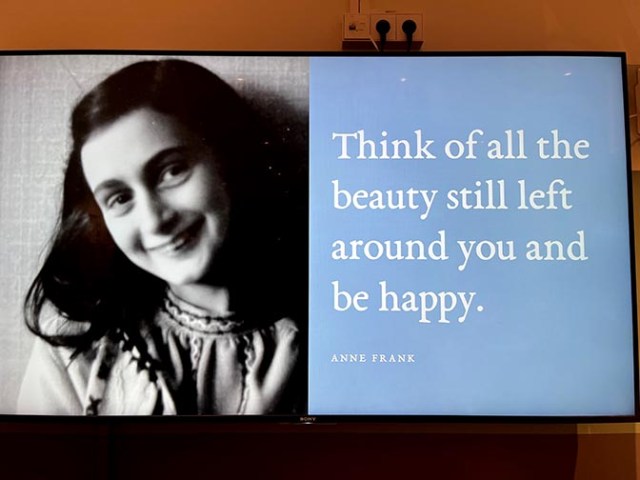
photo of Anne Frank and her quote
At some point in my childhood I read a book called Anne Frank, Diary of a Young Girl so I knew of the story of Anne Frank and her family during World War 2. Though not fresh enough in my memory to remember all the details of the book, the main story is not the sort of thing that is read and then forgotten like most childhood books. Of course this one was not fiction either being the true story of a Jewish family living through terrible times in the words of a girl who lived it.
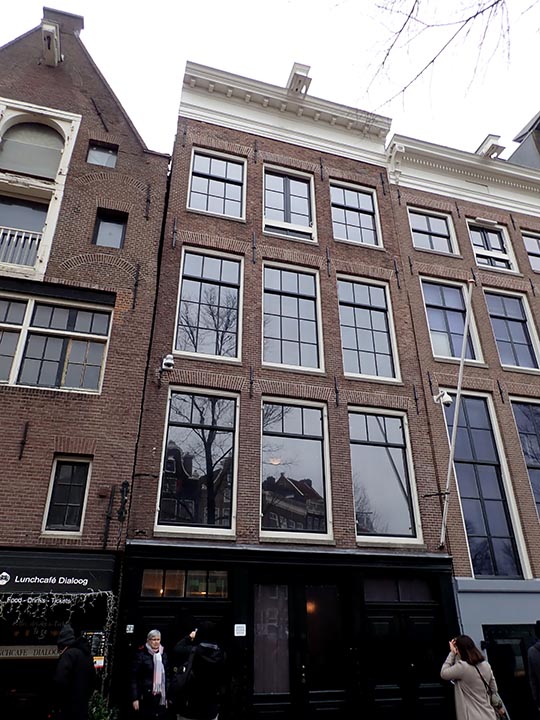
Anne Frank House
Our river cruise on Viking Skirner ended in Amsterdam. During the time leading up to the cruise they sent out information on booking a tour of the Anne Frank house, in case people wanted to do so in order to see it after disembarking there. The instructions were that it could not be booked until 6 weeks before going there – and that it filled fast so booking it right at the 6-week date was recommended.
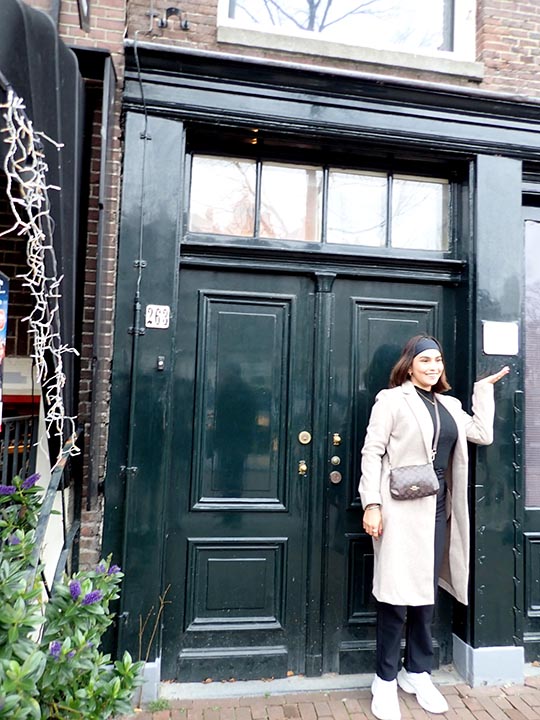
random person at the door to the Anne Frank House
Our friends that we sailed on that cruise with live in an earlier time zone and said they would get tickets for the four of us as soon as it opened to them. They were trying for disembarkation day, but ended up with the day after which worked out fine since we were all staying in Amsterdam for 3 days. On the day we went there someone in the hotel said they’d seen a long que there the previous day and that all of the people in the que had tickets. Someone else said they had gone and got right in.
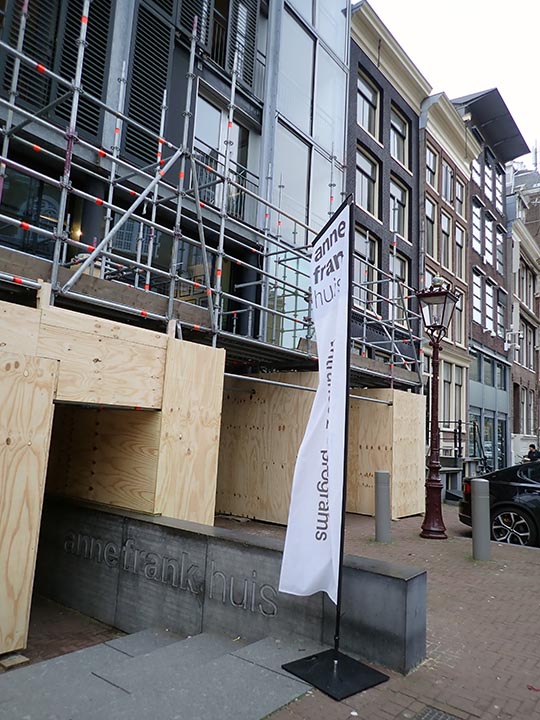
museum entrance
We found the house, but the entrance for the Anne Frank Museum, which includes the house, is in a new-looking building around a corner. What looks like separate buildings on the outside are now all one building on the inside, though that was not the case back in Anne Frank’s day.
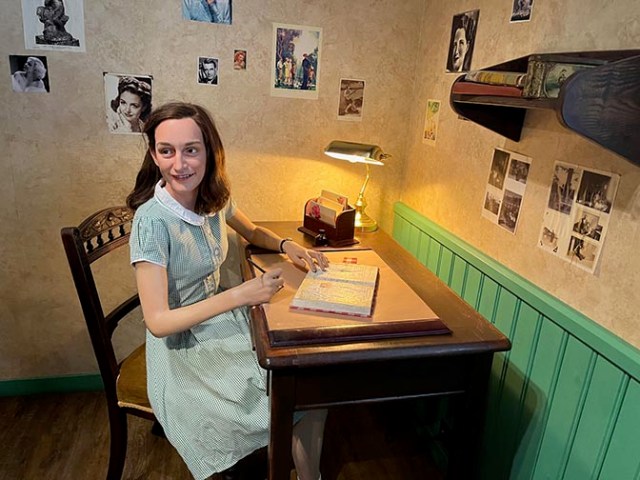
Anne Frank at the wax museum
There were 2 lines to get in. One for people going straight to the museum and the other for people who had tickets for the introductory program, which ours included. For that program you have a specific entry time and can’t come earlier because you would miss the introductory part. If you come late you can still go into the museum, but will not get to see the introduction, which was in a sort of classroom that had some photographs and a few artifacts from Anne’s life. There was also a timeline with dates and photos from her birth to her death.
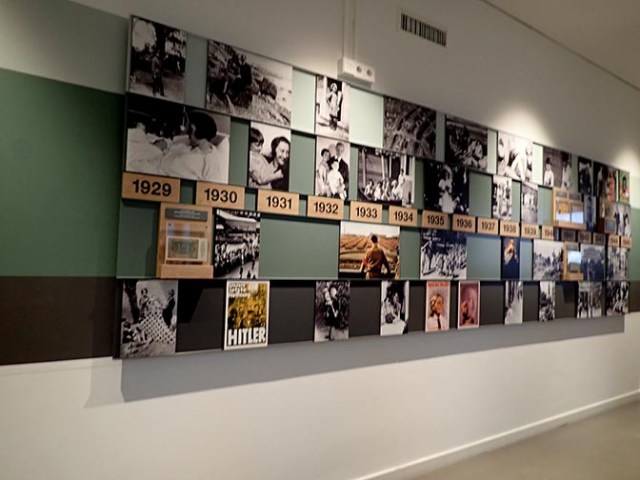
timeline of Anne Frank’s life
The introduction there included some history before the story begins as well as the sad ending. She was actually born in Germany rather than in the Netherlands, but the family fled Germany early in Hitler’s reign in hopes of escaping his wrath against Jewish people. They were not an especially religious family and her father was a decorated veteran of the German military in World War 1. One of the things Anne said at some point during her ordeal was that she looked forward to the time they could go back to just being people rather than Jews. Something she never got to experience.
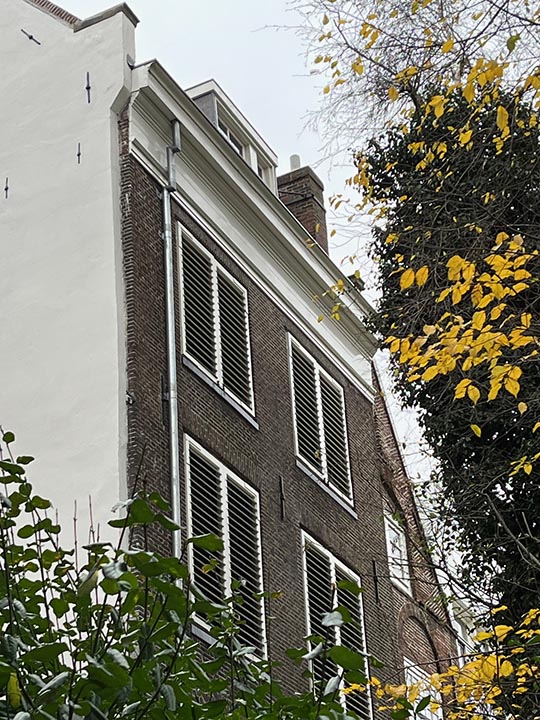
annex from the classroom window
Pictures are allowed outside the house, and were allowed in that room, but no photos are allowed once you enter the museum itself. There was a window from the classroom where a photo could be taken of the annex where the family hid, which can’t be seen from the road. The house seen from the road is the front house and the annex is behind it, though the two are connected. There is nowhere else in the museum tour that you can see the actual annex from, only that window in the classroom.
When the family first moved to Amsterdam they lived a normal life, but once Hitler took over things got worse and worse for Jewish people. The Jewish children were sent to separate schools from the other kids and all of the Jews had ever increasing restrictions put on them. Otto Frank ran a business in the lower floors of the house with a warehouse at the bottom and offices above. The warehouse extended into the back house or annex, though the top two floors and attic of that building were unused. The family lived in a different house at the time as that building was just used for the business.
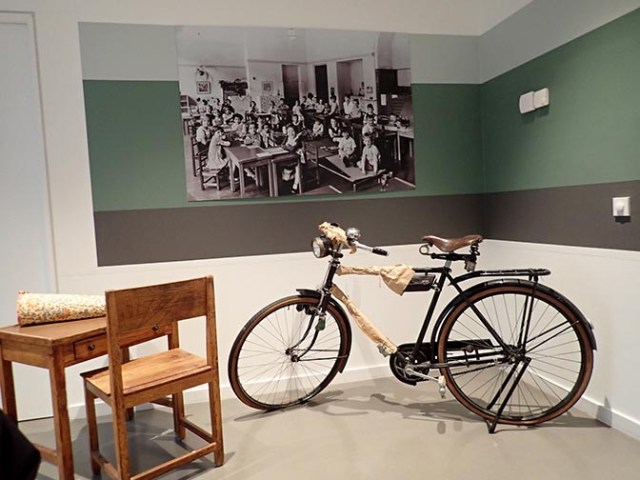
artifacts in the classroom
Knowing that things would only keep on getting worse for them, Otto made plans for going into hiding in an unused portion of the annex building attached behind his workplace along with the family of a Jewish employee. A select few of his non-Jewish employes and some of their family members were the ones who enabled the hiding to happen by bringing them food and other necessities throughout the more than 2 years they stayed hidden there.
Things got worse for Jewish people in the Netherlands with a roundup of the first unlucky people taken and killed to serve as a warning for the rest. When summons began to come for others, one of the ones summoned in the first group was Anne’s sister Margo who was just 16 – 3 years older than Anne. Rather than sending her to certain death the family went into hiding the next day along with another family of 3. Later one more man joined them.
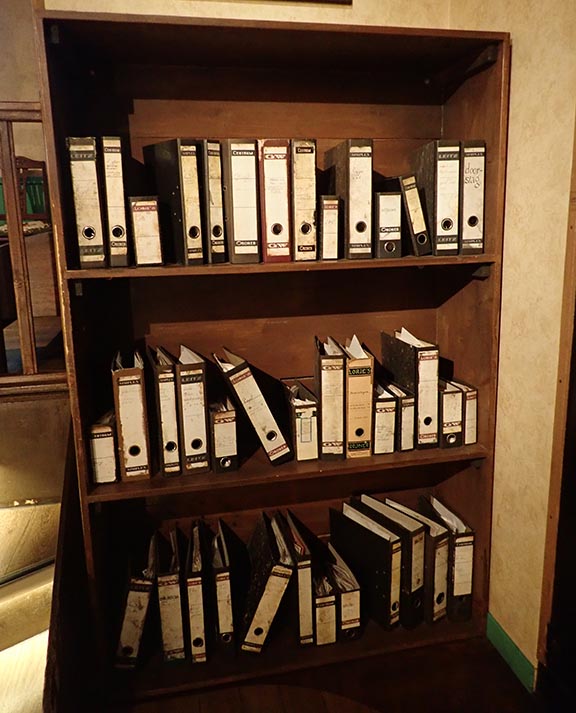
bookcase at the wax museum
A revolving bookcase hid the entry between the annex and the business below. On the lower floors the warehouse extended into the annex building beneath the previously unused upper floors where the families were hiding. Most of the people working there had no idea about the hidden people so they couldn’t make any noise or run any water during the day while the business was open. They also could not look out the windows or have any light show through to the outside at night so that nobody would know they were there.
After they had spent over 2 years in hiding the war was nearly over. They were just waiting for the allies to work their way up to Amsterdam so they could finally be free. Nobody knows how they were found or who turned them in, but one night the Nazis came and arrested them all. They were sent out on the very last train to Aushweitz. After being separated and most eventually sent to other concentration camps, Anne’s father Otto Frank was the only one of the 8 people to survive. One of the people who had helped them hide found the diary, one of the few things not taken by the Nazis, who cleared out all the furniture and anything else they thought had value. The actual diary Anne filled up early on, but she kept writing on whatever paper she had available, which an employee who had helped them found scattered about and saved for when Anne returned along with the diary. Since she never returned it was given to her father, who published it as that had been Anne’s wish to publish the story of their time in the secret annex.
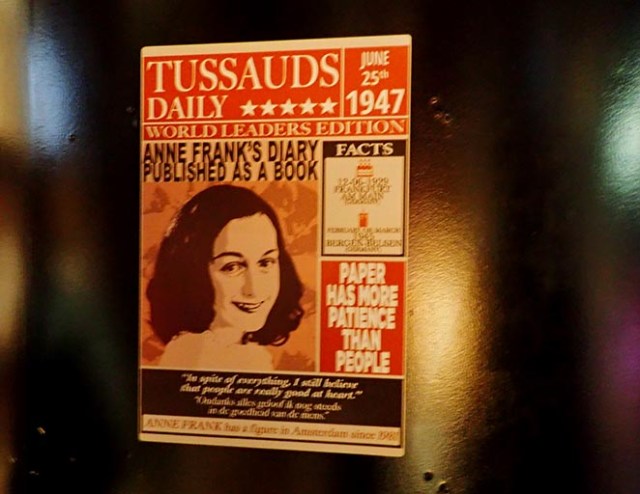
poster at the wax museum
People are given audio boxes before they get into the actual museum, which have different things to say in the various rooms you pass through. Most of it is also written near pictures or items in the rooms. Once you get to the actual secret annex there is no more audio until leaving the annex into additional rooms of the museum. The annex is mostly empty rooms because it was left as it was after the Nazis took everything. The tour does of course exit through a gift shop as do most tourist attractions everywhere. There is a display there of many different versions of the diary published over the years in quite a variety of languages. There’s also a book available of Anne’s fictional writings from her time spent in the secret annex.
Up until recently I found it hard to fathom how one psychopathic leader could get so many people to support them. Unfortunately, not everyone learns from history. There’s an old saying that those who don’t learn from history are doomed to repeat it. The atrocities of World War 2 started by dehumanizing Hitler’s chosen scapegoats and getting others to believe those people are responsible for all of their troubles. Eventually when there are enough people who believe the lies and no longer see that group as fellow human beings, but rather as perpetrators of whatever horrendous deeds are attributed to them it opens the door for terrible things to happen. Those tactics are still at work.
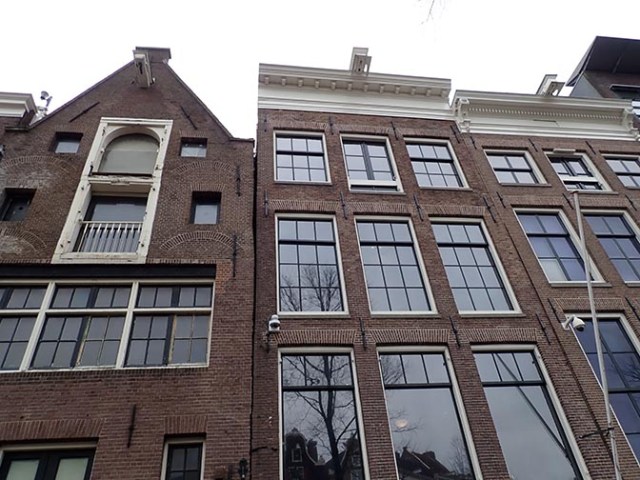
Anne Frank House
Although pictures were not allowed at the Anne Frank Museum, Madam Tussaud’s Wax Museum in Amsterdam has a figure of Anne, in a room that contains a few furnishings that may be similar to what were in the house. Since the Nazis took everything the replicas are probably not exact. There’s also a wax replica of the bookcase used to hide the entry to the annex and pictures are allowed in the wax museum.


 Cruise Stories