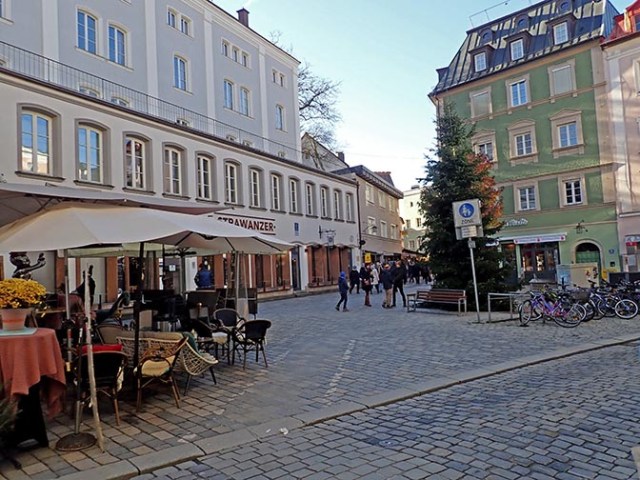
street in Passau
Passau, Germany
Passau sits on the German side of the border with Austria at the confluence of the Danube, Inn and Ilz rivers giving it the nickname Three Rivers City. The city is famous for its gothic and baroque architecture and a historic fortress on the top of a mountain. German is of course the language of the country, but many people also speak English. The population is about 50,000. The University of Passau has over 10,000 students. Passau has a moderate maritime climate. Average temperatures vary from winter lows in the mid 20’s F to summer highs in the upper 70’s F. Currency is the euro. Hitler lived in Passau as a boy and during the second world war there were a lot of Nazis there as well as a couple small concentration camps nearby – a part of their history the town’s residents would just as soon forget. Passau is one of Bavaria’s oldest cities, founded by Celts over 2000 years ago.
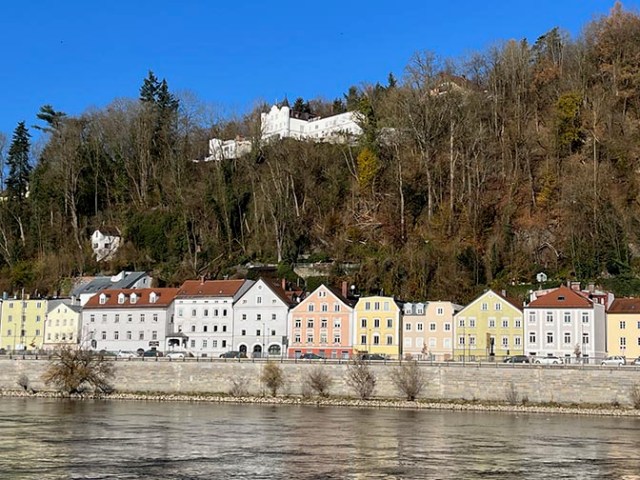
houses across the river from the bus stop in town
Passau River Cruise Port
Viking Skirnir docked about 2 miles from the center of town tied to another Viking ship that we passed through to reach shore. It is common for the river boats to dock that way, though at previous ports ours was the one at shore that other people walked through. Whichever one is leaving first goes to the outside even if they have to move to let the other one in. There were many other boats docked in that area, though we also saw some docked closer to town. There are numerous different river cruise companies, most of which we never knew existed before seeing their ships while on our Viking river cruise. We only ever tied up to other Viking ships, none from any of the other lines. One ship docked right in the main part of town next to where we got off and on the busses from our port. Our dock was in an industrial looking area.
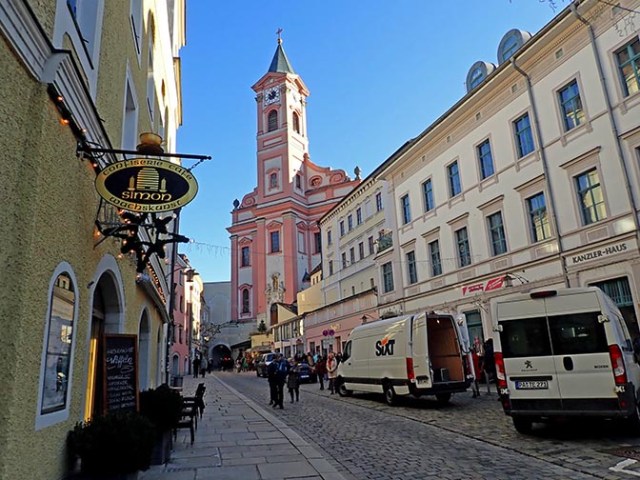
cobblestone streets and a pink church
Passau Walking Tour
Viking river cruises include a free shore excursion at every port. The included tour for our port stop in Passau was a walking tour. It started and ended with the bus ride from the port about 2 miles to the center of town. The bus let us out next to the river where we met up with the tour guides for each group. People are divided into smaller groups for the tours so there are not so many people for each guide. The town has historical buildings and very narrow cobblestone streets. They look like walking paths, but cars do drive on them.
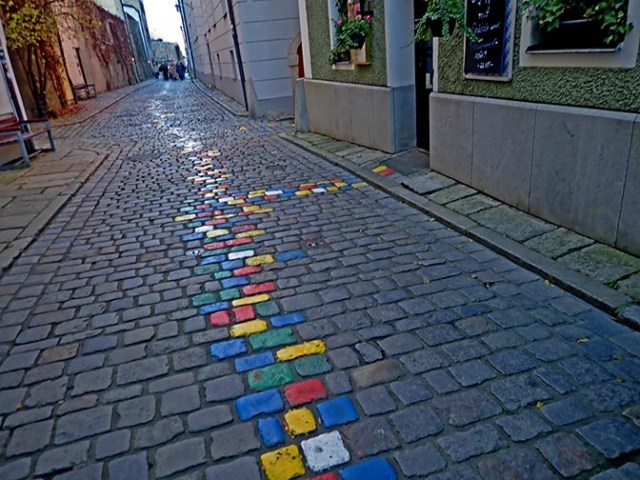
painted cobblestones
The one we started out on had colorful squares painted on some of the cobblestones at the center of the road, with some leading to doorways of shops. Down near the river all of the lower floors are shops rather than residences because floods will sometimes go quite high on the buildings so nobody lives at the bottom.
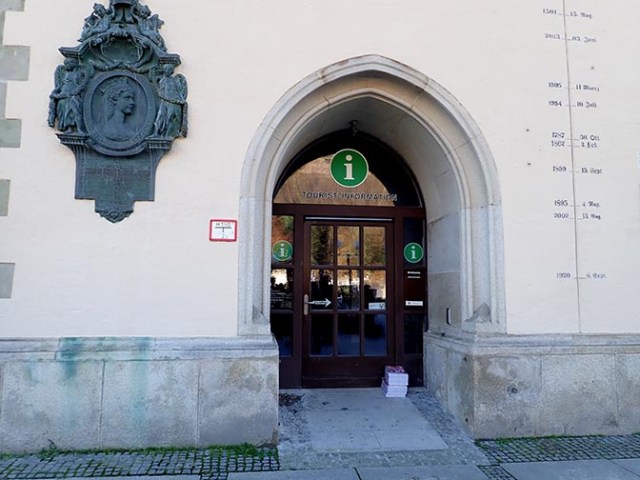
each line represents a different flood
There are high water marks painted on the sides of the buildings in some places. The guide said that the colorful squares led to businesses. They did head into some doorways along that street, but not all of them. Other than some branching a short distance up connecting streets to a doorway, this was the only street in town with the colorful squares.
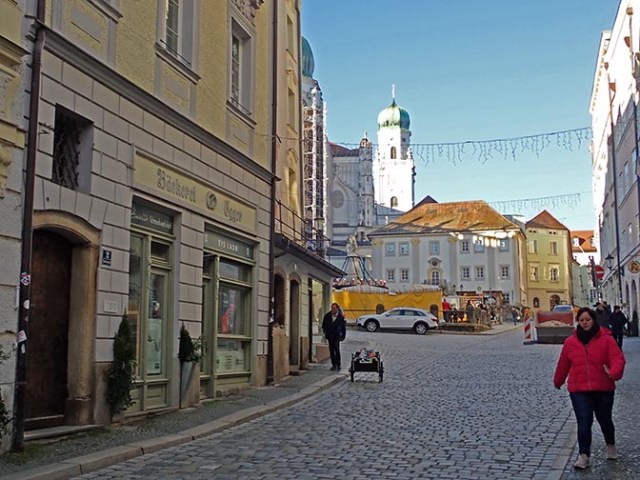
doorways on a cobblestone street
Doorways normally have at least one step above street level, even in places above the flood area. Our guide mentioned that this was because back in medieval times occupants had a tendency to dump their chamber pots into the street and nobody wanted that coming in their door.
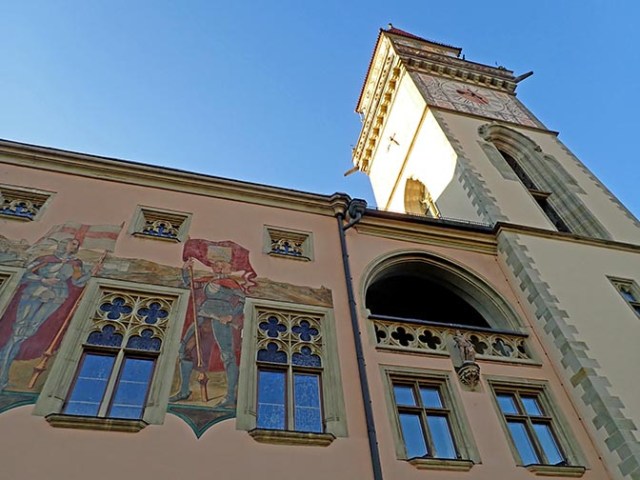
town hall
Most of the many towers throughout the town belong to churches or castles, but one of them was on the town hall, which was built by the common people at a time in history when they got tired of the bishops having all of the power and wanted a bit of control over themselves. They didn’t get a lot of power, but some was better than the none they’d had for centuries. The tower on the town hall signified that small gain of power.
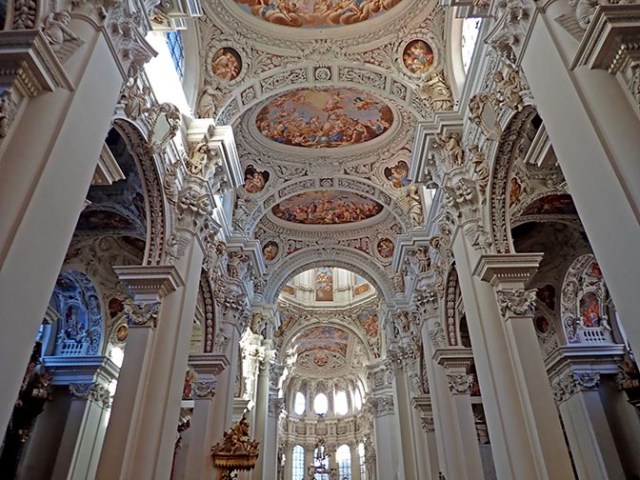
inside St. Stephans cathedral
We walked through several narrow streets, all of which are cobblestone though only the one had painted squares. They are all surrounded by tall buildings. You can see church towers high above the rest in pretty much any direction. There are a lot of churches in Passau. It was not alone in that as pretty much all of the towns we went to had lots of churches. Even the smallest towns we passed along the river had at least one church.
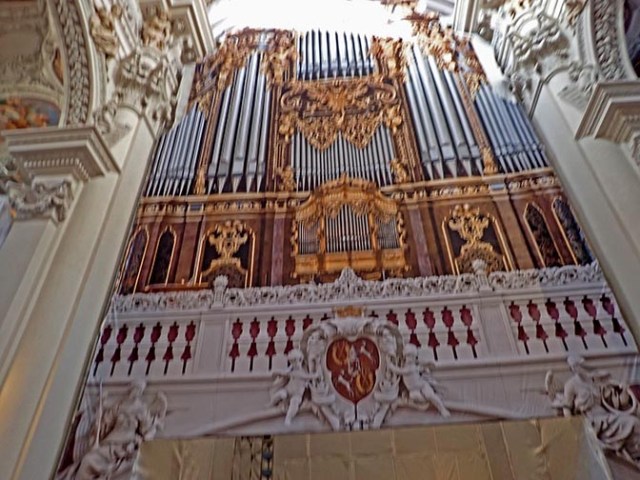
pipe organ at St. Stephens
We worked our way uphill to a cathedral with a Christmas market just outside of it where the tour ended. This was somewhat of a pattern with these tours, ending at a cathedral with a Christmas market. The one in Passau is one of many churches for a small town, originally a bishop’s church done in gothic style. It took 350 years to build and much of it burned down about 100 years later so one side of the church is still gothic outside while the rest is baroque style, as is the inside. Gothic style is upward with pointed arches reaching for the heavens while baroque is symmetrical with horizontal lines. Both are very ornate. Regardless of the town many seemed to have a church or cathedral called St. Stephens, as was the biggest one in Passau. This one had most of the intricacies molded into the walls and ceiling as well as painted ceilings and lots of figures built into the walls rather than gilded with gold like some of the others, though there were some golden things there. It has the largest pipe organ in a cathedral in the world with nearly 2000 pipes and 5 organs – soon to be 7 when the current renovations are complete. They are supposed to finish renovating in 2027. The cathedral also has 8 enormous bells.
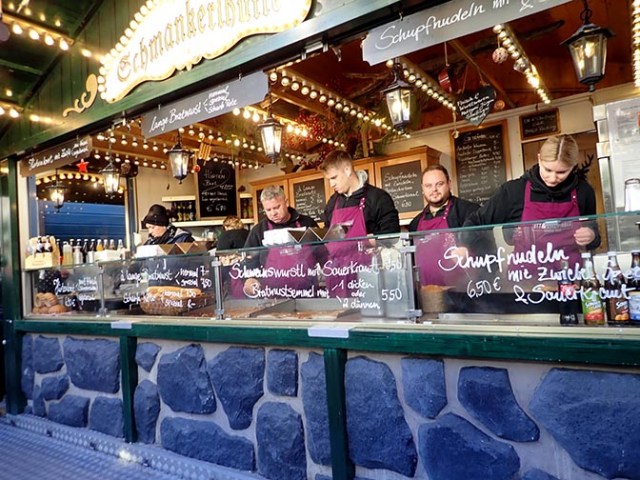
booth at the Christmas market
The Christmas market outside the cathedral was of pretty good size with a lot of food stalls as well as stalls selling ornaments, trinkets, warm things like gloves, scarves, hats, and socks, gift items, or other things. This market had a few unique things that looked like they could possibly be handmade rather than mass produced. The majority of the stalls were food and drinks. Long hot dogs seem to be a big thing though these were longer and slimmer than the ones we saw at the Christmas markets in Austria and Hungary and looked more like sausages in a bun than actual hot dogs. Chocolates are also a popular thing at these markets, as is hot wine, which they call glühwein.
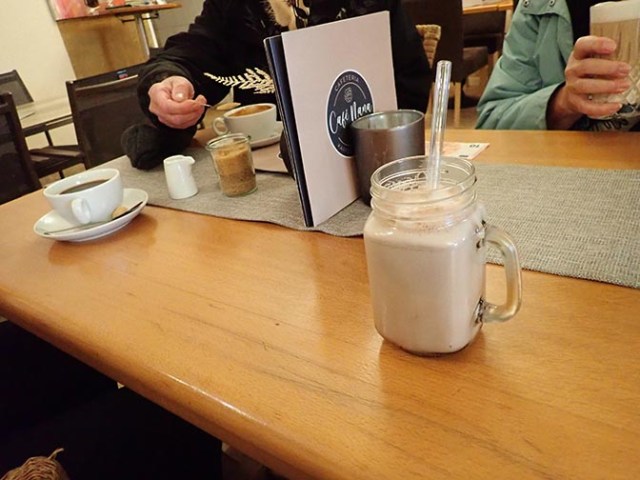
cafe by the river
After walking around the market a bit we made our way back down to the river, but got there about half an hour before the bus back to the port was due so we found a little café nearby where we could sit somewhere warm and sip hot drinks while we waited. Even though it was a sunny day it’s very cold outside in Passau in late November.


 Cruise Stories
What a beautiful and interesting city! There’s a German TV series I’ve enjoyed called (in English) ‘Dark Rivers’ set in Passau, it’s a place I’d love to visit,
Passau looks like such a charming mix of history and beauty! Loved hearing about the colorful cobblestones, rivers, and that epic pipe organ, so cool!