
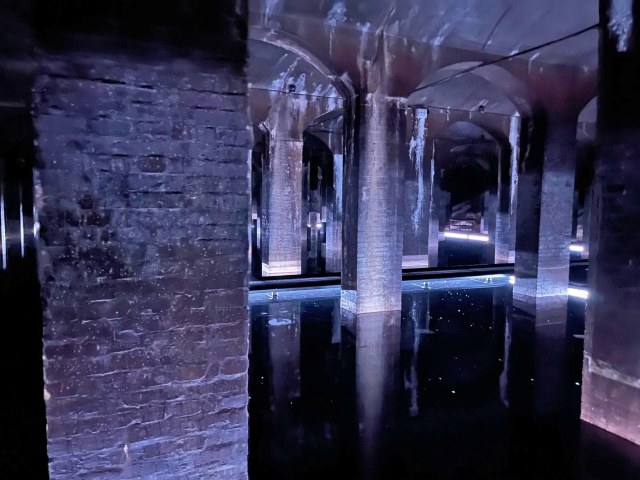
columns in the water
When looking up things to do before our visit to Copenhagen on the way to our Viking river cruise out of Budapest, I came across a place called Cisternerne. It’s an art exhibition inside of an old cistern. It wasn’t the art I was interested in though, it was the fact that it was supposed to have stalactites like a cave – and I like caves.
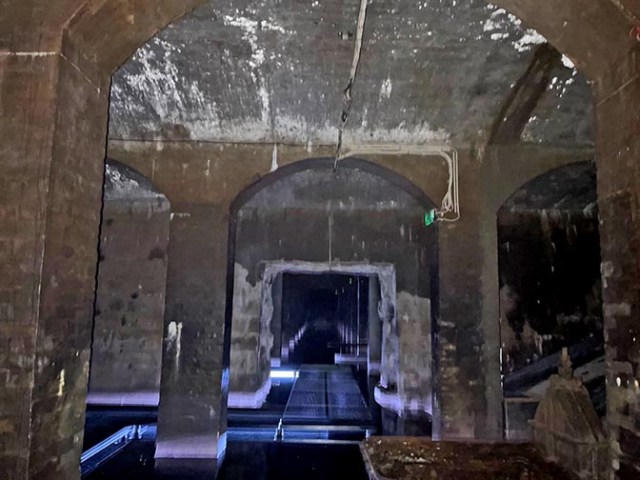
pathway through the arches
The Cisterns were once used as a reservoir for Copenhagen’s drinking water. They could hold over 4 million gallons of water. The cisterns were built in just 3 years starting in 1856. By 1933 they were no longer in use and eventually drained in 1981. In 1996, the former underground water reservoir was turned into an exhibition space. It is now a part of Frederiksberg Museums, used as a venue for art exhibitions and other events where the uniqueness of the location is a major attraction.
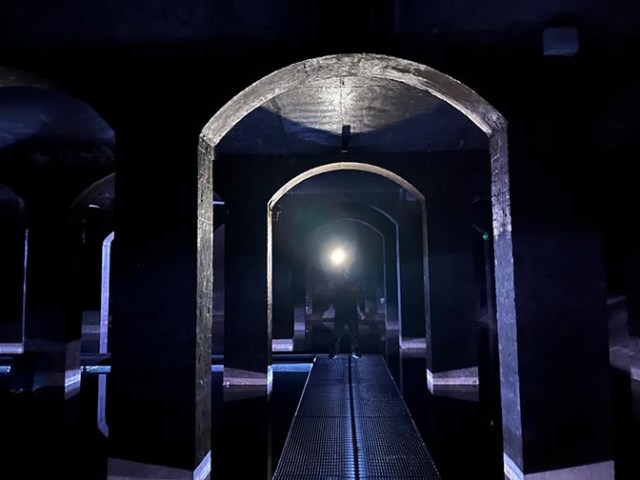
phone light through archways
Located under Søndermarken Park, the Cisterns is the only dripstone cave in Denmark. The natural formation of stalactites and stalagmites commonly happens in abandoned concrete structures, as they have formed within the cisterns. These types of geological formations are quite fragile, so visitors are not supposed to touch them. Online information said the formations here are particularly diverse and breathtaking for this type of feature and are expected to enhance the viewer’s experience when viewing the art exhibited there. All of the exhibits pictured on various websites at that time included visual artworks – and light inside the cisterns. Now there are more dark ones so they must have decided they like doing dark exhibits there.
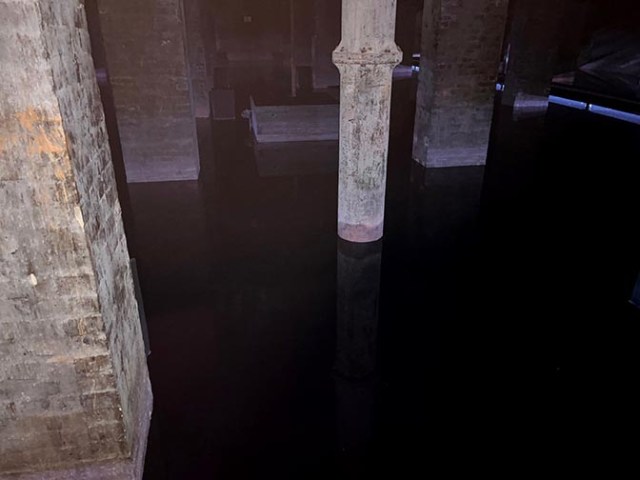
columns in the water
This all sounded quite good when investigating the place online. Much of the info about Cisternerne online showed walkways through the cistern with the art displayed on the walls as the major attraction. That is the main focus of the place, but it did say that you could see the stalactites too, which was what we went there to see.

geese in the park
We took a taxi from our hotel, as it was not in the same area of the city where we were staying. The taxi dropped us off in front of the zoo and the driver pointed to a park across the street saying that was our destination. We walked down a snowy trail in the park not really knowing what we were looking for. There was a flock of geese that looked much like Canadian geese in a field. After a bit we came across a couple glass sort of pyramids in the middle of a field, the first structures we had seen. One of them had a sign out front saying Cisternerne and a sign on the door saying it didn’t open until 11am.
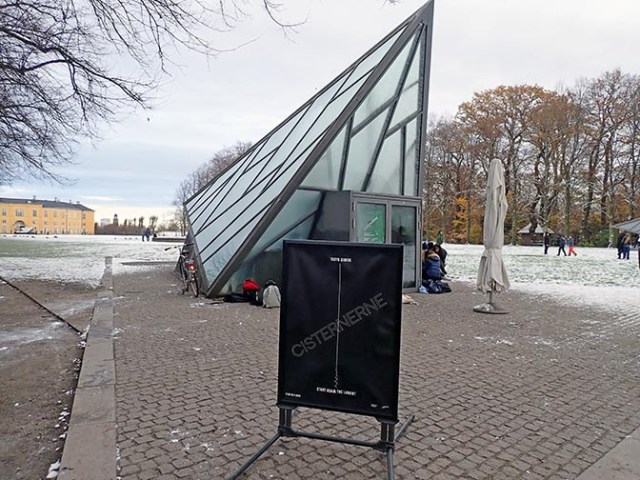
entrance to Cisternerne
The entrance is through that glass pyramid in middle of the park. Exhibits there change periodically. The guy selling the tickets said something about the exhibit at that time being some sort of American artist, but we told him we were there to see the cave formations rather than the art and didn’t pay attention to who he said it was. He replied that the stalactites were not highlighted in this exhibit, which was one of sound rather than sight. He said it would be dark inside and the music loud, but we might still be able to see some stalactites after our eyes got used to the dark. That was quite disappointing to hear, but we had come quite a way from our hotel to see the cave so we went in anyway.
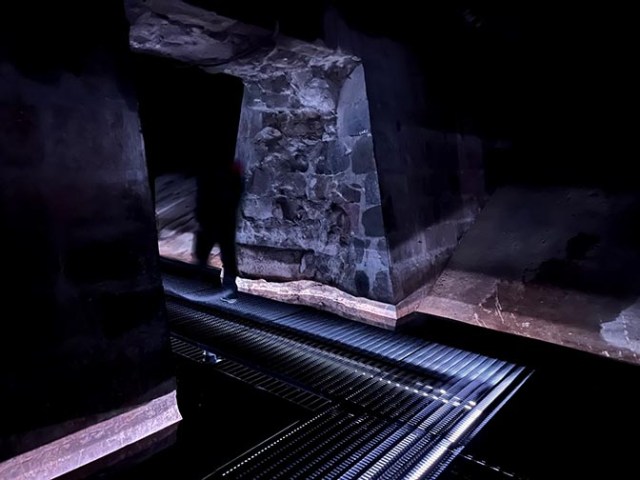
pathway in the dark
We went in when it first opened and though there was a group of school kids waiting to get in when we got there, they must have had some sort of lecture or something before they were actually allowed inside because we wandered around for awhile with nobody else inside before any of them showed up.
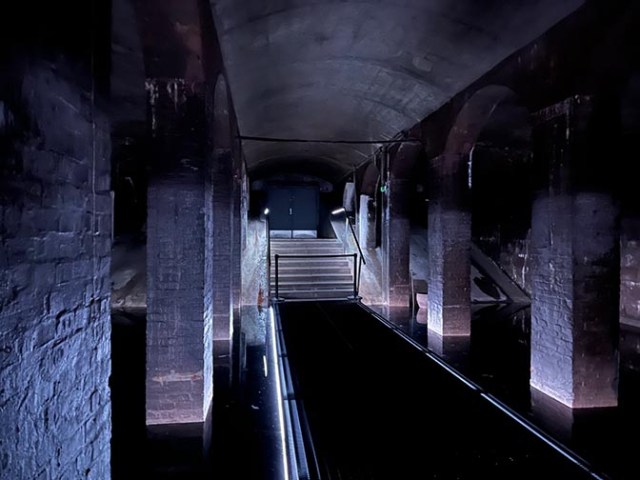
entry and exit path
Once we got down the stairs and through the door it was very dark and the ticket guy was not kidding about the loud music. It was very loud. In this particular exhibit the music was the only art. There were no pictures or paintings of any kind and also no light at all except the pathways you walk on, which were lighted so people could follow the path through the cistern. There is water everywhere that the pathways are not so it is important to stay on the path. Since it was so dark that the water only looked like dark space you couldn’t even tell it was water. Of course anyone straying off the path would know instantly that it was indeed water. The main pathway between the two stairways was lighted on both sides while the rest were just lighted down the middle.
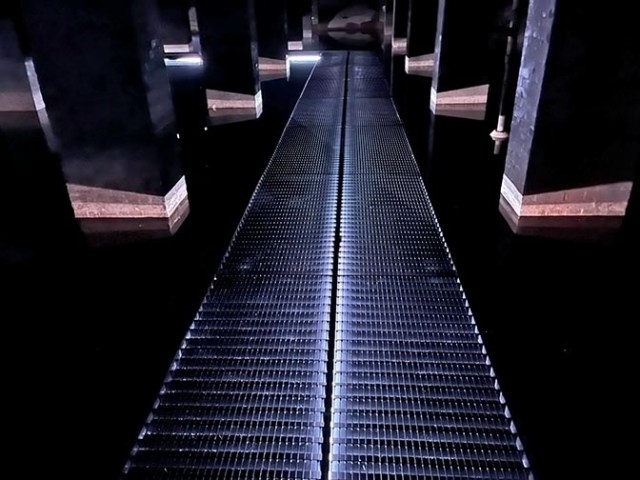
pathway
The pathways were made of metal and hovered just above the water. They wound through the cistern with lots of corners and parallel pathways. In between there were columns and sometimes stone arches.
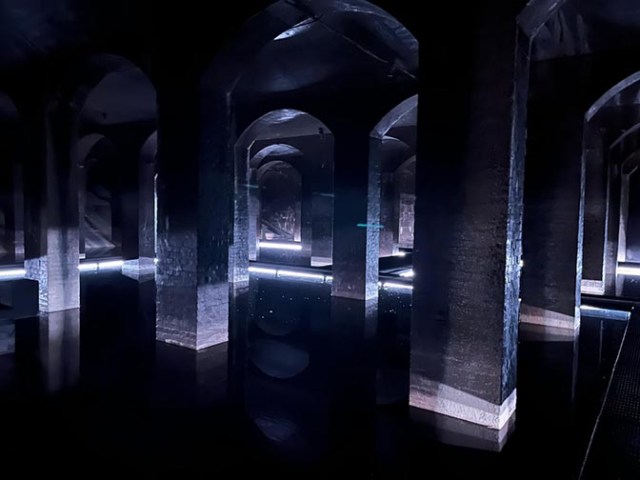
what the phone sees when the naked eye sees nothing but darkness
Most of this was not visible in the dark, but phone cameras are pretty good about picking up things the eye can’t actually see. There were no railings or anything on the sides of the pathways so following the light to stay on the path was the key to staying dry.
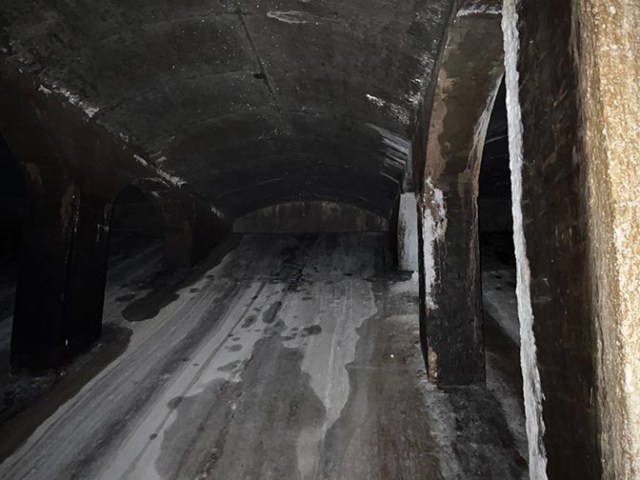
near the ceiling of the outer edge of the cistern
The sides of the cavern have arches with walls that looked to slant down into the water beyond the arch, though it was hard to tell in the dark. In this particular exhibit there was not much to see other than the lighted pathways. Features like columns and arches could only barely be seen in the dark, but the phone photos definitely show it much better than what could actually be seen. I guess the purpose of this exhibit was just to wander around and listen to the music which would have been disappointing even if we hadn’t been there intending to see cave formations since as well as being way to loud it barely even sounded like music. Add a few ghostly projections floating around and it would have been suitable for Halloween. Especially considering pretty much all that we could actually see was the lights on the pathways, not much of the other things that the phone pictures show.
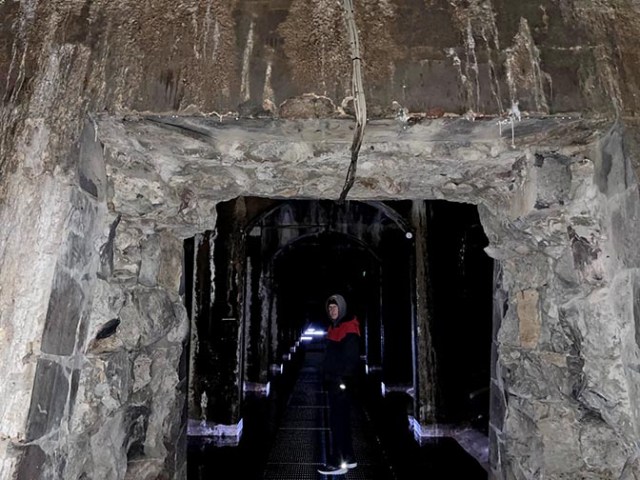
stone arch
Cisternerne didn’t show up on any of the tourist maps we found in Copenhagen, but the zoo directly across the street did. It is a bit of a walk through the park to find the two small glass pyramidal shapes above ground, one of which is the main entrance. The other was closed while we were there and inside of that one the stairway leading down to the cisterns was blocked off. The two are in sight of each other though so it’s a short walk from the closed one to the open one. It’s possible that the one that was closed when we were there may be used as an exit during busier times or for different exhibitions. It would make sense to use that side as an exit so people wouldn’t be going both directions on the entry stairs, though I have no idea if they actually do that. If you come by taxi the people at the zoo can supply numbers to call for a return taxi when you are ready to leave. They even let us wait inside out of the cold for it to arrive. Busses go by there too. The closest train station is called Valby located 1.3 kilometers away.


 Cruise Stories
How fascinating. I missed this.
It is kind of an obscure attraction so it would be easy to miss.