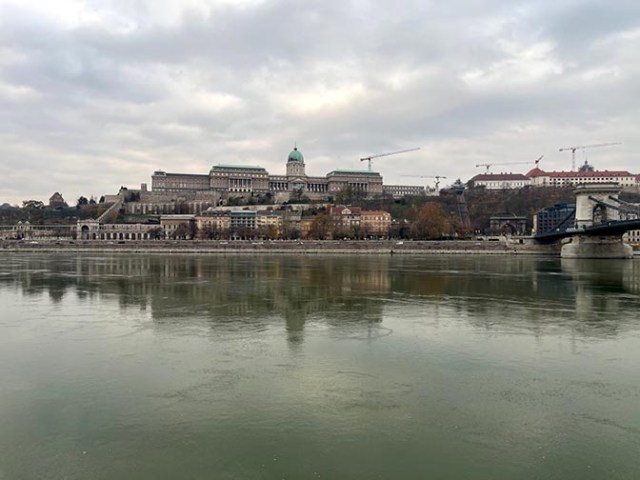
view of Castle Hill from Viking Skirnir
Budapest
Our 15-day river cruise on Viking Skirner began on the Danube River in Budapest, Hungary. The Danube divides Budapest passing between the historic cities of Buda and Pest, now connected by 7 bridges. The Buda side is hilly with a historic castle looming above the river at the top of a hill. The Pest side is flatter and is home to the sprawling parliament buildings on the side of the river.
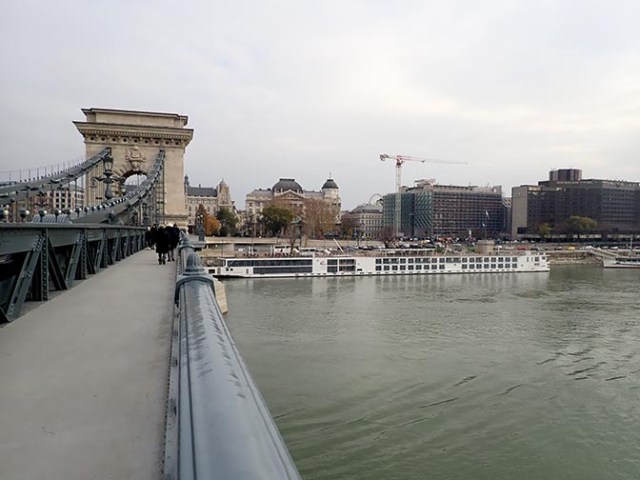
Viking Skirnir in Budapest from the Chain Bridge
Budapest River Cruise Port
Viking has 3 docks in Budapest. Its ships dock both north and south of the Chain Bridge as well as at a third dock near the Elizabeth bridge. There were ships at all 3 of their docks while we were there, sometimes 2 or 3 connected to each other at the same dock so people on the boats further out have to pass through the one(s) closer to the dock to embark or disembark. Our ship, the Skirner was on the dock just south of the Chain Bridge.
Budapest Panoramic Tour
Viking cruises have an included shore excursion at each port that doesn’t cost anything extra. At some ports they also have some optional additional excursions you pay extra for, but we only signed up for the free ones. In Budapest the free tour was called Panoramic Budapest. The other offerings were to a thermal spa and a market. It would be cheaper to take an Uber and do those things on your own, though the market one likely included a guided tour that you wouldn’t get if you went by yourself.

Chain Bridge
In cruise ship lingo, panoramic usually means bus tour, mostly looking at things through the window as you drive by. The Viking tour did exactly that on the Pest side of Budapest through the old part of town where there are lots of old buildings with interesting architecture and tourist attractions. Most of them we had seen pre-cruise either walking around or on the Hop on Hop off bus, but the continuous spiel from the guide on the Viking bus was different from the one on the Hop on Hop off bus. The Viking guide made a point of showing all of the things that Hungary is second in. Second biggest synagogue and a whole bunch of other things I don’t remember.

New York Cafe in Budapest (internet photo)
He did not mention that the New York Café, which always has a ridiculously long line, is the most ornate cafe in the world, which is what the HoHo bus said about it. Probably because being first at something would not fit in with his bit about everything being second. He said it was once the cantina for workers in that building, which the HoHo bus did not mention. Like all the locals there, he pronounced the pest part more like pescht than pest whether talking about just the Pest portion of town or all of Budapest.
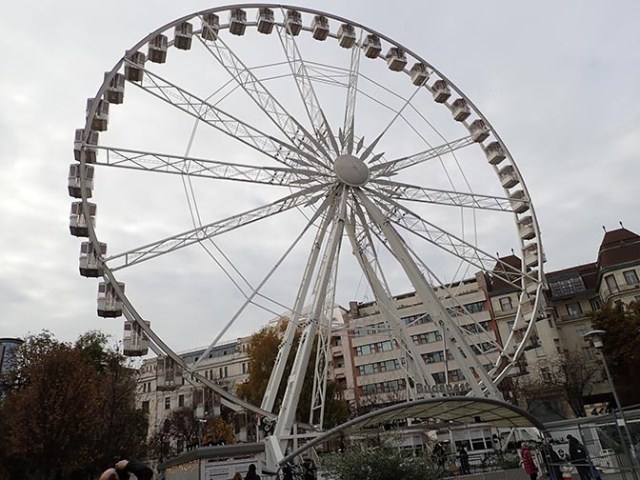
Budapest Eye
We also passed by the Budapest Eye and a couple of Christmas markets, which were close to the hotel we had stayed in prior to the cruise though we had only discovered one of the two Christmas markets. The Budapest Eye is a large Ferris wheel, which we took a ride on while we were in town for a few days before the cruise.

Lego train car
Another interesting thing we went by is an actual train car made of Lego. It always sits in the same place on the tracks rather than going anywhere. After driving around the Pest side the bus crossed a bridge over to the Buda side. Information from the guide included that 2/3 of the city’s population is on the flat Pest side while 1/3 lives on the more expensive hilly Buda side, which has more green spaces due to the lower population of that area. The bus went partway up castle hill, but big busses are not allowed all the way to the top. They are allowed 10 minutes at a stop by a gate with a bathroom in it – one with a fee to pee as is the case with many public restrooms in Europe.

shops in the old town area
From there we walked up the rest of the hill. Just a short distance from the bus the guide pointed out a café where anyone not wanting to do much walking could wait for a couple hours until time for the bus to return to the pick-up point to take people back to the ship.There is an old town area on top of the hill 550 feet above the Danube. Around a corner past the cafe we walked down a street lined with little shops in historical buildings.
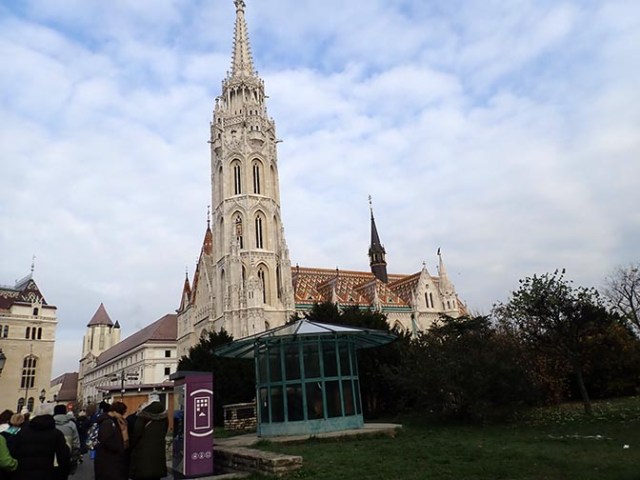
old church
Then he led us on to a couple buildings that looked like churches, but had been used for many purposes over the years. One started out as a church, then was a mosque, stable, and weapons storage before being restored back into a church. The other though it looked like an old building was just on the last stages of restoration having been rebuilt since a lot of things there were destroyed in World War 2 and they are just now getting around to restoring some of them. We just looked at those from the outside.
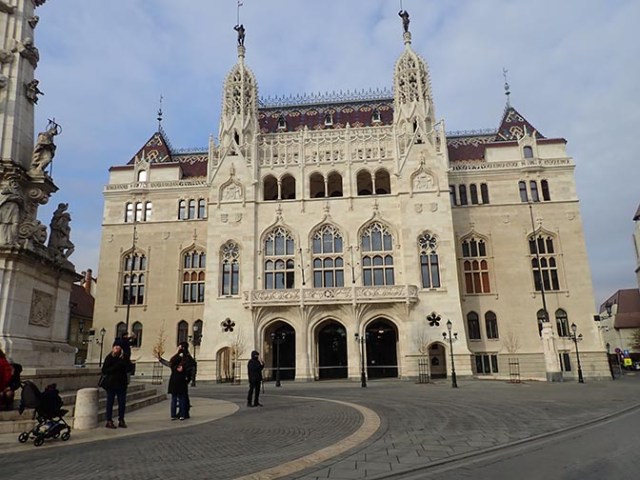
newly restored church
Further on we went to a Matthias Church, which has a fee to enter. The guide paid that for all of the ship people on the tour. It was a beautiful church with many stained-glass windows and other ornate features. The first of many ornate churches we saw on this cruise.
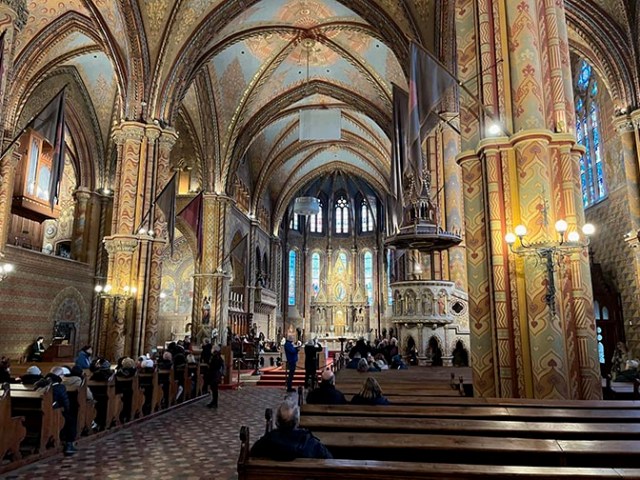
inside Matthias Church
Some side rooms in the church held a variety of artifacts including a crown from a previous ruler. Stairways from a side room led up to a balcony above the alter area with a good view of it, and a higher one that overlooked the ground floor of the church, but not such a good view of the alter area due to pillars blocking the view.

view from the balcony over the front of Matthias Church
The church was close to Buda Castle, but the guided part of the tour ended at the church. People were given free time to walk over to the castle and wander around there at will. Anyone wanting to take the bus back was required to return at the given time because not being allowed to stay in that spot more than 10 minutes it would leave on schedule regardless of whether or not everyone came back.

Fisherman’s Bastion
In between the church and Buda castle there was part of the old city wall and the fisherman’s bastion. The fisherman’s bastion is a UNESCO world heritage site built between 1895 and 1902 as part of a series of developments celebrating the 1000th year of the Hungarian state. It was built in the style of early medieval times from around the year 1000. Theories of why it is called the fisherman’s bastion include it being guarded by fishermen who lived below it or that the town they lived in was called Watertown, but nicknamed Fishtown.
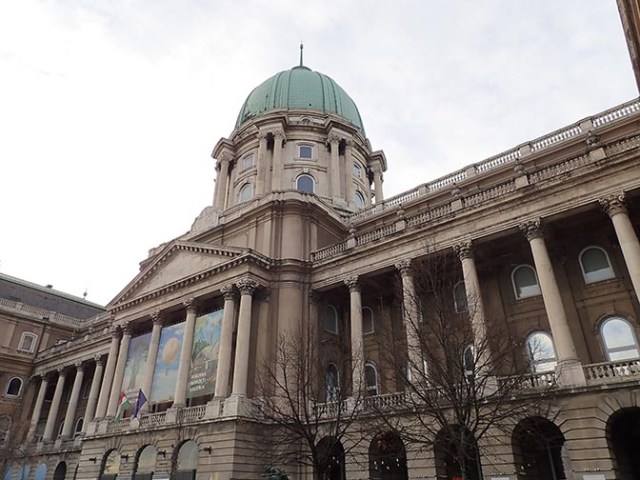
Buda Castle
Buda Castle was built in the 13th century and expanded in the 18th as a home for Hungary’s kings. It’s a tourist attraction now.
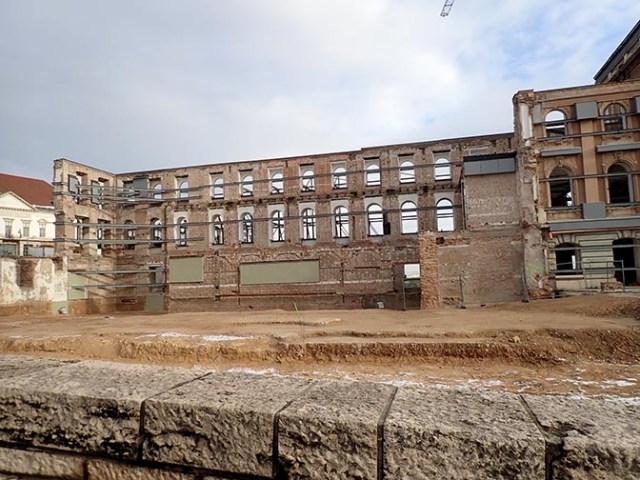
wall at Buda Castle
There’s a wall that is just a wall, the rest of the building having been destroyed in World War 2, but it looked like there was some restoration work going on near that area. That part was a soldier’s barrack rather than part of the actual palace, though one end of the remaining wall was attached to the main building.

Karla by a tiny door in the castle
The castle has statues in the courtyard, a tower behind a wall, and a fantastic view of the river and everything on the other side. It has a restaurant, a coffee shop, and a gift shop. It also has a museum and a library. There is a fee to go inside, which we did not do.

funicular
There is a funicular that goes up and down the hill between the Chain Bridge and the castle. We opted to take it down the hill and walk across the bridge to the ship rather than going back to the bus. A funicular is transportation up and down hills that consists of a pair of counterbalanced carriages on parallel tracks where one goes up while the other goes down.

shoe memorial on the bank of the Danube River
The guide mentioned walking to the shoe memorial and parliament buildings after the bus came back to the ship for anyone who wanted to go, as it was not far from the ship. The shoe memorial is the actual shoes of holocaust victims who were all tied together near the end of the war when the Nazis were running low on bullets. They shot one and them falling into the river dragged the rest along where if the fall didn’t kill them drowning would. Someone collected shoes they had on when they died and lined them all up at the edge of the river where they had been standing. Some are just tiny children’s shoes.

parliament building
The parliament building sits on the side of the river, not too far from the shoe memorial. It’s a sprawling building with many towers, a central dome, and many statues. It was built by 1000 workers from1885-1902.
As is generally the case with cruise ship tours, this one gives a quick overview of the city, but doesn’t begin to cover everything that is there to see. We were there for 3 days before the cruise and didn’t come close to seeing everything so a tour of just a few hours has no chance to cover it all.


 Cruise Stories