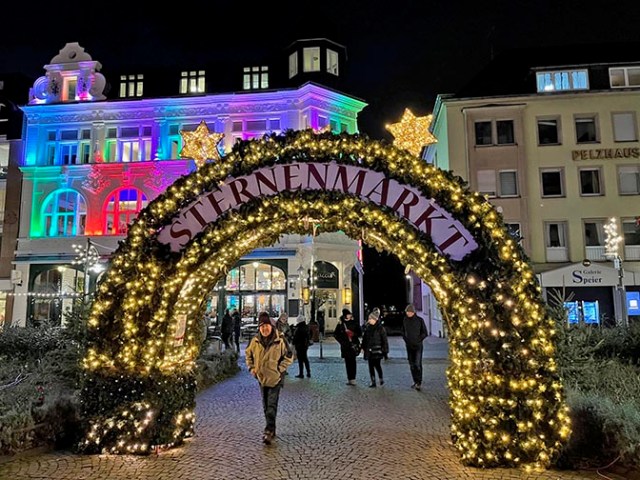
entry to a Christmas market in Koblenz, Germany
Christmas markets are a big thing in a lot of European countries from sometime in November until Christmastime. These festive marketplaces pop up in all sorts of places. On our Viking river cruise from Budapest to Amsterdam most of the towns along the way had Christmas markets. Not in Amsterdam though. Apparently it’s not a thing in the Netherlands.
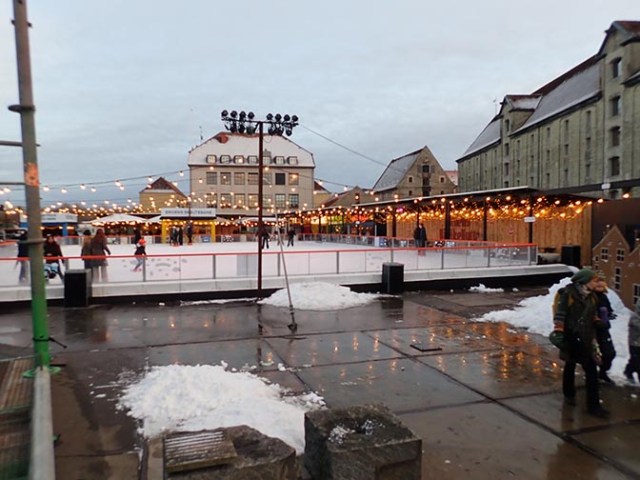
Christmas market in Copenhagen, Denmark
The first place we went was Copenhagen, Denmark where we stayed a couple days pre-cruise. At a Christmas market there John found a little felt stuffed dog ornament that was white with black spots wearing a little hat. It was supposed to be a dalmatian, but it sort of resembles our dog Piper, a blue heeler that is white with black spots. A couple of the Christmas markets we saw in Copenhagen had ice skating, as did some of the others in other places, though most of them did not.
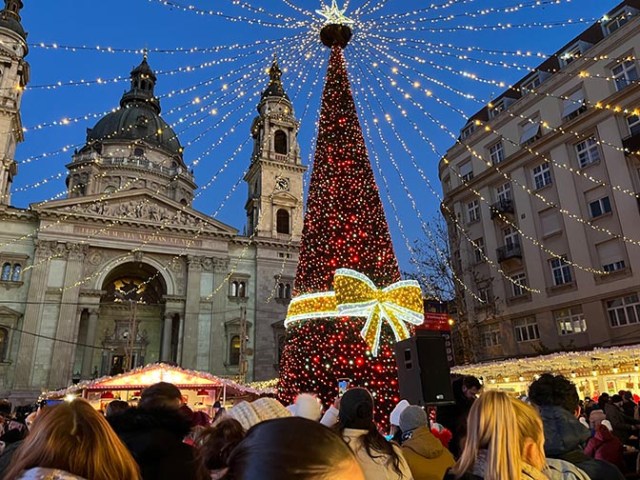
Christmas market in Budapest, Hungary
In Budapest there was a Christmas market about a block away from the hotel where we stayed for a few nights before boarding the ship. When we first went there on a Saturday night it was so crowded you could hardly move from one place to another. Trying to go opposite the main crowd felt like a salmon swimming upstream in boulder filled rapids where a whole lot of effort brings very little progress. We managed to find some dinner, but with no hope of getting anywhere near one of the few already occupied tables standing near the booth out of the main traffic stream was the safest place to eat it. There was a big Christmas tree in a small open space between booths. A church in the square had a light pattern running down the front resembling falling snow. It was realistic enough that just a quick glance at the church looked as if it actually was snowing until the mind registered that there was no snow coming down anywhere else. Although we were in Hungary, the Christmas carols playing there were songs commonly heard in America – and in English.
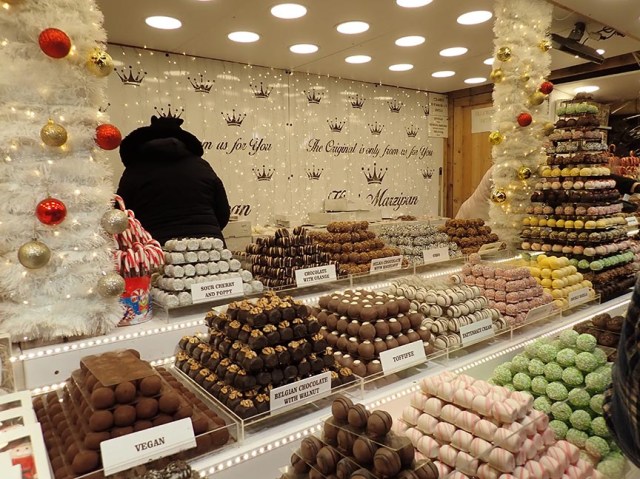
chocolate stall in Budapest
The next night we went back to get a better look at the booths. It wasn’t as crowded so we could actually get close enough to see what they had. A lot of them had different kinds of food or hot drinks while others sold Christmas ornaments and other holiday items or things like jewelry, paprika or other spices, and things people could give as gifts. Paprika is a big thing in Hungary. Rather than just a generic jar of paprika they have a variety of different kinds. Hot wine also seemed popular as quite a few booths had it. A local tour guide said that Hungary is better at making wine than beer so more people drink the wine.
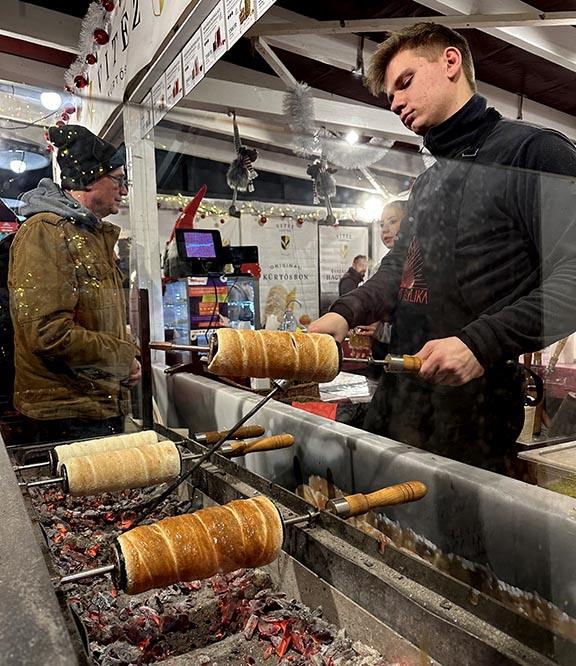
chimney cakes cooking over coals in Budapest (photo by Karla Ermel)
One booth had something called chimney cakes, though the sign there was in Hungarian so we really didn’t know what it said. We saw the name chimney cake with a picture of it on a store elsewhere in Budapest. They made it by rolling out some sort of bread dough and then winding it around a fat stick. This was then buttered, sugared, and set over a bed of hot coals. As they added one at one end of the grill they would move the rest on until they made it to the far end of the row where the toasty brown one would be removed and then immediately coated with whatever topping the person ordering it wanted. They had quite a variety of things including pistachios, coconut, cinnamon, and raspberry. Chocolate chips were also an option, but those were rolled into the dough before cooking rather than sprinkled on top after it was done. The finished cakes are removed from the stick and put into a plastic bag. It’s big enough to serve 4 or 5 people. We tried a pistachio one and it was pretty tasty.
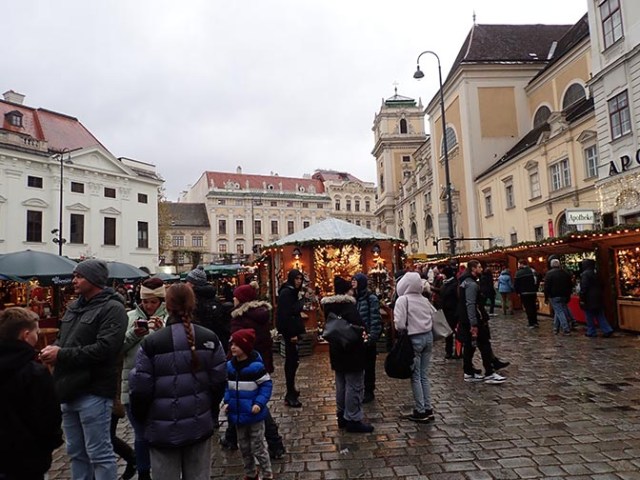
Christmas market by a chapel in Vienna
Vienna had a lot of Christmas markets. Where our bus tour ended in a shopping area near a very tall and fancy church there was a Christmas market next to the church. The market area looked small, but actually continued around a corner that wasn’t visible from the side where the tour went so it was about twice as big as it initially appeared.
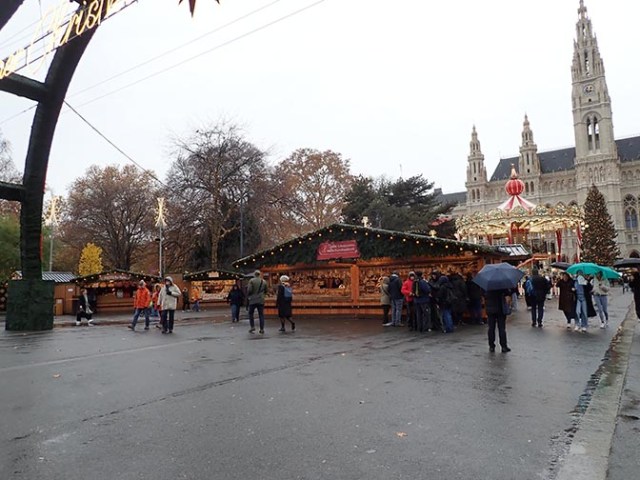
Christmas market near city hall in Vienna, Austria
From there we set out to walk to what was supposed to be the biggest one near city hall. On the way there we passed through another Christmas market where we wandered through and looked at the various stalls. Typical of them all some sold food, some sold Christmas ornaments, and some had other things. A lot of them had the same or similar things to each other in all of the various markets, but occasionally a booth had something unique and different.
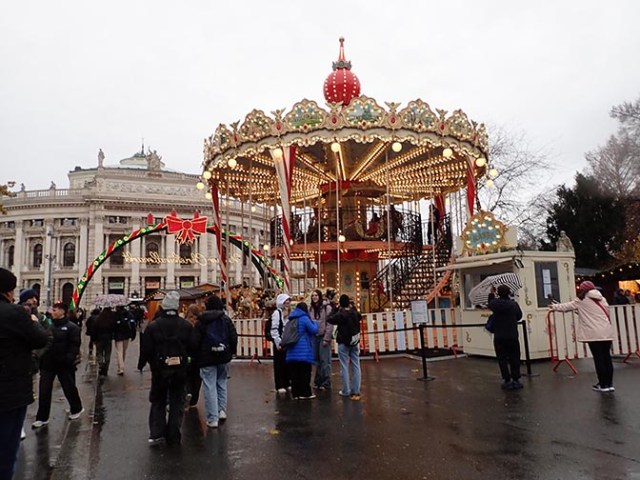
double carousel at a Christmas market in Vienna, Austria
We passed by another small one, but did not stop to look. The big one near city hall had a double decker carousel, something I had not seen before. The booths there were similar to the others. The chimney cakes like we had tried in Budapest were available at the Austrian markets too, but smaller and for more money. We saw them at several more markets along the way, but they were all baked in ovens except at the one in Budapest.
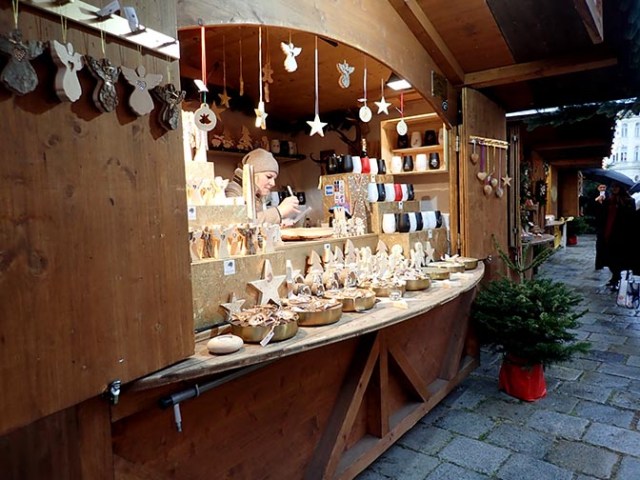
booth at a Christmas market in Vienna
Last time we went to Austria things seemed quite cheap there after having been to Switzerland first where everything cost twice as much, but this time they seemed expensive after coming from Budapest where stuff was cheaper. There was a Ferris wheel at that market, but it was not the oldest one in the world still in operation so we went on to an amusement park to find that one.
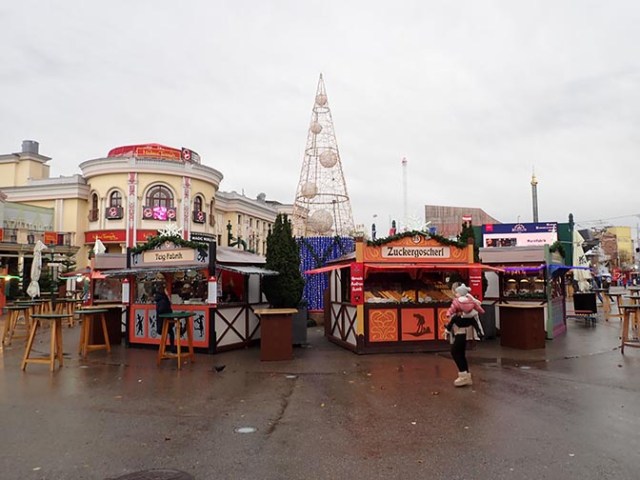
little Christmas market at the amusement park in Vienna
The amusement park was quite large with many rides. The old Ferris wheel was pretty unique with pods that were the largest I’ve seen on a Ferris wheel and resembled small cabins. There was a little Christmas market near the base of the wheel with booths circling around a tree. We got some hot drinks and a giant pretzel to share there. A lot of the booths at these markets sell hot drinks in a glass mug, which you pay for, but then can use at other stalls and even other markets if you bring it with you to avoid buying another cup. The one in Budapest had paper cups, but the Austrian ones and all of the ones in Germany had the glass mugs. Hot wine was a big thing in all of the markets. It was called glogg in Denmark and gluhwein everywhere else. The glogg was not quite the same as gluhwein.
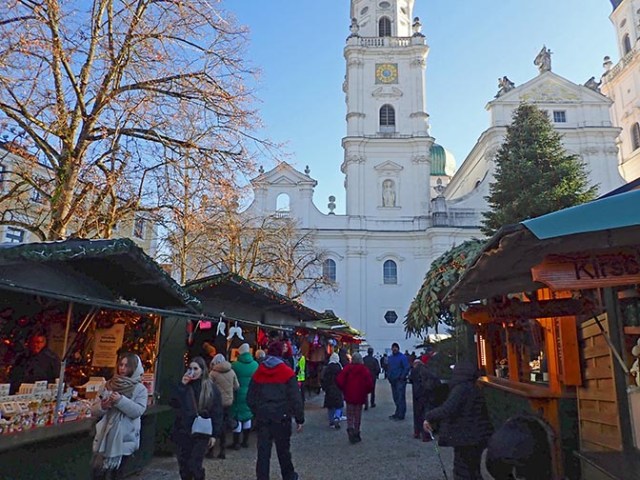
Christmas market in Passau, Germany
In Passau, Germany the walking tour included with the cruise ended at a cathedral with a Christmas market just outside of it. Thus was the only Christmas market we went to in that town. It was a pretty big one with lots of stalls. The majority of them had food or drinks, though there were also some selling trinkets, Christmas ornaments, and warm things like hats, scarves, or socks.
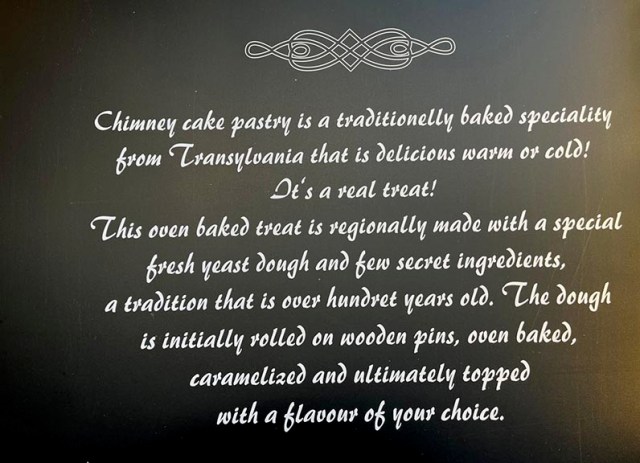
sign at the chimney cake booth in Passau, Germany
One booth had chimney cakes like we had tried in Budapest. These were smaller and baked like all of the ones we saw after the first market. Only the ones in Budapest were huge and roasted over coals. This booth had a sign about them saying that all are a yeast dough rolled out into strips and wrapped around a pole for baking, but each region has its own secret ingredients for their recipe. The toppings vary from one place to another as well.
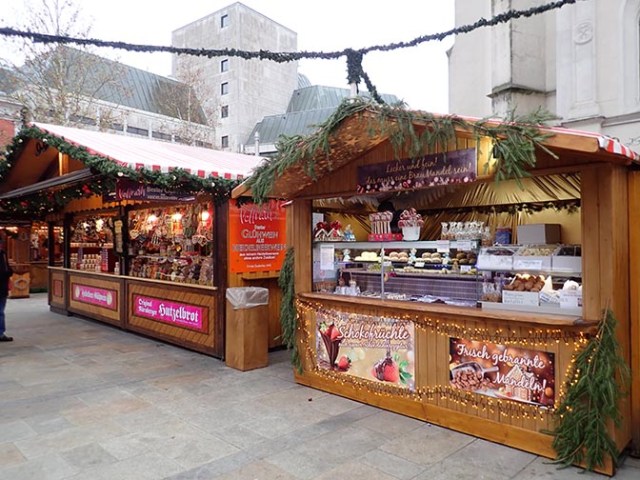
stalls at the Christmas market in Regensburg, Germany
Regensburg, Germany had a fairly big market. Unlike some of the ones in other towns, quite a few of the booths at this one had unique merchandise that looked like it might be handmade. Of course it also had the usual mass-produced looking items and plenty of food stalls. This was the last market we saw that had giant hot dogs or sausage dogs on elongated buns.
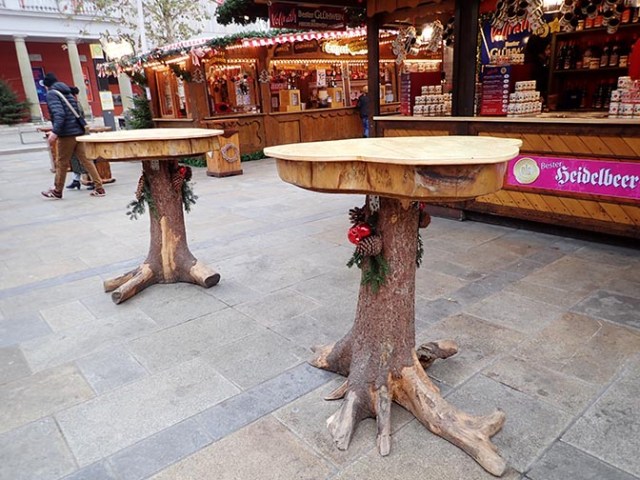
tables at the Regensburg market
The Regensburg market had some rustic wooden tables to give people a place to eat the things they bought there.
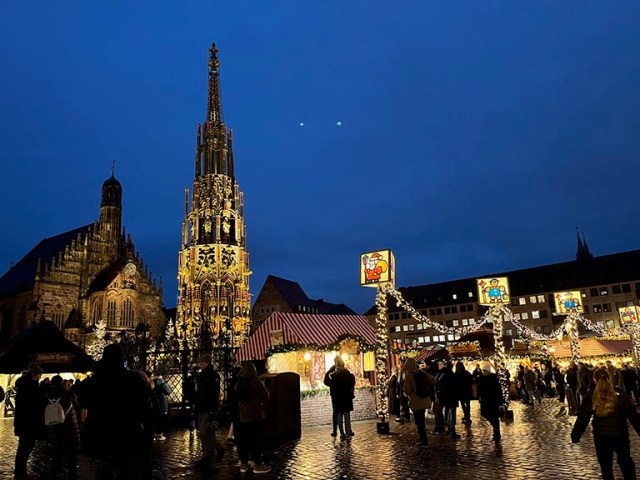
Nuremberg Christmas market after dark
Nuremberg has the oldest Christmas market in Germany having had one in the same spot since the 1600’s. It’s a pretty big one with lots of different stalls. The sausage stalls there sold small sausages instead of the super long ones the prior places had. Most stalls put several links on a round bun, but one of them made big round sausage patties instead.
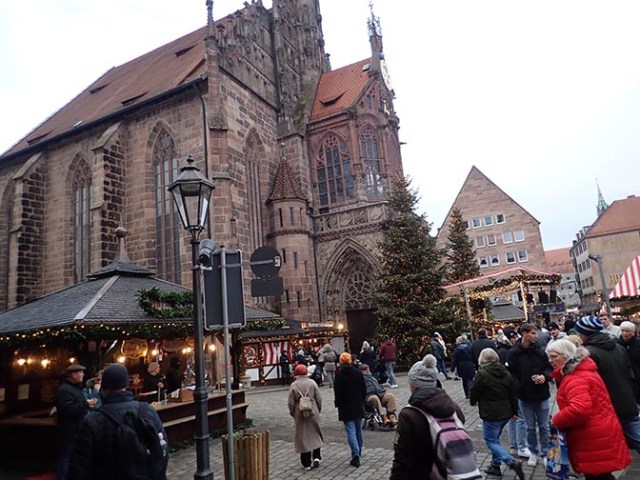
Nuremberg Christmas market
The hot wine stalls had punch instead of hot chocolate for people who didn’t want anything alcoholic. All of the markets we saw before this one had hot chocolate and all of the ones after had the punch. There was quite a variety of merchandise, but the majority of it probably wasn’t handmade. Gingerbread is big there, but it is more of a soft cookie than the cake-like dessert called gingerbread in the USA. They come as big, bigger, and giant cookies, mostly dipped in a variety of flavored coatings including chocolate among many others. We tried an orange flavored one and it was good.
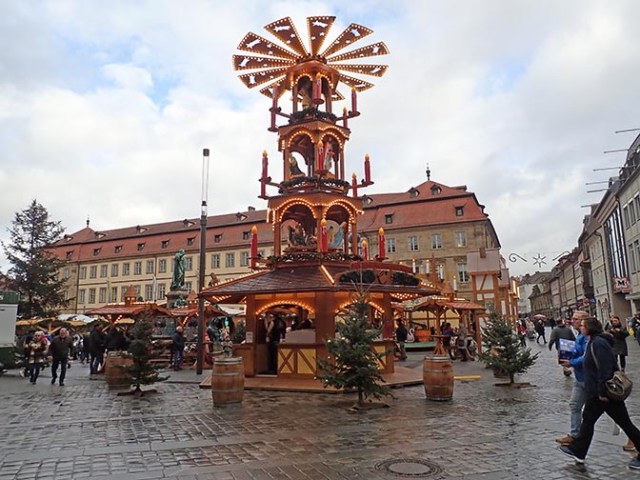
Christmas market in Bamberg, Germany
The market in Bamberg was fairly small as the town is not that big. It had a big carousel-like decoration and a large Christmas tree among the food and market stalls.
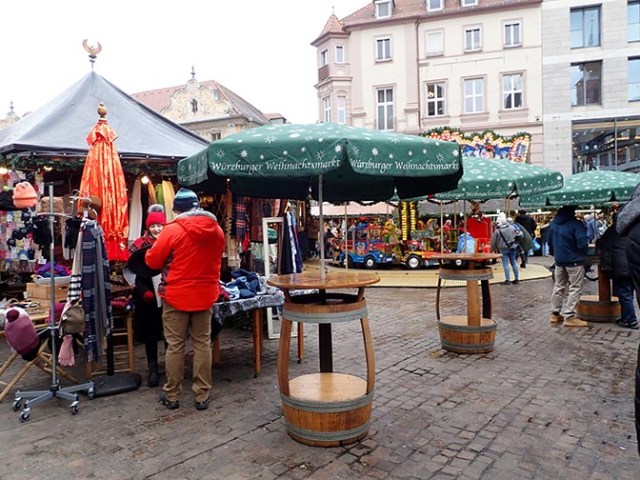
Würzburg, Germany Christmas market
Würzburg has a decent sized Christmas market in their market square where the temporary stalls for the Christmas market shared space with permanent stalls for a market that is always there. That meant a mix of things with the usual Christmas market fare and things like produce stands from the regular market.
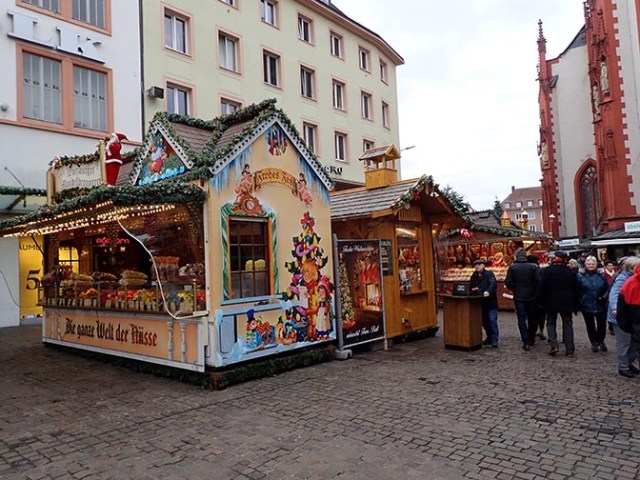
booths at the Christmas market in Würzburg
One shop selling all kinds of glass Christmas ornaments had the closest thing to our dog Piper we’ve found yet. A white dog with black spots and the ears going up rather than down, with the insides of the ears black. If the backside of the ear had been black too it would have really been good since her ears are all black, but close enough we had to buy it. As previously mentioned, Piper is a blue heeler, but white with black spots rather than the mottled color they usually are.

Christmas market in Würzburg, Germany
The giant church next to the Würzburg market is called a chapel rather than a church because the common folk in medieval times built it without the bishop’s consent so they couldn’t call it a church. Some of the buildings or parts thereof are original in Würzburg, but many buildings there are all or partially restored after World War 2 bombings.
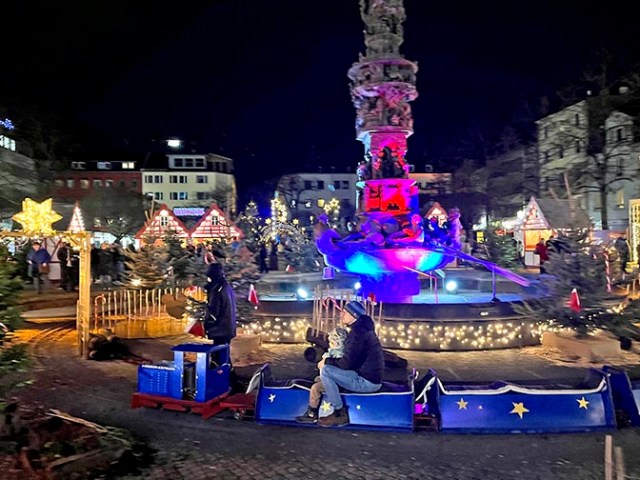
little train at the Christmas market in Koblenz, Germany
In Koblenz there are several Christmas markets. A small one was just a short walk from the ship. It had a miniature train ride around a Christmas tree for very small children. Some tiny booths with a table in them where people could sit were interspersed among the other small booths, which mostly sold food or drinks.
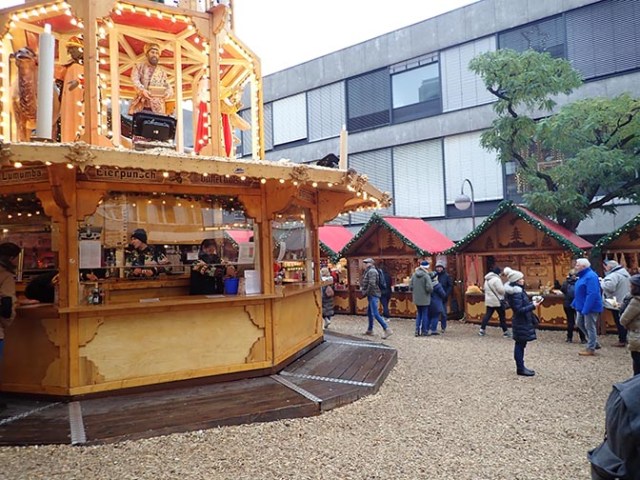
Christmas market in Cologne, Germany
The tour guide in Cologne, Germany repeatedly said that they have the biggest and best Christmas markets anywhere, but other than there being more of them and closer together than what we saw in most other towns, the markets themselves had similar stalls selling similar things.
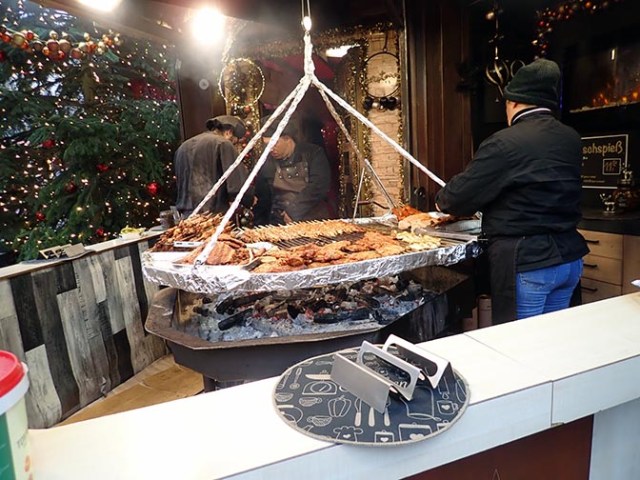
meat stall at a market in Cologne, Germany
Grouping all of the markets that are next to each other or very close together probably makes the biggest market space we saw, but each individual market was not necessarily bigger than some of the larger ones elsewhere.
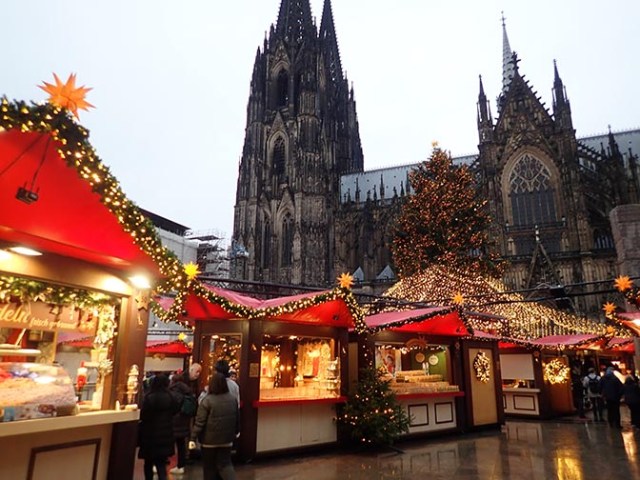
Christmas market in Cologne, Germany
One of them was at the base of the towering gothic cathedral. Markets at the base of churches seemed quite common, but then again some of those towns have a very lot of churches so pretty much anything is near one. Not all of them in Cologne were by churches though. The one closest to our ship had an ice-skating rink. Another one farther down the river had a large Ferris wheel. One of the others had a smaller Ferris wheel and a carousel.
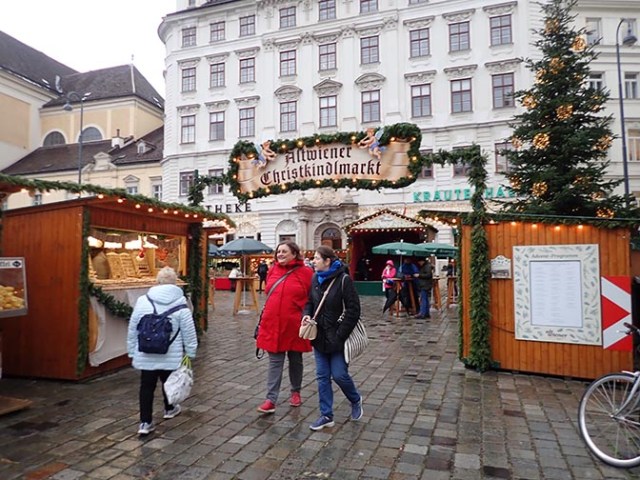
Christmas market in Vienna, Austria
Most of the markets in most of the towns were open from about 10 am until late evening, but the small-town market in Wertheim, Germany was only open on weekends. We were there during the week so all of the stalls were closed. We just saw a small sample of Europe’s Christmas markets. There are many more in many other places.


 Cruise Stories