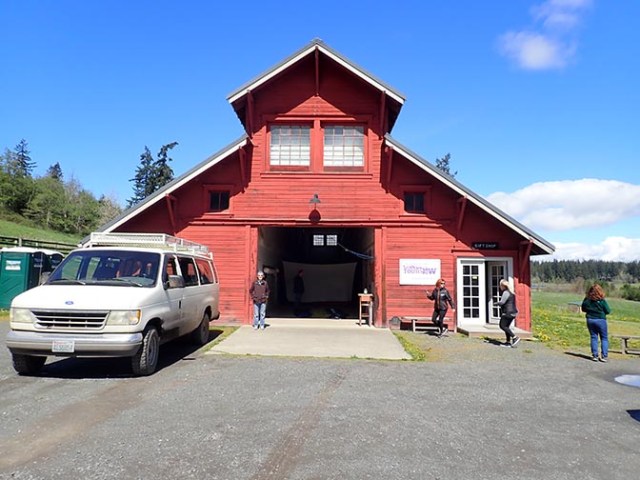
barn at Kristoferson farm where the zipline tour starts and ends
Ziplines probably aren’t the thing most people associate with Seattle or the surrounding area, but there are several in the vicinity. The one we went to is Canopy Tours NW, a zipline course at the Kristoferson Farm on Camano Island about 60 miles north of Seattle. This course includes 6 ziplines, a couple short trail walks, a suspension bridge, and a final descent that is sort of like repelling except that it is done with a constant velocity device where the participant is just along for a ride down at a controlled speed.

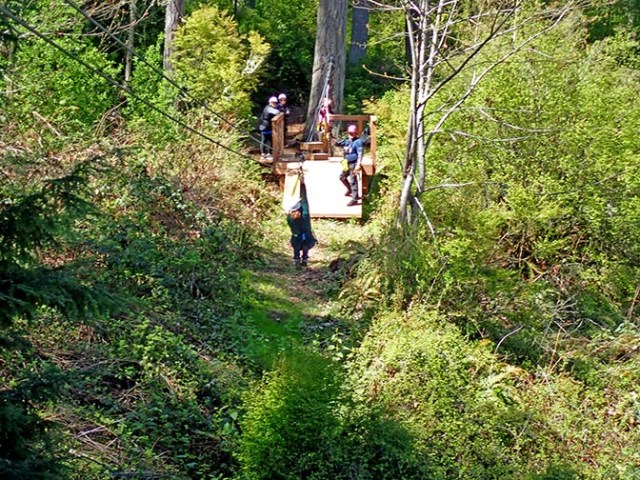
view from one of the zipline platforms
This is a great course for first timers as none of the lines are extremely long or fast. It’s also fun for experienced zipliners because it’s a long enough course to be worth the drive to Camano Island. It goes through a managed forest on an organic farm with some mountain and water views from platforms along the way. On the day we went our group of 4 included Chris and Justin and the other group of 5 we were combined with contained Christa and Justina so there was a bit of a name coincidence going on.
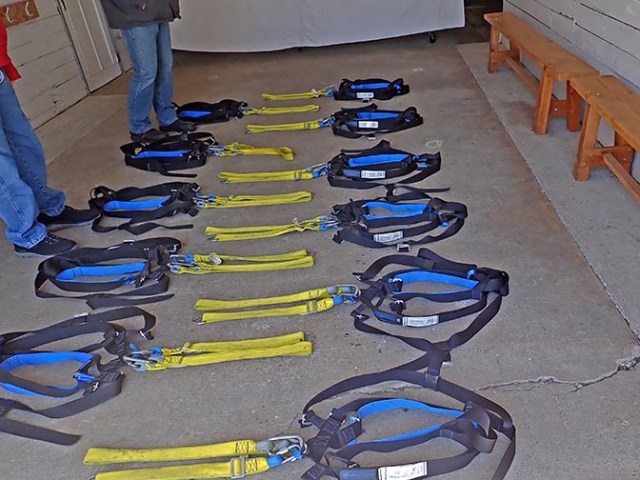
zipline harnesses ready for people to step into
Before the tour starts participants check in at a small store in a corner of a large historic red barn. The store sells some products made from lavender, apples, and other things grown on the farm as well as canopy tour t-shirts and a few other things. Harnesses are laid out on a cement aisleway down the center of the barn, ready for people to get buckled into prior to the tour. They had 11 harnesses ready to go, but only 9 participants came so there must have been a couple no-shows. While harnessing each person up they ask if you’ve ever done a zipline before. Out of the 9 only Chris and I had previously done a full course, but they told Linda they’d count her short onboard zip on Royal Caribbean’s Symphony of the Seas. Some ziplines allow people to go hands free in any position they want including turning upside down, but they said these harnesses were not the right sort for that so everyone was required to remain upright with at least one hand on the yellow strap while on the zipline.

stairway to the first platform
A short van ride up a steep and curvy dirt road brings everyone to the start of the zipline tour where a stairway leads to the first platform. It’s not a real high stairway, but there’s still enough drop between the first two platforms. Although there were a couple other platforms within the course accessed from the ground, this was the only one with stairs.

Linda on the first zipline
The first two zips are the shortest and slowest on the course, designed to give newbies a chance to get accustomed to ziplining before moving onto longer and faster lines. They have a braking system operated by one of the guides. The days of having to keep a gloved hand over the line to brake yourself with on zipline courses seem to be long gone as all the ones I’ve been on anytime recently have some sort of passive or active self-braking system. I did notice that the guides on this tour wore leather gloves and stopped themselves by hand the old-fashioned way though. The first one over to the next platform had to as there was nobody there to operate the braking system for them, but the one following the group did so as well. Most of the ziplines I’ve done recently had giant springs at the end that stopped people on their own without anyone needing to control anything.
the second zipline ended with a ground ramp
The first line went to the platform where the second one starts, as is common in zipline courses, but the second one went down to the ground where people could choose to either run up a ramp as they landed or keep their feet up and land the usual way.

strapped to a tree waiting for the next turn
While on tree platforms between ziplines there is a strap with a giant carabiner on it keeping everyone safely clipped to a cable around the tree trunk. There is also a railing around the outer edge of the platform so nobody would fall off even without the clip. Most of the railings had some sort of information about the trees or animals or plants native to the area.

part of an informational sign on one of the platforms
The two guides kept in contact with walkie talkies so each always knew when they were ready for the other to send or retrieve the next person. At each platform the next person steps up on a little stairway block while the guide attaches all their necessary equipment to the line and doesn’t remove the cable from the tree until after informing the other guide that the person is ready to go.
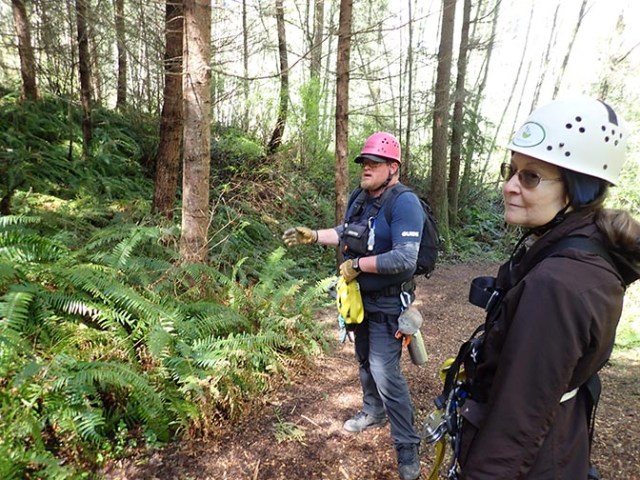
guide talking about plants on the trail walk between ziplines
After the second line we had a short walk along a trail while one of the guides talked about various plants along the way – and warned anyone who might not be from the area not to touch the stinging nettles that commonly grow in Washington’s forests. Often there are sword ferns growing near nettles. If you do get stung fern juice rubbed onto the sting will offer some relief. There were a lot of salmonberry and huckleberry bushes alongside the trail. Both are edible, but it was not the season for either one to have berries on them.

Linda taking off on platform 3
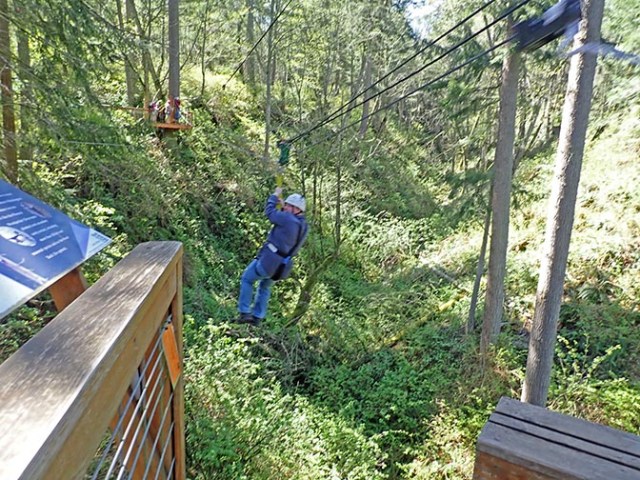
it wasn’t very far between the third and fourth platforms
The next couple zips were longer and faster than the first two, with one going platform to platform and the other to the ground with a warning not to try and run up that ramp as the speed at the end of this line would be too fast for that to work. Keeping feet up and using the braking system provided was the way to go there.

refreshment stop
The landing for the fourth line was on the ground. Water and hot chocolate waited at a little clearing next to the platform with a cup dispenser hanging nearby and a fire pit that was covered at that time, but probably there for use on colder days. A wooden bench near the water cooler had WOO HOO carved into the seat.

Linda on the wonky bridge
Another short walk brought us to the log bridge that the guide referred to as the rickety bridge. It had a cable above it for the clips that usually went on ziplines or trees and people could hold the straps hanging down from there for better balance. They warned against going too fast which might result in falling between the logs and getting bruised. The guide also said to step across two logs at the middle, but that didn’t work so well with my short little legs and one foot did slip off. Quickly raising both feet allowed me to slide along the cable somewhat like a zipline for a few inches until setting a foot back down on the next log, which worked much better than letting that fallen foot hit a log – and no bruising involved. Stepping on every log after that prevented any more slips. Only stepping on every other one is fine for tall people with long legs like the guide, not short people like me.

Justin on the 5th line
One of the people from the other group was smaller and lighter than me. She went just ahead of me on the second to last zip and the guide asked her if she wanted to go with velocity, which meant he would give her a push at the start so she’d go faster than just stepping off the edge or curling up her feet and going off on her own like we all had on the previous lines. She said yes to that and when it was my turn I asked if I could go with velocity too. On the last line he asked me if I wanted to have velocity again (but not her), so I did. More fun the faster it goes after all. Heavier people go fast on their own.
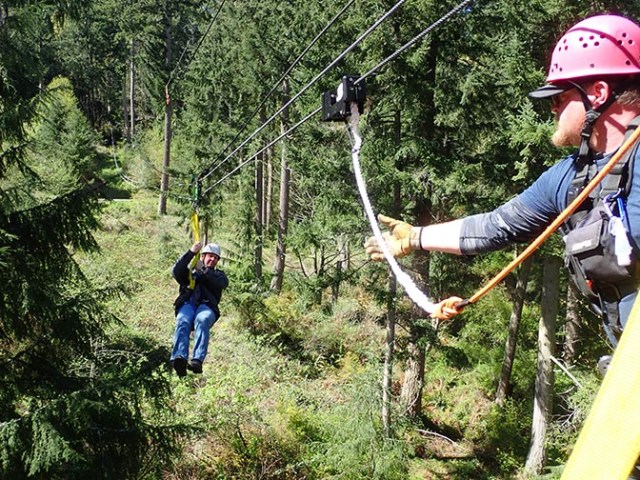
the guide has the braking system out ready to stop Chris
The guide who went ahead of everyone else put the braking system out on the line on the landing platform for each person to catch them as they came in.

guide taking care of Justin’s harness
The guide at the takeoff platform hooks you up to the line before you go and the one on the landing platform unhooks everything when you stop there.

Chris passing over the leaning tree
The last line passed over a tree that looked like it was leaning over to get out of the way of people going by on the zipline, which ran above it only because of the lean. The base of the trunk sat on one side of a small stream while the top came up at an angle on the other. It likely had partially fallen in a storm long before the zipline existed, but survived and grew crooked. That probably was a lifesaver for that tree because if it had grown straight it likely would have been cut down to avoid people on the zipline running into it.
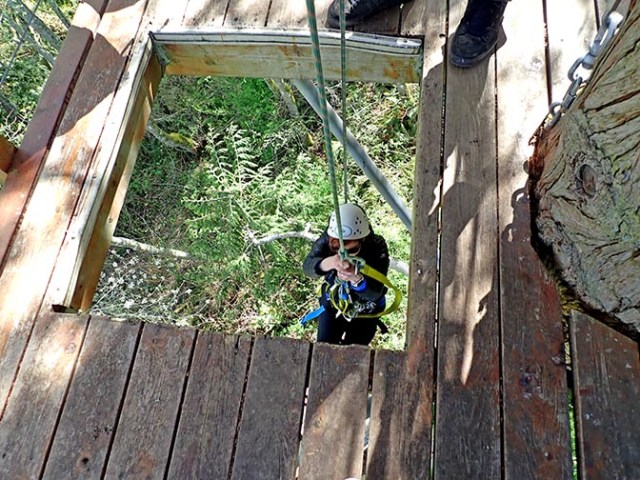
hole in the last platform
The last platform had a square hole cut into it, which is for the descent. When your turn comes you hold a rope and stand on a small bit of platform between the tree and the hole – while still clipped to the tree so there is no danger of falling. From there they clip on the apparatus that lowers you to the ground, then you drop through the hole and descend. It’s not super slow, but not fast either. After landing on the platform below you get out of the way and go stand on the ground nearby so the next person can go. Once everyone was down they sent down the apparatus they’d used and the last guide repelled down and then yanked that rope down too. They put those things into a plastic tub to take with them since there was not another group that day. They don’t leave the ropes out to get weather-worn, but have to set them up each day that there are tours.

Justin coming down
There was no need for the van to pick anyone up at the end of the course because it finished within sight of the barn where we first started so people could just walk the rest of the way back. Once back at the barn the harnesses were removed and dropped back on the cement for the guides to put away. A tip jar sat on a table by the entrance to the center aisle.

view of the barn from the end of the course
They do not allow anything brought along that doesn’t fit into a pocket and recommend not using back pockets as things are likely to fall out there. Keys can be left at the store for safekeeping so they don’t get lost on the course. At least one hand is required to hold on while actively on the line, but phones or cameras can come out of the pocket for taking photos from the platforms in between. The whole course took about 2 and a half hours, but according to my Garmin watch I only had a bit over 11 minutes of moving time. Most of the rest of it was standing on platforms waiting for the next turn other than the snack break.


 Cruise Stories